 Skip to content


Picture this: a friend can’t stop talking about a fantastic new coffee shop they discovered. Compare that to seeing a slick, paid ad for the same place. Which one are you more likely to trust?
That genuine, enthusiastic recommendation is the perfect real-world example of earned media. It’s essentially digital word-of-mouth—the kind of positive buzz that brands get from their actions, not their ad budget. Think news features, glowing customer reviews, or a social media post that suddenly goes viral.
The Heartbeat of Brand Credibility
We’re all swimming in a sea of advertisements, and earned media is the lighthouse that guides people to authentic brands. It’s any organic publicity you get from someone else without paying for it directly. Put simply, it’s what people are saying about your brand when you’re not in the room.
This kind of media is pure gold because it’s founded on trust. When a respected journalist, a passionate customer, or a key industry influencer decides to talk about you, that endorsement carries a weight that traditional advertising just can’t match.
It’s no surprise, then, that 30% of public relations professionals say they’re relying more on earned media now than ever before. As trust in paid ads wanes, the value of authentic promotion skyrockets. This is a core component of building a strong public perception and is central to effective online reputation management for small businesses.
Key Forms of Earned Media
So, what does earned media actually look like out in the wild? It usually falls into a few key categories:
- News Features and PR: This happens when a publication runs an article or a news segment about your company, your product, or your unique expertise.
- Customer Reviews: Think of all that genuine feedback left on sites like Google, Yelp, or other industry-specific review platforms.
- Social Media Mentions: These are the unpaid shout-outs, shares, and user-generated content from your customers and fans on Instagram, TikTok, or X.
This infographic breaks down the main channels that form the earned media ecosystem.
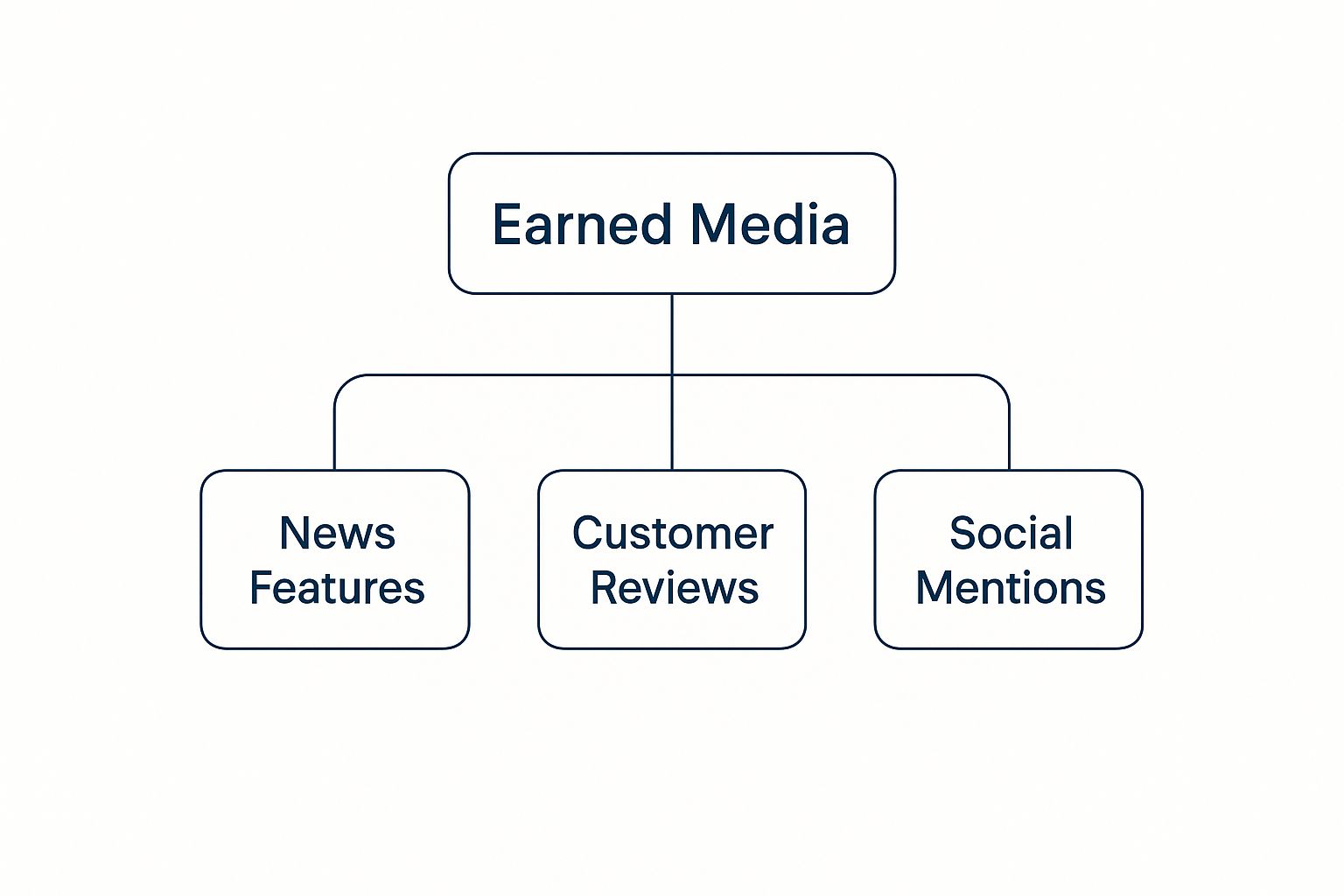
As you can see, each of these channels plays a unique role in building a powerful, third-party narrative around your brand.
Where Earned Media Fits in Your Marketing Strategy

Earned media isn’t a standalone tactic; it’s a powerful component of a much bigger picture. To really grasp its value, you need to see how it works with everything else you’re doing. The best marketing strategies are never a one-trick pony. They blend different media types together, and one of the clearest ways to understand this mix is through the PESO model®.
PESO stands for Paid, Earned, Shared, and Owned media. Think of them as the four pillars holding up your brand’s reputation. Each one plays a distinct role, but they are far more powerful when they work in concert.
Let’s walk through this with a practical example. Imagine a new startup is launching an innovative project management tool. Here’s how they could use the PESO model® to make a splash.
The PESO Model® was created by Gini Dietrich of Spin Sucks
Paid Media: Buying Your Way In
First up is Paid Media. This is straightforward: you pay for placement. It’s all about control and speed, allowing you to get your message in front of a very specific audience, right now.
For our startup, this would look like:
- Running Google Search Ads for terms like “best project management software.”
- Placing sponsored posts on LinkedIn to reach project managers in the tech industry.
- Paying influencers to feature their tool in a YouTube video.
Owned Media: Your Brand’s Home Turf
Next, we have Owned Media. These are the channels you control completely—your digital real estate. It’s where you get to tell your story, your way.
Examples for our startup include:
- Their official website and blog, which they populate with case studies and how-to guides.
- An email newsletter delivering product updates and tips directly to their subscribers’ inboxes.
- Their own social media profiles on platforms like X and LinkedIn, where they share company news.
Shared Media: When Your Audience Becomes Your Amplifier
Shared Media is what happens when your audience does the work for you. It’s the organic amplification of your owned content by your community. People see something they like and pass it along.
This happens when:
- A happy customer retweets a link to the startup’s latest blog post.
- A user shares a promotional video on their personal Facebook page.
- Someone leaves a glowing comment on one of their Instagram posts, and their friends see it.
Earned Media: The Ultimate Endorsement
Finally, we get to Earned Media. This is the holy grail: authentic, third-party validation that you simply can’t buy. It’s the organic buzz that happens when others—journalists, bloggers, customers—decide your story is worth telling. This is powerful because it comes from a place of genuine interest, not a transaction.
Earned media is fundamentally about credibility. While you can pay for visibility, you must earn trust. This is where the true value lies, as 92% of consumers trust recommendations from others over brand advertising.
For our tech startup, earned media is the game-changer. It could be a feature story in a top tech publication, an unsolicited positive review from a respected industry analyst, or a Reddit thread that blows up with users raving about the product. This type of endorsement builds lasting authority in a way that paid ads never could. When influential figures organically recommend a product, it creates a ripple effect, a core concept in social influence marketing.
The PESO Model® Explained
To tie this all together, here’s a quick breakdown of how each media type stacks up against the others in terms of control, cost, and credibility.
| Media Type | Definition | Examples | Key Benefit |
|---|---|---|---|
| Paid | You pay for placement and visibility. | Google Ads, social media ads, sponsored content, influencer campaigns. | Control & Speed: Guaranteed placement and immediate reach. |
| Earned | Others talk about you organically. | News articles, media mentions, reviews, awards. | Credibility: Unbiased, third-party validation builds immense trust. |
| Shared | Your audience amplifies your content. | Retweets, shares, user-generated content, community posts. | Amplification: Extends the reach of your message through your network. |
| Owned | You control the platform and content. | Website, blog, email newsletter, social media profiles. | Authority: A central hub to build your brand and nurture your audience. |
Understanding these distinctions is the first step. The real magic happens when you get them to work together, using your paid ads to promote an owned blog post that ultimately earns media coverage and gets shared across social platforms.
The Real-World Payoff of a Strong Earned Media Strategy

Knowing what earned media is is one thing. Truly understanding what it can do for your business is what separates good marketing from great marketing. When you nail your earned media strategy, you’re not just getting your name out there—you’re building a rock-solid foundation for growth on the back of credibility, visibility, and genuine connection.
Its most powerful benefit is hands-down the credibility and trust it builds. Think about it: when a respected publication, a well-known industry expert, or just a happy customer praises your brand, it’s like getting a seal of approval from a trusted friend. That kind of third-party endorsement carries so much more weight than any ad you could ever buy.
Driving Business Growth and SEO Authority
Beyond the warm-and-fuzzies of building trust, earned media is a serious engine for business growth. In fact, a study from Cision revealed that 66% of marketers use earned media placements to feed their sales pipeline, and 50% point to it as a driver of overall revenue. These numbers make it crystal clear: authentic buzz translates directly to the bottom line. You can find more data on how brands use different media types on sweetfishmedia.com.
This impact also has a massive ripple effect on your search engine optimization (SEO). Every time an authoritative website mentions or links to you, it’s a huge vote of confidence in the eyes of search engines like Google. These high-quality backlinks and organic mentions are gold, signaling that your site is credible and relevant.
Just one solid feature in a major trade journal or news site can lead to:
- Higher search rankings for your most important keywords.
- A significant jump in your domain authority.
- A new, steady stream of qualified referral traffic.
It creates a fantastic cycle: better SEO gets you more visibility, which opens the door for even more earned media opportunities.
Getting More Bang for Your Buck and Expanding Your Reach
Let’s talk about one of the most attractive parts of earned media: its incredible cost-effectiveness. Sure, it takes time and effort to build relationships and pitch stories, but you’re not paying for ad space.
A single viral moment or a well-placed article can deliver a return on investment that blows months of paid advertising out of the water. It’s simply a smarter, more efficient way to spend your marketing resources.
Finally, earned media gives you a golden ticket to new audiences. When a creator or publication features your brand, you’re instantly introduced to their loyal, engaged community. This is how you tap into niche markets and demographics that would otherwise be expensive and difficult to reach. You’re basically expanding your brand’s footprint by borrowing the trust that someone else has already worked hard to build.
Modern Earned Media in Action
https://www.youtube.com/embed/LAp84mxkkF4
It’s one thing to talk about theory, but earned media really comes to life when you see it working out in the real world. The game has changed dramatically. We’ve moved far beyond the days when a press release and a few newspaper clippings were the end goal. Today, earned media happens in a fast-paced digital world where genuine enthusiasm is your most valuable asset.
Think about a B2B software company landing a 20-minute feature on a top tech podcast. That’s earned media. Or picture a small, sustainable fashion brand suddenly going viral because a TikTok creator genuinely fell in love with their product and kicked off a trend. That’s earned media, too. These examples show brands getting a stamp of approval from all sorts of trusted voices, not just traditional reporters.
This shift is completely remaking media relations. We’re no longer just focused on legacy media. Instead, we’re navigating a sprawling network of digital platforms like TikTok, YouTube, podcasts, and influential newsletters. It makes sense when you consider that more than half of U.S. adults now get their news primarily from social media. You can dig deeper into this trend over at Spin Sucks.
The B2B Tech Podcast Feature
Let’s walk through a realistic scenario for a B2B tech company. Instead of just blasting out a press release about a new software feature, they take a smarter approach. They build a genuine relationship with the host of a popular industry podcast.
To get the host’s attention, they offer up exclusive data from a new research report they’ve put together. This leads to a dedicated segment on the podcast discussing their findings, which naturally positions their brand as an authority. This is a perfect example of creating a “media magnet”—content so valuable and interesting that people in the media want to cover it.
The Viral Sustainable Fashion Trend
Now, let’s switch gears to a direct-to-consumer (D2C) sustainable fashion brand. A micro-influencer buys one of their jackets made from recycled materials and films a “Get Ready With Me” video for TikTok. In it, she authentically praises the jacket’s quality and the company’s mission.
The video strikes a chord. It racks up thousands of shares, and soon, other users are making their own videos featuring the same jacket. This wasn’t just a lucky break; it was the result of a smart foundation.
- An Exceptional Product: The high-quality jacket and the brand’s clear, sustainable mission gave people a real reason to talk.
- Genuine Community Engagement: The brand was right there in the comments, engaging with early posts and making people feel like part of a community, which only fueled more sharing.
The core lesson here is that the best earned media strategies are often rooted in something you fully control: creating an exceptional product and customer experience that people can’t help but share.
The Local Restaurant Buzz
Finally, imagine a new local restaurant. They don’t have a big PR budget, but they are laser-focused on creating incredible food and an unforgettable dining experience. That hard work pays off, leading to dozens of glowing five-star reviews on Google and Yelp.
A local food blogger, always on the hunt for the next great spot, sees the wave of high ratings and decides to check it out. They are so impressed that they write a detailed, unpaid rave review on their blog, which drives a flood of new reservations. The restaurant’s success was built on a foundation of excellent customer experience, which organically generated the reviews that ultimately earned them valuable media coverage.
In every one of these cases, the win came not from aggressive pitching, but from creating something genuinely worth talking about.
How to Proactively Generate Earned Media

While a big earned media hit can feel like a lucky break, the most impactful moments almost never happen by accident. They’re the payoff from a deliberate, proactive strategy. You can’t just sit back and wait for attention; you have to actively create the conditions that make your brand newsworthy and impossible to ignore.
This all starts with a mental shift. Stop thinking about asking for coverage and start focusing on providing genuine value. The true foundation of any great earned media strategy is a remarkable product or service. When you give people an incredible experience, you create a natural engine for positive word-of-mouth—the purest form of earned media there is.
Build Authentic Relationships
Long-term success in this game is all about building real connections with journalists, creators, and industry influencers. We’re not talking about blasting out generic, impersonal emails. This is about old-fashioned relationship-building.
First, figure out who the key voices are in your niche. Follow their work, leave thoughtful comments on their social media posts, and get a real feel for what kinds of stories their audience loves. When you finally do reach out, your pitch needs to be tailored and offer something that helps them, not just you.
The goal is to become a trusted resource, not just another brand asking for a favor. Offer exclusive data, expert commentary, or unique access that helps them create compelling content for their audience.
This approach flips the script. Your outreach becomes a mutually beneficial partnership instead of a one-sided request. Over time, these relationships become one of your most powerful assets, making it much easier to get coverage when you have big news to share.
Create Irresistible Media Magnets
To truly cut through all the noise online, you need to create “media magnets.” These are assets so valuable or interesting on their own that they naturally attract attention and shares. They’re a secret weapon for digital PR because they basically hand journalists and creators a ready-made story.
So, what does an effective media magnet look like?
- Original Research Reports: Run a survey or analyze some data to uncover fresh industry insights nobody else is talking about.
- Compelling Infographics: Turn complex information into a beautiful, easy-to-understand visual that people can’t help but share.
- Powerful Case Studies: Tell dramatic, data-backed success stories from your customers that prove your impact.
- User-Generated Content Campaigns: Get your community involved by encouraging them to share their own experiences. A strong user-generated content strategy can deliver a constant flow of authentic stories and social proof.
A big part of generating earned media is also about building your website’s credibility, since mentions and links from other sites are huge trust signals. As you create these media magnets, it’s smart to explore strategies to increase domain authority by earning high-quality backlinks. When you make your brand the source of fascinating stories, you make it easy for everyone else to talk about you.
How to Measure What You Don’t Pay For: The Real ROI of Earned Media
So, how do you actually prove the value of something you didn’t directly pay for? This is the question that trips up a lot of marketers, but believe me, measuring the impact of earned media is entirely possible. It just requires a different mindset.
You can’t track it with the same click-and-convert precision as a paid ad, and that’s okay. A modern approach means we stop counting press clippings and start focusing on tangible business outcomes.
The real challenge in measuring earned media isn’t a lack of data. It’s knowing which metrics actually move the needle. The crucial shift is moving from asking “how many mentions did we get?” to “what did those mentions achieve for the business?”
When a feature about your company runs in a major industry publication, it’s not just a vanity win. It’s a massive driver for your brand’s search authority and overall visibility. By tracking the right key performance indicators (KPIs), you can confidently show the true return on your efforts.
The Metrics That Actually Matter
First things first, you need a baseline. Start by tracking your Share of Voice (SOV) to see how you stack up against the competition. This metric is simply the percentage of the conversation in your industry that belongs to your brand. Modern tools make it easy to track mentions across news sites and social media, giving you a clear picture of whether you’re gaining ground.
Next, you have to look beyond the numbers and understand the feeling behind them. This is where sentiment analysis comes in. Are people talking about your brand in a positive, negative, or neutral light? This context is everything. Consistently positive sentiment is one of the strongest indicators of genuine brand health and customer loyalty.
Finally, let’s connect the dots back to your own digital turf—your website.
- Referral Traffic: Jump into Google Analytics. See which articles, blogs, and social posts are actually sending people to your site. This tells you which earned placements are most effective at sparking curiosity and driving action.
- Backlink Profile & Domain Authority: Keep a close eye on how your earned media coverage is boosting your SEO. Every time a reputable site links to you, it’s a vote of confidence in the eyes of Google. These backlinks directly improve your domain authority, which is critical for climbing the search rankings over time.
Putting an exact dollar figure on all this can feel tricky, but tracking these core metrics starts to tell a very compelling story. For a more detailed breakdown of the financial side, check out our guide on how to calculate earned media value and assign a concrete number to your organic wins.
Answering Your Top Questions About Earned Media
It’s easy to get tangled up in the jargon of paid, owned, and earned media. Let’s clear up some of the most common questions people have and give you a solid foundation for building your own strategy.
Earned Media vs. Shared Media
This one trips people up all the time, but the difference is actually pretty simple. Think of it as creation versus circulation.
Shared media is when your audience circulates content you already made. A great example is when someone retweets your company’s announcement or shares your latest blog post on their LinkedIn profile. They’re just passing along your message.
Earned media, on the other hand, is when someone else creates entirely new content about you. A food blogger trying your restaurant and then writing a full review from scratch? That’s earned media. A tech journalist including your product in their “Best of” roundup? Also earned.
The real distinction is who hit ‘publish’ on the content. If your audience is just hitting the share button on your work, it’s shared. If a third party is writing, filming, or talking about you on their own, it’s earned.
Can You Pay for Earned Media?
Nope. Not a chance.
The moment you exchange money for a mention, a post, or a feature, it instantly becomes paid media. It’s now a sponsored post, an advertisement, or an advertorial. The “earned” part of the name is there for a reason—you have to earn it through merit.
This is precisely what makes earned media so powerful. Its value comes from its authenticity. It’s a genuine, third-party endorsement, and that’s something money just can’t buy.
What’s the Best First Step?
Before you even think about outreach, you need something worth talking about. The best first step is to create something of undeniable value.
You have to give journalists, bloggers, and creators a real reason to pay attention. You can’t just ask for a mention; you need a hook.
This could be things like:
- A unique data report you commissioned that reveals surprising industry trends.
- A powerful customer success story that showcases incredible, verifiable results.
- A sharp, insightful opinion from one of your executives on a topic everyone is talking about right now.
Give people a great story to tell, and you’ve already done most of the hard work.