 Skip to content


- Meta Description: Struggling to prove the value of your campaigns? This guide breaks down how to use an influencer ROI calculator to measure real financial returns. Learn the formulas, get templates, and see how platforms like REACH Influencers automate the process for maximum impact.
- Schema Markup:
{
  "@context": "https://schema.org",
  "@type": "BlogPosting",
  "mainEntityOfPage": {
    "@type": "WebPage",
    "@id": "https://reach-influencers.com/blog/influencer-roi-calculator"
  },
  "headline": "Using an Influencer ROI Calculator to Prove Your Impact: A Complete Guide",
  "description": "Struggling to prove the value of your campaigns? This guide breaks down how to use an influencer ROI calculator to measure real financial returns. Learn the formulas, get templates, and see how platforms like REACH Influencers automate the process for maximum impact.",
  "image": "https://cdn.outrank.so/64cdc0e0-2a54-4cd9-a45d-c4196c5e1d4e/d908f062-3ff0-487b-a68c-14f8d19c4826/influencer-roi-calculator-marketing-roi.jpg",
  "author": {
    "@type": "Organization",
    "name": "REACH Influencers"
  },
  "publisher": {
    "@type": "Organization",
    "name": "REACH Influencers",
    "logo": {
      "@type": "ImageObject",
      "url": "https://reach-influencers.com/logo.png"
    }
  },
  "datePublished": "2023-10-26"
}
Table of Contents
- Why You Can’t Afford to Ignore Influencer ROI
- Gathering the Right Data for Your ROI Calculation
- The Simple Math Behind Every Influencer ROI Calculator
- Putting Your Influencer ROI Calculator to Work
- Turning Your ROI Data into Smarter Decisions
- Bringing It All Together: Your Path to Smarter Influencer Marketing
- Got Questions? We've Got Answers
An influencer ROI calculator is simply a way to measure the financial return you get from an influencer marketing campaign compared to what you spent on it. It helps you look past vanity metrics and see exactly how much revenue your partnerships are generating for every dollar invested. For any brand serious about growth, understanding this calculation is non-negotiable.
Platforms like REACH Influencers are designed to make this process seamless, integrating ROI tracking directly into your campaign management. By automating data collection and analysis, you can move from guesswork to a data-driven strategy that proves the value of every partnership.
Why You Can’t Afford to Ignore Influencer ROI
Let's be real—influencer marketing can feel like a guessing game sometimes. You pay a creator, you see a nice little bump in likes and comments, but tying that activity directly to your sales? That's where things get fuzzy.
In today's market, you can't build a strategy on guesswork. Using an influencer ROI calculator isn't just a smart move; it's essential for anyone serious about growth.
Tracking performance accurately turns your campaigns from a hopeful expense into a predictable revenue stream. It's how you prove your marketing spend is working to the higher-ups and make decisions based on hard data, not just gut feelings. Without it, you’re flying blind, with no real way to tell a dud campaign from a runaway success.

Shifting from Metrics to Money
A lot of marketers get stuck on the surface. High engagement rates and a growing follower count look great on a report, but they don't keep the lights on. The million-dollar question is whether those beautifully shot Instagram posts are actually leading to sales.
This is where you need a change in perspective. Calculating ROI forces you to follow the money, connecting the dots from start to finish:
- Impressions and Engagement: The first touchpoint—getting eyes on your brand.
- Website Traffic: The people who were interested enough to click through.
- Conversions and Sales: The final, most important step, where a follower pulls out their credit card.
Seeing this full picture is crucial. For creators, this understanding is just as important. Knowing your real impact is a huge part of learning how to monetize social media and earn real income as a professional.
The Power of a Platform-Based Approach
Trying to track all this manually in a spreadsheet is a headache waiting to happen. It's tedious, and it's easy to make mistakes. This is exactly why specialized platforms have become such a game-changer for brands and agencies that are serious about getting results.
Modern tools like REACH Influencers, for instance, build ROI tracking right into the campaign dashboard. All the heavy lifting is done for you, giving you a real-time look at your ROI without drowning in spreadsheets. You can see at a glance which influencers are driving the most revenue, what kind of content is resonating, and if you're on track to hit your financial targets.
When ROI calculations are automated, you get your time back. You can spend it on what really matters: strategy, creative ideas, and building better relationships with your influencers.
This guide will walk you through everything you need to become an expert on influencer ROI. We'll break down the formulas for doing it by hand, share some templates to get you started, and show you how the right tool can make the whole thing a breeze. By the end, you'll be ready to make smarter, more profitable decisions for your brand.
Gathering the Right Data for Your Influencer ROI Calculator
Before you can even think about using an influencer ROI calculator, you need good, clean data. Seriously, the accuracy of your final number hangs entirely on the quality of what you put in. We're not talking about chasing vanity metrics like likes and shares; this is about collecting the specific data points that draw a straight line from an influencer's content to your business goals.
Think of it like baking. If you grab salt instead of sugar, it doesn't matter how perfectly you follow the recipe—the cake will be a disaster. The same goes for your ROI calculation. If your data is a mess, your final number will be just as useless.
Defining Your Key Conversion Metrics
First things first: you need to decide what a 'conversion' actually means for your campaign. Is it a sale? An email sign-up? An app download? The answer to that question will tell you exactly which metrics to track.
For instance, if a skincare brand is launching a new serum, a conversion is a sale. Plain and simple. Their goal is to move product, so they need to be tracking revenue.
But what if a B2B software company is running a campaign? For them, a conversion might be a demo request or a whitepaper download. Their immediate goal isn't a sale; it's generating qualified leads.
Key Takeaway: Your campaign goal defines your conversion metric. Don't track a single thing until you know precisely what you want the audience to do. This clarity is the bedrock of an accurate ROI calculation.
Building Your Data-Gathering Toolkit
Once you know what you’re tracking, you need the right tools to capture that data without any leaks. Trusting an influencer’s self-reported screenshots just isn’t going to cut it. You need your own system to attribute actions directly back to each creator.
Here's a practical checklist of what you should have in place:
- UTM Parameters: These are little snippets of text you add to a URL to track where your traffic is coming from. By creating a unique UTM link for every influencer, you can see exactly who is driving clicks and, more importantly, conversions.
- Unique Discount Codes: This is one of the cleanest ways to attribute sales. Give each influencer a distinct code, like "SOPHIA15". When a customer uses it at checkout, there's no question about who sent them.
- Custom Landing Pages: If you're running a lead generation campaign, build a dedicated landing page for each influencer. This isolates their traffic and makes it incredibly easy to count sign-ups or downloads.
- Affiliate Links: These are basically pre-packaged tracking links that monitor clicks and sales, often paying the influencer a commission. They are a great, built-in method for tracking performance without much extra setup.
The shift toward using influencer marketing ROI calculators has exploded as brands finally move past surface-level metrics. The data shows the average return is $5.20 for every dollar spent, and we've seen some top-tier TikTok campaigns hit returns of $20 or more. For a $10,000 campaign, that means a potential return between $52,000 and $57,800, which really drives home why precise data tracking is so critical.
Tracking Beyond the Sale
While sales and leads are usually the main event, a complete picture of performance includes other valuable metrics. To really get an accurate ROI, you have to understand how to measure social media engagement. Engagement tells you how connected the audience is and gives you a pulse on your brand's health.
Platforms like REACH Influencers make this a whole lot easier by pulling all these analytics into one campaign dashboard. Instead of trying to patch together data from a dozen different sources, you get a single, unified view of what's working. This means tracking not just clicks and sales but also the engagement metrics that signal a campaign's momentum. You can even go a step further with our specialized influencer engagement rate calculator to see how your partners stack up.
By setting up a solid tracking system before your campaign even goes live, you ensure that every click, view, and sale can be measured. That kind of data discipline is what separates the campaigns that feel successful from the ones you can actually prove are successful.
The Simple Math Behind Every Influencer ROI Calculator
At its core, the math for calculating influencer ROI is surprisingly straightforward. It's all about answering a single, crucial question: for every dollar you spent, how many did you get back? This is the fundamental formula that drives all performance marketing, and it's your best tool for proving a campaign’s worth.
The classic equation looks like this:
ROI % = [ (Revenue – Investment) / Investment ] * 100
While the formula is simple enough, the real work is in pinning down what "Revenue" and "Investment" actually mean for your specific campaign. Getting these two numbers right is what separates a fuzzy, feel-good metric from a true measure of success.
Deconstructing Your Total Investment
Your "investment" is rarely just the check you write to the influencer. To get an honest ROI, you have to account for every single dollar that went into making the campaign happen. If you miss these hidden costs, you'll end up with an inflated ROI that looks great on paper but doesn't reflect reality.
Here are the key expenses you need to bundle into your total investment:
- Influencer Fees: This is the obvious one, whether it’s a flat rate, a commission, or some hybrid model.
- Product Seeding Costs: The retail value of any free products you sent is a real cost. If you gifted a $500 camera, that's a $500 investment.
- Shipping and Handling: Don't forget the logistics. The cost to get that product into the influencer's hands counts.
- Agency or Platform Fees: Using a platform like REACH Influencers or working with an agency? Their management fees are part of the total investment.
- Content Production Expenses: If you paid for a professional photographer, rented a studio, or bought special props, add those line items in.
This decision tree gives you a great visual for how your campaign goals shape the kind of data you need to be tracking from the get-go.
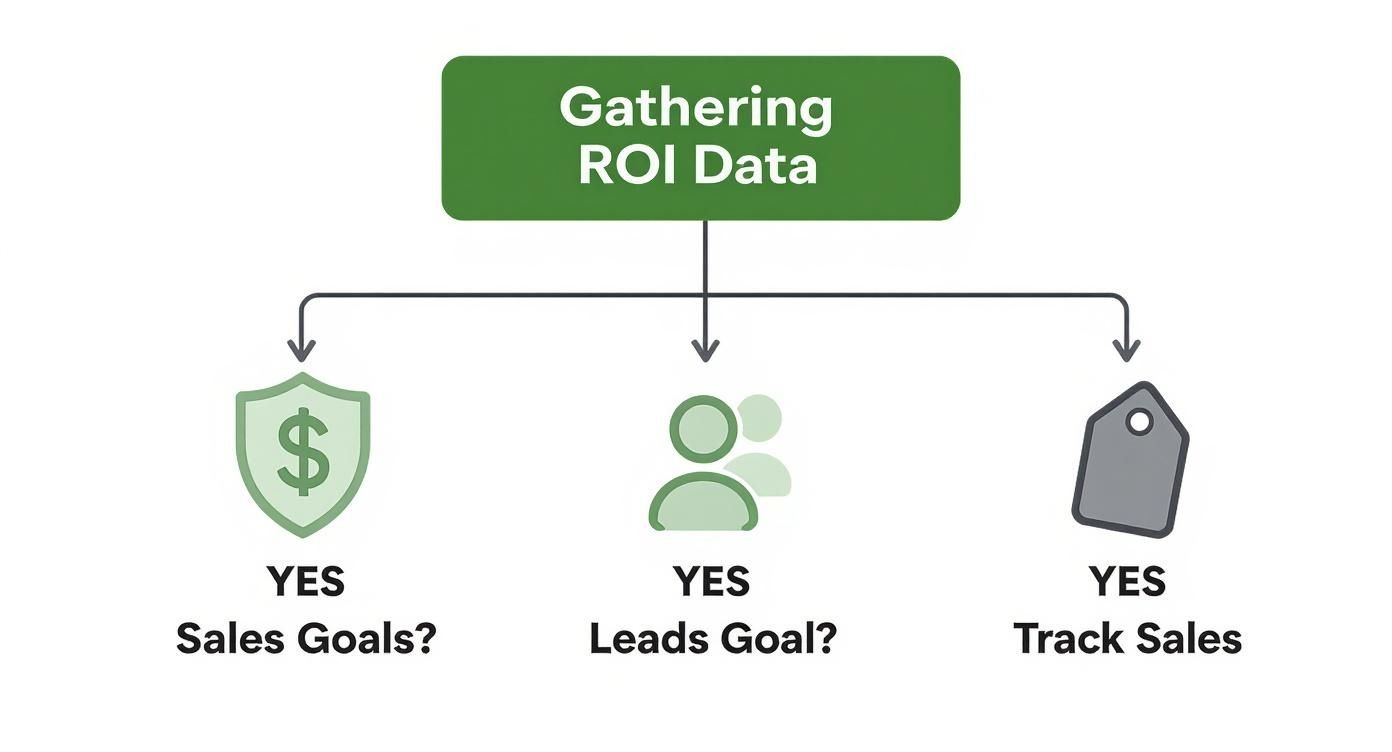
As you can see, it all starts with a clear goal. Without one, you're just gathering data in the dark, and your ROI calculation won't mean much.
Choosing Your Influencer ROI Calculation Model
So, what happens when your campaign isn't about driving immediate sales? The classic ROI formula is perfect for that, but it falls short when your goal is to build brand awareness or generate leads. For those objectives, you need a different way to measure your return.
An effective influencer campaign doesn't always lead directly to a sale. Sometimes, its greatest value is in building brand buzz or filling your sales pipeline with qualified leads for the future.
This is where a more thoughtful approach is necessary. On average, brands see a return of $5.78 for every dollar spent on influencer marketing, with some high-performers hitting $10 or more. That means a $10,000 investment could bring in anywhere from $57,800 to $100,000 in value—but only if you're measuring it correctly.
Choosing the right calculation model is key to understanding your campaign's true impact. Here's a breakdown of the most common approaches to help you decide which is right for you.
Choosing Your Influencer ROI Calculation Model
| ROI Model | Primary Goal | Key Metrics Required | Best For |
|---|---|---|---|
| Standard ROI | Direct Sales | Revenue Generated, Unique Discount Code Usage, UTM Link Conversions | E-commerce brands, product launches, and campaigns with a clear "buy now" call-to-action. |
| Cost Per Acquisition (CPA) | Lead Generation | Total Leads, Sign-ups, Demo Requests, App Downloads | B2B companies, subscription services, and any campaign focused on building a customer database. |
| Earned Media Value (EMV) | Brand Awareness & Reach | Impressions, Reach, Likes, Comments, Shares, Saves | Top-of-funnel campaigns where the main goal is to generate buzz and brand visibility. |
Each model gives you a different lens through which to view your results. Picking the one that aligns with your primary campaign goal is the only way to get a truly accurate picture of your performance.
For any campaign focused on lead generation, understanding your Cost Per Acquisition (CPA) is non-negotiable. This metric tells you exactly how much you're spending to acquire a new lead, which is a vital piece of the puzzle. We have a detailed guide on what Cost Per Acquisition is and how to calculate it if you want to dive deeper. By choosing the right model from the start, you ensure you’re measuring success against the right yardstick.
Putting Your Influencer ROI Calculator to Work
Knowing the formulas is a great start, but the real test is applying them in the wild. Let's walk through the three most common ways to actually calculate your return on investment, moving from a quick gut-check to a fully automated system.
Each method has its pros and cons, depending on the scale of your campaigns and how much time you can spare. We'll start with the simplest approach for a quick answer, then move to a more organized spreadsheet, and finally, look at the most efficient and accurate way: using a dedicated influencer marketing platform.
The Manual Method: A Quick Sanity Check
The most straightforward way to use an influencer ROI calculator is to just do the math yourself. Think of it as a back-of-the-napkin estimate—perfect when you need a fast answer without firing up a complex spreadsheet.
Let's say you paid an influencer $2,000 for a campaign. You also gifted them $500 worth of product. Your total investment is $2,500. A quick check of their unique discount code shows they brought in $7,000 in sales.
Here’s how that plays out:
- Find your profit: $7,000 (Revenue) – $2,500 (Investment) = $4,500
- Calculate ROI: ($4,500 / $2,500) * 100 = 180% ROI
Boom. You now know that for every dollar you put in, you got that dollar back plus an extra $1.80 in profit. It’s fast, simple, and gives you an immediate sense of profitability. The problem? This method falls apart fast once you're juggling more than a handful of influencers.
The Spreadsheet Template: A More Organized Approach
When things get more serious, a spreadsheet is your best friend. This lets you track multiple influencers, different costs, and various revenue streams all in one place. You can build your own from scratch or find a pre-made template online that already has the formulas plugged in.
A good spreadsheet should track a few key things:
- Influencer Name
- Influencer Fee
- Product Costs
- Other Expenses (like shipping or platform fees)
- Total Investment (a simple sum of all your costs)
- Tracked Revenue (pulled from discount codes or UTM links)
- Calculated ROI (a formula that does the math for you)
This setup gives you a much clearer, side-by-side view of who’s actually driving results. The biggest downside is the manual labor involved. Someone on your team still has to constantly pull data from Shopify, Google Analytics, and your payment processor. It’s time-consuming and a prime opportunity for human error to creep in.
The Automated Platform: The Error-Free Method
For a truly scalable and reliable way to use an influencer ROI calculator, you let an integrated platform do the heavy lifting. Tools like REACH Influencers connect directly to your data sources, automatically pulling in costs and revenue to calculate your ROI in real time.
This approach completely removes manual data entry, which saves a ton of time and provides insights that a spreadsheet just can't match. You can literally watch performance metrics update as sales roll in, helping you make smarter, faster decisions about your campaigns.
Here’s a glimpse of how the REACH dashboard visualizes this data.
This kind of visual breakdown instantly shows your total media value, cost, and the final ROI, turning a mountain of data into a simple, actionable snapshot of your campaign’s health.
By switching from manual work to an automated platform, you shift your focus from tedious data entry to meaningful data analysis. Instead of spending hours compiling numbers, you can spend minutes interpreting them and plotting your next move.
The value here is crystal clear. While manual methods are fine for small tests, you need a robust tool to profitably scale your influencer program. An automated platform doesn’t just calculate ROI—it helps you understand the story behind the numbers. This is how you stop just running campaigns and start building a predictable, scalable revenue engine.
Turning Your ROI Data into Smarter Decisions
Getting that final ROI percentage is a great feeling, but it’s really just the starting line. A number on a spreadsheet doesn't do much on its own. The real magic happens when you use that data to make smarter, more profitable decisions for your next campaign.
This is the leap from just measuring things to building a real strategy. It’s about digging into the results to find the gold hiding in plain sight. An influencer ROI calculator tells you what happened, but a strategic mindset helps you understand why it happened and what to do next.
What Does a Good ROI Look Like?
Before you can improve, you need to know where you stand. What’s a "good" return in the world of influencer marketing, anyway?
As the global market for this industry has soared past $21.1 billion, we've gotten a much clearer picture. Industry benchmarks consistently show the average ROI is around $5.78 for every dollar spent.
So, if you ran a campaign with a $10,000 budget, a typical return would be about $57,800 in revenue. That’s a solid baseline. For a deeper dive, check out these influencer ROI benchmarks on Influencer Hero.
If your ROI is tracking above that average, you're doing something right. If it's a bit lower, don't sweat it—that’s a clear signal you have an opportunity to optimize and grow.
Your ROI isn't just a grade for your last campaign; it's a roadmap for your next one. Use it to identify what worked, double down on your winners, and cut what isn't delivering.
From Data to Actionable Insights
Your overall ROI is just the headline. The real story is always in the details. You need to break down your data to see which specific creators, platforms, and tactics are punching above their weight.
Start by asking a few critical questions:
- Which influencers drove the most sales? Pinpoint your top one-to-three performers. What made their content so effective? Was it their authentic tone, a super-clear call-to-action, or the creative format they used?
- Which platforms performed best? Did your TikTok videos crush it while your Instagram Stories were just okay? This tells you exactly where to allocate more budget next time.
- What type of content resonated most? Compare the ROI from different formats. Maybe you'll find that raw, unboxing videos outperformed your polished, professional photoshoots.
This is where a platform like REACH Influencers really shines. Instead of getting lost in spreadsheets, the analytics dashboard automatically shows you this breakdown. You get a clear, visual report of your ROI by creator, channel, and even content type, instantly highlighting your biggest growth opportunities. Getting this right is a huge part of mastering cross-channel marketing attribution and seeing the whole picture.
Tips for Boosting Future Campaign ROI
Once you’ve identified what’s working, you can build a strategy to repeat that success and make it even better.
Here are a few practical tips to get you started:
- Re-invest in Top Creators: Don't just send a thank-you note to your best-performing influencers. Lock them into long-term partnerships. They’ve already proven they can connect with your audience and drive real results.
- Optimize Your Call-to-Action (CTA): Did you notice that influencers with a direct, urgent CTA had higher conversion rates? Make that a non-negotiable part of your future campaign briefs.
- A/B Test Creative Formats: Use your next campaign to test one new thing. For instance, have two similar influencers post at different times of the day to see which window generates more buzz and sales.
By constantly analyzing your results and turning those insights into action, you create a powerful feedback loop. Each campaign gets smarter than the last, pushing your influencer marketing ROI higher and higher over time.
Bringing It All Together: Your Path to a Better Influencer ROI Calculator
If there’s one thing to take away from all this, it’s that successful influencer marketing is built on solid data, not just hopeful guesswork. Making the leap from spending money to building profitable, scalable programs all comes down to accurate measurement. When you consistently use an influencer ROI calculator, you’re doing more than just crunching numbers—you're gaining the strategic clarity you need to invest with confidence.
We've walked through how to track the right metrics, use the core formulas, and pick the calculation method that best fits your campaign goals. You now have everything you need to look past vanity metrics and tie your influencer efforts directly to the bottom line.
From Insight to Action
Of course, the most crucial step is turning what you've learned into what you do. A great ROI figure is only useful if it helps you decide what's next. Do you double down on your best-performing creators? Should you shift your budget from one platform to another? Answering these questions is what separates a good campaign from a truly great one.
This is where having the right tools makes a world of difference. While manual calculations and spreadsheets are a fantastic starting point, they just can't keep up as your program grows.
Key Takeaway: The real goal is to create a feedback loop where performance data from one campaign directly shapes the strategy for the next. That’s how you achieve sustainable, long-term growth.
For brands and agencies ready to take their programs to the next level, platforms like REACH Influencers are built to automate this entire process. Instead of losing hours to manual data entry, you get real-time dashboards that translate complex analytics into clear, actionable steps for growth.
This approach elevates the influencer ROI calculator from a simple reporting tool into a strategic command center. You can see at a glance which partnerships are driving real value and make smarter, faster decisions to optimize every dollar you spend. Once you start measuring what truly matters, you'll unlock the full financial potential of your influencer partnerships and turn them into a predictable and powerful revenue engine for your brand.
Got Questions? We've Got Answers
Let's dig into a few of the questions that pop up all the time when marketers start using an influencer ROI calculator. It’s normal to hit a few tricky spots when you first get serious about tracking performance.
What Is a Good ROI for an Influencer Campaign Anyway?
This is the big one, but the honest answer is: it depends.
You'll see industry reports throwing around an average return of $5 to $6 for every $1 spent. That’s a solid 400-500% ROI. But a "good" ROI is completely relative to your business model and what you're trying to achieve.
For a luxury brand selling high-margin handbags, a 200% ROI might be fantastic. But if you're a direct-to-consumer brand with razor-thin margins, you might need to see a 1000% ROI before you pop the champagne. The best strategy is to set your own baseline and aim to beat it with every new campaign.
How Do I Calculate ROI for Awareness Campaigns?
So, what happens when sales aren't the main goal? This is where Earned Media Value (EMV) comes in handy. It’s a smart way to put a dollar value on the buzz your campaign creates—things like likes, comments, and shares.
Think of it this way: EMV calculates what you would have paid for that same level of engagement and exposure if you had bought it through traditional paid ads. It's not a direct revenue figure, but it gives you a concrete benchmark to measure the value of all that brand visibility you just earned.
Can I Really Trust the Data Influencers Give Me?
It’s always smart to trust but verify. While most creators are professional and honest, your own data should always be your source of truth.
Start with what you can track yourself. That means leaning heavily on the analytics from your UTM links, unique promo codes, and e-commerce dashboards.
For metrics you can't see on your end, like post impressions or story views, it’s perfectly fine to ask for screenshots from the creator’s native analytics. An even better, more foolproof method is to use a platform like REACH Influencers. We integrate directly with social media APIs to pull verified data right into your reports. It takes the guesswork out of the equation and ensures your influencer ROI calculator is running on numbers you can actually trust.
Ready to stop guessing and start measuring? REACH Influencers provides a powerful, all-in-one platform with a built-in influencer ROI calculator, real-time analytics, and automated reporting. Discover the perfect creators, manage campaigns effortlessly, and prove your impact with data-driven insights. Schedule your demo today!