 Skip to content


For any growing agency, there comes a point where manual work just doesn't cut it anymore. That's where marketing automation for agencies steps in. Think of it less as a tool and more as a strategic system for running client campaigns, nurturing leads, and reporting on performance without someone having to push a button for every single action. It’s about letting your team step away from the tedious, repetitive tasks to focus on the high-value strategic and creative work that truly moves the needle for clients.
What Is Marketing Automation for Agencies

Picture having a dedicated, tireless operations manager for each of your clients. This team member works 24/7, executing campaigns perfectly every time. That's the real power of marketing automation built specifically for agencies. It’s far more than just an email scheduler; it's a complete system designed to put the predictable, repeatable parts of your marketing services on autopilot.
This frees up your talented people from the daily grind of exporting spreadsheets, manually sending follow-up emails, or queuing up social media posts. Instead, they can channel their expertise into what clients are actually paying for: brilliant strategy, compelling creative, and strong relationship-building. The distinction is critical for agencies—unlike a generic tool built for one company, an agency platform is designed from the ground up to manage dozens of client accounts from a single hub.
The Two Pillars of Agency Automation
At its core, marketing automation for agencies stands on two key principles. Grasping these helps demystify how these powerful systems actually get the job done.
- Rule-Based Automation: This is the straightforward "if this, then that" logic. You define the triggers and the corresponding actions, and the software executes them flawlessly. A classic example is sending a welcome email the moment a new lead fills out a contact form or scheduling a week's worth of social posts for a client's product launch.
- Machine Learning Automation: This is the more intelligent, adaptive side of the coin. These systems chew through massive amounts of data to spot patterns and make smart predictions. Think of it as the brain behind the operation, capable of scoring leads based on how likely they are to buy, personalizing website content on the fly for different visitors, or even identifying which customers might be about to churn.
Key Takeaway: The goal isn't to replace your marketers—it's to supercharge them. By handing over the manual work to technology, agencies unlock their most valuable asset: human expertise. This lets your team focus on the kind of strategy and innovation that clients can't find anywhere else.
Practical Applications in an Agency Setting
This isn't just theory; it has a real impact on your daily operations, boosting both your team's efficiency and your clients' results. For a closer look at one of its key components, see how you can elevate your client services with chatbots for marketing.
Ultimately, these systems are architected to manage a diverse client portfolio from one central dashboard. This multi-tenant design means you can roll out sophisticated marketing workflows across multiple accounts with ease, ensuring consistent quality and freeing up your team to focus on growing the agency. It's about building a scalable engine for client success.
Why Automation Is a Game Changer for Agencies
Bringing marketing automation into your agency is like giving your team a superpower. It’s the difference between running a manual assembly line and operating a smart, automated factory. You stop being just a service provider and start becoming a true growth engine for your clients, completely changing how you deliver results and prove your value.
The most immediate win? A huge boost in operational efficiency. Think about all those repetitive tasks that eat up your team's day: sending follow-up emails, pulling weekly reports, or manually scheduling a month's worth of social media posts. Automation takes all of that off their plate. This frees up your best people to focus on what really matters—strategy, creative thinking, and the high-impact work that gets clients excited.
Scale Your Agency Profitably
Before automation, agency growth was often a painful, linear process. Landing five new clients meant you probably had to hire two more account managers just to keep up with the manual work. It was a constant balancing act. Marketing automation completely shatters that model.
Now, you can onboard new clients with standardized, automated workflows that deliver a consistently great experience every time. This means your current team can manage a much larger portfolio of clients without getting burned out. The result is a more profitable, sustainable business. You’re not just adding clients anymore; you're building a scalable system for success.
Deepen Client Relationships with Better Results
It might sound strange, but using technology can actually make your client relationships feel more human. Automation handles the logistics of consistent, timely, and personalized communication, keeping your clients' audiences engaged around the clock. Imagine a system that automatically sends a perfect follow-up email based on what a user just did on your client's website. That’s the kind of precision that gets results.
When you're consistently delivering better outcomes, client satisfaction and trust naturally follow. With the campaigns running smoothly in the background, your team has more time for the good stuff: strategic planning sessions, proactive check-ins, and building real partnerships.
Key Insight: Automation isn't about replacing people. It's about amplifying their talent. By taking care of the mechanical tasks, it frees up your team to focus on the strategy, creativity, and relationships that no machine can ever replicate.
The infographic below shows how these benefits build on each other, creating a powerful cycle of success for your agency.
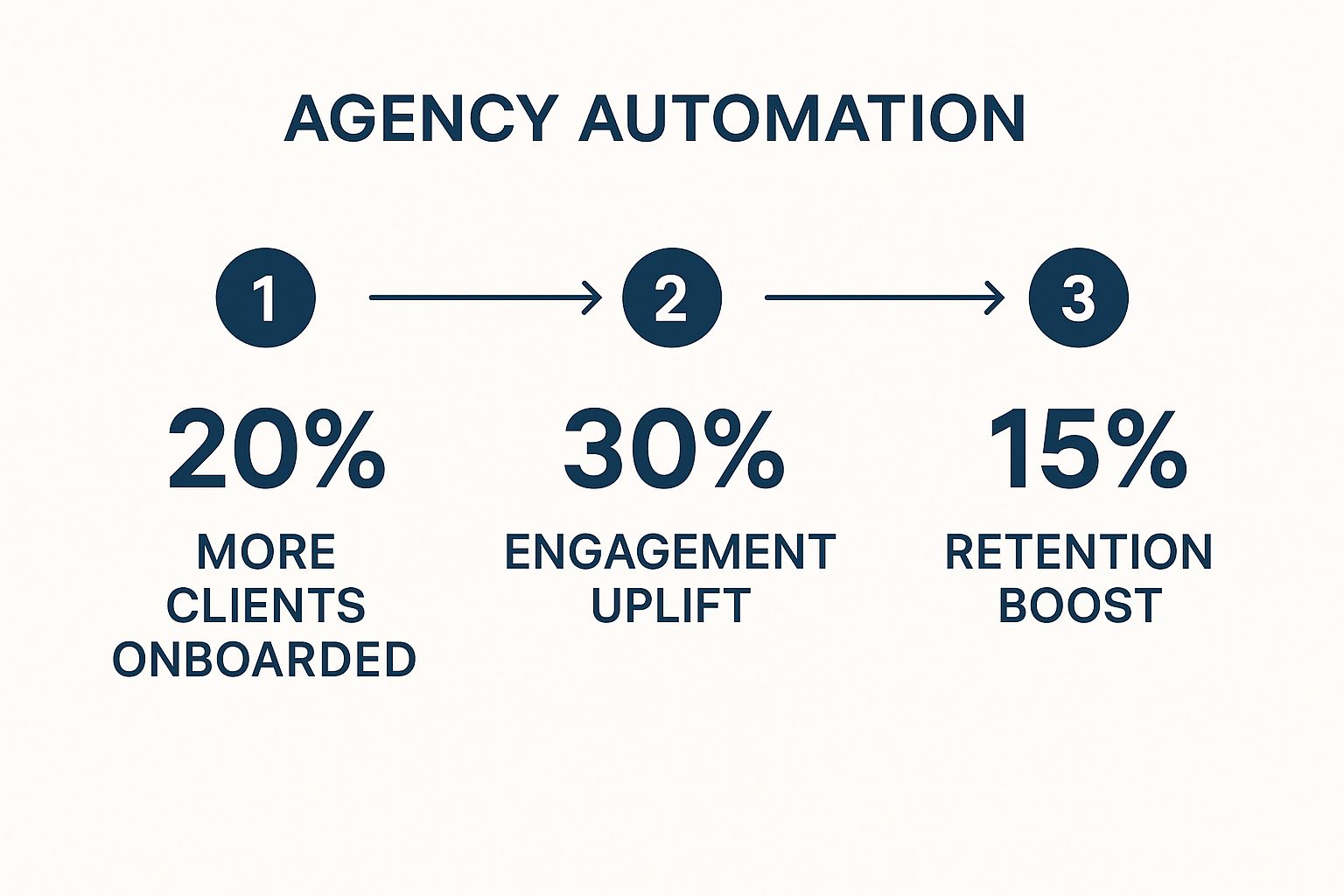
As you can see, the initial efficiency gains fuel better engagement, which is the key to keeping clients happy and loyal for the long haul.
Prove Your Value with Data-Driven Reporting
Finally, automation gives you the ultimate tool for proving your agency's worth: centralized, undeniable data. No more scrambling to pull metrics from a dozen different platforms for your monthly report. Instead, you can generate comprehensive, easy-to-understand reports with the click of a button. Platforms like REACH are built for this, creating a single source of truth for campaign performance.
This data-driven approach is a game-changer for client trust and retention. When you can clearly point to the ROI with accurate, real-time numbers, conversations change. You're no longer justifying your retainer; you're planning the next big win. The right dashboards are crucial here, which is why we’ve broken down the best marketing dashboard tools to help you keep clients impressed.
The numbers back this up. Industry data shows that 76% of companies are now using automation. Agencies, in particular, are leading the charge, using it 76% more than sales teams. And the financial return is clear: companies report earning an average of $5.44 for every $1 spent on automation. You can dig into more of these stats in the latest industry reports on thunderbit.com.
Building High-Impact Client Automation Workflows
This is where the rubber meets the road. Moving from the "what" to the "how" is where marketing automation truly starts to shine for agencies. Your real value comes from building repeatable, high-impact workflows that get your clients tangible results they can see and feel.
Think of these workflows as the engine of your client's campaigns, humming along 24/7. They're the digital assembly lines that turn casual interest into genuine leads.
It all starts with a trigger—say, a visitor downloading an ebook. That one action kicks off a series of pre-planned steps, like sending a thank you email, updating their lead score, or even pinging a sales rep. This system ensures no one falls through the cracks and every interaction feels timely.
Creating Powerful Lead Nurturing Sequences
One of the first and most valuable workflows you can build for any client is a solid lead nurturing sequence. This is how you gently guide a potential customer from "just looking" to "ready to buy." The numbers don't lie: companies that are great at lead nurturing generate 50% more sales-ready leads at a 33% lower cost.
The goal here isn't to blast prospects with sales pitches. It’s about building trust by delivering real value over time.
Here’s a classic example:
- Trigger: Someone fills out a form to download a whitepaper.
- Immediate Action: An email with the download link hits their inbox instantly. Speed is everything at this point; you want to capitalize on that moment of interest.
- Wait Period (3 days): The system pauses. You don't want to overwhelm them.
- Follow-up Action: A second email goes out with a relevant case study, showing how others in their shoes have succeeded with your client’s solution.
- Conditional Split: Now it gets smart. If they click the case study, their lead score bumps up, and they get tagged as "Highly Engaged." If they don't, they might get a helpful blog post a few days later instead.
This kind of branching logic is what makes the communication feel personal. It adapts to their behavior, making every message more relevant.
Building Dynamic Email Campaigns
Let's be honest, the days of "one-size-fits-all" email blasts are over. Marketing automation lets you build dynamic campaigns that change based on what people actually do. This level of personalization is what drives real engagement and, ultimately, conversions.
Take an e-commerce client. A simple "abandoned cart" workflow can be a goldmine, recovering revenue you thought was lost.
- Trigger: A shopper adds a product to their cart but leaves without buying.
- Action 1 (2 hours later): A friendly reminder email lands in their inbox, maybe with a picture of the item they left behind.
- Action 2 (24 hours later): If they still haven't bought, a second email might feature glowing customer reviews for that product to build a little more confidence.
- Action 3 (3 days later): A final, gentle nudge could ask if they had any trouble with checkout, gathering valuable feedback even if you don't make the sale.
Pro Tip: For that first abandoned cart email, keep it simple and helpful. More often than not, the person just got distracted. A simple reminder is often all it takes to close the deal, no discount needed.
Automating Social Media and Client Reporting
Consistency is the name of the game in social media, but managing a dozen client accounts is a recipe for burnout. Automation tools allow your team to schedule posts far in advance, keeping the content flowing while freeing up your social media pros to focus on what matters: actual engagement and community building.
Automated reporting is another huge time-saver. Forget spending hours at the end of each month wrestling with spreadsheets. You can set up dashboards that pull data automatically, giving clients a real-time look at their performance.
To help you get started, we've outlined some of the most essential automation workflows that deliver immediate value for clients.
Key Automation Workflows for Agency Clients
| Workflow Type | Primary Goal | Common Triggers | Example Action Sequence |
|---|---|---|---|
| Lead Nurturing | Guide prospects through the sales funnel | Form submission, content download | Send welcome email -> Wait 3 days -> Send case study |
| Client Onboarding | Welcome new clients and set expectations | Contract signed, first payment | Send welcome kit -> Schedule kickoff call -> Assign team |
| Reputation Management | Encourage and monitor online reviews | Purchase completed, project finished | Send review request -> Monitor review sites -> Alert team |
| Automated Reporting | Keep clients informed of campaign KPIs | End of week/month | Pull data from platforms -> Populate dashboard -> Email link |
Mastering these workflows is how you build a truly scalable agency. You'll not only drive better results for your clients but also create a far more efficient and profitable operation for yourself.
For a deeper dive into the strategies behind these systems, you can learn more about marketing automation best practices in our detailed guide. Platforms like REACH are built to make this easy, giving you a central hub to manage every one of these essential workflows for every client you have.
Choosing the Right Automation Platform for Your Agency

Picking a marketing automation platform is one of those make-or-break decisions for an agency. This isn't just another piece of software; it becomes the central nervous system for your client campaigns and your own growth. Get it right, and you unlock massive efficiency and scale. Get it wrong, and you’re looking at constant friction, wasted budgets, and a very frustrated team.
Think of it like laying the foundation for a house. A weak or poorly-suited foundation will compromise everything you build on top of it, no matter how brilliant your strategies are. The right platform has to support you today and be ready for where you’re headed tomorrow.
The market for these tools is exploding, which tells you just how critical they've become. Valued at USD 6.65 billion in 2024, the industry is on track to hit USD 15.62 billion by 2030. This growth is driven by smart, accessible platforms that give agencies of all sizes a shot at using powerful tools without the old-school price tag. You can dig deeper into the numbers with recent market analyses on inbeat.agency.
Core Features Agencies Cannot Ignore
When you're vetting options, remember that an agency's needs are fundamentally different from a single in-house marketing team. You're juggling multiple clients, brands, and strategies, so certain features are absolutely non-negotiable.
Your evaluation checklist should be laser-focused on tools built for the agency model. These platforms are designed from the ground up to handle the complexity and scale that are just part of your daily grind.
Here are the must-haves you should be looking for:
- Multi-Client Management: How easy is it to jump between client accounts? A proper agency platform gives you a single dashboard to manage everyone, saving you from the logistical nightmare of logging in and out of a dozen different instances.
- White-Labeling Capabilities: When you send a report or give a client access to a dashboard, it needs to have your branding on it, not the software company's. This is crucial for reinforcing your value and maintaining a professional, polished image.
- Robust Integrations: Your automation hub has to play nice with the other tools in your stack (and your clients'). We’re talking CRMs, analytics platforms, and social media managers. Without seamless connections, you’re stuck with data silos and tedious manual work.
All-in-One Platforms vs. Specialized Tools
One of the biggest forks in the road is deciding between a comprehensive, all-in-one suite and patching together a collection of best-in-class specialized tools. There are real trade-offs to each approach, and the right answer depends entirely on how your agency is built and what you offer.
An all-in-one platform like REACH gives you a unified ecosystem where every tool is designed to work together from the start. This drastically simplifies team training, consolidates reporting, and creates a single source of truth for all your campaign data.
On the flip side, a specialized approach lets you hand-pick the absolute best tool for every individual function—the best for email, the best for social, the best for analytics. While you might get deeper functionality in one area, you often pay the price in integration headaches and a higher total cost. For example, you’ll probably need dedicated social media management tools for agencies that may or may not sync smoothly with your main automation platform.
Key Consideration: For most agencies managing a diverse service mix, an all-in-one solution provides better value and far greater operational simplicity. The unified data model alone can save you hundreds of hours on reporting and analysis.
Critical Questions to Ask During a Demo
A software demo is your chance to get past the slick sales pitch and see if a platform can actually handle your agency’s real-world workflow. Never go into a demo unprepared. Have a list of specific, practical questions ready.
Don’t be shy about pushing for details. If you get a vague answer on a critical feature, that's a major red flag.
Your Demo Checklist:
- Scalability: How does your pricing and platform architecture support an agency that plans to double its client roster in the next year?
- User Friendliness: Seriously, how steep is the learning curve? Can you walk us through building a complex, multi-step workflow right now? I want to see how intuitive it really is.
- Support: What does your support model look like for agencies? Do we get a dedicated contact who understands our business, or are we just another ticket in a generic help queue?
- Reporting: Show us how to build a custom, white-labeled report from scratch that pulls data from email, social, and a paid ad campaign.
Choosing the right marketing automation platform is a strategic investment in your agency's future. By focusing on these core needs, you can find a true partner that helps you scale efficiently and deliver killer results for every single client.
Integrating AI to Supercharge Your Automation Strategy
Think of marketing automation as the powerful engine driving your agency's client campaigns. It's reliable and executes tasks perfectly. Now, think of artificial intelligence as the supercharger you bolt onto that engine—suddenly, you're in a completely different performance class.
Automation on its own is all about following predefined rules. But when you introduce AI, your campaigns start to think, predict, and adapt on their own. This isn't about replacing your team's strategic minds. It's about arming them with insights and speed that were simply out of reach before, turning a simple "if this, then that" system into a self-tuning growth machine for every client.
The industry is already making this shift in a big way. The AI marketing market is on track to double, jumping from $20 billion in 2022 to an expected $40 billion by the end of 2025. With nearly 20% of marketers planning to use AI agents for automation, it’s clear these tools are becoming standard issue. If you're curious about where things are headed, you can discover more AI marketing statistics at Cubeo.ai.
Predictive Analytics for Smarter Lead Scoring
One of the most powerful things AI brings to the table is its knack for predicting the future with surprising accuracy. Traditional lead scoring is based on simple, static rules—give someone 5 points for opening an email, 10 for visiting a pricing page. It works, but it's still just an educated guess.
AI-powered predictive lead scoring goes much deeper. It analyzes hundreds of data points, from demographics and past behaviors to subtle website interactions, to calculate a lead's true likelihood of converting. It finds the hidden patterns your team might miss, letting you focus on the leads that are genuinely ready to talk.
Practical Application: Instead of your client's sales team chasing down every person who downloads an ebook, the AI flags the top 10% who also fit the profile of past high-value customers. This points their efforts exactly where they’ll have the biggest impact, boosting close rates and making your agency look like a hero.
Ultimately, this moves you from just generating a list of leads to delivering a pipeline of pre-vetted opportunities.
Generative AI for Hyper-Personalized Content
Let's be real: no human team can write truly personalized copy for thousands of contacts. It's an impossible task. But for generative AI, it's just another Tuesday. These tools can analyze a customer's data and instantly craft email subject lines, body copy, and ad creative that speaks directly to them.
And this is way more than just plugging a {{first_name}} tag into a template. AI can:
- Adjust Tone: Write in a casual, friendly tone for a prospect from a startup and switch to a more formal one for a lead at an enterprise company.
- Highlight Relevant Features: Showcase different product benefits based on the specific pages a user browsed on your client's website.
- Create Dynamic Offers: Generate unique discount codes or suggest content that aligns perfectly with a lead's stage in the buying journey.
Being able to create this kind of one-to-one communication at scale gives your clients a massive leg up on the competition.
Real-Time Campaign Optimization
No campaign performs perfectly right out of the gate. Traditionally, your team would wait a week or two, pore over the data, and make manual adjustments. AI-driven optimization does this constantly, in real-time, 24/7.
It’s always watching, automatically shifting ad spend to the best-performing channels, A/B testing creative on the fly, and tweaking bids to get the most bang for your client's buck. This continuous improvement cycle means their budget is always working as efficiently as possible. Innovations like AI in video conversational intelligence are even opening doors for interactive campaign elements that learn and adapt.
Platforms like REACH build these AI capabilities right into the system, letting you deploy smarter, self-tuning campaigns for every single client. By combining the rock-solid reliability of automation with the predictive power of AI, your agency can deliver a level of results that’s simply impossible to achieve by hand.
Frequently Asked Questions About Agency Marketing Automation
Jumping into marketing automation is a big move for any agency. It’s totally normal to have questions about how it all works in the real world—from what it costs to how you’ll manage it day-to-day. We’ve rounded up the most common questions we hear from agency leaders to give you clear, no-fluff answers.
Think of this as your practical guide for getting a powerful automation system up and running in your agency.
How Much Does Marketing Automation Cost?
This is usually the first thing everyone wants to know, and the honest answer is: it depends. The price tag can swing pretty widely based on the platform's power, how many client accounts you’re running, and the size of your contact lists. Most pricing breaks down in a few common ways.
- Tiered Pricing: Most platforms charge you based on the number of contacts in your database. This model is great when you're starting out, but you have to keep a close eye on it as your clients' audiences grow.
- Per-User Pricing: Some tools charge a flat monthly fee for every team member who needs access. This can be a bargain for small, tight-knit agencies but can get pricey as your team expands.
- Feature-Based Tiers: You'll also see plans that lock advanced features—like AI-driven analytics or white-labeling—behind more expensive tiers.
A small agency just getting its feet wet might find a solid plan for a few hundred dollars a month. On the other hand, a larger agency juggling dozens of clients could easily invest several thousand. The trick is to look past the monthly fee and think about the total cost of ownership, which includes setup, training, and any integration work you might need.
Key Takeaway: The goal isn't finding the cheapest option; it's finding the best value. A platform that saves your team 20 hours a week on manual tasks pays for itself almost immediately, even if it costs more upfront.
How Do I Prove the ROI to My Agency and Clients?
Proving return on investment (ROI) is everything. You need to justify the cost to your own leadership and show clients you’re delivering real value. The great thing about marketing automation platforms is they are built from the ground up to make this incredibly easy by putting all your data in one place.
You can really tackle ROI from two angles:
- Efficiency Gains (Your Internal ROI): Start tracking the hours your team gets back. If automating client reports saves each of your account managers five hours a month, you can put a dollar amount on that saved labor. That’s time they can now spend on big-picture strategy or winning new business.
- Performance Lifts (Your Client’s ROI): This is where the magic happens. Use the platform’s built-in analytics to show clients undeniable improvements in metrics like lead conversion rates, customer lifetime value, and campaign engagement. When you can draw a straight line from an automated email sequence to a 15% bump in sales-qualified leads, the value speaks for itself.
What Is the Implementation Process Like?
Getting started with marketing automation is a project, not just a software subscription. A smooth rollout needs a smart plan. While every platform has its quirks, the process usually follows a few key stages.
- Data Migration: First things first, you need to import your clients’ existing contact lists, customer data, and old campaign info. A clean, organized database is the bedrock of everything else.
- System Integration: Next, you’ll hook the automation platform into your other essential tools—your CRM, analytics software, social media managers, you name it.
- Workflow Building: This is the fun part. You’ll start building out your core automation sequences, like welcome emails for new leads or onboarding campaigns for new clients. It's always best to start with a few simple, high-impact workflows before you try to build something super complex.
A phased approach almost always works best. Don’t try to automate your entire agency on day one. Nail one area, show everyone how awesome it is, and then build from there.
How Do I Train My Team to Use the Platform?
A powerful tool is just an expensive paperweight if your team doesn't know—or want—to use it. Getting your people on board and properly trained is non-negotiable.
A great first step is to identify one or two "automation champions" on your team. Find the people who are genuinely excited by the tech and empower them to lead the charge and help their colleagues.
Most good platforms will give you plenty of resources to get everyone up to speed. Here's a quick look at what we've found to be the most helpful resources for getting an agency team fully ramped up and confident with a new marketing automation platform.
| Question | Answer |
|---|---|
| How long does it take to implement? | A basic setup can take a few weeks, but a full-scale implementation across all clients can take 2-3 months. Plan for a phased rollout to manage the process smoothly. |
| Do we need a dedicated person to run it? | It’s highly recommended. Having an "automation specialist" or a small team ensures someone owns the platform, masters its features, and drives strategy. |
| Can we white-label the platform for clients? | Many agency-focused platforms, like REACH, offer white-labeling. This allows you to brand reports and even the platform interface with your agency's logo for a seamless client experience. |
| What's the biggest mistake agencies make? | Trying to do too much, too soon. Start with simple, high-impact workflows, prove their value, and then expand. Don't try to automate every single task from day one. |
| How do we ensure data privacy and compliance? | Choose a platform that is transparent about its security measures and is compliant with regulations like GDPR and CCPA. Ensure your own data handling processes are sound from the start. |
In the end, encouraging your team to start with small, easy wins is the best way to build momentum. Once they see how automation can wipe their most annoying tasks off their to-do list, their excitement will build all on its own. The goal is to make the platform feel like a helpful colleague, not another piece of complicated software to learn.
Ready to see how a platform built for agencies can streamline your operations and drive client growth? REACH provides all the tools you need in one intuitive dashboard. Discover how you can manage multiple clients, automate high-impact workflows, and deliver white-labeled reports that prove your value. Learn more about REACH for agencies.