 Skip to content

Paid social marketing is straightforward at its core: you pay to place ads on social media. But it's not about just throwing money at a post and hoping for the best. It's the art and science of putting your brand in front of the exact right people, at the exact right time, to drive real business results.
It's the difference between hoping customers wander into your store and putting up a giant, flashing billboard on the busiest highway in the world, pointing them directly to your door. This guide will walk you through everything you need to know to master paid social marketing and turn your ad spend into a powerful growth engine.
Table of Contents
- The Power of Paid Social Marketing
- Choosing the Right Social Platforms
- Finding Your Audience and Crafting Winning Ads
- Budgeting and Bidding for Maximum ROI
- How to Weave Influencers into Your Paid Social Strategy
- Measuring What Matters and Optimizing for Growth
- Your Top Paid Social Questions, Answered
The Power of Paid Social Marketing
Think of your regular, organic posts as conversations you have with people already following you. They're essential for building community and keeping your current audience engaged. Paid social marketing, on the other hand, is your ticket to explosive growth. It lets you break out of your existing bubble and introduce your brand to millions of potential new customers who fit your ideal profile perfectly.
This is a far more sophisticated game than just hitting the "Boost Post" button. A real paid social strategy involves setting clear goals, meticulously defining audiences, creating ads that stop the scroll, and carefully managing your budget to get a measurable return. It's a serious investment for a reason. In 2025 alone, brands spent an incredible $277 billion on social media ads, a number that shows just how central this has become. For a deeper dive, the full global overview report has some fascinating data.
Let's quickly summarize what a solid paid social strategy looks like.
Paid Social Marketing at a Glance
A well-rounded paid social plan has several interconnected parts, all working together to turn ad spend into tangible results. This table breaks down the essentials.
| Component | Objective | Key Benefit |
|---|---|---|
| Clear Objectives | Define what success looks like (e.g., leads, sales, awareness). | Prevents wasted spending and focuses all efforts. |
| Audience Targeting | Identify and reach the most relevant users for your brand. | Increases ad relevance and lowers acquisition costs. |
| Compelling Creative | Design ads that grab attention and inspire action. | Drives higher engagement and better conversion rates. |
| Strategic Budgeting | Allocate funds effectively to maximize your return. | Ensures sustainable growth and a positive ROI. |
| Performance Tracking | Measure key metrics to understand what's working. | Provides the data needed to optimize and improve. |
Ultimately, these components combine to create a powerful engine for customer acquisition and brand growth that is both scalable and predictable.
Why Paid Social Is a Must-Have Today
With more than 5.17 billion people now on social media, the sheer scale is staggering. But it's the precision that makes it so powerful. Paid social is a key part of any modern social media marketing plan, and here’s why you can’t afford to ignore it:
- Guaranteed Reach: Let's be honest, organic reach is in the basement. Getting your posts seen without paying is a lottery. Paid campaigns guarantee your message gets delivered to the people who matter most.
- Precision Targeting: The targeting options are incredible. You can zero in on people based on their age, location, hobbies, what they've bought online, or even if they've visited your website before. This means less money wasted on people who will never buy from you.
- Measurable ROI: Unlike some other forms of advertising, you can track almost everything. You know exactly how many clicks, leads, or sales each dollar generated, making it easy to prove its value and justify your budget.
It's a common myth that you need a massive budget to get results. The truth is, the scalability and pinpoint targeting make paid social a fantastic tool for small businesses trying to punch above their weight and find new customers.
The Secret Sauce: Authentic Content
Here’s the catch: you can have the best targeting in the world, but if your ad looks like a generic, corporate stock photo, people will scroll right past it. Today's users are incredibly sharp and have a built-in filter for anything that feels fake or overly polished. This is where authentic, creator-driven content changes everything.
When you bring influencers into your paid strategy, you get something magical. You're no longer just another brand shouting into the void; you're sharing a genuine recommendation from a trusted voice. That's what platforms like REACH Influencers are all about—connecting brands with creators who can produce content that feels real and truly connects. For example, a beauty brand can use the REACH platform to find a creator who genuinely loves their foundation, then turn that creator's authentic video review into a high-performing paid ad.
By putting your ad budget behind this kind of authentic content, you get the best of both worlds: the credibility of an influencer and the massive, targeted reach of a paid social campaign.
Choosing the Right Social Platforms
You wouldn't try to sell retirement plans at a music festival, right? The same logic applies to paid social media. The biggest mistake you can make is trying to be everywhere at once. The real secret is to be exactly where your ideal customers are already spending their time.
Think of it this way: each social platform is its own unique world with a specific culture and audience. Your job is to find the perfect match for your brand. This all starts with a single, crucial question: what is your main goal? Are you trying to get your name out there, or are you looking to drive direct sales?
The decision tree below gives you a bird's-eye view of how this choice plays out. Your primary goal is the starting point that guides every other decision you'll make.
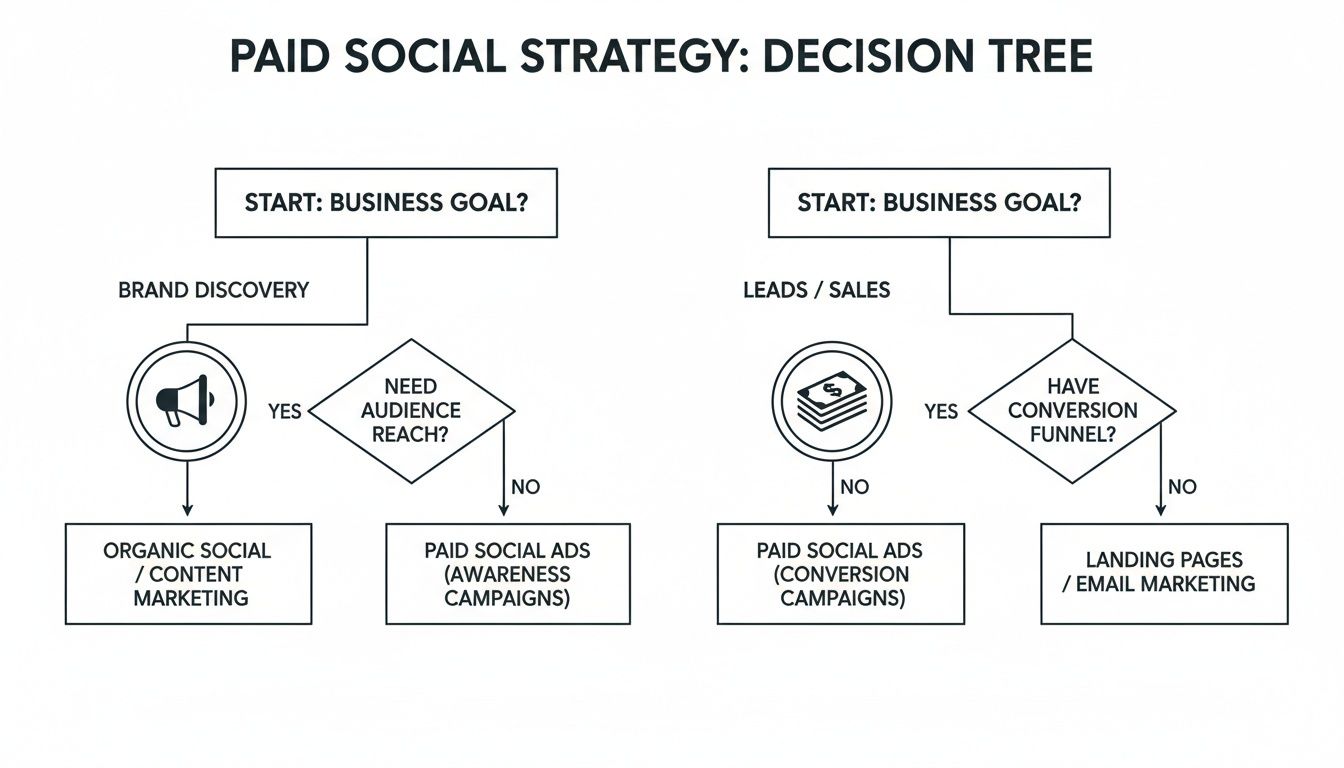
As you can see, the path you take branches out directly from your core business objective, pointing you toward entirely different platforms and ad types.
Aligning Platforms With Your Goals
Let's get practical. Before you spend a single dollar, you need to know what a "win" looks like for your campaign.
Goal: Brand Awareness. If you just want to get your brand in front of as many new faces as possible, you need platforms built for massive reach. We're talking about places like Meta (Facebook & Instagram) and TikTok, where visual content spreads like wildfire. The aim here is simply reach and repetition.
Goal: Leads & Sales. If you need to see a more immediate return, you'll want platforms where people are in a business or buying mindset. LinkedIn is the undisputed king for B2B leads, while Pinterest and Instagram Shopping are absolute powerhouses for e-commerce.
Getting this alignment right from the start is the difference between a campaign that soars and one that just burns through your budget.
A Look at the Top Paid Social Arenas
Each major platform brings something different to the table. The key is understanding their user base and the kind of content that thrives there.
Meta (Facebook & Instagram)
With billions of users between them, Meta's platforms give you incredible reach and some of the most granular targeting options available anywhere.
Facebook is the all-around workhorse. It can do almost anything, from drumming up foot traffic for a local shop to powering a massive e-commerce operation. Instagram, on the other hand, is all about visual appeal. It's the go-to spot for brands that want to connect with Millennials and Gen Z through polished, yet authentic, imagery and video.
TikTok
If your target audience is under 35, you simply can't ignore TikTok. It’s the home of viral trends and bite-sized video. Brands that win here aren't the ones with slick corporate ads; they're the ones that embrace creativity, humor, and authenticity. It’s a fantastic channel for getting people excited about your products in an entertaining, low-pressure way.
The money is certainly flowing in this direction. Paid social ad spend is on track to hit a staggering $317.33 billion globally by 2026. For younger consumers, platforms like Instagram (with 3 billion users) and TikTok (with 1.99 billion users) are where 60% of product discovery now happens.
Niche Platforms for Specific Audiences
Beyond the giants, a few other platforms offer incredibly focused opportunities.
LinkedIn: For any B2B company, LinkedIn is non-negotiable. It’s the only place you can target people by their job title, company size, or industry. This makes it perfect for finding high-quality leads for your sales team, promoting webinars, or selling professional services.
Pinterest: Don’t think of Pinterest as just social media; it's a visual search engine. People come here actively looking for ideas and products to buy, from home decor and fashion to recipes and DIY projects. That built-in purchase intent makes it a goldmine for e-commerce brands looking to drive traffic and sales.
Choosing the right platform is the first—and most important—step in building a successful paid social campaign. To get a better handle on who is using each platform, take a look at our detailed breakdown of social media demographics by platform.
Finding Your Audience and Crafting Winning Ads

Let's be honest, successful paid social marketing really comes down to two things: reaching the right people and showing them something they actually want to see. If you get one part wrong, you're just lighting money on fire. But when you get them both right? That’s when you build a real engine for growth.
Think of it like this: having the world’s best ad creative is like having a top-of-the-line fishing rod. It’s useless if you cast your line in a puddle with no fish. On the flip side, knowing exactly where the fish are won’t help if you're using a string with no bait. You need both the right spot (your audience) and the right lure (your ad).
The Three Main Ways to Target Your Audience
This is where the real genius of paid social comes into play. You don't have to shout your message from a billboard and hope for the best. Instead, you can get incredibly specific about who sees your ads. Most platforms, including heavyweights like Meta and TikTok, give you three main types of audiences to work with.
Core Audiences: This is your starting point. You build these groups from the ground up using all the data the platform provides. Think demographics (age, location), behaviors, and interests. You can target people who love "hiking," live in Denver, and work in tech.
Custom Audiences: These are folks you already know. You create these audiences by uploading your own lists—like your email subscribers—or by tracking people who have visited your website. This lets you get back in front of someone who, for example, added a product to their cart but didn't check out.
Lookalike Audiences: Here’s where you can really scale. The platform takes one of your Custom Audiences (say, your absolute best customers) and uses its algorithm to find millions of other users who look and act just like them. It's the single best way to find new customers who are very likely to be interested in what you offer.
By combining these, you create a complete strategy. You can use broad Core Audiences to introduce your brand, retarget interested people with Custom Audiences, and then go find more people just like them with Lookalikes.
How to Create Ads That People Don't Hate
Once you’ve figured out who you're talking to, you have to nail what you’re going to say. The most common mistake I see brands make is creating ads that feel like… well, ads. That slick, corporate polish just makes people scroll faster.
In 2026, the name of the game is authenticity. People want to see content that feels real and fits right into their social feed.
That's why user-generated content (UGC) and influencer-driven creative are so powerful. An ad showing a real person genuinely excited about your product feels less like a sales pitch and more like a tip from a friend. The data backs this up time and time again; UGC-style creative simply works better because it feels native and builds trust.
A study found that consumers are 2.4x more likely to say UGC is the most authentic content, compared to brand-created content. This shift is crucial; people trust people, not logos.
Using Influencer Content to Fuel Your Ads
So, how do you get a constant supply of this authentic, high-performing creative? That's a major roadblock for a lot of brands. It's a ton of work to find the right creators, manage the relationships, and make sure the content is on-brand.
This is exactly the kind of problem a platform like REACH Influencers was designed to fix. Instead of spending weeks searching and guessing, you can use a discovery engine to find creators who are a perfect fit for your brand and whose followers are the exact people you want to reach. The platform helps manage everything from outreach and contracts to content approval and payments.
Imagine finding a creator whose audience is a perfect match for your ideal customer. Through REACH, you partner with them to create a simple, authentic video using your product. That video then becomes the creative for your paid social campaign, which you can serve up to a massive Lookalike Audience built from your best customers.
This is how you bring it all together. You’re combining the credibility of an influencer with the incredible scale and precision of paid social advertising. You get creative that stops the scroll, delivered directly to an audience that’s primed to convert.
For a deeper dive on the technical side, check out our guide on TikTok ad specs. It will give you a clear idea of what's needed to ensure your budget is spent on creative that actually connects with people and drives results.
Budgeting and Bidding for Maximum ROI
Let's talk about the money. This is where many people get nervous, but getting your paid social marketing budget right is less about having deep pockets and more about being smart with every dollar you spend. Think of it as a strategic investment in your growth—one that needs a clear plan to pay off.
Without solid financial guardrails, it's way too easy to burn through cash without seeing any real results. The trick is to tie your spending directly to your business goals, turning that ad budget from a simple expense line into a powerful growth engine.
Choosing Your Budget Model
Most social platforms give you two main ways to control your spending. Neither is inherently better; the right choice really just depends on your campaign's goals and how long it's running.
Daily Budget: This is exactly what it sounds like—a daily spending cap. It's fantastic for ongoing, "always-on" campaigns where you want a consistent presence. You get predictable spending day in and day out, which prevents you from accidentally blowing your whole budget in the first week of the month.
Lifetime Budget: Here, you set one total budget for the entire campaign flight. This gives the platform’s algorithm more freedom to spend more on high-opportunity days (like a weekend for a B2C brand) and pull back on slower ones. It's the perfect model for campaigns with a fixed end date, like a flash sale or a webinar promotion.
Understanding Bidding Strategies
Once your budget is set, you have to tell the platform how to spend it. This is where bidding comes in. You’re essentially telling the ad auction what you value most. Your bidding strategy is what translates your marketing goals into the platform's language.
Your bid strategy is your direct instruction to the ad platform. It's how you say, "This is the outcome I'm willing to pay for." Get this right, and you align your spending with what actually moves the needle for your business—be it views, clicks, or sales.
Here are the most common ways to bid:
Cost Per Mille (CPM): With CPM, you pay for every 1,000 times your ad is shown (an impression). This is your go-to for brand awareness campaigns where your main objective is just getting in front of as many eyeballs as possible.
Cost Per Click (CPC): You only pay when someone actually clicks your ad. This is a classic middle-of-the-funnel strategy. It’s perfect for driving traffic to your website or a specific landing page because you’re only paying for people who show genuine interest.
Cost Per Acquisition (CPA): This is where things get really tied to business results. You only pay when a specific action is completed—like a lead form submission, an app install, or a purchase. It’s the ultimate bottom-of-the-funnel strategy because it connects your ad spend directly to revenue.
Proving Your Paid Social Marketing Is Profitable
So, how do you know if any of this is actually working? The one metric that rules them all is Return On Ad Spend (ROAS). It’s a simple calculation that tells you exactly how much money you’re making for every dollar you put into your ads.
The formula is dead simple: (Total Revenue from Ads / Total Ad Spend) x 100. If you get a ROAS of 300%, it means you're making $3 for every $1 spent. To make sure your campaigns are truly driving growth, getting a handle on measuring social media ROI is non-negotiable.
This is where integrating influencer marketing, especially with a platform like REACH Influencers, can give you a huge leg up. The platform’s analytics make it incredibly easy to see how influencer-generated content is performing in your paid campaigns. You can directly track the clicks, conversions, and revenue coming from those ads, which makes calculating your ROAS and proving the value of your collaborations a breeze.
How to Weave Influencers into Your Paid Social Strategy
Think of your paid social campaign as a solid engine. Now, what if you could give it a serious shot of nitrous? That’s what happens when you bring influencers into the mix. It's the secret to making your ads not just seen, but actually felt.
This approach combines the raw, genuine appeal of a creator with the sharp, scalable power of paid ads. The result is a campaign that punches way above its weight class.
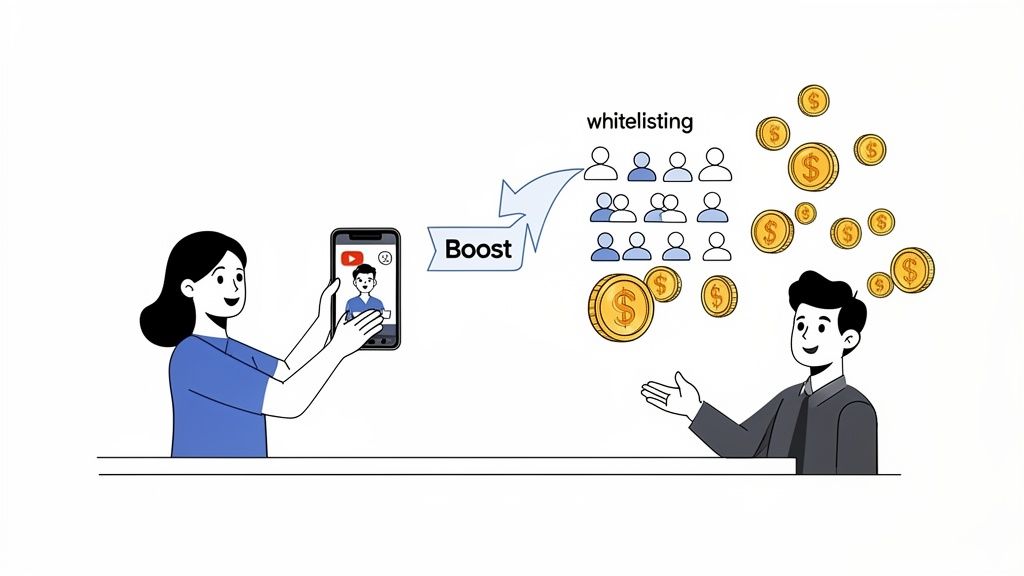
Imagine this: a creator your target audience already follows and loves posts an honest, fun video about your product. Normally, that’s great, but it only reaches their followers. But what if you put ad money behind that post?
Suddenly, that authentic stamp of approval is showing up in the feeds of thousands—or even millions—of new, perfectly targeted potential customers. This is the simple brilliance of influencer whitelisting, a cornerstone of any serious paid social marketing plan.
The Power of Influencer Whitelisting
So, what exactly is influencer whitelisting? It's when a creator gives a brand permission to advertise directly from their social media account. Your team gets to use their name and their content to run ads, but you control the budget and the targeting. This goes way beyond simply "boosting" a post.
It’s the best of both worlds, really:
- Real-Deal Authenticity: The ads come from a human, not a logo. People’s guards come down immediately, and trust goes way up.
- Massive Scale: You can take that creator’s content and push it to highly specific audiences you’ve built, reaching far beyond their organic follower count.
- Total Control & Optimization: You get all the backend ad data. This lets you A/B test everything—the creative, the headline, the call-to-action—to squeeze every drop of performance out of your budget.
When someone sees an ad from an influencer they already know and like, it doesn't feel like an ad. It feels like a genuine recommendation from a trusted source, almost like a tip from a friend.
This opens up a goldmine of high-performing creative that looks and feels completely natural on the platform. To get a more detailed breakdown of how it works, check out our guide on what is whitelisting.
Managing It All from One Place
Trying to manage whitelisting campaigns with a handful of creators can get messy fast. You're juggling contracts, content approvals, usage rights, payments, and tracking performance in a chaotic web of spreadsheets and email chains. It's a surefire way to make mistakes and let great opportunities slip through the cracks.
This is where a dedicated platform like REACH Influencers becomes a game-changer. It’s built to bring this entire messy process into a single, clean dashboard. From there, a brand or agency can:
- Find the Perfect Partners: Use the discovery tool to find creators whose audience and engagement metrics are a perfect match for your campaign goals.
- Handle the Paperwork: Manage contracts, usage rights, and payments smoothly, making sure everyone is on the same page and fully compliant.
- Approve the Creative: Review and sign off on all influencer-generated content before it goes live, ensuring it hits the mark for your brand.
- Track What Matters: See all the key metrics—clicks, conversions, ROAS—for every single whitelisted ad, all in one spot.
An approach like this cuts out the administrative headache and frees you up to think strategically about your paid social marketing. You can scale up your influencer work efficiently without losing control or visibility.
Connecting Influencer Ads Directly to Sales
The link between influencer content and paid social is becoming even more crucial as social commerce explodes. More and more, social platforms are becoming places where people don't just discover products—they buy them on the spot.
The numbers don't lie. By 2026, a full 26% of marketers plan to invest more heavily in direct social shopping tools like Instagram Shops. With social commerce sales expected to clear $1.08 trillion by 2028, tying your ad spend directly to sales is no longer a "nice-to-have."
Platforms like TikTok and Instagram are where people go to research products, and a huge chunk of Millennials are already buying things directly on Facebook. You can find more of these insights in this excellent HubSpot marketing statistics report.
This is where a platform like REACH really shines. It helps you find influencers whose followers are ready to buy, and then it gives you the tools to track every sale back to the source, proving your ROI in black and white.
Measuring What Matters and Optimizing for Growth
So, you’ve launched your campaigns. The ads are live. But how do you know if your paid social marketing is actually working? Likes and shares are nice, but they don’t pay the bills. To really get a handle on your campaign's performance, you have to look past those surface-level "vanity metrics" and focus on the numbers that drive your business forward.
Think of it like being the coach of a sports team. You don't just care about how many flashy plays your team makes; you care about the final score. In paid social, your final score is measured by Key Performance Indicators (KPIs) that connect your ad spend directly to real-world results.
The Metrics That Truly Matter
To prove the value of your ad budget, you need to track the metrics that show a clear return. These three are the gold standard for figuring out if your campaigns are a success.
Conversion Rate: This is the big one. It’s the percentage of people who click your ad and then take the specific action you wanted them to, like making a purchase or signing up for a demo. A high conversion rate is a great sign that your ad creative and your landing page are working together perfectly to persuade your audience.
Cost Per Acquisition (CPA): This number tells you exactly how much you're spending to land one new customer or lead. If you spend $100 on ads to get 10 new customers, your CPA is $10. The goal is to get this number as low as possible without sacrificing quality.
Return On Ad Spend (ROAS): This is the ultimate bottom-line metric. It shows you exactly how much revenue you’re generating for every single dollar you put into advertising. For example, a 3:1 ROAS means you’re making $3 in revenue for every $1 you spend. This is where you prove your worth.
Focusing on these three KPIs will give you an honest, clear-eyed view of your campaign's financial performance and tell you exactly where to focus your efforts.
A Cycle of Continuous Improvement
Optimization isn't something you do once and then forget about. It's an ongoing process of testing, learning, and refining your approach. The best paid social marketers are in a constant loop of improvement, using data to make their campaigns smarter and more effective over time.
The core of optimization is about being a detective, not a gambler. You aren't just trying random things and hoping they work. You're using data to form educated guesses, testing them scientifically, and then doubling down on what the evidence tells you.
Here's a simple framework you can follow to get into that rhythm:
- Analyze Your Data: Get in the habit of diving into your campaign reports. Look for patterns and outliers. Which ads have the lowest CPA? Which audiences are delivering the highest ROAS? The answers are in the data.
- Form a Hypothesis: Based on what you see, make an educated guess. For instance: "I think a video testimonial ad will perform better than our current static image ad because it feels more authentic and builds trust."
- Run an A/B Test: Put your hypothesis to the test. Run the new video ad against the old static image, showing both to the same audience. It's crucial to only change one variable at a time so you know exactly what caused the difference in performance.
- Scale What Works: Once the test has enough data, look at the results. If the video ad really did produce a lower CPA and a higher ROAS, it's time to pause the static image ad and shift more of your budget to the winning video.
By repeating this simple process, you start making decisions based on data, not just gut feelings. This is how you turn small insights into consistent growth and better results from your paid social marketing efforts.
Your Top Paid Social Questions, Answered
Jumping into paid social can feel like a big leap, but you're not the first to have questions. Let's tackle some of the most common ones we hear from brands who are just getting started.
What’s the Real Difference Between Paid and Organic Social?
Think of your organic social media as a conversation with your current friends and followers. You’re building a community and nurturing relationships with people who already know you. The reach is often limited, but the trust is high.
Paid social marketing, on the other hand, is like buying a primetime ad slot. You pay to get your message in front of a massive, specific audience that goes far beyond your follower list. It’s all about guaranteeing visibility and pushing for clear goals, like driving traffic or making sales.
How Much Should a Small Business Really Spend?
This is the big one, and there’s no single right answer. But the good news? You don't need a huge budget to see what works.
Most businesses can get their feet wet with a small, focused budget of just $10-$20 per day on one platform. The goal isn't to spend a lot upfront; it's to test a single objective, carefully watch your Return On Ad Spend (ROAS), and only increase your budget once you've found a winning combination.
So, How Do I Actually Start My First Campaign?
Getting your first campaign live is simpler than you think. Don't try to do everything at once.
Just follow these steps:
- Pick one goal. Are you trying to get your name out there, send people to your site, or generate leads? Choose one.
- Choose one platform. Go where your audience lives. Don't spread yourself thin across Facebook, Instagram, and TikTok from day one.
- Build a basic audience. Start with simple demographic and interest targeting. You can get more complex later.
- Use a proven winner. Got an organic post that people loved? Boost that. You already know the content works.
- Start with a small daily budget. This lets you learn the ropes without risking a ton of cash on a strategy you haven't validated yet.
Mastering paid social marketing is about combining smart strategy, authentic content, and data-driven optimization. When you weave influencer content into your campaigns, you create ads that don't just reach people—they resonate. Ready to take your paid social ads to the next level with influencer content that people actually trust? REACH is the all-in-one platform for finding creators, running campaigns, and tracking every dollar. See how we can amplify your strategy.