 Skip to content


Figuring out the ROI of influencer marketing comes down to one simple question: for every dollar you spend, how many dollars do you get back? Think of it as the ultimate scorecard for your campaigns. It cuts through the fluff of likes and shares to give you a hard number that proves your strategy's value.
A positive ROI means your strategy is making money. A negative one is a clear sign that something needs to change.
But tracking this can feel chaotic, with data scattered across social platforms, payment systems, and spreadsheets. This guide is here to fix that. We'll walk you through a clear, step-by-step process to take the mystery out of measuring your returns. And with a powerful platform like REACH Influencers, you can automate this entire process, giving you the real-time data needed to optimize campaigns and justify your budget with confidence.
Table of Contents
- What Is Influencer Marketing ROI and Why Does It Matter?
- Understanding the Core Metrics for Calculating ROI of Influencer Marketing
- How to Calculate Your Campaign ROI Step by Step
- Choosing the Right Attribution Model for Your Goals
- How to Maximize Your ROI of Influencer Marketing
- How REACH Proves Your Influencer Marketing ROI
- Common Questions About Influencer ROI
What Is Influencer Marketing ROI and Why Does It Matter?
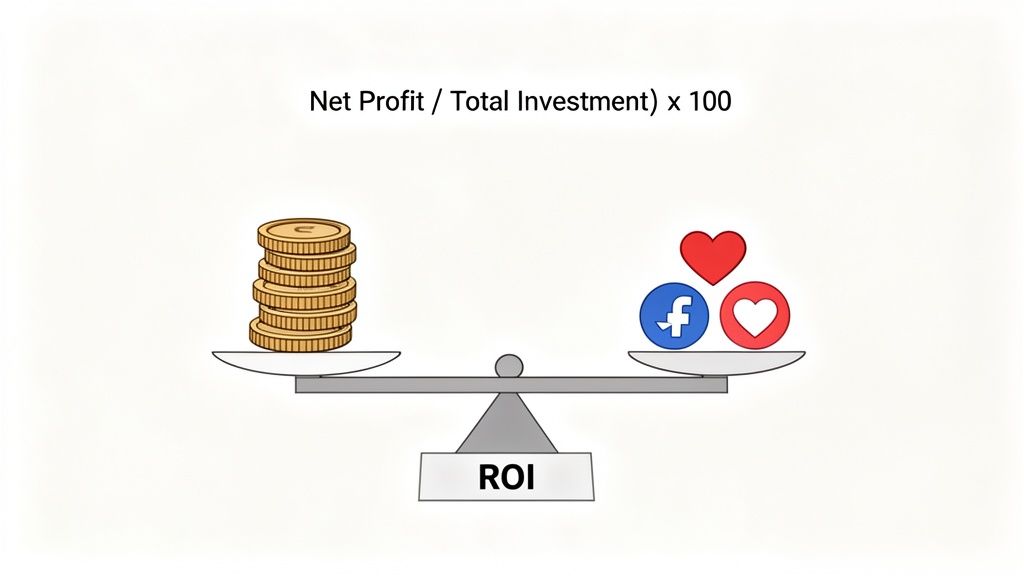
At its heart, the ROI of influencer marketing is a straightforward financial metric. It tells you exactly how much profit your campaign pulled in compared to what it cost to run. This single number answers the one question that really matters to your boss or CFO: "Was this investment worth it?"
So many brands get tripped up here because trying to connect an influencer's post to an actual sale feels messy. You've got data scattered across different social platforms, payment records in another system, and sales figures in a spreadsheet. It’s tough to draw a straight line from A to B.
This guide is here to fix that. We'll walk you through a clear, step-by-step process to take the mystery out of it.
The Basic Formula for ROI
The standard formula for calculating ROI is refreshingly simple. Here it is:
ROI = [(Net Profit from Campaign – Total Campaign Investment) / Total Campaign Investment] x 100
Let's unpack that. Your investment is every single penny you spent—influencer fees, the cost of sending them products, even the hours your team put in. The net profit is the revenue that came directly from the campaign, after you subtract all those costs. The final number gives you a clean percentage.
For instance, say you spend $5,000 on a campaign and it brings in $20,000 in sales. Your net profit is $15,000. Do the math, and your ROI is a whopping 300%.
Why Tracking ROI Is Non-Negotiable
If you aren't tracking your returns, you're just throwing money at the wall and hoping something sticks. You have to measure the ROI of influencer marketing. It’s not optional. Here’s why:
- Justifying Your Budget: Hard data silences the skeptics. When you can show a clear return, getting that budget approved for next quarter becomes a much easier conversation.
- Optimizing Future Campaigns: Once you know which influencers, platforms, and post formats drive the best results, you can double down on what works and cut what doesn't.
- Identifying Top Performers: ROI numbers don't lie. They shine a spotlight on which influencer partnerships are the most profitable, helping you nurture those high-value, long-term relationships.
- Proving Marketing's Value: This is how you connect your team's work directly to the company's bottom line. It transforms the marketing department from a cost center into a legitimate revenue driver. For a closer look, check out our guide on calculating social media ROI.
This is exactly the problem a platform like REACH Influencers was designed to solve. It brings everything—influencer discovery, campaign management, payments, and analytics—under one roof. This gives you an accurate, real-time view of your performance from the get-go, making the ROI of influencer marketing easier to prove than ever before. You get to focus on strategy, not spreadsheets.
Understanding the Core Metrics for Calculating ROI of Influencer Marketing

To get a real handle on your influencer marketing ROI, you have to know what you're measuring. Think of it like a recipe: you need a precise list of ingredients (your costs) and a clear way to measure the final result (your returns).
If you miss an ingredient, the whole thing can be a flop. That's where a lot of brands stumble. They'll track the obvious stuff, like how much they paid an influencer, but completely forget about all the "hidden" costs. On the other side of the coin, they might only count direct sales, ignoring a ton of other valuable outcomes.
Let’s break down both sides of this equation so you can get a full, honest picture.
Pinpointing Your Total Campaign Investment
Your total investment is every single dollar you put into a campaign, plus the value of the resources you use. To get this right, you have to look past the influencer’s check and account for everything it took to make the campaign happen.
Here are the main costs you need to tally up:
- Direct Influencer Compensation: This one’s the most straightforward. It’s what you pay the creator, whether it’s a flat fee for posts and stories or a commission on affiliate sales.
- Product Seeding Costs: Don't forget the value of the free products you send out! You should calculate this based on your Cost of Goods Sold (COGS), not the retail price, and be sure to add in any shipping expenses.
- Platform and Tool Subscriptions: Using an influencer platform like REACH Influencers to find creators, manage your workflow, and track results? The cost of that subscription is a key part of your investment.
- Internal Team Hours: Time is money. You need to track the hours your team spends on influencer outreach, negotiations, content approvals, and reporting. Just multiply those hours by their hourly rate to get a true dollar figure.
- Content Production and Ad Spend: Did you hire a video editor or put money behind the influencer’s post to boost its reach? These are direct campaign costs and need to be included in your total investment.
Measuring Your Total Campaign Return
Once you’ve got a firm grip on your costs, it's time for the fun part: measuring what you got back. This isn't just about direct sales; it’s about every positive outcome that helps your business grow.
This is where things get exciting. On average, brands see a return of $5.78 for every $1 spent on influencer marketing, with some campaigns pulling in an incredible $18 for every dollar.
To see where you stand, you’ll need to track these key return metrics:
- Direct Revenue from Sales: This is the easiest return to measure. Use unique discount codes, custom UTM links, and affiliate links to track every sale that comes directly from your campaign.
- Value of New Leads: Not every conversion is a sale right away. Your campaign might bring in hundreds of new email signups or trial users. You can assign a dollar value to each lead based on how many typically convert into paying customers down the line.
- Earned Media Value (EMV): Think of EMV as a way to put a price tag on buzz. It estimates what you would have paid in traditional advertising to get the same level of exposure and engagement your campaign generated organically.
- Value of Influencer-Generated Content (IGC): The photos and videos influencers create are valuable assets. You can repurpose this content on your own social media, in ads, or on your website, saving you a small fortune on creative production costs. To understand the potential returns here, especially on Instagram, it's helpful to know how much Instagram pays for Reels and what brands are willing to pay for that content.
To give you a clearer view, here’s a quick rundown of the metrics you should be tracking on both sides of the ROI equation.
Key Metrics for Calculating Influencer Marketing ROI
A breakdown of the essential cost and return metrics to track for a comprehensive ROI calculation.
| Metric Category | Specific Metric | How to Track It |
|---|---|---|
| Investment | Influencer Fees | Flat fees, commission rates, or product trade value outlined in your contract. |
| (Costs) | Product Seeding (COGS) | (Cost of Goods + Shipping) x Number of Influencers. |
| Team Hours | Employee hourly wage x Hours spent on the campaign. | |
| Platform/Tool Fees | The monthly or annual subscription cost of your influencer marketing software. | |
| Ad Spend | The budget allocated to boosting or promoting influencer content. | |
| Return | Revenue from Sales | Sales data from unique discount codes, affiliate links, and UTM parameters. |
| (Gains) | Value of New Leads | (Number of New Leads) x (Your Average Lead-to-Customer Conversion Rate). |
| Earned Media Value (EMV) | Use a platform or formula to calculate the value of impressions, engagement, and reach. | |
| Value of IGC | The estimated cost you would have paid to produce that content in-house or with an agency. |
By meticulously tracking both your investments and returns, you build a solid foundation for calculating a truly meaningful ROI. This isn't just about proving a campaign worked; it's about gaining the insights you need to make every future campaign even more successful.
How to Calculate Your Campaign ROI Step by Step
Okay, so we've got all the pieces of the puzzle—your investments and your returns. Now it's time to put them together. Figuring out your influencer marketing ROI isn’t nearly as complicated as it might seem. The best way to get a feel for it is to walk through a real-world example from start to finish.
Let's imagine a direct-to-consumer skincare brand called 'Glow Up'. They’re launching a new vitamin C serum and decide to partner with a handful of micro-influencers who are known for their authentic, results-driven beauty content. Their main goal? Drive sales and see a direct impact from their spending.
We'll break down how they do it in three simple, manageable steps.
Step 1: Tallying All Campaign Investments
First things first, Glow Up needs a crystal-clear picture of every single dollar they spent on this campaign. Getting this right is critical—if you underestimate your costs, you’ll end up with a wildly inflated ROI that doesn't reflect reality. This goes way beyond just the fees you pay the influencers.
Here’s a realistic breakdown of their total investment:
- Influencer Fees: They partnered with five micro-influencers, paying each a flat fee of $1,000 to create one Instagram Reel and three Stories. That’s a total of $5,000.
- Product Costs: Each influencer got the new serum plus a supporting skincare kit. The Cost of Goods Sold (COGS) for each kit was $100. So, that's another $500.
- Platform Subscription: Glow Up uses the REACH Influencers platform to find creators, manage the campaign, and track everything. Their monthly subscription fee is $200.
Add it all up, and Glow Up has their total campaign investment.
Total Investment = $5,000 (Fees) + $500 (Product Costs) + $200 (Platform Fee) = $5,700
That number, $5,700, is the "I" in their ROI formula. It's the complete, honest cost of getting the campaign up and running.
Step 2: Measuring All Campaign Returns
With their total investment locked in, Glow Up’s next step is to measure what they got back. This means tracking direct revenue, of course, but also looking at other valuable outcomes that contribute to their bottom line. For this campaign, they zeroed in on sales and the media value generated by the content.
Here’s how they measured their returns:
- Direct Sales from Promo Codes: Each influencer shared a unique 15% off discount code. By tracking every sale made with those codes, Glow Up could directly attribute $15,000 in revenue to the campaign.
- Earned Media Value (EMV): The campaign generated a lot more than just sales—it created real buzz. Using the analytics inside REACH Influencers, they calculated the EMV from all the organic engagement and reach, which came out to $2,000.
Adding these two together gives Glow Up their total return.
Total Return = $15,000 (Direct Sales) + $2,000 (EMV) = $17,000
This $17,000 figure represents the total value the campaign produced, mixing hard sales with the powerful (but softer) value of brand exposure.
Step 3: Applying the ROI Formula
Now for the easy part. With both investment and return figures ready, all that’s left is to plug them into the ROI formula we talked about earlier. This will give Glow Up a simple, clear percentage that proves the campaign's performance.
The formula is: [(Total Return – Total Investment) / Total Investment] x 100
Let's run Glow Up's numbers:
- Subtract Investment from Return: $17,000 – $5,700 = $11,300 (This is their net profit).
- Divide Net Profit by Investment: $11,300 / $5,700 = 1.982.
- Multiply by 100 to get the percentage: 1.982 x 100 = 198.2%.
The final result is a 198% ROI. In plain English, for every dollar Glow Up invested, they earned $1.98 back in profit.
This kind of data-driven approach, made much simpler with a platform to automate the tracking, completely changes the conversation. It moves you from asking, "Did the campaign work?" to "How can we scale these incredible results?"
This example shows just how straightforward calculating influencer ROI can be. While you could technically track all this in a spreadsheet, platforms like REACH Influencers do the heavy lifting for you. If you want to play around with your own numbers, you can use our free influencer ROI calculator to estimate potential returns. And for a wider view on proving marketing value, you can also explore how to measure marketing ROI across all of your different channels.
Choosing the Right Attribution Model for Your Goals
So, how do you know exactly which influencer drove a sale? This is one of the trickiest parts of proving the ROI of influencer marketing. That’s where attribution models come in.
Think of it like a soccer team. Does only the person who kicked the goal get the credit? Or do you also give a nod to the players who passed the ball and set up the shot? Attribution models are just the rules you use to decide who gets credit for the win—or in this case, the conversion.
Picking the right model is crucial because it directly shapes how you see an influencer's performance. If you get it wrong, you might end up undervaluing some of your most important players.
This flowchart maps out the basic decision-making process for calculating ROI, a process that attribution models bring much-needed clarity to.
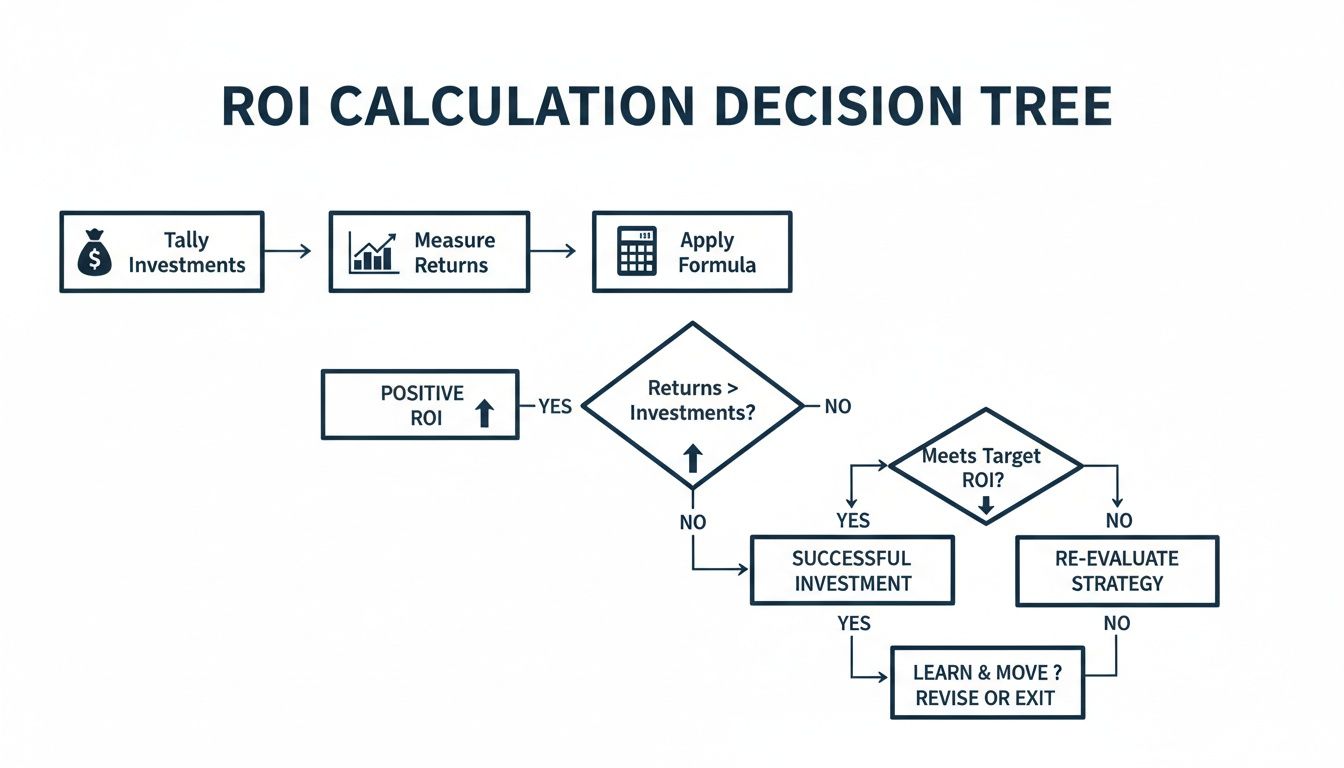
As you can see, measuring ROI isn't just one step. It's a structured flow, and attribution is a key piece of that puzzle.
Understanding Common Attribution Models
There are a few different ways to slice this pie, but most brands lean on a handful of tried-and-true models. Each one tells a slightly different story and works best for different campaign goals. Let's break down the most common ones.
-
First-Touch Attribution: This model gives 100% of the credit to the very first influencer a customer saw. It’s a fantastic choice for campaigns all about brand awareness and discovery because it highlights the creators who are bringing fresh eyes to your brand.
-
Last-Touch Attribution: The complete opposite of first-touch, this model gives 100% of the credit to the final influencer someone engaged with right before buying. It’s the easiest model to track and is perfect for campaigns laser-focused on driving immediate sales.
-
Multi-Touch Attribution: This is where things get more sophisticated. Instead of an all-or-nothing approach, multi-touch splits the credit across several influencers in the customer's journey. A linear model, for instance, gives equal credit to everyone involved. A time-decay model gives more weight to the interactions that happened closer to the sale.
The right attribution model connects the dots between what an influencer does and what your business gets out of it. Without one, you're only seeing a sliver of the full picture and could easily misjudge an influencer's true impact.
How to Select the Best Model for Your Campaign
So, which model is best? The answer depends entirely on your goals. There’s no one-size-fits-all solution here; it's all about matching your measurement strategy to your campaign objectives.
For example, a brand launching a new product line might use a first-touch model to identify which influencers are best at creating that initial buzz. Later on, when they run a big holiday sale, they could switch to a last-touch model to see who’s actually closing the deals. To get a holistic view of how influencers work alongside your other marketing efforts, you can explore the world of cross-channel marketing attribution.
This is where a platform like REACH Influencers can make your life a whole lot easier. With built-in tracking links and conversion analytics, you can test different models without drowning in spreadsheets. It helps you see a clearer, more accurate picture of what each influencer brings to the table, so you can make smarter investment decisions and confidently prove the ROI of influencer marketing.
How to Maximize Your ROI of Influencer Marketing
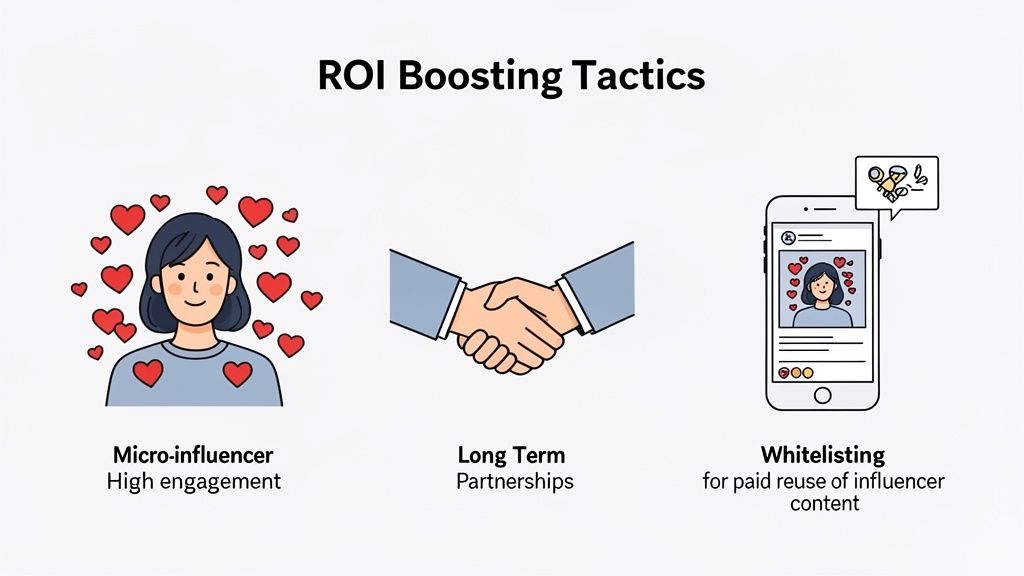
Figuring out your ROI of influencer marketing is a huge win, but it’s not the end of the game. The real magic happens when you take what you've learned and use it to make your next campaign even better. This isn't a one-and-done deal; it's a constant process of tweaking and refining your strategy based on what the data is telling you.
The good news? You don't need to throw more money at your campaigns to see bigger returns. It’s about making smarter choices—who you partner with, how you work together, and what you do with their content after it’s posted.
Let's break down some of the most effective tactics to get more bang for your buck.
Prioritize Micro-Influencers for Higher Engagement
When it comes to influencers, bigger isn't always better. It sounds a bit backward, I know. While celebrities and mega-influencers have massive follower counts, their audiences are often so broad that engagement drops off.
On the flip side, micro-influencers have smaller but incredibly dedicated communities built around very specific interests.
This tight-knit following leads to higher trust and, you guessed it, a much better return on your investment. Their recommendations come across less like a polished ad and more like a tip from a good friend. That authenticity is gold when it comes to driving actual sales.
In fact, the numbers back this up. Micro-influencers consistently deliver a better ROI of influencer marketing, with some studies showing returns between 8:1 to 12:1. Compare that to the typical 2:1 or 3:1 return for mega-influencers, and the choice becomes pretty clear. You can discover more insights about these ROI trends and see how different influencer tiers perform.
Of course, finding these high-impact creators can feel like searching for a needle in a haystack. This is exactly where a platform like REACH Influencers shines. Its discovery tools let you zero in on creators based on their niche, engagement rates, and audience demographics, making it easy to find the perfect micro-influencers for your brand.
Build Long-Term Ambassador Programs
One-off sponsored posts can give you a nice, temporary bump in traffic or sales, but they rarely build true brand loyalty. That’s why the smartest brands are moving away from short-term campaigns and toward long-term partnerships. When you build an ambassador program, you’re not just hiring an influencer; you’re creating a genuine brand advocate.
These ongoing relationships boost your ROI in a few key ways:
- Deeper Authenticity: When an influencer features your brand over and over, their audience starts to see it as a natural fit for their lifestyle, not just another #ad.
- Increased Trust: Consistency builds credibility. The audience starts to associate your brand with an influencer they already look up to.
- Cost-Effectiveness: It's often cheaper to negotiate a long-term contract than to pay for several individual posts, giving you more content and exposure for your money.
Long-term partnerships transform influencers from hired spokespeople into integral members of your marketing team. This sustained advocacy creates a powerful compounding effect on your brand's growth and profitability.
Managing these relationships can get messy, with all the contracts, payments, and content approvals. The REACH platform streamlines this whole process, giving you a central dashboard to manage everything. This lets you focus on building strong relationships instead of drowning in admin work.
Whitelist Influencer Content for Paid Ads
One of the most powerful, yet often overlooked, strategies for boosting ROI is whitelisting. Simply put, this means you get permission from an influencer to run their content as a paid ad directly from their social media account, targeting a new, relevant audience.
This tactic is a powerful hybrid, combining the raw authenticity of influencer content with the laser-focused targeting of paid social ads.
The results can be incredible. Ads that look like organic posts from a trusted creator perform worlds better than a typical corporate ad. They stop the scroll, feel natural in the feed, and cut through the ad fatigue we all feel.
Here’s why whitelisting is a game-changer for your ROI:
- Lower Customer Acquisition Cost (CAC): These ads get way more clicks and engagement, which means your cost to acquire a new customer often plummets.
- Increased Conversion Rates: The built-in social proof of an influencer endorsing your product gives people the confidence to click "buy."
- Extended Content Lifespan: You get to squeeze every last drop of value out of your best-performing content, putting it in front of new eyes long after its organic buzz has faded.
By weaving these three strategies into your plan—focusing on micro-influencers, building lasting partnerships, and whitelisting your best content—you can systematically drive up your ROI of influencer marketing and turn your campaigns into reliable revenue machines.
How REACH Proves Your Influencer Marketing ROI
Trying to calculate the ROI of influencer marketing can feel like you're trying to solve a puzzle with pieces scattered all over the room. You're constantly jumping between social media insights, payment records, and sales data, and getting a clear picture feels almost impossible. This is exactly why a dedicated platform isn't just a nice-to-have—it's what turns a chaotic process into a smart, data-backed strategy.
REACH Influencers was designed to fix these very problems. Forget about tracking everything in messy spreadsheets. Our platform brings every moving part of your campaign into one place, so you can stop guessing and start knowing what's actually driving results.
By unifying your data, REACH gives you the clarity to measure your campaign's value and, more importantly, prove it.
Centralized Analytics and Automated Tracking
One of the biggest headaches in proving ROI is just getting all your data organized. The REACH dashboard pulls in all your campaign analytics in real-time, so you can see what’s happening as it happens.
This automated system gets rid of the manual data entry that leads to human error and eats up your team's valuable time. Instead, you get a live, accurate view of how your campaigns are performing at any given moment.
- Real-Time Dashboards: Instantly see crucial metrics like engagement, clicks, and conversions without any delay.
- Automated Link Tracking: We automatically create unique tracking links for every influencer, making it dead simple to attribute sales and leads directly back to their content.
With this kind of automation, you can finally stop wasting time collecting data and start spending your time acting on it.
When all your data lives in one place, every decision you make is grounded in solid evidence. You can spot your top-performing influencers and content instantly, allowing you to fine-tune your strategy on the fly and push your ROI of influencer marketing even higher.
Stakeholder-Ready Reporting and Budget Justification
Getting buy-in from leadership takes more than just throwing numbers at them; you need to tell a clear and convincing story. REACH builds professional, easy-to-digest reports that spell out the financial impact of your campaigns.
These reports are designed to be shared directly with stakeholders. They translate complex performance metrics into tangible business outcomes that don't just justify your budget but also showcase the incredible work your team is doing.
For instance, a D2C beauty brand recently used REACH reports to show a 250% ROI on their latest product launch. The clean, visual data didn't just prove the campaign was a home run—it gave them the hard evidence they needed to secure a 50% budget increase for the next quarter.
That's what happens when you turn raw data into a powerful narrative. By making the whole process simpler, REACH turns proving your ROI of influencer marketing from a constant struggle into one of your biggest strengths.
Common Questions About Influencer ROI
Even with the best strategy laid out, you're bound to have some questions once you start digging into the actual numbers. Let's tackle some of the most common ones that pop up when it's time to prove your campaign's worth.
What Is a Good ROI for Influencer Marketing?
While "good" can feel subjective, the industry has some solid benchmarks. Most brands are thrilled to see a $5 to $6 return for every $1 spent. That’s a great target to shoot for.
That said, high-performing campaigns, especially those that tap into the power of micro-influencers, can blow that out of the water, sometimes reaching returns of $18 or more. At the end of the day, anything over a 1:1 return means you're in the black, but that 5:1 ratio is a healthy and achievable goal.
How Long Does It Take to See ROI?
This really boils down to what you’re trying to achieve. The timeline for seeing a return is completely tied to your campaign goals.
- For awareness campaigns: You can see an impact almost immediately. Metrics like reach and impressions will spike within days—sometimes hours—of an influencer's post going live.
- For conversion campaigns: Be patient. Sales-focused efforts usually take longer to mature, often somewhere between 4 to 12 weeks. Think about it—your audience needs time to move from seeing a product to actually pulling out their wallet. This is why long-term partnerships often deliver the most consistent and sustainable ROI over time.
Which Platform Has the Highest Influencer ROI?
Instagram has been the king for a long time, but the data is pretty clear: TikTok currently delivers the highest ROI.
Its algorithm is a powerhouse for matching authentic content with hyper-engaged audiences. This often translates into better conversion rates and a lower cost to acquire new customers. Of course, the best platform is always the one where your target audience actually hangs out.
How Do You Track Sales from an Influencer?
Guesswork won't cut it. The most reliable method is using tools built specifically for attribution.
By giving each influencer unique UTM links, custom discount codes, or affiliate links, you can trace every single click and purchase directly back to the source. It’s like giving each one their own digital fingerprint. An influencer platform like REACH automates this whole process, making sure every conversion is accurately tallied up for your final ROI of influencer marketing calculation.
Ready to stop guessing and start proving the value of your campaigns? REACH Influencers provides the centralized dashboard, automated tracking, and professional reporting you need to measure and maximize your ROI of influencer marketing with confidence. Schedule your demo today and see how our platform can transform your strategy.