 Skip to content


Does your day-to-day feel like you're drowning in a sea of spreadsheets, endless email threads, and a dozen different Slack channels? If that sounds familiar, you're not alone. For a growing agency, this chaotic patchwork of tools is often the default way of managing client work. While it might get the job done at first, it doesn't take long before it becomes a major roadblock, hurting your profits, creating unnecessary friction with clients, and making it impossible to scale effectively. This guide will explore how the right agency client management software can transform your operations.
Platforms like REACH are built from the ground up to solve these exact problems by creating a seamless link between agencies, brands, and creators, especially in the influencer marketing space. By centralizing everything—from influencer discovery and outreach to content approvals and real-time performance tracking—you can replace manual grunt work and streamline your entire workflow. This unified approach ensures every campaign is executed flawlessly and proves its value to your clients with clear, undeniable ROI.
Why Spreadsheets Are Holding Your Agency Back
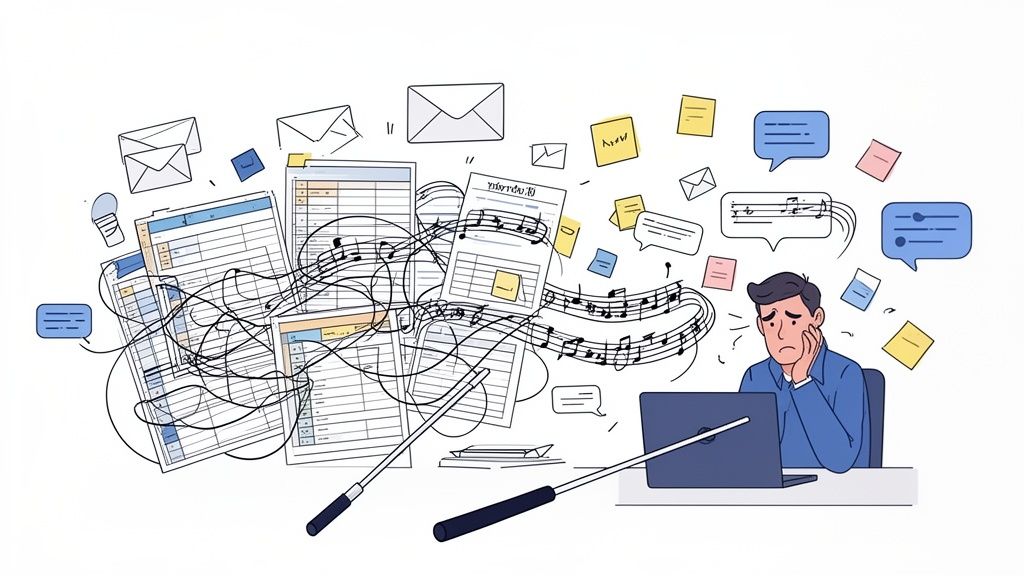
When your agency's operations are all over the place, you're not really running a business—you're just juggling tasks. It's like trying to lead an orchestra without a conductor. You’ve got talented musicians (your team), a brilliant score (your client’s goals), and an eager audience (your client). But without someone to unify their efforts, you just get noise instead of harmony. Everyone is playing their part, but the timing is off, cues are missed, and the final performance is a letdown.
That's exactly what happens when you rely on a dozen different tools. Budgets are tracked in one spreadsheet, critical client feedback is buried in an email chain, and project updates are scattered across countless Slack messages. There's no single source of truth, which breeds inefficiency and opens the door to costly mistakes.
The Hidden Costs of Manual Management
Sticking with outdated methods isn't just inefficient; it's actively costing you money and damaging client relationships. And as you try to scale, these problems only get worse, making it nearly impossible to deliver high-quality work consistently.
Here are the big issues you're probably facing:
- Wasted Billable Hours: Your team burns precious time just trying to find information, manually update trackers, or cross-reference data. That’s time they should be spending on creative, strategic work that actually moves the needle for clients.
- Increased Risk of Errors: When you're manually entering data across multiple documents, mistakes are inevitable. A single typo in a budget sheet or a missed approval email can throw an entire project off course and erode the trust you've built.
- Lack of Real-Time Visibility: Spreadsheets are snapshots in time. They can’t give you a live look at project progress, budget burn, or team availability, which makes it incredibly difficult to make smart, proactive decisions.
- Poor Client Experience: Nothing kills client confidence faster than having to chase you for updates or getting reports with inconsistent numbers. A clunky, disorganized process makes your whole agency look unprofessional.
The Shift to a Centralized System
This is where agency client management software comes in. Think of it as the conductor your operational orchestra has been missing. It brings all your communication, project tracking, approvals, and reporting into one unified system. A dedicated platform finally replaces the chaos with clarity, giving you a central hub where your team and your clients can all work in perfect sync.
A purpose-built platform doesn't just organize tasks; it creates a predictable, scalable, and professional framework for delivering exceptional client work, turning operational efficiency into a competitive advantage.
For specialized niches like influencer marketing, this shift is even more critical. Platforms such as REACH solve these problems by centralizing everything from influencer contracts to campaign analytics. By replacing manual grunt work, you can streamline your entire workflow. You can learn more about how to boost productivity with our guide to marketing automation for agencies. This unified approach ensures every campaign is executed flawlessly and proves its value with clear, undeniable ROI.
A Look Under The Hood: Core Features of Agency Client Management Software
To really get what makes agency client management software so valuable, you have to see it as more than just a digital tool. Think of it less like a filing cabinet and more like an interconnected ecosystem designed to bring order to the chaos of agency life. Each feature is built to solve a specific, real-world headache that agencies deal with every single day.
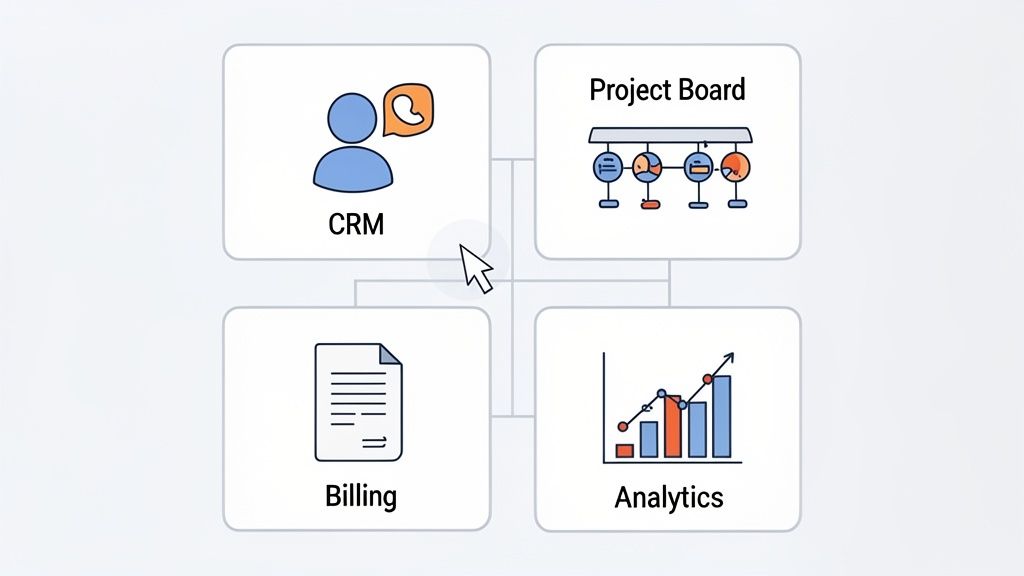
Let's pull back the curtain on the core components that make this software a must-have. Once you see how they work together, you'll understand how the right platform can completely change how your agency runs.
So, what are these essential features, and what problems do they actually solve? This table gives a quick overview of the core functions that turn a chaotic agency environment into a smooth, predictable operation.
| Feature | Core Function | Problem It Solves for Agencies |
|---|---|---|
| Unified CRM | Centralizes all client and contact information, communication history, and contracts. | Stops the frantic search for client details across emails, spreadsheets, and notes. |
| Project Dashboards | Provides a real-time, visual overview of all tasks, milestones, and campaign progress. | Replaces confusing spreadsheets with clear, actionable insights into project health. |
| Automated Billing | Connects project work, time tracking, and expenses directly to invoicing. | Eliminates lost revenue from unbilled hours and drastically cuts down on admin time. |
| Analytics & Reporting | Aggregates campaign data and generates professional, easy-to-understand performance reports. | Proves your agency's value and ROI to clients without spending days building reports. |
| Approval Workflows | Creates a streamlined, trackable process for clients to review and approve creative assets. | Ends the back-and-forth email chains and "he said, she said" confusion over feedback. |
| White-Labeling | Allows agencies to brand the client portal with their own logo and colors. | Delivers a professional, cohesive brand experience that builds client trust and loyalty. |
| Security & Permissions | Controls which team members and clients can access specific information or features. | Protects sensitive client data and ensures everyone only sees what they need to see. |
These features aren't just a random collection of tools; they are a thoughtfully designed system. Let's dig a little deeper into how each one works in the real world.
A Unified CRM for Clients and Creators
At the end of the day, an agency is all about its relationships. A built-in Customer Relationship Management (CRM) system acts as the single source of truth for every client, prospect, and even your creative partners or influencers. It’s so much more than a contact list—it’s your agency’s relationship brain.
This is where you keep every email, note, contract, and bit of historical data in one easy-to-find place. No more digging through ancient email threads to remember what a client asked for three months ago. Your whole team gets a complete, 360-degree view.
This isn't just an agency trend; it's a massive shift in business. The CRM market was valued at USD 40.2 billion in 2023 and is expected to hit nearly USD 107.07 billion by 2032. With North America making up about 43.6% of that market, it’s clear that businesses expect this level of data-driven partnership from their agencies.
Interactive Project and Campaign Dashboards
Let's be honest: static spreadsheets and never-ending to-do lists are terrible for managing complex projects. Modern agency software throws them out in favor of dynamic, interactive dashboards that give you a live look at every single campaign.
It’s basically your agency's mission control. Using visual tools like Gantt charts and Kanban boards, these dashboards show you exactly where every project stands at a glance. This clarity helps you:
- Spot Bottlenecks: Instantly see which tasks are stuck or where a team member is overloaded, so you can step in before things go off the rails.
- Track Milestones: Keep an eye on key deadlines and deliverables to make sure campaigns stay on track and on budget.
- Improve Collaboration: Everyone can see how their piece of the puzzle fits into the bigger picture, which naturally leads to better teamwork.
For a specialized agency, these dashboards are even more essential. In a platform like REACH, for example, the campaign dashboard pulls together influencer outreach, content approvals, and live performance data into one shared workspace for everyone involved.
Automated Billing and Payments
Keeping your agency’s finances healthy is priority number one, but manual invoicing is a slow, error-prone nightmare. That’s why a core feature of any good platform is integrated billing and payment automation, tying the work you do directly to your revenue.
By linking time tracking and project milestones straight to your invoicing system, you can create perfectly accurate invoices in just a few clicks. This simple change stops revenue from slipping through the cracks and frees up your team from mind-numbing administrative work.
Automating the billing cycle does more than just save time—it accelerates your cash flow, reduces payment disputes, and instills client confidence through professional, transparent financial processes.
Many platforms also connect to payment gateways like Stripe or PayPal, letting clients pay their invoices online instantly. It’s a small touch that not only makes their life easier but also gets you paid faster, bringing much-needed stability to your cash flow.
Advanced Reporting and Analytics
Proving your worth is how you keep clients around for the long haul. The best agency management platforms come with powerful analytics and reporting tools that transform raw data into a compelling story of success. Forget about pulling metrics from a dozen different sources; the software does it all for you.
This means you can generate polished, branded reports that highlight campaign performance, ROI, and key wins without wasting hours in spreadsheets. For instance, REACH’s platform provides real-time click tracking and conversion data, allowing agencies to build live reports that show stakeholders a clear return on their investment and justify every dollar spent.
Some advanced platforms go even further, integrating specialized tools like the top online reputation management software solutions to give you a truly complete picture of your impact on a client’s brand.
What You Really Gain from a Centralized Platform
Looking past a simple list of features, you start to see the real magic of agency client management software. It’s not about the tools themselves, but what they empower your agency to actually do. Having everything in one place is the difference between just surviving the daily chaos and building a business that’s scalable, profitable, and genuinely respected. The improvements ripple out to everyone, transforming how your team works and how your clients see you.
For an agency, the biggest win is a massive jump in efficiency. When your team isn't digging through different apps, spreadsheets, and email chains to find what they need, they can spend that time on strategic work that actually moves the needle. That shift goes straight to your bottom line.
Supercharge Your Agency's Efficiency and Profitability
A unified system does more than just get you organized; it unlocks a level of productivity that's simply out of reach when you're juggling a patchwork of different tools. By linking your projects, people, and payments together, you create a smooth, predictable engine for your business.
Here’s what that looks like in practice:
- Slash Administrative Work: Think about all the time spent on generating reports, creating invoices, and sending follow-up emails. Automating these tasks frees up your best people to focus on client results, not paperwork.
- Smarter Resource Planning: When you have a bird's-eye view of every project and who’s working on what, you can assign tasks more effectively. This helps you prevent team burnout and make sure every project has the right people on it.
- Get Paid Faster: With billing and payments built right in, you can send out accurate invoices in a few clicks and get that cash in the door quicker. That kind of financial stability is the foundation for growth.
- Know Your True Profitability: By tracking time and expenses for each project, you finally get a clear picture of which clients and services make you the most money. This lets you make much smarter decisions about where to focus your efforts.
The market is already signaling how important this is. Between 2024 and 2032, the global agency management software market is expected to jump from USD 3.4 billion to USD 6.1 billion, growing at a rate of 7.5% each year. This isn't just a trend; it's a response to a real need. Agencies are tired of disjointed spreadsheets and are pushing to centralize their data, automate their work, and prove their value with hard numbers.
Deliver an Unforgettable Client Experience
While the internal boosts are huge, the effect on your clients is just as powerful. A central platform gives you a way to offer transparency and professionalism that builds rock-solid trust, turning one-off clients into dedicated long-term partners.
A great client experience isn't an accident. It's the direct result of a well-designed, transparent, and collaborative process. Centralized software provides the framework to deliver that experience every single time.
For clients, the benefits are immediate. They get a clean, professional experience that reminds them of the value you're providing at every step. For any agency looking to grow, getting a handle on the basics of client relationship management (CRM) is the first step toward using this kind of specialized software effectively.
This is where a platform like REACH really comes into its own. It offers a single dashboard for influencer marketing campaigns, giving clients a live look at their investment. They can see how influencers are progressing, approve content as it comes in, and watch performance metrics update in real-time.
On top of that, REACH’s white-labeling features let you wrap this entire experience in your own branding. The client portal shows your logo and colors, creating a seamless, professional space that feels like it was built just for them. This blend of radical transparency and branded polish doesn't just impress clients—it makes your agency an essential part of their success.
How to Choose the Right Agency Client Management Software
Picking the right agency client management software isn't just a purchase; it's more like bringing on a new business partner. It's easy to get wowed by flashy features in a quick demo, but a structured evaluation is what really tells you if a tool will fuel your growth or just create new headaches down the road.
This is a strategic investment, not just a new app for the team. And it’s a big decision, especially when you consider the business software market is expected to rocket from USD 721.14 billion in 2026 to a staggering USD 1,523.46 billion by 2034. With so much of that growth centered on customer and marketing tools, the pressure to get it right is real.
Taking a methodical approach is the best way to avoid that dreaded buyer's remorse and make sure your team, your clients, and your bottom line all come out ahead.
Assess Your Agency’s Unique Needs
Before you even start looking at demos, you need to look in the mirror. Every agency runs differently. Are you a high-volume creative shop drowning in proofs and approvals? Or are you a hyper-focused influencer marketing agency where everything revolves around creator management, campaign data, and contracts?
Your core services have to be the first filter. A generic, all-in-one project management tool might do a little bit of everything, but it masters nothing. If influencer campaigns are your bread and butter, a purpose-built platform like REACH is designed to handle the messy, specific details of that world—from discovery to payment—in a way a generalist tool never could.
This flow shows how a single, central platform benefits both your internal team and your clients who crave transparency.
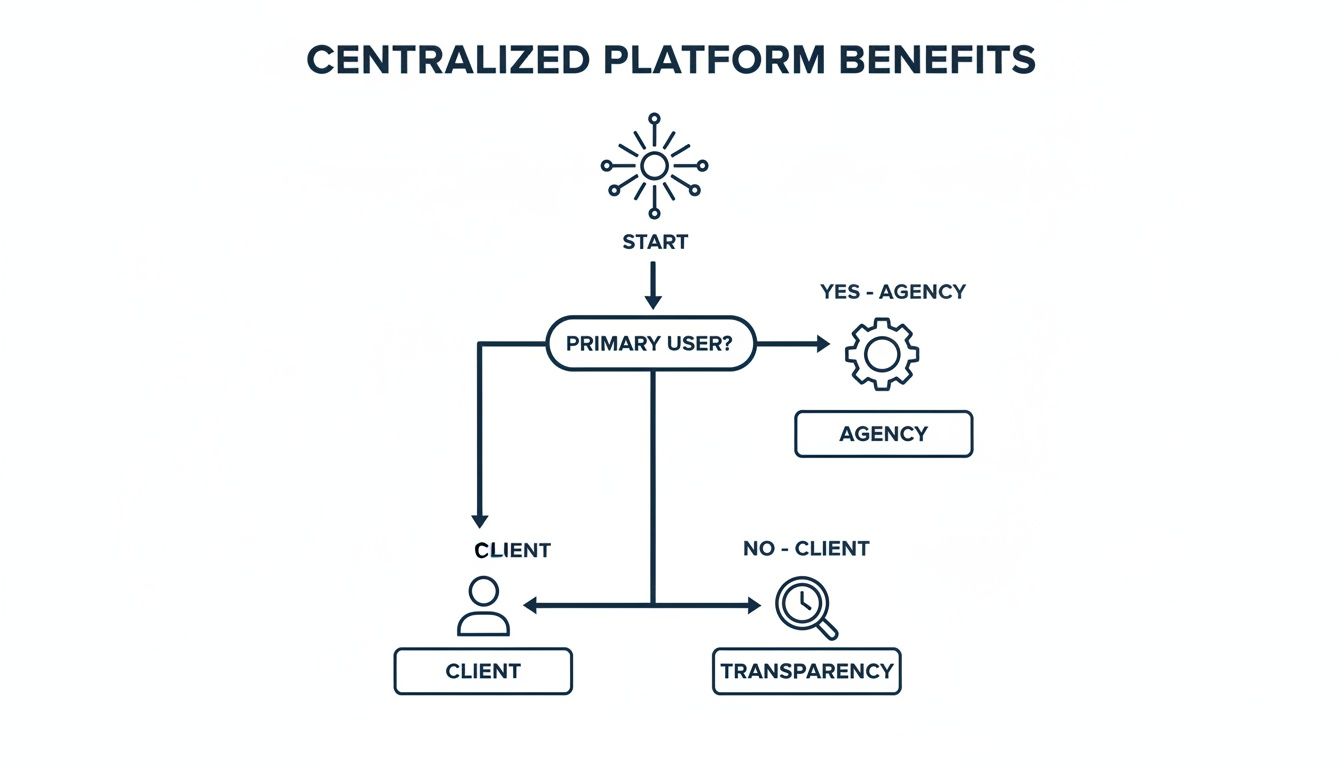
The key takeaway here is simple: when your internal workflows are smooth and efficient, the client experience becomes clearer and more professional.
Evaluate Scalability for Future Growth
The software that fits you today has to fit the agency you want to be tomorrow. Think about your five-year plan. Are you adding new services? Doubling your headcount? Expanding into new markets? Your software has to be able to keep up without forcing you into a painful and expensive migration later.
A scalable platform is an asset that appreciates in value as your agency expands. An inflexible one becomes a liability that holds you back.
Here are a few things to keep an eye on:
- User and Project Limits: Can you add as many clients and projects as you can land, or will you hit a pricing wall right when you start to succeed? Platforms like REACH are built for agency growth, offering things like unlimited projects.
- Feature Roadmaps: Does the company behind the software have a clear plan for the future? You want to see consistent updates and new features that are in tune with where the industry is heading.
- Performance Under Load: Will the system grind to a halt once you load it up with data, users, and a ton of projects?
Scrutinize Integration Capabilities
Your client management software can't live on an island. It has to play nicely with the other tools you depend on every single day, whether that’s QuickBooks for accounting, Slack for team chat, or your go-to email marketing platform.
Bad integrations create data silos and force your team into mind-numbing manual work, which completely defeats the purpose of getting a new system. Before you sign anything, map out your current tech stack and confirm the new software has solid, native integrations or at least a flexible API you can use for custom connections.
Prioritize an Intuitive User Experience
Finally, never forget this: the most powerful software on the planet is useless if your team hates using it. A clunky, confusing interface is a recipe for low adoption, endless frustration, and a quick slide back to old, inefficient spreadsheets. The user experience (UX) isn't just a bonus—it's a make-or-break feature.
Look for a clean, intuitive design that makes it easy for your team and your clients or creators to get up to speed. A professional, branded portal, for example, can completely change the dynamic of the client relationship for the better. We dig into this more in our guide on white-label influencer software for agencies.
When a system is genuinely easy to use, your team will actually embrace it, and that’s when you’ll see the real return on your investment.
To make this process a bit more structured, here’s a checklist you can use when comparing different platforms.
Software Selection Checklist for Agencies
| Evaluation Criteria | What to Look For | Why It Matters |
|---|---|---|
| Core Feature Alignment | Do the features directly solve your biggest operational pain points? (e.g., creator discovery, contract management, campaign reporting) | A perfect fit means less need for clumsy workarounds and third-party tools. |
| Scalability | Are there limits on users, clients, or projects? Is the pricing model sustainable as you grow? | You need a partner for the long haul, not a tool you'll outgrow in a year. |
| Integration Power | Does it offer native integrations with your essential tools (accounting, email, etc.)? Is there a robust API? | Seamless integrations eliminate data silos and save hundreds of hours of manual work. |
| User Experience (UX) | Is the interface clean, intuitive, and easy to navigate for both your team and your clients? | High adoption rates depend on a positive user experience. If it's hard to use, it won't get used. |
| White-Labeling | Can you brand the platform with your agency's logo and colors to create a seamless client portal? | This reinforces your brand's professionalism and enhances the client experience. |
| Support & Onboarding | What level of training and ongoing support is offered? Is there a dedicated account manager? | A great support system ensures you get the most out of your investment from day one. |
| Security & Compliance | Does the platform meet industry standards for data security (e.g., GDPR, CCPA)? | Protecting client and creator data is non-negotiable and protects your agency from liability. |
Using a checklist like this helps you move beyond the sales pitch and make a decision based on the factors that will genuinely impact your agency's day-to-day operations and future success.
Avoiding Common Pitfalls During Implementation
Bringing new software into your agency is about much more than just flicking a switch. It’s a full-on change management project, and even the most powerful platform on the market will fall flat if the rollout is fumbled. The secret to a smooth transition is knowing what can go wrong and getting ahead of it.
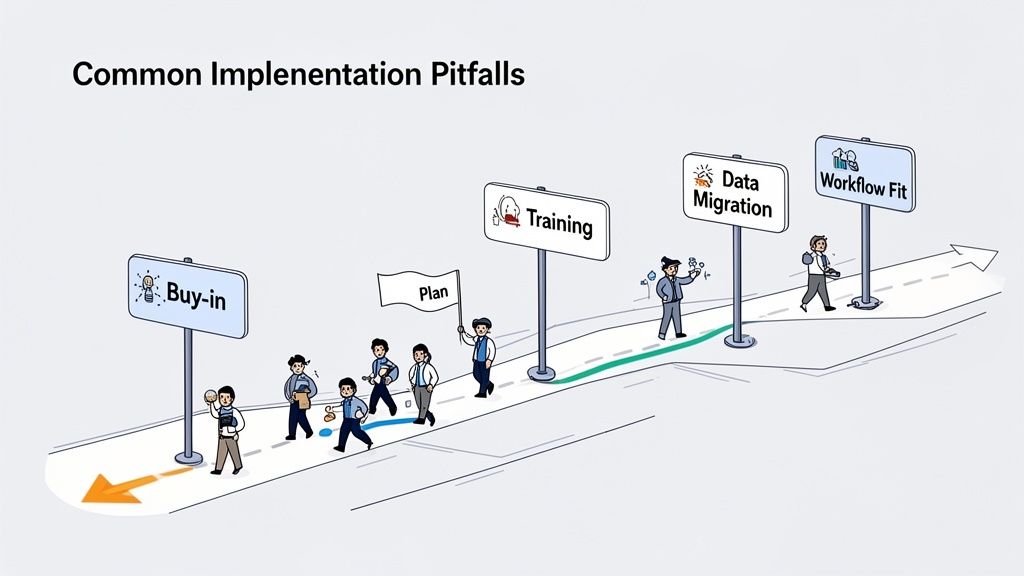
Too many agencies stumble right out of the gate, leaving their teams frustrated and wondering what they’re even paying for. Let's walk through the most common traps and how you can sidestep them entirely.
Overcoming Low Team Buy-In
Let's be honest: the biggest hurdle you'll face isn't technical, it's human. If your team sees a new platform as just another box to check or a new layer of admin work, they'll quietly go back to their trusty old spreadsheets. Resistance is natural, so you have to show them what’s in it for them.
Forget the high-level corporate talk. Get specific. Pinpoint the daily grind—the mind-numbing manual reports, the endless approval-chasing emails—and demonstrate exactly how the new system makes that pain go away.
For instance, a platform like REACH takes the soul-crushing work out of influencer outreach, follow-ups, and tracking performance. Frame it that way. This isn't about micromanagement; it's about freeing them from grunt work so they can do what they do best: strategy and creative. You want them to want to use it, not feel like they have to.
Navigating Poor Data Migration
All that historical client and campaign data is gold. A botched data migration is like moving into a beautiful new office but losing half your files and furniture on the way. It’s chaotic, cripples your operations from day one, and leaves everyone scrambling.
A successful data migration isn't just about dragging and dropping files. It's about meticulously cleaning, organizing, and mapping your information so it’s not just present, but actually useful in its new home.
Don't let this happen to you. Plan the move carefully:
- Clean Your Data First: Before you even think about moving a single byte, audit what you have. Get rid of duplicates, fix errors, and archive anything that's obsolete. Garbage in, garbage out.
- Run a Test Migration: Never, ever do the full migration in one shot. Take a small slice of non-critical data and run a test. This is your chance to spot bugs and fix your process before it's too late.
- Validate the Results: Once the migration is done, have your team jump in and check it. Is everything there? Is it accurate? Does it make sense?
Avoiding a Workflow Mismatch
It’s easy to get wowed by a platform with a million features, but if it doesn't fit how your agency actually operates, it's useless. Forcing your team to abandon proven processes to conform to a rigid piece of software is a recipe for failure. The tool should bend to your workflow, not the other way around.
This is a dealbreaker for specialized agencies. If you’re an influencer marketing shop, a generic project management tool is going to feel clunky and create constant friction. It won't have the built-in features you need for creator discovery, contract management, or content approvals. This is precisely why choosing the right agency client management software that’s built for your specific niche is absolutely critical for success.
Measuring the ROI of Your New Agency Client Management Software
So, you've invested in new agency client management software. That's a great first step, but how do you actually prove it was worth the money? A real return on investment goes way beyond just feeling more organized. It’s about seeing clear, tangible improvements across the board.
To get the full picture, you need to look at both the hard numbers and the softer, qualitative wins. This is how you stop seeing technology as just another expense and start treating it as a strategic tool that actively grows your business.
Pinpointing Quantitative Metrics
Let's start with the easy part: the numbers. Quantitative ROI is all about the data you can track in a spreadsheet. These are the most direct signs that your new platform is paying for itself.
Before you even switch the software on, you need to benchmark your current performance. That way, you have a clear "before and after" picture.
Here are the core metrics to track:
- Time Saved on Admin Tasks: How many hours a week does your team burn on manual reports, creating invoices, or chasing down client approvals? A 25% reduction in admin time isn't just a pipe dream; it's a realistic target that frees up your team for actual client work.
- Reduction in Billing Errors: Let's be honest, manual invoicing is a recipe for mistakes and missed revenue. Track how often you're making billing errors or discovering unbilled hours. A good platform should get this number close to zero.
- Increased Client Retention: Happy clients don't leave. Keep an eye on your client churn rate over the next six to twelve months. When clients feel informed and can see results clearly, they're far more likely to stick around.
Evaluating Qualitative Gains
The numbers tell one story, but the qualitative benefits are where the magic really happens. These are tougher to measure, but they often deliver the most significant long-term value by improving your agency's culture and strengthening client relationships.
A platform's true value isn't just in the tasks it automates, but in the collaborative, transparent, and strategic environment it creates for your team and your clients.
Think about the impact on things like:
- Improved Team Morale: Nobody enjoys tedious, repetitive work. When you remove those frustrating tasks, your team can focus on the creative, strategic stuff they were hired for. This leads to happier employees and less turnover.
- Enhanced Client Satisfaction: Clients crave clarity and transparency. Giving them a professional, real-time dashboard to view their campaign progress builds an incredible amount of trust. It shifts your relationship from vendor to a true partner.
Platforms like REACH are designed specifically to deliver these kinds of measurable results. Its integrated analytics, for instance, can completely eliminate the hours your team spends cobbling together manual reports. You can explore more on the power of unified reporting with these essential marketing dashboard tools.
By automating data collection and giving clients a live look at their campaign’s performance, REACH transforms reporting from a dreaded chore into a powerful showcase of your agency's value. This directly boosts both your internal efficiency and your clients' confidence.
Frequently Asked Questions
Getting into the weeds of agency client management software can spark a few questions. If you're wondering if this is the right move for your team, you're not alone. Let's tackle some of the most common things we hear from agencies just like yours.
What’s the Real Difference Between a CRM and Agency Client Management Software?
It’s easy to get these two mixed up, but the difference is pretty stark once you look closer. A standard CRM is really built for one job: managing a sales pipeline. It’s all about tracking leads, nurturing prospects, and closing deals.
Agency client management software, however, picks up where a CRM leaves off and covers the entire client relationship. It bundles that sales functionality with project management, team collaboration, billing, client approvals, and reporting.
Here's a simple way to think about it: A CRM is your little black book for sales. Agency software is the entire mission control for your business, connecting your clients, projects, team, and finances all in one spot.
How Long Does It Actually Take to Get Set Up?
This isn't the monumental, months-long headache it used to be. For a modern, cloud-based platform, you could be fully up and running anywhere from a few days to a couple of weeks.
Of course, a few things can affect that timeline:
- How much old data you need to bring over.
- How many other tools you need to connect it with.
- The size of your team that needs to get trained up.
The key is picking a platform that’s built to be intuitive and has a solid support team ready to help. That’s what makes for a quick, painless switch.
Is This Kind of Software Overkill for a Small Agency?
Not at all. In fact, you could argue small agencies get the biggest bang for their buck, and fast. The old-school, enterprise-level price tags are a thing of the past. Modern platforms are surprisingly affordable, with flexible plans that grow with you.
For a small but mighty team, this software isn't just a nice-to-have; it's what lets you scale without chaos. It helps you establish polished, repeatable processes from day one, so you can deliver top-tier client work and compete with agencies ten times your size. It’s about building a solid foundation so you can grow efficiently.
Ready to swap the chaotic spreadsheets for a clear, centralized hub? REACH gives you one place to manage your influencer campaigns, keep clients happy, and prove your worth with the leading agency client management software in the influencer marketing space.