 Skip to content

Figuring out the ROI on social media is all about connecting the dots between the effort you put in—your time, budget, and creative energy—and the actual money it brings back to your business. It’s the process of looking past the surface-level wins, like likes and follows, to see how your social channels are actually fattening up your bottom line. An effective strategy, often supercharged by influencer marketing platforms like REACH Influencers, turns social media from a cost center into a predictable revenue engine.
This guide will walk you through a practical framework for defining, tracking, and maximizing your social media ROI, so you can justify your budget and drive real business growth.
Table of Contents
- What Social Media ROI Really Means for Your Business
- Choosing the Metrics That Actually Matter for Calculating ROI on Social Media
- A Step-by-Step Framework for Calculating Your ROI on Social Media
- Driving High Returns with Influencer Marketing
- How to Use Short-Form Video to Maximize Your ROI
- Frequently Asked Questions About Social Media ROI
What Social Media ROI Really Means for Your Business
For years, many businesses treated social media like a fuzzy, hard-to-pin-down expense. It was something you were supposed to do, but tying all those impressive engagement numbers to real business results felt like a constant struggle. This ambiguity made it tough to ask for a bigger budget or convince the higher-ups that the work was truly paying off.
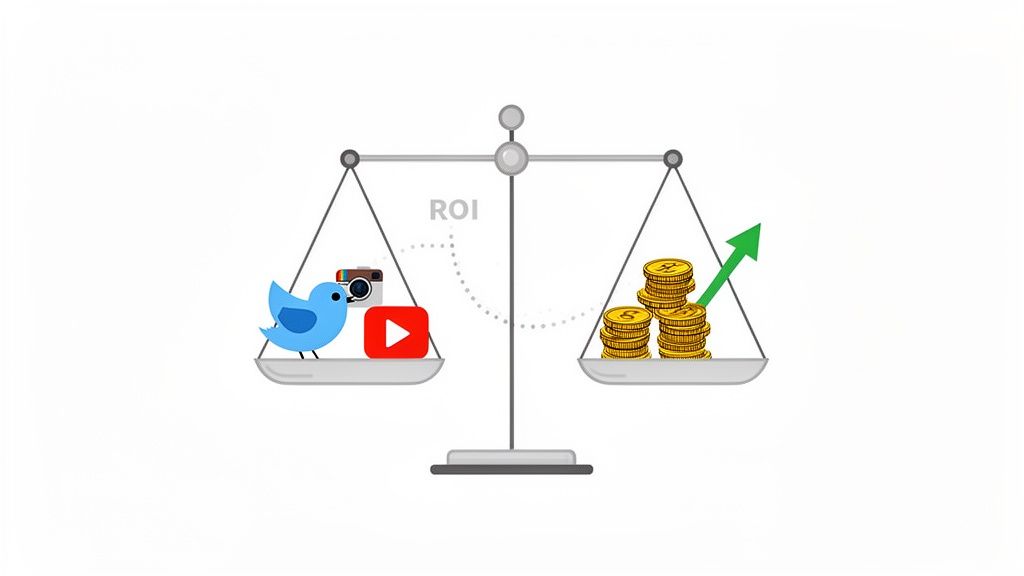
But things have changed. Proving the ROI on social media isn't a "nice-to-have" anymore; it's a must. This is the metric that flips the script, turning social media from a simple cost into a serious revenue driver.
Here’s a simple way to think about it: Likes and shares are like a round of applause. It feels great and shows the audience is engaged, but it doesn't tell you if they're buying merch after the show. ROI is the merch sales—the tangible, measurable proof that your performance led to profit.
Why This Metric Is Non-Negotiable
Getting a handle on your return is about so much more than filling out a spreadsheet. It’s about making smarter decisions that move your business forward. When you get into the habit of measuring your social media ROI, you start seeing some real advantages.
- Justify Your Marketing Spend: Nothing speaks louder than cold, hard data. A clear ROI is your best argument for not only keeping your social media budget but growing it. It proves to leadership that every dollar you invest is designed to come back with friends.
- Sharpen Your Strategy: Once you know what’s working, you can do more of it. You can confidently pour resources into the channels, content, and campaigns that deliver the goods, and cut back on what isn't.
- Pinpoint Your Most Profitable Channels: Maybe you’ll find out your Instagram influencer campaigns are outperforming your Facebook ads by a mile. This kind of insight helps you put your money where it makes the biggest impact.
- Tie Social Activity to Business Goals: Measuring ROI makes sure your social media efforts are pulling their weight and directly contributing to what the company cares about most, whether that’s generating leads, driving sales, or keeping customers happy.
The biggest hurdle for marketers is translating social media buzz into bottom-line results. A positive ROI is the ultimate proof that you’re not just making noise—you’re making money.
Turning Partnerships into Profit
This becomes especially important when you dive into influencer marketing. Working with creators can sometimes feel a bit abstract, but it's actually one of the most measurable ways to get a fantastic return—if you have the right setup. This is precisely the problem that platforms like REACH Influencers were designed to solve.
REACH gives you the framework to track every cent spent on an influencer campaign and see exactly how it connects to sales. By giving each creator a unique tracking link, for instance, you can see exactly how many clicks and sales came from their specific post. Suddenly, a creative collaboration becomes a clear financial victory.
When you can see all these results in one place, calculating the ROI on social media for each influencer is a breeze. It proves their value and gives you the data you need to make your next campaign even more successful.
Choosing the Metrics That Actually Matter for Calculating ROI on Social Media
Calculating your social media ROI isn't about tracking every vanity metric under the sun. The real secret is to focus on what actually moves the needle for your business. Measuring the right Key Performance Indicators (KPIs) is like having a map for a road trip—it makes sure every dollar and hour you spend gets you closer to your destination.
Think about your customer's journey. It starts with them just discovering your brand, then maybe they start interacting with your posts, and finally, they take a meaningful action like buying something. Your metrics should follow that same path, from broad awareness all the way down to a sale.
Top-of-Funnel Metrics for Brand Awareness
At the very top, the goal is simple: get your brand in front of as many of the right people as possible. These metrics don't scream "profit" by themselves, but they are the foundation. Without awareness, you have no one to sell to.
- Reach: How many unique people saw your content? This is your starting point for understanding your potential audience size. If your reach is growing, you're expanding your brand's footprint.
- Impressions: This is the total number of times your content was shown on a screen. If your impressions are much higher than your reach, it means people are seeing your content multiple times, which can be great for brand recall.
- Follower Growth: A steadily increasing follower count is a strong signal that your content is hitting the mark and people want to hear more from you. It's a direct indicator of growing brand interest.
These early-stage metrics are what fill your pipeline. They represent the pool of potential customers you're building for the future.
Mid-Funnel Metrics for Engagement and Consideration
Okay, so people have seen your brand. Now what? The next step is to see if they’re actually interested. Engagement metrics tell you if your audience is actively interacting with your content instead of just scrolling past it. This is where you start building a real relationship.
These actions show you've captured their attention, turning them from passive viewers into engaged prospects. You can get a much deeper understanding of this by exploring different types of social media engagement metrics and what they reveal about a user's intent.
Here are the key engagement KPIs to watch:
- Likes, Comments, and Shares: These are the classic signs that your audience likes what you're doing. Shares are especially powerful—they're basically a personal endorsement from a user to their own network.
- Clicks: A click is a clear sign of intent. Someone was interested enough to want to learn more, visit your website, or check out your offer. It's a critical step down the funnel.
- Website Traffic: How many people are actually leaving the social platform to visit your website? This is the bridge connecting your social media activity to your core business hub.
Measuring engagement is about quality, not just quantity. A single, thoughtful comment from a potential customer is often worth more to your future ROI than a hundred mindless likes.
Bottom-of-Funnel Metrics for Conversions and Revenue
This is where the rubber meets the road. Bottom-of-funnel metrics are where your social media efforts turn into cold, hard business value. These are the most important numbers for your final ROI calculation.
- Lead Generation: How many potential customers did you capture? This could be from webinar sign-ups, e-book downloads, or contact form fills. You'll need to assign a value to each lead to properly measure ROI.
- Conversion Rate: What percentage of people who clicked your social media link took the desired action (like making a purchase)? A high conversion rate shows that your content and your landing page are working together perfectly.
- Revenue: The ultimate metric. This is the total amount of sales generated directly from your social media efforts. Using tools like UTM codes is non-negotiable for tracking this accurately.
By separating your metrics into these three stages, you get a crystal-clear picture of how your work is paying off. You can see how growing your reach at the top directly fuels the sales happening at the bottom, giving you a complete and defensible view of your social media ROI.
Matching Social Media KPIs to Your Business Goals
Use this table to select the most relevant KPIs for your campaign objectives, ensuring you measure what truly matters for proving ROI.
| Business Goal | Primary KPIs to Track | Example Metric |
|---|---|---|
| Increase Brand Awareness | Reach, Impressions, Follower Growth | Gaining 10,000 new followers in Q1 |
| Boost Engagement | Likes, Comments, Shares, Click-Through Rate | Achieving a 5% average engagement rate |
| Drive Website Traffic | Clicks, Website Sessions from Social | Generating 5,000 website sessions per month |
| Generate Leads | Form Fills, Gated Content Downloads | Capturing 200 qualified leads from a campaign |
| Drive Sales | Conversion Rate, Revenue, Average Order Value | Attributing $50,000 in sales to social media |
Choosing the right metrics from the start makes proving your value so much easier. Instead of presenting a jumble of data, you can tell a clear story that connects your social media strategy directly to business success.
A Step-by-Step Framework for Calculating Your ROI on Social Media
Let's move from theory to real-world results. Figuring out your social media ROI isn't nearly as intimidating as it sounds once you have a solid framework. It really just comes down to one powerful formula that cuts through the noise and gives you a clear measure of success.
The basic formula for calculating your return is beautifully simple.
This image breaks it down to its core: your return is simply the profit from an investment divided by its cost. To make this practical, let's walk through each piece and see how it applies directly to your social media efforts.
Step 1: Identify Your Profit
The "Profit" side of the equation is the value you've generated from all your social media activity. This is the fun number to track because it shows the direct impact you’re having on the business’s bottom line.
But profit isn't always as simple as a sales number. To get the full story, you need to account for all the different ways your channels create value.
- Direct Revenue: This is the most straightforward piece. It’s the total sales that came directly from a social media campaign, which you can track using things like unique discount codes or UTM parameters in your links.
- Lead Value: Not every click ends in a sale right away. If your goal is generating leads, you have to assign a dollar value to each one. A great way to do this is to figure out your average lead-to-customer conversion rate and multiply it by your average customer lifetime value (CLV).
For example, if 1 in 10 of your leads becomes a customer, and each customer is worth $1,000 over their lifetime, then every lead you generate is worth $100. This simple math suddenly makes your lead generation campaigns much easier to value.
Step 2: Calculate Your Total Investment
Your "Total Investment" is everything you've spent to run your social media campaigns. To get a truly accurate ROI, you have to be meticulous here and track every single expense, not just the obvious ones.
An incomplete cost calculation is the fastest way to get a misleading ROI. Overlooking hidden costs like team salaries or software fees will artificially inflate your return and lead to poor strategic decisions.
Here’s a checklist of what to include in your total investment:
- Ad Spend: The money you put directly into paid ads on platforms like Facebook, Instagram, or LinkedIn.
- Content Creation Costs: Think photographers, videographers, graphic designers, or copywriters.
- Influencer Fees: Any payments made to creators for collaborations and sponsored posts. Platforms like REACH Influencers can really simplify this by managing all your influencer payments and tracking spend per campaign in one place.
- Software and Tools: Your monthly or annual subscription costs for social media management, scheduling, or analytics tools.
- Labor Costs: The portion of your team's salaries that goes toward social media. Just calculate the hours they spend on social media tasks and multiply by their hourly rate.
Step 3: Connect Actions to Conversions with Attribution
This is where things can get a little tricky: accurately connecting a sale or lead back to a specific social media post or ad. This is the job of attribution modeling. An attribution model is just a set of rules that decides how credit for a sale is given to the different touchpoints a customer interacted with.
For instance, a simple "last-touch" model gives 100% of the credit to the very last thing a person clicked before buying. It’s easy to track, but it often ignores all the earlier posts that built awareness and trust. It’s crucial to pick a model that actually reflects how your customers discover and buy from you. If you want to dive deeper, our guide to cross-channel marketing attribution is a great place to start.
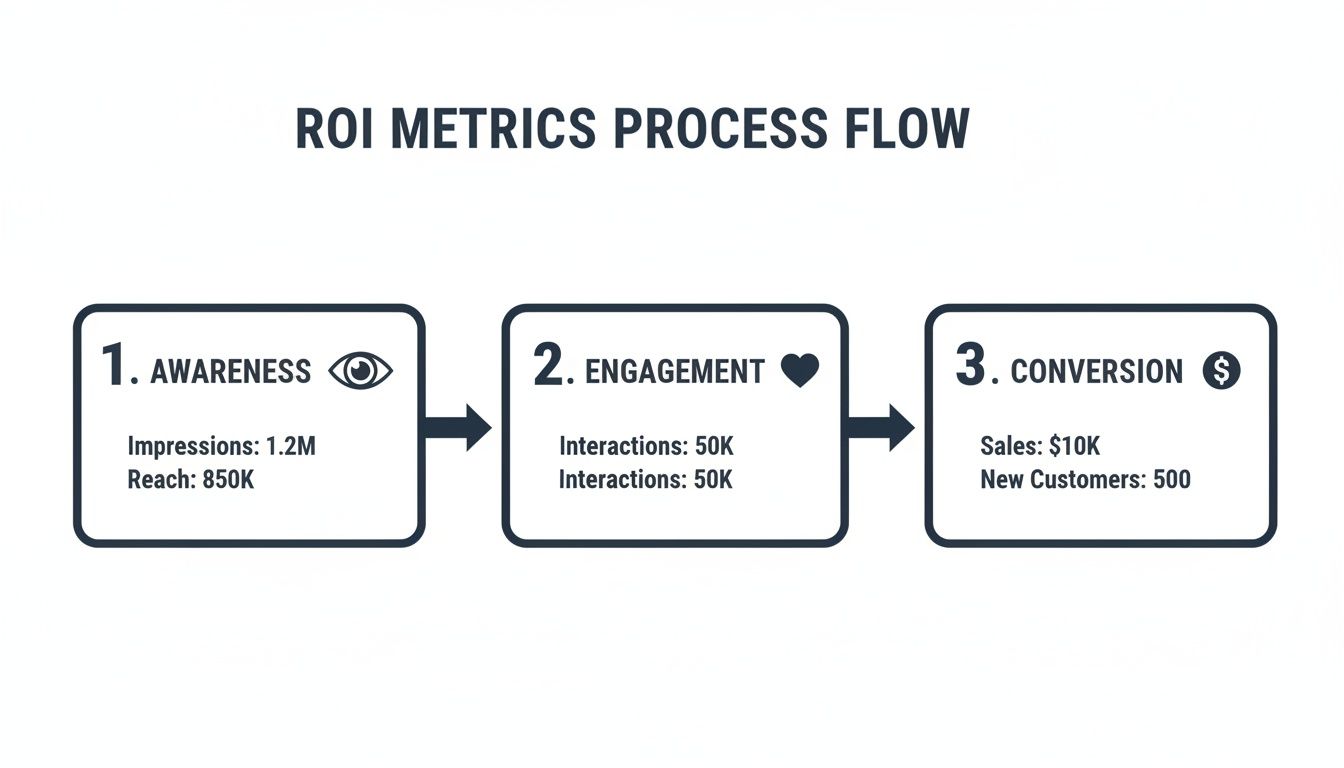
This process flow shows how a user moves from simply seeing your content to becoming a paying customer.
By mapping out the journey from initial awareness to final conversion, attribution models help you measure what’s working. Tracking this flow ensures every stage of the funnel gets the credit it deserves, leading to a much more accurate ROI.
Step 4: Putting It All Together—A Real-World Example
Let's say a skincare brand runs an influencer campaign on Instagram to launch a new serum.
- Profit: They generated $15,000 in sales, which they tracked using the influencer's unique affiliate link.
- Total Investment:
- Influencer Fee: $2,000
- Product Samples: $500
- Team Time (5 hours @ $50/hr): $250
- Total Investment = $2,750
Now, we just plug those numbers into our formula:
( $15,000 (Profit) / $2,750 (Investment) ) x 100 = 545%
The ROI on social media for this one campaign was an incredible 545%. This number doesn't just prove the campaign was a success; it gives the marketing team a rock-solid case for investing in more influencer partnerships in the future.
Driving High Returns with Influencer Marketing
While paid ads have their place, influencer marketing has become a serious engine for driving a high ROI on social media. This isn't just about placing ads; it's about earning authentic, trust-based promotion. Instead of brands shouting about how great they are, they team up with creators whose audiences already know and trust them.
The whole thing is built on basic human psychology. We're all a bit skeptical of a slick corporate ad, but we listen when someone we admire recommends something. An influencer’s endorsement feels more like a tip from a friend than a sales pitch, which is why it cuts through the noise and drives real results.
Why Creator Partnerships Consistently Outperform Traditional Ads
The magic of influencer marketing really boils down to one word: authenticity. A creator has spent years building a real connection with their community, and that relationship is everything. When they recommend a product, it comes with a layer of social proof that a branded ad could only dream of.
This trust pays off—literally. In fact, influencer marketing consistently delivers one of the best returns out there, averaging an ROI of $5.78 for every dollar spent. That's nearly double what many brands see from traditional digital ads, and it's a huge reason why so many are shifting their budgets. You can see more stats on why this is happening over at Sprinklr.com.
The core of a successful influencer campaign isn't just reach; it's resonance. A creator’s authentic connection with their audience is the key that unlocks a higher ROI than most other social media strategies can deliver.
Strategies for Maximizing Your Influencer Investment
Getting a great return from your influencer campaigns isn't about luck. It's about being smart and strategic with every dollar you spend. With the right approach, you can turn a good campaign into a powerhouse of profitability.
Here are a few proven ways to boost your influencer ROI:
- Collaborate with Micro-Influencers: Don't get blinded by massive follower counts. Creators with smaller, niche audiences (think 10,000 to 100,000 followers) often have sky-high engagement rates. Their recommendations feel more personal and can lead to incredible conversion rates, usually at a much lower cost.
- Repurpose Creator Content: The partnership doesn't have to end with a single post. That amazing content your influencer creates can be a goldmine. Use their photos and videos in your social ads, on your product pages, and in email campaigns to get way more mileage out of your initial investment.
- Focus on Long-Term Partnerships: One-off campaigns are good, but lasting relationships are better. When you work with the same influencers over time, they become genuine brand advocates. Their promotions become even more authentic, and the returns start to compound.
Using Technology to Prove Influencer ROI
For years, the biggest headache with influencer marketing was proving it actually worked. How do you connect a post to a sale? That’s where a dedicated platform becomes a game-changer. If you want to dive deeper into this, check out our full guide on the ROI of influencer marketing.
Tools like REACH Influencers are designed specifically to solve this problem. The platform helps you find the most cost-effective and high-performing creators for your niche right from the start, so you’re not just guessing who will deliver the best results.
Once your campaign is running, the REACH analytics dashboard gives you real-time data on how things are going. By tracking clicks, conversions, and sales with unique links, you can directly attribute revenue to each creator. This gives you the hard numbers you need to calculate a precise ROI on social media, fine-tune your strategy, and confidently show anyone the incredible value your influencer program is delivering.
How to Use Short-Form Video to Maximize Your ROI
If influencer marketing is the engine, think of short-form video as the high-octane fuel that makes it go. In today's social media world, video isn’t just another option on the menu—it’s the single most powerful format for grabbing attention and driving a real ROI on social media. It’s fast, engaging, and super shareable, which is exactly how people consume content now.
The psychology behind why it works is surprisingly simple. Short videos on Instagram Reels and TikTok are designed for quick hits of information or entertainment. This bite-sized format lets brands tell stories that actually stick, leading to much higher engagement and a clearer path to a sale.
Why Video Delivers Such Great Returns
The numbers don't lie: investing in video really pays off. In fact, 21% of marketers say that short-form video delivers the best ROI out of everything they do. This isn't just a fleeting trend; it’s a fundamental shift in how people discover products and decide what to buy.
This is especially true when you combine video with influencer marketing. Creators are natural-born storytellers and they live and breathe the short-form video format. They know how to make content that feels authentic and real, not like a stuffy old commercial, which builds trust almost instantly.
When an influencer creates a video, they aren't just showing off a product; they're demonstrating its value within the context of a real person's life. This authentic use-case is far more persuasive than a polished ad, leading directly to a higher ROI.
This powerful mix of genuine storytelling and a high-impact format is a one-two punch for driving sales and getting a clear return on your investment.
Actionable Tips for High-ROI Video Content
You don’t need a Hollywood budget to create video content that actually converts. Just stick to a few key principles, and you can produce videos that stop the scroll and drive measurable results, giving your ROI on social media a serious boost.
Here are a few proven strategies to get you started:
- Jump on Trends: Keep an eye out for trending audio clips, challenges, and video styles on platforms like TikTok and Reels. Hopping on a trend makes your brand feel current and helps the algorithm push your content to a much bigger audience.
- Think Mobile-First: The vast majority of people are watching these videos on their phones. Always shoot vertically (a 9:16 aspect ratio is perfect), use big, easy-to-read text, and add captions so your message gets across even with the sound off.
- Add a Clear Call-to-Action (CTA): Never assume people know what to do next. End your video with a direct instruction, like "Shop the link in bio," "Download our free guide," or "Follow for more tips."
- Keep It Short and Sweet: You have about three seconds to grab someone's attention. Get straight to the point and deliver your message fast before they swipe away.
Finding Creators Who Are Video Rockstars
The real challenge isn't just making a video; it's finding the right person to tell your brand's story. This is where a platform like REACH Influencers becomes a game-changer. Its discovery tool lets you filter creators by how well their content performs, including their video engagement rates.
Instead of taking a wild guess, you can pinpoint influencers who have a proven history of creating videos that people love. This data-first approach takes the risk out of the equation, making sure you partner with creators who can deliver a strong financial return. Many brands are looking to grow on popular platforms like TikTok, where creator-led video is everything. With a tool like REACH, you can build a video strategy that not only gets views but delivers a measurable and impressive ROI.
Frequently Asked Questions About Social Media ROI
Even with a solid plan, you're bound to have questions once you start digging into the nitty-gritty of social media performance. Let's tackle some of the most common ones marketers ask when trying to prove their ROI on social media.
How Long Does It Take to See a Return?
This is the classic "it depends" question, but for good reason. The timeline for seeing a return really hinges on your goals. If you're running a direct-response campaign, like an influencer promoting a flash sale with a unique discount code, you could see a measurable profit in just a few days.
But for bigger brand-building efforts, you have to play the long game. These campaigns are all about building trust and loyalty, and that doesn't happen overnight. It can often take 6 to 12 months before you see that work translate into a clear financial lift, usually through more direct traffic or people searching for your brand by name. The key is consistency—sticking with a smart strategy almost always pays off over time.
What Is Considered a Good Social Media ROI?
You'll often hear a 5:1 ratio thrown around as a solid benchmark—that's $5 in revenue for every $1 you spend. But honestly, a "good" ROI is completely relative to your own profit margins and business model. What a high-margin software company considers a win is going to look very different from a low-margin retail shop.
For instance, influencer marketing often punches above that average, with some studies showing returns closer to $6 for every $1 invested. The best thing you can do is set your own baseline with your first few campaigns and aim to beat it. Keep testing new ideas to see what really moves the needle for your brand.
The most valuable benchmark is your own past performance. Aiming to consistently improve your ROI quarter over quarter is a more powerful indicator of success than chasing a generic industry number.
How Do You Measure ROI for Brand Awareness?
This is a tough one because you can't tie a sale directly to a "brand awareness" campaign. It feels a bit fuzzy. The trick is to look at proxy metrics—the numbers that show your brand's presence is growing stronger.
Keep an eye on the growth in these key areas:
- Branded Search Volume: Are more people typing your brand name directly into Google?
- Direct Website Traffic: Are more users coming straight to your site without a referral?
- Social Media Mentions: Is the organic chatter about your brand increasing?
You can then calculate an indirect return by estimating what it would have cost to get that same traffic or exposure through paid ads. It's not a perfect science, but it gives you a meaningful way to value your awareness efforts.
Which Social Media Platform Delivers the Best ROI?
There’s no magic bullet here. The "best" platform isn't about some universal ranking; it's about finding where your target audience hangs out. The right channel is wherever your people are active, engaged, and open to hearing from you.
For a B2C brand with a highly visual product, Instagram and TikTok are often goldmines. But if you’re in B2B and need to generate leads, LinkedIn is almost always the top performer. Instead of looking for the one perfect channel, test your campaigns across a few platforms where you know your ideal customers spend their time. The data will quickly tell you which ones deliver the highest ROI on social media for your business.
Ready to stop guessing and start proving the value of your influencer marketing? REACH Influencers provides the tools you need to track every dollar, measure every conversion, and calculate a precise ROI for every campaign. Our centralized platform takes the complexity out of influencer management, so you can focus on building profitable partnerships and proving the ROI on social media to your leadership team.
Discover how REACH can maximize your social media ROI today.
{ “@context”: “https://schema.org”, “@type”: “BlogPosting”, “mainEntityOfPage”: { “@type”: “WebPage”, “@id”: “https://reach-influencers.com/roi-on-social-media” }, “headline”: “A Practical Guide to Measuring ROI on Social Media in 2024”, “description”: “Learn how to accurately measure, track, and maximize the ROI on social media with this practical guide. From setting KPIs to leveraging influencers, get the framework you need to prove your impact.”, “image”: “https://cdn.outrank.so/64cdc0e0-2a54-4cd9-a45d-c4196c5e1d4e/003ce404-0137-45e5-8eb1-f36cb8a299e7/roi-on-social-media-social-media-roi.jpg”, “author”: { “@type”: “Organization”, “name”: “REACH Influencers”, “url”: “https://www.reachinfluencers.com/” }, “publisher”: { “@type”: “Organization”, “name”: “REACH Influencers”, “logo”: { “@type”: “ImageObject”, “url”: “https://www.reachinfluencers.com/logo.png” } }, “datePublished”: “2024-05-21”, “dateModified”: “2024-05-21” } { “@context”: “https://schema.org”, “@type”: “FAQPage”, “mainEntity”: [{ “@type”: “Question”, “name”: “How Long Does It Take to See a Return on Social Media?”, “acceptedAnswer”: { “@type”: “Answer”, “text”: “The timeline to see ROI on social media varies. Direct response campaigns can show returns within days. Brand-building efforts typically take 6-12 months to translate into a clear financial lift as they focus on building long-term trust and loyalty.” } },{ “@type”: “Question”, “name”: “What Is Considered a Good Social Media ROI?”, “acceptedAnswer”: { “@type”: “Answer”, “text”: “A 5:1 ratio ($5 revenue for every $1 spent) is a common benchmark, but a ‘good’ ROI depends on your business’s profit margins. The best approach is to establish your own baseline and aim for continuous improvement.” } },{ “@type”: “Question”, “name”: “How Do You Measure ROI for Brand Awareness Campaigns?”, “acceptedAnswer”: { “@type”: “Answer”, “text”: “Measuring ROI for brand awareness involves tracking proxy metrics like branded search volume, direct website traffic, and social media mentions. You can estimate the value by calculating what it would have cost to achieve similar exposure through paid advertising.” } },{ “@type”: “Question”, “name”: “Which Social Media Platform Delivers the Best ROI?”, “acceptedAnswer”: { “@type”: “Answer”, “text”: “The best platform for ROI depends entirely on your target audience. For visual B2C products, Instagram and TikTok are often effective. For B2B lead generation, LinkedIn is typically the top performer. The key is to test and identify where your customers are most engaged.” } }] }**Meta Description:**
Learn how to accurately measure, track, and maximize the ROI on social media with this practical guide. From setting KPIs to leveraging influencers, get the framework you need to prove your impact.