 Skip to content


Calculating your ROI on social media (Return on Investment) boils down to one critical question: Is the time, money, and effort you're pouring into platforms like Instagram, TikTok, and Facebook actually paying off? It's the ultimate metric that cuts through the noise of vanity metrics—like likes and shares—to tell you if your social strategy is growing your business or just spinning its wheels.
Think of it as the ultimate proof that what you're doing is working. Understanding and proving the ROI social media generates is no longer a "nice-to-have"; it's a core competency for any serious marketing team. This guide will walk you through exactly how to measure it, the challenges you'll face, and the strategies that deliver real, quantifiable results.
Table of Contents
- What Is Social Media ROI and Why It Matters
- The Essential Formula for Calculating Your ROI on Social Media
- Common Challenges in Measuring Social Media ROI
- Practical Strategies to Accurately Track Performance
- How Influencer Marketing Can Seriously Boost Your Social Media ROI
- How to Report Your Social Media ROI to Stakeholders
- Frequently Asked Questions About Social Media ROI
What Is Social Media ROI and Why It Matters
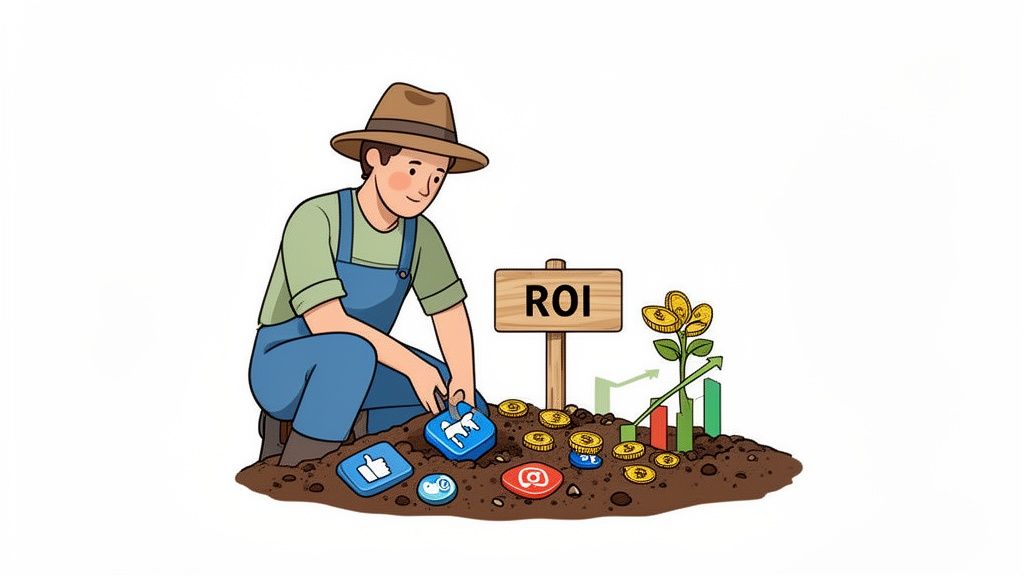
Let's use an analogy. Imagine your social media activities are seeds you're planting. You invest in good soil (your content), fertilizer (ad spend), and your own hard work. Calculating your social media ROI is like measuring the harvest—how many baskets of fruit (sales, leads, new customers) did those seeds produce? Without that measurement, you're just gardening in the dark.
For years, marketers got stuck on "vanity metrics" like likes, shares, and follower counts. While these numbers feel good and can signal that people are paying attention, they don't directly pay the bills. A post with a thousand likes that generates zero sales has questionable business value.
This is exactly why getting a grip on ROI is no longer optional. It moves the conversation away from fuzzy metrics and toward tangible business results. For brands serious about growth, especially those leveraging influencer marketing, this clarity is everything. A top-tier influencer marketing platform like REACH Influencers is designed to provide this clarity, connecting campaign activities directly to measurable outcomes early in the process.
By focusing on ROI, you transform social media from a cost center into a powerful revenue driver. It’s the language executives understand and the data that justifies bigger budgets and more ambitious campaigns.
The True Purpose of Tracking ROI
Tracking your return isn't just about patting yourself on the back; it's a compass that guides your entire strategy. When you consistently measure your ROI on social media, you unlock crucial insights that let you:
- Optimize Your Budget: You can confidently shift money toward the platforms and campaigns that deliver the best results—like that killer influencer collab on Instagram—and pull back from what's not working.
- Refine Your Strategy: The data tells the story. You’ll see if your audience goes wild for video content, loves user-generated stories, or prefers educational carousels, which helps you make smarter creative choices.
- Demonstrate Business Impact: Solid ROI data allows you to walk into any meeting and show stakeholders exactly how social media contributes to core goals like customer acquisition and revenue growth.
To measure social media performance accurately, having the right tools is key. This is where you can connect the dots between campaign spending and real-world results. For a deeper look at how this applies to visual content, consider delving into video marketing ROI.
Ultimately, tracking social media ROI is about making smarter, data-backed decisions that fuel real, sustainable growth.
The Essential Formula for Calculating Your ROI on Social Media
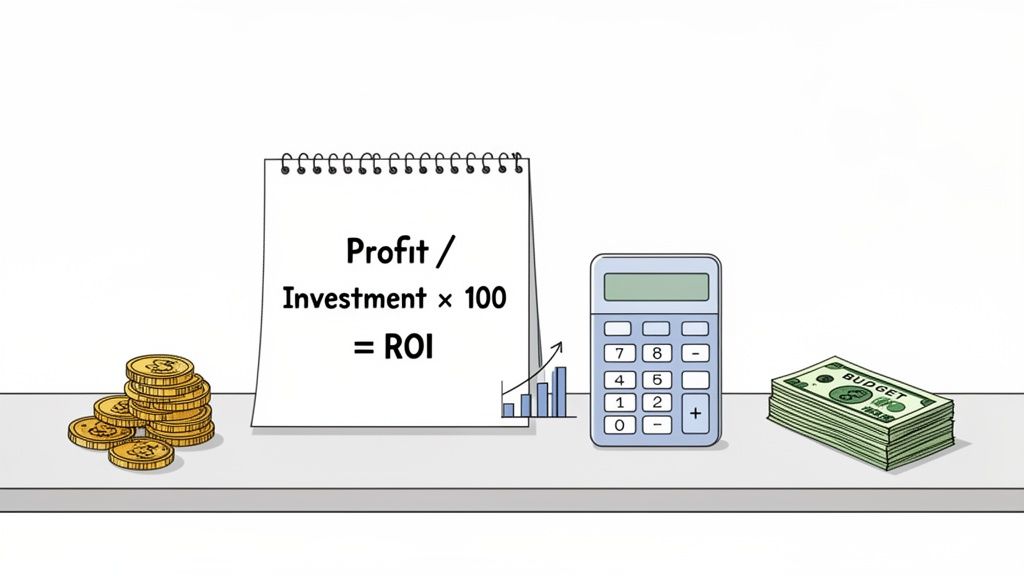
Figuring out your social media ROI might seem complex, but it all comes down to one simple formula. This is your foundation for proving that your tweets, posts, and campaigns actually contribute to the bottom line.
The Basic Social Media ROI Formula:
(Profit / Total Investment) x 100 = Social Media ROI %
Think of it this way: for every dollar you put into social media, how much did you get back after covering all your expenses? A positive percentage is a win. A negative one is a clear sign that it’s time to adjust your strategy.
Let’s pull back the curtain on each part of the equation so you can start using it confidently.
Defining Your Profit
First, what do we mean by profit? It’s the total money you made from your social media efforts. This has to be a real, measurable dollar amount.
Profit can come from a few different places:
- Direct Sales: This is the easiest one—revenue from people who clicked a link on social media and bought something right away.
- Lead Value: What’s a new lead worth to your business? If each lead is typically worth $50 and your campaign brought in 100 new leads, that’s $5,000 in value.
- Recurring Revenue: Any new subscriptions or monthly contracts that came directly from a social media channel.
Tallying Your Investment
Now for the other side of the coin: your investment. This isn’t just about the money you spend on ads. To get a true picture of your social media ROI, you have to account for every resource you pour into your channels.
Common costs to track include:
- Ad Spend: The direct cost of your paid campaigns on platforms like Facebook, Instagram, or TikTok.
- Content Creation Costs: Any money spent on photographers, designers, copywriters, or video editors.
- Software and Tools: Your monthly subscriptions for scheduling, analytics, or influencer marketing platforms.
- Time and Labor: Don’t forget the salaries of your social media team! Calculate their hourly rate for the time they spend on a specific campaign.
It's no surprise that Facebook often comes out on top. In fact, 28% of marketers say it delivers the highest ROI, thanks to its massive audience and powerful ad targeting. With an average return on ad spend of nearly 3:1, it’s a powerful channel. A platform like REACH Influencers can take this even further by helping you connect with influencers whose audiences are genuinely engaged, making every dollar you invest work harder.
If you want to get a better handle on measuring returns across all your marketing channels, check out this guide on how to calculate marketing ROI and prove its value. Mastering these basics will make it so much easier to justify your budget and show everyone the incredible impact of your work.
Common Challenges in Measuring Social Media ROI
If you feel like you're trying to solve a puzzle with missing pieces when measuring your social media ROI, you’re definitely not alone. The path from a social media "like" to a final sale is rarely a straight line, which throws a few common hurdles in front of even the most experienced marketers.
One of the biggest struggles is figuring out sales attribution. Let's be real: today's customer journey is messy. It hops across multiple channels over days or even weeks.
Imagine someone discovers your brand through an influencer post on Instagram. A few days later, they see a retargeting ad on Facebook, and then they finally buy something by searching for you on Google. So, who gets the credit? Is it the influencer who planted the seed, the ad that served as a reminder, or the search that sealed the deal? This tangled path makes it tough to assign a clear dollar value to any single social media activity.
The Problem with Attribution Models
The truth is, most customers bump into a brand multiple times before they decide to convert. Sticking with a simple "last-touch" model—where the very last click before a purchase gets 100% of the credit—is a huge mistake. It completely overlooks the critical role social media plays in building awareness and keeping your brand top-of-mind. This creates a massive blind spot when you’re trying to prove the true roi social media brings to the table.
The modern customer journey isn't a sprint; it's a relay race. Giving all the glory to the anchor leg ignores the crucial work of the runners who got the baton there.
To see the full picture, you need a smarter approach. If you're struggling to untangle this web, digging into the different models of cross-channel marketing attribution can be a game-changer, helping you give credit where credit is due.
Other Common Measurement Hurdles
Beyond the attribution puzzle, marketers run into a few other familiar challenges:
- Valuing Brand Awareness: How do you put a price tag on someone simply knowing your brand exists or feeling good about it? These "soft" metrics are incredibly valuable for long-term growth but don't neatly show up on a sales report.
- Tracking Offline Sales: If a customer sees your campaign on their phone and then walks into your store to buy, connecting that purchase back to your online efforts is next to impossible without special tracking methods like unique coupon codes.
- Limited Built-in Analytics: While social media platforms offer their own analytics, they often live in a bubble. They don’t give you the full story of how your social posts impact bigger business goals like website traffic or lead generation.
Recognizing these challenges is the first step. Think of them not as roadblocks, but as signs pointing you toward the need for better strategies and the right tools for the job.
Practical Strategies to Accurately Track Performance
Figuring out your ROI on social media isn't about finding one secret tool. It's about putting a few smart, practical tactics in place to clear up the confusion in your data. Instead of guessing where your sales come from, you can build a system that actually follows the customer’s path, from that first tap on a post all the way to the final purchase.
This whole process really starts with UTM parameters. Think of them like digital breadcrumbs you add to the end of your social media links. When someone clicks a link with a UTM code, it tells tools like Google Analytics exactly which campaign, which platform, and even which specific post sent them over to your website.
This small step is a total game-changer for attribution. All of a sudden, you can see which channels are not just sending you traffic, but are actually leading to real sales, giving you hard data to back up your work.
The visual below shows some of the common hurdles—like those winding multi-touch journeys and the tricky business of valuing brand awareness—that these tracking strategies are designed to help you leap over.
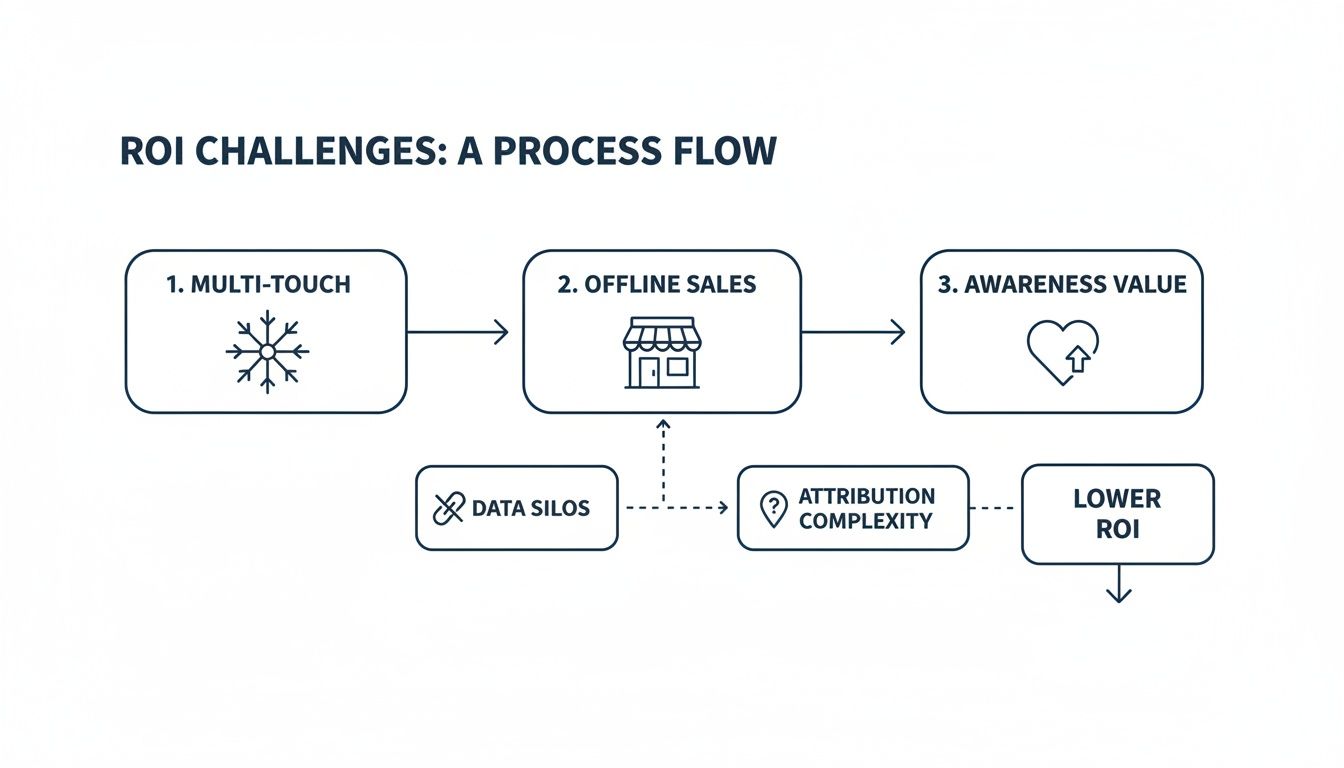
As this flowchart shows, a customer's journey is often messy, making it tough to assign credit where it's due. That’s why we need sharper tracking methods.
Implementing Tracking Pixels for Clearer Conversion Data
Another must-have tool in your kit is the tracking pixel, like the Meta Pixel for Facebook and Instagram. A pixel is just a tiny piece of code you add to your website. When someone who saw your social ad takes an action—like adding an item to their cart or buying something—the pixel "fires" and reports this activity back to the social platform.
This creates a direct link between what you spend on ads and what happens on your site. You can finally see not just which ads are getting clicks, but which ones are actually driving valuable business results.
When you combine UTM parameters with tracking pixels, you stop making assumptions and start gaining real, evidence-based insights. You're no longer just shouting into the void; you're creating a feedback loop that tells you exactly what’s working and what isn't.
Choosing the Right Attribution Model
Once you have all this data flowing in, you have to decide how to give credit for each sale or lead. This is where attribution models come into play. To get started, let’s look at the two most common types:
- First-Touch Attribution: This model gives 100% of the credit to the very first place a customer ever interacted with your brand. It’s great for figuring out which channels are best at introducing new people to your business.
- Last-Touch Attribution: This one does the opposite, giving all the credit to the final touchpoint right before the conversion. It’s perfect for seeing which channels are the closers—the ones that seal the deal.
Sure, there are more complicated multi-touch models out there, but starting with one of these is a great way to simplify your analysis and get clear answers.
For influencer campaigns, where every single click matters, this is especially critical. A platform like REACH solves this problem by pulling everything into one central dashboard. You get real-time click tracking for every influencer's link, taking all the guesswork out of the equation. This gives you a clean, consolidated view of which creators are driving the most traffic and sales, making sure your social media ROI is always crystal clear.
How Influencer Marketing Can Seriously Boost Your Social Media ROI

If you're searching for a reliable way to get more bang for your buck, influencer marketing is one of the smartest moves you can make to improve your social media ROI. Let's face it, traditional ads can feel pushy and interruptive. Influencers, on the other hand, offer authentic social proof that resonates with people.
They’ve spent years building real trust with their followers, so when they recommend something, it feels more like getting a tip from a good friend than hearing a corporate sales pitch.
That authenticity is what makes all the difference. When an influencer talks about your product, they're essentially lending you their hard-earned credibility. This gives you a direct line to a targeted, engaged audience that’s already listening, creating a connection that static ads just can't match.
The numbers back this up, too. On average, influencer marketing is now pulling in a return of $5.78 for every $1 spent. That figure leaves most other digital advertising channels in the dust. With global social commerce expected to rocket past $1 trillion by 2028, partnering with creators isn't just a trend—it's becoming a core part of any smart growth strategy.
The Hidden Strength of Micro-Influencers
Here’s a common misconception: you don’t need a celebrity-sized budget to get incredible results. In fact, some of the best value comes from micro-influencers—creators with smaller but fiercely loyal followings.
Their audiences are often laser-focused on a specific niche and hang on every word, which frequently leads to much higher conversion rates and a fantastic social media ROI.
A micro-influencer partnership feels less like an advertisement and more like a community recommendation. This genuine connection is what drives action and delivers a surprisingly high return on a smaller investment.
For example, a boutique fitness apparel brand partnered with five micro-influencers on TikTok through the REACH Influencers platform. Each creator had under 50,000 followers but a highly engaged audience of fitness enthusiasts. By providing unique discount codes, the brand could track sales directly. The campaign cost a fraction of a single macro-influencer post but generated a 7:1 return on investment within the first month by tapping into these dedicated communities.
The cost is lower, the targeting is spot-on, and the results can be stunning. To see the full picture, you have to measure the ROI of influencer marketing properly.
Of course, the trick is finding the right creators. That’s where a platform like REACH Influencers comes in. Our discovery tools help you find those perfect micro-influencers based on who their audience is, how engaged they are, and what they’re passionate about. From there, we make managing the entire campaign—from first contact to final payment—incredibly straightforward, so you can be sure every dollar is working hard for your bottom line.
How to Report Your Social Media ROI to Stakeholders
Alright, you’ve been in the trenches, running campaigns and crunching numbers. Now comes the real test: showing the higher-ups what it was all for. Proving your social media ROI isn't about dumping a spreadsheet on their desk; it's about telling a story they actually care about—one that connects your work directly to the company's bottom line.
Think about it from their perspective. They speak the language of profit, loss, and growth. So, you need to translate your efforts into their language. Instead of opening with likes and shares, lead with the money. Show them exactly how that influencer campaign drove 25% more sales or how your content strategy slashed customer acquisition costs.
Creating Reports That Actually Get Read
Let’s be honest, no one wants to read a wall of data. Your report needs to be clean, visual, and straight to the point. The goal is to build a narrative around your biggest wins, not to drown them in every single metric you've tracked.
Here’s a simple structure that always works:
- Start with the headline news. Kick things off with a quick executive summary. Put the most important numbers right at the top—total revenue generated, overall social media ROI percentage, and the key takeaway.
- Show, don't just tell. Use simple charts and graphs to make your data easy to digest. A line graph showing a steady increase in leads from social media is far more powerful than a table of numbers.
- Connect the dots for them. Don't make them guess. Explicitly link your social media results to the big-picture company goals, whether that’s breaking into a new market or hitting a specific revenue target.
Your report should act as a bridge, connecting your team's day-to-day activities to the company's financial success. Every chart, every number should build a clear, undeniable case for social media's value.
This final step is where a tool like REACH can be a lifesaver. It takes all your data and helps you build professional, easy-to-understand dashboards and reports automatically. You can quickly pull together presentations that showcase campaign performance and prove the impact of your work, leaving no doubt in your stakeholders' minds.
Frequently Asked Questions About Social Media ROI
We’ve walked through the what, why, and how of social media ROI, but you probably still have a few questions floating around. That’s completely normal. Let's tackle some of the most common ones that come up when it's time to connect the dots between your social efforts and the bottom line.
Think of this as the practical part of the conversation—the quick answers you need to get back to work with confidence.
What Is a Good ROI for Social Media?
Everyone wants to know the magic number, but the truth is, a "good" ROI really depends on your business. Your profit margins, industry, and what you’re trying to achieve all play a huge role.
That said, a common benchmark to aim for is a 5:1 ratio. This means for every $1 you put into your social media efforts, you get $5 back. If you’re hitting a 10:1 ratio or higher, you’re absolutely crushing it.
But remember, context is king. A campaign designed to build brand awareness won't have the same direct monetary return as a lead-gen campaign, but its long-term value can be massive. The most important thing is to set your own realistic goals and track your performance against them.
How Do You Measure ROI for Organic Social Media?
This one’s a classic challenge. Measuring the return on your organic (unpaid) posts feels a bit like trying to catch smoke, but it's totally doable. The trick is to shift your thinking. Your "investment" isn't ad spend; it's the time and salaries of your team, plus any tools you use.
Here’s a simple way to approach it:
- Put a price on your goals. First, figure out what a website click, a new email subscriber, or a PDF download is actually worth to your business in dollars and cents.
- Get smart with UTMs. Add unique UTM codes to the links in your organic posts. This is a non-negotiable. It lets you see exactly how much traffic and how many conversions came from a specific post when you look at your Google Analytics.
- Don't forget assisted conversions. Social media often plays a supporting role. Check your analytics to see how many customers interacted with your organic social content on their way to making a purchase, even if it wasn't the very last click. This proves its influence.
Which Social Media Platform Has the Best ROI?
If only it were that simple! The real answer is: it depends entirely on where your audience hangs out.
For most B2C brands, Facebook and Instagram are often the heavy hitters. Their massive user bases and incredibly detailed ad targeting options make them a powerful combo for driving sales.
On the other hand, if you're in the B2B world, LinkedIn is usually the undisputed champion for generating high-value leads. The best platform for you will always be the one where your ideal customers are actively listening and engaging. Test everything, measure the results, and then go all-in on what's proven to work for your business.
Ready to stop guessing and start proving the value of your influencer campaigns? REACH Influencers provides a centralized dashboard with real-time analytics, click tracking, and professional reporting to make calculating your social media ROI effortless. Discover how REACH can transform your influencer marketing strategy today.
{
“@context”: “https://schema.org”,
“@type”: “BlogPosting”,
“mainEntityOfPage”: {
“@type”: “WebPage”,
“@id”: “https://reach-influencers.com/blog/roi-social-media”
},
“headline”: “Boost Your ROI on Social Media: A Practical Guide to Proving Its Value”,
“description”: “Learn how to calculate, track, and improve your social media ROI with our comprehensive guide. Discover practical strategies, essential formulas, and how influencer marketing can maximize your return.”,
“image”: “https://cdn.outrank.so/64cdc0e0-2a54-4cd9-a45d-c4196c5e1d4e/af5fed79-079f-48ae-85d9-40f80afcdb18/roi-social-media-roi-growth.jpg”,
“author”: {
“@type”: “Organization”,
“name”: “REACH Influencers”,
“url”: “https://reach-influencers.com”
},
“publisher”: {
“@type”: “Organization”,
“name”: “REACH Influencers”,
“logo”: {
“@type”: “ImageObject”,
“url”: “https://reach-influencers.com/logo.png”
}
},
“datePublished”: “2023-10-26”,
“dateModified”: “2023-10-26”,
“faqPage”: {
“@type”: “FAQPage”,
“mainEntity”: [{
“@type”: “Question”,
“name”: “What is a good ROI for social media?”,
“acceptedAnswer”: {
“@type”: “Answer”,
“text”: “A common benchmark for a good social media ROI is a 5:1 ratio, meaning you earn $5 for every $1 spent. However, this can vary based on your industry, profit margins, and campaign goals. The most important thing is to set realistic goals and track performance against them.”
}
},{
“@type”: “Question”,
“name”: “How do you measure ROI for organic social media?”,
“acceptedAnswer”: {
“@type”: “Answer”,
“text”: “To measure organic social media ROI, your ‘investment’ is the time and salary of your team. You can track ROI by assigning a monetary value to conversion goals (like a website click or email sign-up), using UTM codes on all links to track traffic in Google Analytics, and monitoring assisted conversions to see how organic social contributes to the overall customer journey.”
}
},{
“@type”: “Question”,
“name”: “Which social media platform has the best ROI?”,
“acceptedAnswer”: {
“@type”: “Answer”,
“text”: “The platform with the best ROI depends entirely on where your target audience is active. For many B2C brands, Facebook and Instagram are top performers due to their large user bases and advanced targeting. For B2B companies, LinkedIn is often the most effective for generating high-value leads. The best approach is to test different platforms and focus your budget on what works for your specific business.”
}
}]
}
}