
Here's the honest answer: there’s no single magic number when you're asking, "what is a good click through rate" (CTR). What counts as a great CTR for a high-intent search ad might be just okay for an email campaign and completely different for an influencer post. It all comes down to your industry, the channel you're using, and your campaign goals.
This guide will break down the benchmarks for every major channel, from paid search to influencer marketing, and give you actionable frameworks to improve your performance.
Table of Contents
- What Click-Through Rate Really Means for Your Brand
- What Is a Good Click Through Rate on Different Channels?
- Paid Search vs. Display Ads: What to Expect from Your CTR
- Social Media & Video: What’s a Good CTR Here?
- How AI Is Reshaping Organic Search CTR
- Actionable Strategies to Improve Your CTR
- Common Questions About Click-Through Rate
What Click-Through Rate Really Means for Your Brand
At its core, click-through rate is one of the most important digital marketing performance metrics. It tells you what percentage of people who saw your content—whether it’s an ad, an email, or a search result—were interested enough to actually click on it.
Think of it like this: your ad is a storefront window. Everyone who walks by is an "impression." The people who decide to open the door and come inside are the "clicks." CTR measures how effective your window display is at getting people to step inside. The math is simple: (Total Clicks ÷ Total Impressions) x 100 = CTR.
So, if your ad was shown 1,000 times and got 50 clicks, your CTR is 5%. This percentage gives you a powerful snapshot of how well your message is landing. A high CTR usually means your creative is hitting the mark, while a low one is a clear sign that something’s off and needs adjustment.
Average CTR Benchmarks at a Glance
To give you a starting point, here’s a quick look at some typical CTRs you might see across different marketing channels.
| Marketing Channel | Average CTR Benchmark |
|---|---|
| Search Ads | 3-5% |
| Social Media Ads | 1-2% |
| Email Marketing | 10-15% |
Keep in mind, these are just averages. They provide a general idea but don't tell the whole story for your specific campaign.
Why Context Is Everything
User intent is the key to understanding these numbers. Someone typing a search into Google is actively looking for an answer or a product, so they’re already in a "clicking" mindset. In contrast, a person scrolling through their Instagram feed is there to be entertained, not necessarily to shop.
This chart drives that point home, showing just how different the baseline expectations should be for each channel.
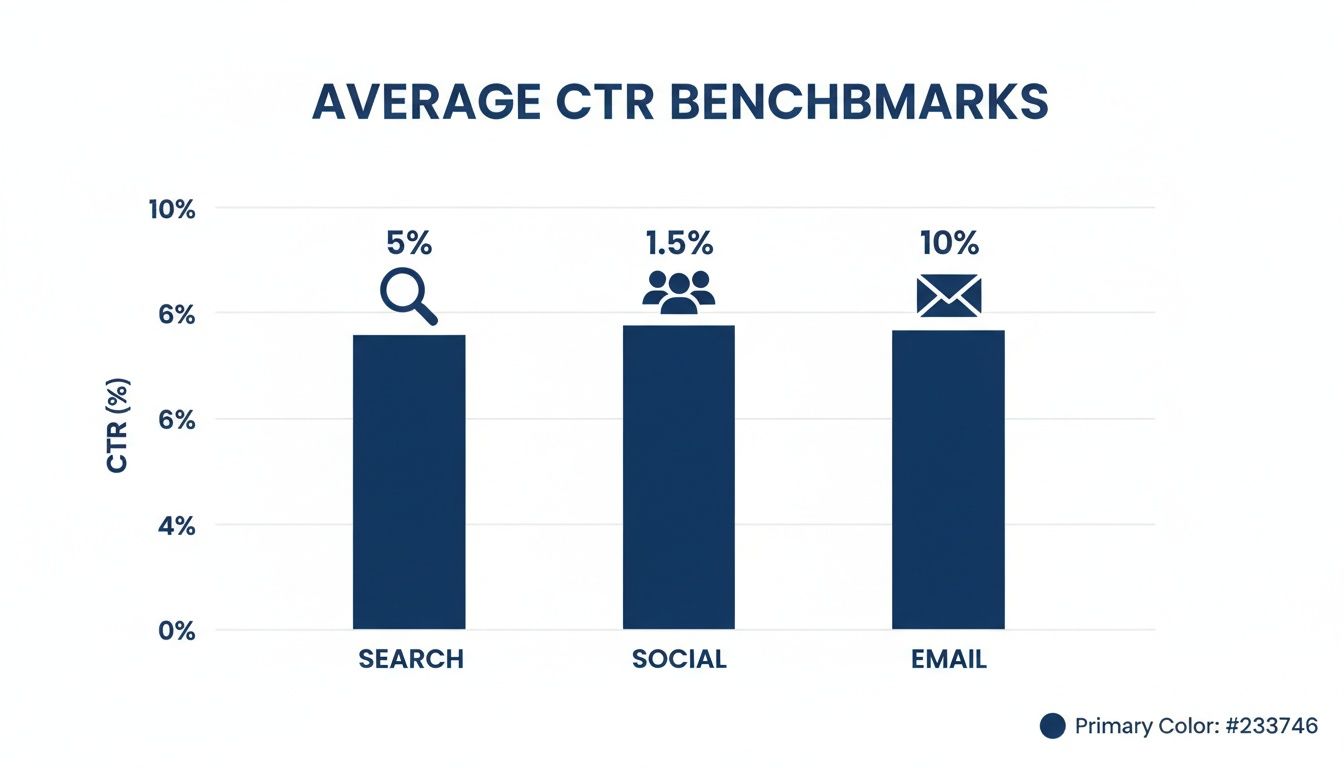
As you can see, email tends to lead the pack, with search following, and social media often having the lowest average CTR. This is why comparing your email CTR to your social media ad CTR is like comparing apples to oranges.
How Influencer Marketing Changes the Game
Those benchmarks are great for traditional ads, but influencer marketing operates on a different level. When a trusted creator shares something, it doesn't feel like a standard ad—it feels like a genuine recommendation from a friend. This is where a top influencer marketing platform like REACH Influencers comes in, helping you find creators whose audience is a perfect match for your brand.
By partnering with the right influencers, brands can tap into pre-built trust and authenticity. This often leads to CTRs that blow typical social media averages out of the water. That authentic connection is why influencer posts see such high engagement. A link shared by a creator is powerful because it comes with a built-in stamp of approval, making their followers much more likely to click.
What Is a Good Click Through Rate on Different Channels?
If you're trying to find a single, universal number for a "good" click-through rate, you're going to have a bad time. It's like asking, "What's a good speed for a vehicle?" The answer is totally different if you’re in a race car on a track versus a delivery truck in city traffic.
In marketing, context is everything. A 2% CTR could be a massive win for one campaign and a total flop for another. It all boils down to a few key factors: the user's mindset, where and how they see your ad, and how well they already know you. Once you get a handle on these variables, you can start setting much more realistic goals.
User Intent: The Hunter vs. The Scroller
The biggest driver behind CTR is what the user is actually trying to do. Just think about the difference between someone typing a search into Google and someone mindlessly scrolling through their Instagram feed.
- Active Intent (High CTR): When someone goes to Google, they're on a mission. They're actively hunting for an answer, a product, or a solution to a problem. Because they’re already looking for something specific, they are primed and ready to click on a relevant ad. This is why search ads often see higher CTRs.
- Passive Intent (Low CTR): On social media, people are usually in discovery mode—they're just passively scrolling to be entertained or see what their friends are up to. Your ad is an interruption, not the reason they're there. That means you have to work a lot harder to earn that click.
This fundamental difference in mindset is the main reason search ads typically outperform social media ads on CTR. It all comes down to the user's frame of mind.
Ad Format and Platform
The way you present your message also plays a massive role. An ad format that crushes it on one platform might completely bomb on another.
An eye-catching video ad on TikTok is built to stop a user mid-scroll, while a simple text ad on Google is designed to provide a direct answer. Each format has its own definition of success.
A flashy, engaging video ad is great for grabbing attention, but a simple, well-written search ad can deliver a much higher CTR if it perfectly matches what the person is looking for. Your creative has to feel native to the platform to really succeed. For a deeper dive on how creative and relevance impact performance, this guide to improving organic search CTR from Databox has some great insights.
Audience Temperature: Cold, Warm, and Hot
Finally, your existing relationship with the audience—or lack thereof—has a huge impact on whether they'll click. We often talk about this as audience temperature, which basically sorts people into three groups:
- Cold Audience: These are complete strangers. They’ve never heard of your brand, so earning their trust and their click is the toughest job. Expect lower CTRs here.
- Warm Audience: This group knows who you are. Maybe they’ve visited your site or follow you on social media, but they haven't bought anything yet. They're much more likely to click than a cold prospect.
- Hot Audience: These are your people—your loyal customers and biggest fans. They already know, like, and trust you, so they're far more willing to click on your links, leading to the highest CTRs.
This is why an email campaign to your existing customers will almost always have a better CTR than a Facebook ad targeting people who have never heard of you. It’s also what makes influencer marketing so powerful. Creators introduce your brand to their built-in warm audiences, creating an instant connection that drives clicks. A platform like REACH Influencers helps brands tap into these pre-warmed communities by matching them with the right creators, turning what would have been a cold introduction into a warm handshake.
Paid Search vs. Display Ads: What to Expect from Your CTR
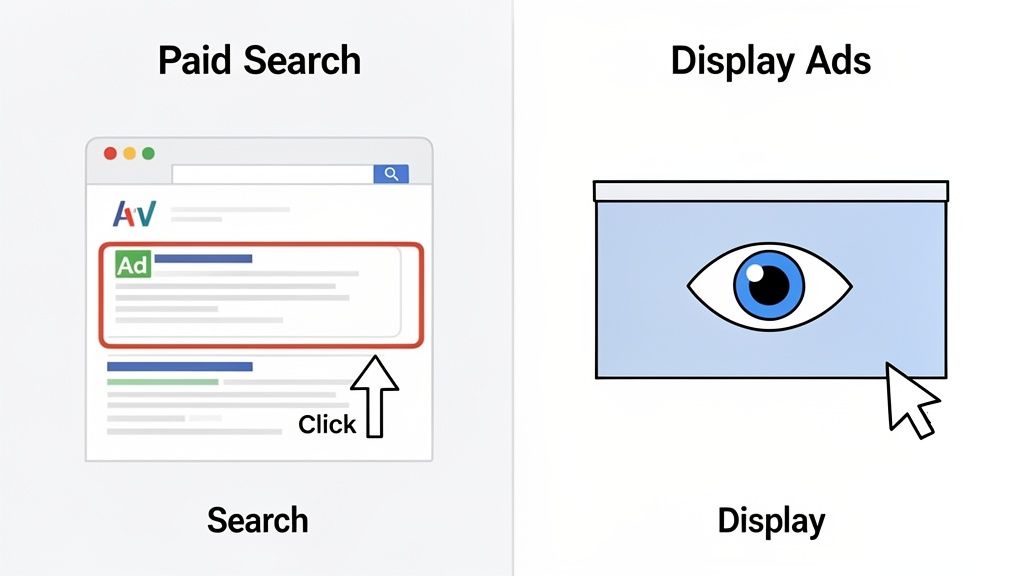
When we talk about paid ads, we’re really talking about two different worlds: search and display. Think of it this way: a search ad is like a helpful librarian answering a specific question, while a display ad is like a billboard trying to catch your eye as you drive by.
A person typing something into Google is on a mission. They have a problem and are actively looking for a solution, which makes them prime candidates to click on a relevant ad. On the other hand, someone reading an article is there for the content; your display ad is an interruption, however welcome it might be. This huge difference in user intent is why their CTRs are miles apart.
What’s a Good CTR for Google Ads?
Google Ads is the undisputed champ of paid search, so its data gives us a fantastic baseline for what to expect. While benchmarks are always shifting, knowing the current numbers helps you set goals that are ambitious but achievable.
So, what’s a “good” CTR in 2025? It really depends on the channel. Google Search ads are where you’ll see the highest numbers, with an average CTR of 6.66% across all industries. But that’s just the average. Some fields see incredible results.
Arts & Entertainment ads, for example, pull in an average CTR of 13.1%. That's followed by Sports & Recreation at 9.19%, Shopping & Gifts at 8.92%, and Automotive at 8.29%. For industries with a longer sales cycle, like Finance, B2B Services, or Legal, a strong CTR is typically in the 5–8% range.
Then there’s the Google Display Network, where the average CTR is just 0.46%. That number might seem low, but it reflects the completely different job display ads are meant to do.
The big takeaway here is that your industry is just as important as the channel you’re using. Fun, consumer-focused niches will almost always get more clicks than complex B2B services where people take their time to decide.
A 13% CTR for an art gallery is amazing, but a 5% CTR for a law firm could be a massive win. Context is everything.
What Drives a High CTR in Paid Search?
Getting a great CTR on your search ads boils down to one word: relevance. Since people are actively looking for something, how well your ad matches their search query is the single most important factor.
It really comes down to three things working together:
- Keyword Relevance: Your ad has to be a direct match for the keywords you’re bidding on. If someone searches for "vegan leather boots," your ad needs to talk about vegan leather boots—not just "women's shoes."
- Ad Copy That Pops: You have to grab their attention. Use action-oriented words, call out what makes you special (like free shipping or a limited-time discount), and always include a clear call-to-action that tells them what to do next.
- Ad Extensions: These are the little extras you can add to your ad—your phone number, location, or links to specific pages on your site. They make your ad bigger, more helpful, and much more clickable.
A big piece of this puzzle is the Google Quality Score, which is heavily influenced by your expected CTR. Google rewards ads that give users a good experience with better placements and lower costs. It's a win-win.
How to Make Display Ads Work
With an average CTR of less than 0.5%, it’s obvious that display ads are playing a different game. Success here isn't always about the immediate click. It's often about getting your name out there, building brand recognition, and staying on people’s minds.
But that doesn’t mean you can’t get people to click. The best display campaigns nail two things:
- Eye-Catching Visuals: Unlike a plain text ad, a display ad has to be visually compelling. We’re talking high-quality images, clean branding, and a design that gets noticed without being annoying.
- Smart Targeting: Since users aren't searching for you, you have to go find them. This means using smart targeting options, like showing ads to people who have already visited your website (retargeting) or targeting users based on their interests, demographics, and online habits.
With display ads, a low CTR can be perfectly fine as long as your campaign is still profitable. To get a better handle on how cost and clicks relate, you can check out our guide on how to calculate cost per click.
In the end, search and display ads have different but equally important jobs. A customer might see your brand for the first time in a display ad, search for you on Google a week later, and finally make a purchase after clicking a link from an influencer they trust—an influencer you found through a platform like REACH Influencers. It’s a journey, and each channel’s CTR plays a part in getting them to the finish line.
Social Media & Video: What’s a Good CTR Here?
Trying to define a single “good” click-through rate for all social media is like trying to find one outfit that works for a wedding, a hiking trip, and a lazy Sunday on the couch. It just doesn’t make sense. Every platform, from the polished world of Instagram to the fast-paced, creative chaos of TikTok, has its own rules, audience, and algorithm.
Success isn't about chasing some universal number. It’s about understanding the specific environment you're in and setting realistic goals for that space.
Unlike search ads, where people are actively looking for something, social media ads are an interruption. You’re trying to grab someone’s attention while they’re scrolling through photos of their friends and funny videos. This means your creative has to work way harder to earn that click, which is why social CTRs are often lower than search. But get it right, and the results can be fantastic, especially with authentic, creator-led content.
Unpacking CTRs on Meta (Facebook & Instagram)
For many, Meta is the first stop for social advertising. With its huge user base and powerful targeting tools, it’s a beast. But performance can be all over the map depending on your industry and what you’re trying to achieve with your campaign.
Recent data shows that Facebook video ads aimed at driving traffic average a 1.57% CTR. But that number shifts dramatically once you look at specific industries. Real Estate, for example, leads the pack with a solid 2.60% CTR.
Here’s a quick breakdown for other sectors:
- Shopping: 1.67%
- Healthcare: 1.61%
- Beauty: 1.51%
- Legal: 0.99%
These numbers really drive home how much your specific audience’s interest and the relevance of your ad matter. It’s also a good idea to put these numbers in context. For example, a platform like Constant Contact sees an average 1.36% CTR for email marketing, which shows that older channels can still hold their own.
TikTok and YouTube: A Whole Different Ballgame
Then you have platforms like TikTok and YouTube, where everything is driven by video and entertainment. This completely changes the game. An ad that looks too corporate or slick on TikTok is doomed to be scrolled past in a heartbeat. The key to success here is to blend in, not to stick out like a sore thumb.
The best-performing ads on TikTok often don't feel like ads at all. They’re authentic, creator-driven videos that look and feel native to the feed—and that's what gets people to click.
YouTube gives you a few different ad formats, from the skippable in-stream ads to the ones you have to sit through. Your CTR is going to depend heavily on which format you choose and, more importantly, the quality of your creative. If you can't hook someone with a compelling story in those first five seconds, you’ve already lost them to the "Skip Ad" button. Because of this, a good CTR on YouTube can be anywhere from 0.5% to 2%, hinging almost entirely on how quickly you can grab someone's attention.
How Influencers Give You a CTR Advantage
This is where influencer marketing really shines. Think about it: a standard ad from a brand is an interruption. A recommendation from a creator you trust? That’s just good content. That built-in trust is the secret ingredient for driving a high CTR on social media.
When brands use a platform like REACH Influencers, they can connect with creators whose audiences are already hanging on their every word. A fashion influencer on Instagram can send way more traffic to a clothing brand's website than a generic ad because their post feels like a genuine style tip. Likewise, a tech creator on TikTok can get tons of clicks for a new gadget simply by showing it off in a fun, authentic video.
These partnerships let brands tap into that native, trusted feel of influencer content, helping them hit CTRs that traditional advertising can only dream of. To get a better handle on how creators drive these results, check out our guide to key social media engagement metrics.
How AI Is Reshaping Organic Search CTR
The ground is shifting under the feet of every SEO professional, and the tremor is coming from one place: AI-powered search. Google’s AI Overviews (AIO) are fundamentally changing how people get answers, and it’s forcing us to rethink one of the oldest metrics in the book—organic click-through rate. What we all thought was a good CTR for search is being rewritten right before our eyes.
For a long time, the game was simple. Get on the first page, get the click. But with AI Overviews, Google is now spoon-feeding answers directly on the search results page. This means users find what they’re looking for instantly, without ever visiting a single website.
This creates a brand new problem for marketers and content creators. It's a fantastic, faster experience for the searcher, but it pulls the rug out from under the websites that have spent years creating the very content that fuels those answers. SEO isn't going away, but putting all your eggs in that one basket is starting to look like a very risky bet.
The Numbers Don't Lie: Clicks Are Disappearing
This isn't just a hunch; the data tells a stark story about how AI is siphoning off organic clicks. The performance gap between search queries that trigger an AI Overview and those that don't is widening fast.
Let's look at the stats. In June 2024, search queries without an AI Overview had an average organic CTR of 2.74%. Compare that to queries with an AI Overview, which only saw 1.76%.
Now, fast forward to September 2025. The non-AIO queries dipped to 1.62%, but the AIO queries fell off a cliff to just 0.61%. That's a massive 61% overall drop in CTR for any search that includes an AI Overview. If you want to dig deeper, you can explore more research on AIO's impact on CTR to see the full picture.
The takeaway here is clear: when Google’s AI gives the answer, the user’s motivation to click an organic link vanishes. For anyone in marketing, this means the definition of what is a good click through rate for organic search is changing for good.
It's Time to Pivot to Channels You Actually Own
So, where do we go from here? It’s time for a strategic pivot. SEO is still crucial for getting your brand seen, but relying on it as your sole source of traffic is no longer a viable long-term strategy. The answer is to focus on building direct channels and loyal communities that you control.
And this is exactly where influencer marketing shines.
- Build a Direct Audience: Stop "renting" your audience from Google. Start building your own through email lists, social media communities, and direct followers.
- Create Real Loyalty: A loyal follower will come straight to your website, completely bypassing search engines.
- Partner with Creators: Influencers have already done the hard work of building trust and loyalty with an audience—the exact thing brands now desperately need.
By teaming up with trusted creators, you can build an audience that isn’t subject to the whims of the next big algorithm update.
When an influencer recommends your brand, they aren't just sending a click; they're sending a warm lead who trusts their judgment. This connection is something an AI-powered search result can never replicate.
This strategic shift is what makes a platform like REACH so important right now. REACH Influencers helps brands connect with creators who have that genuine, authentic bond with their followers. By working with these influencers, you build a resilient audience that comes to you directly, creating a stable source of traffic and sales that no search engine can ever take away.
Actionable Strategies to Improve Your CTR
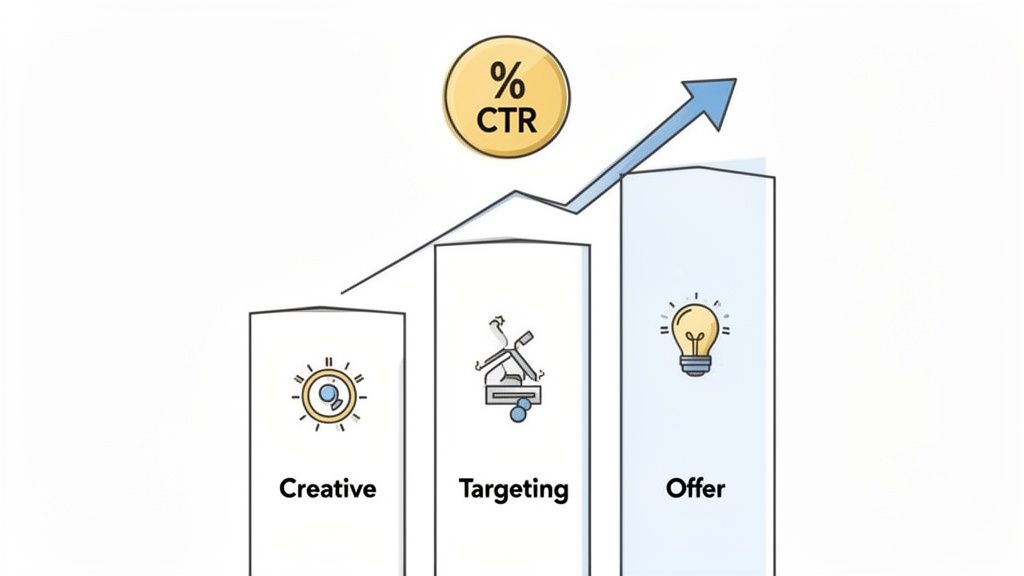
Knowing the benchmarks is one thing, but actually improving your own numbers is where the real work begins. Getting a better click-through rate isn't about luck. It's about systematically tweaking your message, targeting, and offer until they click—literally—with your audience. By focusing on a few core areas, you can transform a so-so CTR into a powerful engine for traffic and conversions.
This isn't a search for a single magic bullet. It’s a framework built on optimizing three key areas that work together to make your content impossible to ignore.
Pillar 1: Optimize Your Creative
Your creative is your first impression. Whether it's an ad, a search result, or an email subject line, it has one job: grab attention. To do that, it needs to be compelling, relevant, and crystal clear.
Start with your headlines and titles. You might be surprised to learn that simply including numbers in a title can dramatically boost engagement. Some studies even suggest that odd numbers outperform even ones.
- A/B Test Everything: Always be testing. Pit different headlines, images, and calls-to-action (CTAs) against each other. Sometimes a tiny change in wording can lead to a huge lift in clicks.
- Use Power Words: Words like "exclusive," "proven," or "guaranteed" trigger an emotional response or a sense of urgency, making your copy far more persuasive.
- Add Brackets or Parentheses: Research has found that adding a clarification like "[Case Study]" or "(New Data)" to a title can increase clicks by almost 40%.
Pillar 2: Refine Your Audience Targeting
You could have the most brilliant ad in the world, but if it's in front of the wrong person, it's just noise. The more precisely you can target your audience, the more relevant your message becomes, and a higher click-through rate is the natural result.
This is where truly knowing your customer pays off. Dig deeper than basic demographics and think about their behaviors, their interests, and what keeps them up at night.
The goal is to make your audience feel like you created the content just for them. When a message feels personal and directly addresses a need, the click becomes a natural next step.
Platforms like REACH Influencers are designed for exactly this. They help brands move past broad-stroke targeting by connecting them with influencers who have already built trust with a specific, engaged community. With REACH's discovery tools, you can filter creators by niche, audience demographics, and engagement, ensuring your message lands with people who are ready to listen. That kind of precision is how you cut through the noise on crowded platforms.
Pillar 3: Align Your Offer with Your Promise
A high CTR is useless if people click your ad and then immediately hit the back button. Your ad or title makes a promise, and your landing page has to deliver on it—instantly. A mismatch between your ad copy and your destination is a classic reason for poor post-click performance.
Make sure the user's journey is smooth and intuitive:
- Message Match: The headline on your landing page should echo the ad copy that brought them there.
- Clear Value Proposition: Whatever you promised in the ad—a discount, a guide, a solution—should be front and center. No digging required.
- Consistent Visuals: Use similar imagery and branding in both your ad and on your landing page to create a familiar, trustworthy experience.
For a deeper dive, check out these proven strategies to improve your click-through rates and start getting more from every campaign.
Common Questions About Click-Through Rate
Once you get the hang of the basics, you'll inevitably start having more specific questions about your own click-through rates. Think of this section as a quick-reference guide for those moments, designed to help you tackle the most common questions marketers ask. The goal is to help you read your data with more confidence and make smarter decisions.
We’ll get into everything from why a low CTR isn't always a disaster to the surprising impact of influencer marketing.
Is a Low CTR Always a Bad Sign?
Definitely not. When you’re trying to figure out what is a good click through rate, context is everything. If you're running a campaign focused purely on brand awareness, for example, your main goal is getting as many eyeballs on your ad as possible. A lower CTR in that scenario is perfectly fine.
The same goes for highly specialized B2B industries. A low CTR might still be wildly profitable if the few people who do click are high-value leads who eventually make a purchase.
Always measure CTR against your specific campaign objectives. A low CTR with a high conversion rate is often better than a high CTR with zero conversions.
How Does Ad Position Affect CTR in Google Ads?
It has a huge impact. In paid search, the ads at the very top of the results page almost always get more clicks. It makes sense—they're the first thing people see.
But those prime spots also cost more per click (CPC). A smart marketer knows that chasing the highest CTR isn't the whole story. You have to find that sweet spot between ad position, cost, and conversion rate to get the best return on your investment.
Can Influencer Marketing Achieve a Higher CTR?
Yes, and it’s one of the main reasons it's so effective. Influencer marketing works because it feels authentic. When a creator shares a link, it comes across as a genuine recommendation from a friend, not a stuffy corporate ad. That trust makes their followers much more likely to click.
The content is also perfectly matched to the audience's interests because it's coming from someone they already follow and respect. Using a platform like REACH helps brands find creators with hyper-engaged, niche audiences, which can lead to CTRs that blow traditional ads out of the water. The message just lands better because it has a built-in stamp of approval from the community.
Understanding what is a good click through rate is about looking beyond a single number and analyzing performance in the context of your goals, channel, and industry. By focusing on relevance, creative excellence, and authentic connections, you can drive more meaningful clicks.
Ready to tap into the power of authentic connections and watch your CTR climb? Discover how REACH Influencers can connect you with the perfect creators to drive real engagement and incredible results. Learn more about our influencer marketing platform and start your first campaign today.
{
“@context”: “https://schema.org”,
“@type”: “BlogPosting”,
“mainEntityOfPage”: {
“@type”: “WebPage”,
“@id”: “https://reach-influencers.com/blog/what-is-a-good-click-through-rate”
},
“headline”: “What Is a Good Click Through Rate? An In-Depth Guide for 2025”,
“description”: “Discover what a good click-through rate (CTR) is across search, social, and email marketing. This guide provides industry benchmarks and actionable strategies to improve your CTR.”,
“image”: “https://cdn.outrank.so/64cdc0e0-2a54-4cd9-a45d-c4196c5e1d4e/4f635642-ff62-44fd-a7b1-f029cb1e8e2a/what-is-a-good-click-through-rate-ctr-benchmarks.jpg”,
“author”: {
“@type”: “Organization”,
“name”: “REACH Influencers”,
“url”: “https://reach-influencers.com”
},
“publisher”: {
“@type”: “Organization”,
“name”: “REACH Influencers”,
“logo”: {
“@type”: “ImageObject”,
“url”: “https://reach-influencers.com/logo.png”
}
},
“datePublished”: “2024-10-26”,
“dateModified”: “2024-10-26”
}
{
“@context”: “https://schema.org”,
“@type”: “FAQPage”,
“mainEntity”: [{
“@type”: “Question”,
“name”: “Is a low CTR always a bad sign?”,
“acceptedAnswer”: {
“@type”: “Answer”,
“text”: “No, a low CTR is not always a bad sign. For brand awareness campaigns, impressions are more important than clicks. Similarly, in high-value B2B niches, a low CTR can still be very profitable if it leads to qualified conversions. Context and campaign goals are key.”
}
},{
“@type”: “Question”,
“name”: “How does ad position affect CTR in Google Ads?”,
“acceptedAnswer”: {
“@type”: “Answer”,
“text”: “Ad position significantly impacts CTR. Ads in the top positions on the search results page receive the vast majority of clicks. However, these positions are also more expensive, so marketers must balance CTR with cost-per-click (CPC) and overall return on investment.”
}
},{
“@type”: “Question”,
“name”: “Can influencer marketing achieve a higher CTR?”,
“acceptedAnswer”: {
“@type”: “Answer”,
“text”: “Yes, influencer marketing can often achieve a much higher CTR than traditional advertising. This is because influencer recommendations are seen as authentic and trustworthy by their followers. The content is inherently relevant to the audience, leading to higher engagement and more clicks.”
}
}]
}