 Skip to content

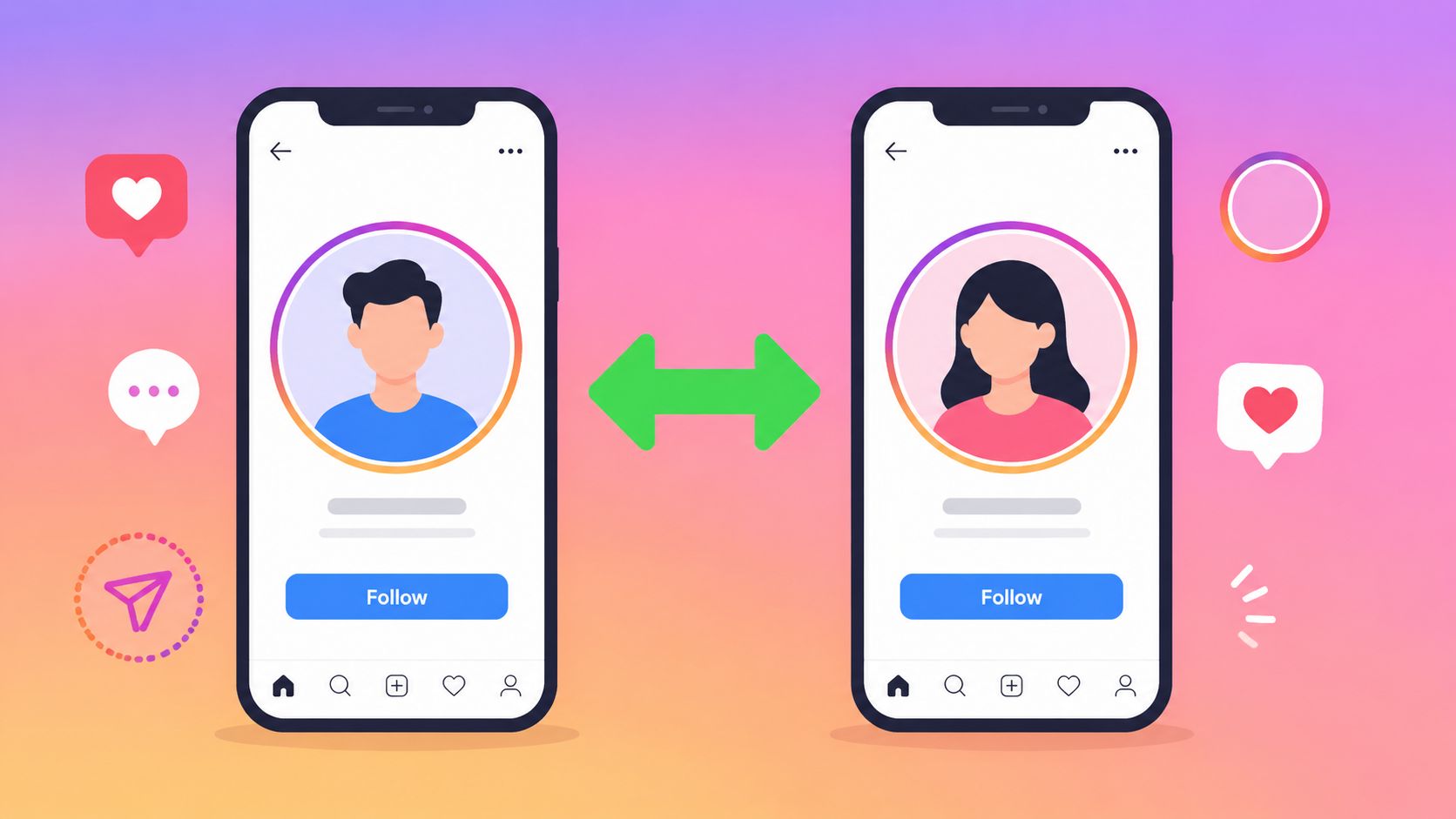
A mutual on Instagram is an account that follows you and that you follow back. If you're staring at a profile, seeing “Followed by [names] and [X] others,” or trying to figure out whether a creator has a real community around them, that simple two-way follow matters more than most brand managers realize.
You've probably run into this during influencer research. A creator looks strong at first glance. The content is polished, the follower count is decent, and the comments seem active. Then you notice something more useful than vanity metrics: shared connections, familiar niche accounts in their network, and signs that people in the category know them. That's where mutuals stop being social slang and start becoming a practical signal.
If you've ever searched what does mutual mean on Instagram, the basic answer is easy. The more important answer is professional. Mutuals can tell you whether an account is part of a real niche community, whether outreach is likely to land well, and whether a partnership has a better shot at producing authentic engagement instead of surface-level exposure.
Meta description: Learn what mutual means on Instagram, where to see it, how Instagram uses mutuals in recommendations, and why brands should use mutual connections to vet influencers and assess community health.
An Introduction to Instagram Mutuals
Mutuals are often first noticed in a familiar place: an Instagram profile that says “Followed by [names] and [X] others.” That line looks small, but it carries context.
In everyday Instagram use, mutuals are friends, acquaintances, and online connections who follow one another. Instagram's own messaging around community ties this reciprocal relationship to stronger conversations and a shared interest in each other's content, as shown in Instagram's post discussing mutuals and connection.
That matters because a two-way follow isn't just a label. It's one of the clearest signs that a relationship exists on both sides, not just from audience to creator.
Why marketers should care
Brand teams often over-focus on visible numbers and under-use visible network signals. Mutuals help correct that. They show whether a creator sits inside a real cluster of relevant accounts or whether they're floating on top of a broad but shallow audience.
For influencer vetting, that distinction matters in a few practical ways:
- Community fit: Mutuals often reveal whether a creator is known inside a niche.
- Outreach warmth: Shared connections can make first contact feel less cold.
- Audience overlap: Mutuals can hint at whether a brand and creator already touch the same community.
- Trust cues: When relevant people follow each other back, that usually signals more than passive awareness.
Practical rule: A creator with fewer but relevant mutual connections in your category is often more useful than a creator with a larger audience and no visible niche network.
What mutuals do not tell you
Mutuals are useful, but they're not a standalone KPI. They don't replace content review, audience relevance, brand safety checks, or deliverable planning. A strong network signal with weak creative fit still leads to mediocre campaigns.
That's the trade-off. Mutuals are best used as a screening layer, not a final decision.
What a Mutual Really Means on Instagram
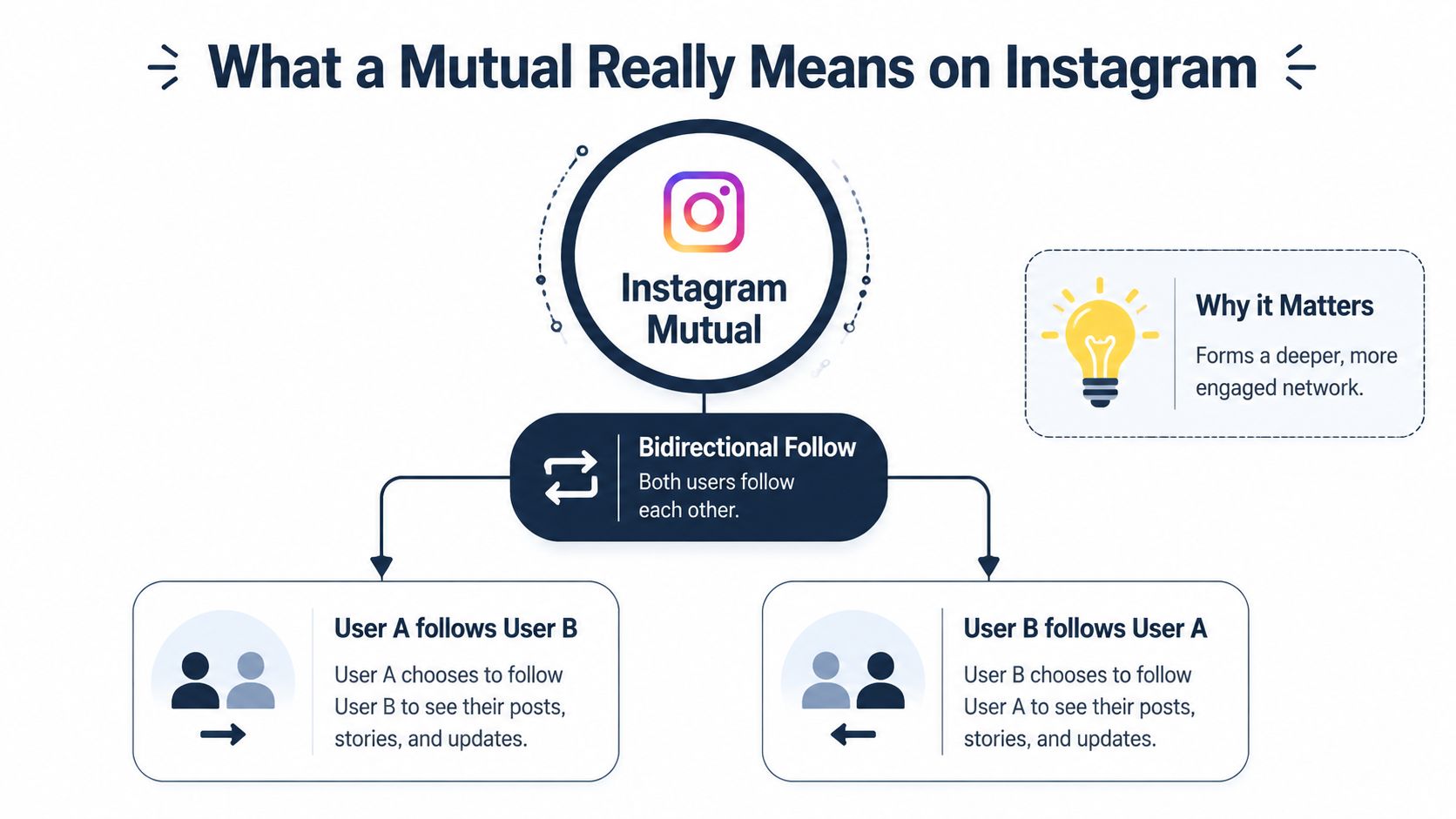
A mutual on Instagram is best understood as a two-way street. One-way follows are simple awareness. A mutual means both accounts chose to subscribe to each other's content.
Instagram also treats that relationship differently inside the product. According to BuzzVoice's glossary entry on Instagram mutuals, a mutual is a bidirectional relationship that's flagged in the interface, and mutuals are prioritized for Direct Messages, Notes, and Story replies because the platform treats that relationship as stronger.
Where you see mutual status in the app
Instagram doesn't always spell it out with one universal label, so people get confused. In practice, you'll usually spot mutual signals in a few places:
- Followers list: You may see a “follows you” label.
- Profile previews: Instagram may show “Followed by [names] and [X] others.”
- Suggested accounts and discovery surfaces: Shared network overlap often appears as a clue for why an account is being surfaced.
Those are slightly different views of relationship data, but they point to the same thing: Instagram is showing you that two accounts are connected through reciprocal or overlapping follow relationships.
Why this matters beyond definitions
For marketers, the functional impact matters more than the vocabulary. A creator who is a mutual with other relevant accounts isn't just connected socially. That creator may also be more visible in the communication and attention layers that matter on-platform.
That changes how I evaluate creator lists. I don't read mutuals as proof of influence. I read them as proof of embeddedness. An account with strong mutual relationships in a niche often has easier collaboration paths, warmer peer engagement, and less friction when a campaign needs comments, reshares, clarifications, or follow-up content.
Mutuals tell you the account has a relationship history, not just audience reach.
A simple decision filter
When you're comparing two similar creators, ask:
| Question | Why it matters |
|---|---|
| Do they have visible mutuals with respected niche accounts? | It suggests real category presence. |
| Are those mutuals relevant to the campaign? | Relevance beats random overlap. |
| Does their content reflect those relationships? | Network signals should match actual content behavior. |
If those answers line up, mutual status becomes more than a social detail. It becomes a practical signal that the creator may be easier to work with and more credible to the audience you care about.
How the Instagram Algorithm Uses Mutuals
Instagram doesn't use mutuals as a decorative social label. It uses them as a discovery signal.
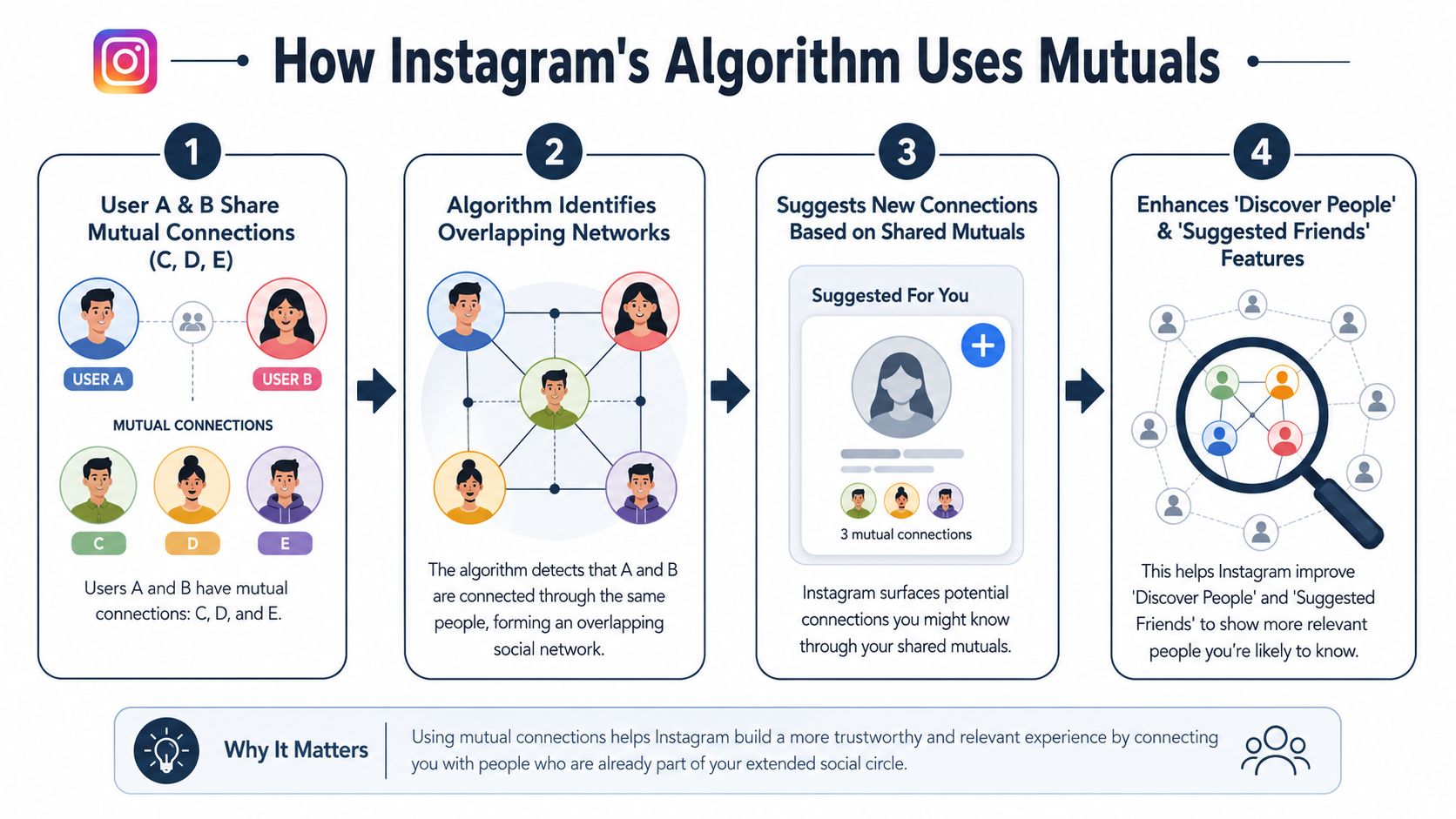
The platform treats mutual relationships as a meaningful indicator of trust and relevance when suggesting new connections. In plain terms, if two accounts share overlapping networks, Instagram reads that as a sign they may know each other, belong to the same community, or care about similar content.
The logic behind suggested accounts
Instagram's own product behavior makes this fairly clear. The platform designates mutuals as people who follow one another and uses shared network overlap to suggest new follows. It treats mutual followers as a primary signal for suggested friends, especially when accounts share multiple followers.
That's why the Discover People experience often feels socially familiar. The system isn't guessing at random. It's mapping relationship proximity.
Here's the practical version of that logic:
- Instagram compares follower networks.
- It looks for overlap between users.
- It ranks overlapping connections as more relevant than isolated ones.
- It uses that overlap to fuel recommendations.
Why shared overlap matters to brands
For brand managers, this affects both organic visibility and campaign planning. If a creator sits inside a dense niche network, Instagram has more relationship data telling it that this creator belongs in that audience cluster.
That doesn't guarantee campaign performance. It does improve the odds that the creator's content is being interpreted within a coherent community context rather than as standalone broadcasting.
A useful parallel exists in engagement strategy. Teams that work to boost POD brand Instagram engagement often focus on audience relevance, repeat interactions, and niche coherence. Mutuals fit that same logic. They indicate that engagement may come from people who already have a relationship path to the creator.
What Instagram still doesn't make clear
There's an important limitation here. Instagram shows mutual-friend style labels, but it does not publicly explain the exact overlap threshold required to trigger specific recommendations. That means marketers can understand the direction of the signal without seeing the exact weighting formula.
So don't overengineer it.
Working approach: Treat mutuals as a directional relevance cue. Use them to prioritize review, not to reverse-engineer the algorithm.
What works and what doesn't
What works
- Reviewing mutual overlap during shortlist building
- Looking for niche-relevant network density
- Combining mutual signals with content quality and audience fit
What doesn't
- Assuming lots of mutuals automatically means strong influence
- Treating generic mutual overlap as category authority
- Using mutuals without checking whether the creator's actual content matches the community signal
That's the trade-off. Mutuals help Instagram infer closeness. Brands still have to verify whether that closeness is useful.
Why Mutuals Matter for Vetting Influencers and Brands
Mutuals become operational at this stage.
In influencer marketing, the most expensive mistake isn't always choosing a creator with weak numbers. It's choosing a creator who looks relevant on paper but has no real standing inside the audience you want to reach. Mutuals can help you catch that early.
According to The Social Cat glossary on Instagram mutuals, mutual count can be a more accurate benchmark for campaign reach and community retention than total follower count because it isolates the segment with the highest algorithmic affinity for the creator. That's a useful lens for brand teams because it shifts attention from raw size to relationship quality.
Mutuals as a vetting signal
When I'm reviewing creators for a niche campaign, mutuals help answer a simple question: Is this creator part of the conversation, or just adjacent to it?
A strong mutual pattern can suggest:
- Peer recognition: Other creators in the space know them.
- Audience familiarity: Community members aren't just following, they're connected.
- Category legitimacy: The account appears integrated into a real niche cluster.
- Collaboration potential: Outreach often lands better when there's visible overlap.
This is especially useful in crowded verticals where surface-level content can look similar across dozens of accounts.
A better way to read network quality
A creator can have a polished media kit and still have weak community roots. On the other hand, a creator with moderate scale but strong niche mutuals often produces better campaign conversations, cleaner comment sections, and more believable endorsements.
That's why mutuals are valuable during shortlist review, but only if you interpret them correctly.
| Weak read | Better read |
|---|---|
| “They have lots of followers, so they must be influential.” | “Their network suggests people in the niche actually know and follow them back.” |
| “They look polished.” | “Their relationships and content both support the positioning.” |
| “We can ignore overlap.” | “Overlap may tell us whether outreach will feel native or forced.” |
A mutual-heavy network in the right niche often signals trust that follower count alone can't show.
Where this helps brands most
Mutuals are especially useful when you're trying to avoid inflated audiences. If a creator's public network signals don't match their stated positioning, that's a cue to dig deeper into audience quality, engagement patterns, and follower authenticity. A practical next step is reviewing signs discussed in guides about fake subscriber count checks for influencer vetting.
For brands, this improves three parts of execution:
- Shortlisting: You remove weaker fits earlier.
- Outreach: Shared context makes intros more natural.
- Retention: Partners with real community ties are often better long-term collaborators.
Mutuals won't replace briefs, contracts, approvals, or reporting. They will help you choose better people before all of that begins.
Practical Strategies to Leverage Mutual Connections
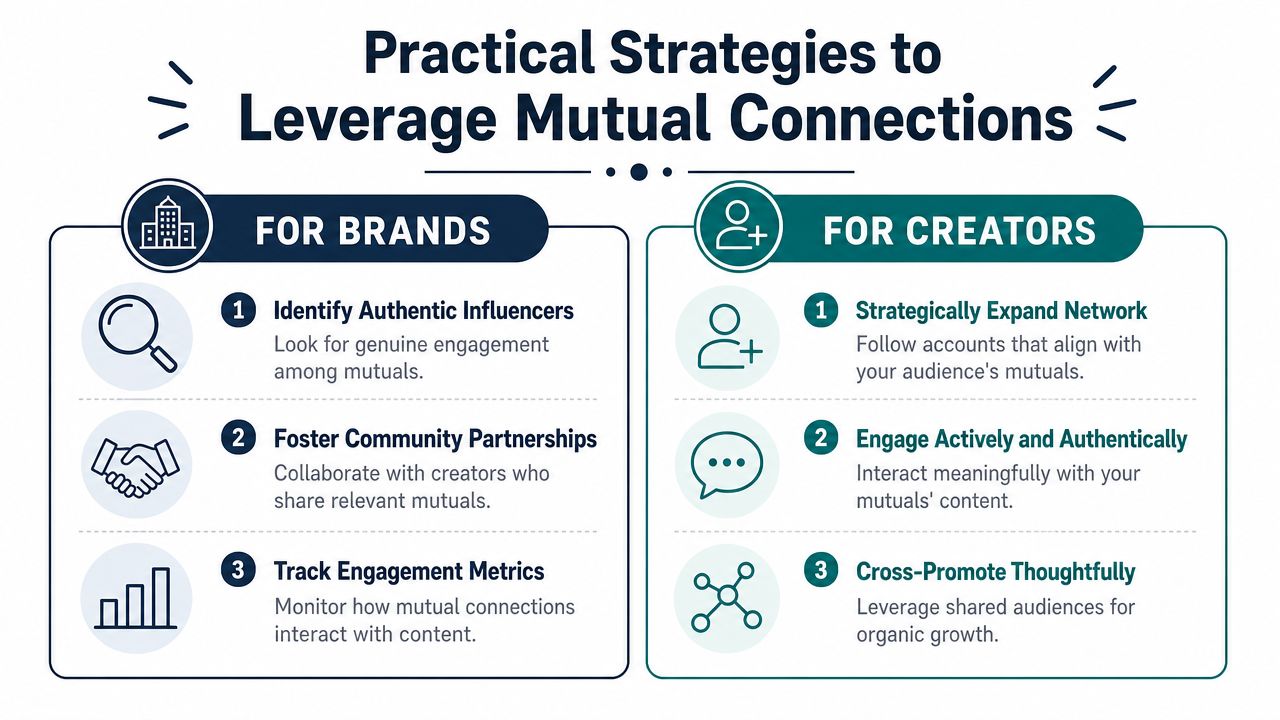
Once you understand what mutual means on Instagram, the next question is what to do with that information. The answer is different for brands and creators, but the principle is the same. Use mutuals to build a more intentional network, not a larger but weaker one.
Instagram already gives you a native way to inspect some of this. The platform displays “Followed by [names] and [X] others” to reveal mutual connections, which lets users check shared audience relationships without third-party apps.
For brands
Brands should use mutuals as a relationship map, not just a curiosity.
- Review shared connections before outreach: If a creator is followed by people your team already trusts, that's a useful signal.
- Follow strategically: Follow back key customers, category experts, and creator partners when there's a real reason to build the connection.
- Watch comment behavior: Mutuals who actively comment and reply often reveal stronger community health than passive overlap alone.
This is also where direct messaging matters. If your team needs a refresher on how Instagram messaging works in creator outreach, this guide on what a DM means and how brands use it is a practical primer.
For creators
Creators should think about mutuals as a quality filter for networking. Not every follow needs to become mutual. Forced reciprocity creates clutter fast.
Better uses include:
- Build lateral relationships with peers. These often lead to collaborations and introductions.
- Stay visible to relevant accounts. Commenting thoughtfully on mutuals' content is better than random cold engagement.
- Use overlap carefully for cross-promotion. Shared audiences can help, but only when the fit is obvious.
Field note: The strongest creator networks usually look natural from the outside. You can tell when people actually know each other versus when they're mechanically following back.
Privacy and visibility trade-offs
Mutuals also create a visible map of your network. That's useful for brands doing due diligence, but it also means your closest account relationships can be partially legible to other users.
That has two implications:
- For brands: your ecosystem can become visible to competitors.
- For creators: your core niche relationships become part of your public credibility, but also part of your public trail.
That's not a reason to hide. It's a reason to be intentional. Build mutual connections that support your positioning, because people can often infer a lot from who follows whom back.
From Insight to Execution with Your Influencer Campaigns
Mutuals sound simple because they are simple. A two-way follow is easy to define. The strategic value comes from what that relationship reveals.
For a brand manager, mutuals can help answer questions that follower count can't. Is this creator known in the niche? Do they seem connected to a real audience cluster? Will outreach feel cold, or will it land inside a recognizable network? Those aren't small questions. They shape shortlist quality, response rates, and the odds of a campaign feeling credible.
The best use of mutuals is disciplined, not obsessive. Check them during research. Compare them against content quality. Use them to spot creators with authentic community ties. Then move into execution with clear briefs, realistic deliverables, and organized communication.
If you're building a stronger process, these guides on how to collaborate on Instagram as a brand or creator, Instagram's official help resources, and Meta's creator education resources are useful next reads.
If someone on your team asks again, what does mutual mean on Instagram, the plain answer is still the same. It means both accounts follow each other. The professional answer is better. It's one of the fastest visible clues that a relationship is real, that a community exists, and that a creator may be a stronger campaign partner than their surface metrics suggest.
If you've identified creators with real community fit, REACH helps you run the campaign without losing control of the workflow. You can organize outreach, track deliverables, manage communication, monitor content across platforms, and handle payments from one dashboard, so your team spends less time juggling spreadsheets and more time executing creator partnerships that make sense.