 Skip to content


Ever had a friend rave about a new restaurant, and you just had to try it? That's the heart of social influence marketing. It’s all about brands partnering with creators—people who have already built a loyal following—to share a message that feels more like a trusted recommendation than a disruptive ad.
What Is Social Influence Marketing, Really?
At its core, social influence marketing is a partnership between a brand and an online creator. Instead of blasting a generic message to a massive, undefined audience like old-school advertising, this strategy focuses on reaching specific communities through voices they already listen to and trust. The whole idea is to weave a brand's message into a creator's content so it feels genuine and adds real value for their audience.
This entire approach hinges on two key things: authenticity and credibility. It’s a win-win-win situation:
- For brands: It's a direct line to highly engaged, niche audiences, complete with authentic content that resonates.
- For creators: They get to earn a living from their passion while sharing products they genuinely believe in with their followers.
- For audiences: They discover cool new things from a source they trust, often getting special discounts or unique perspectives.
From A-List Celebrities to Niche Creators
This isn't a brand-new idea; it's the modern-day evolution of the classic celebrity endorsement. But there's a crucial difference: relatability. A famous actor promoting a high-end watch can feel a million miles away. A micro-influencer sharing their favorite local coffee spot? That feels like a real tip from a friend.
This move from broad celebrity appeal to the focused authority of niche creators is what makes modern social influence marketing so powerful. It’s about finding people whose personal brand and audience are a perfect match for your own.
This strategic shift has powered explosive growth. What was once a small-time tactic is now a marketing powerhouse, with the market ballooning from $1.7 billion in 2016 to an estimated $32.55 billion by 2025. You can dive deeper into the psychology of influence to understand why these personal recommendations are so effective.
To really grasp the difference, let's compare social influence marketing directly with traditional advertising.
Social Influence Marketing vs Traditional Advertising
| Attribute | Social Influence Marketing | Traditional Advertising |
|---|---|---|
| Approach | Dialogue-driven, a two-way conversation | Monologue-driven, a one-way broadcast |
| Trust Factor | High, built on established relationships | Low, often viewed with skepticism |
| Audience | Niche, highly targeted communities | Broad, mass-market demographics |
| Content | Authentic, integrated, user-generated | Polished, scripted, overtly promotional |
| Engagement | High, encourages interaction and discussion | Low, typically passive consumption |
| ROI Measurement | Trackable through specific links and codes | Often difficult to measure direct impact |
This table shows a fundamental shift from interruption to integration. One talks at people, while the other starts a conversation with them.
Results That Go Beyond Standard Metrics
This approach doesn't just feel different—it performs differently, too. Campaigns driven by creators often deliver much higher engagement and conversion rates precisely because the message comes from a trusted source, not a faceless corporation.
Social influence marketing transforms advertising from an interruption into a conversation. It leverages the power of human connection and trust to build brand affinity in a way that traditional ads simply cannot.
The proof is in the numbers. Just look at how influencer-led campaigns stack up against a brand's own organic social media efforts.
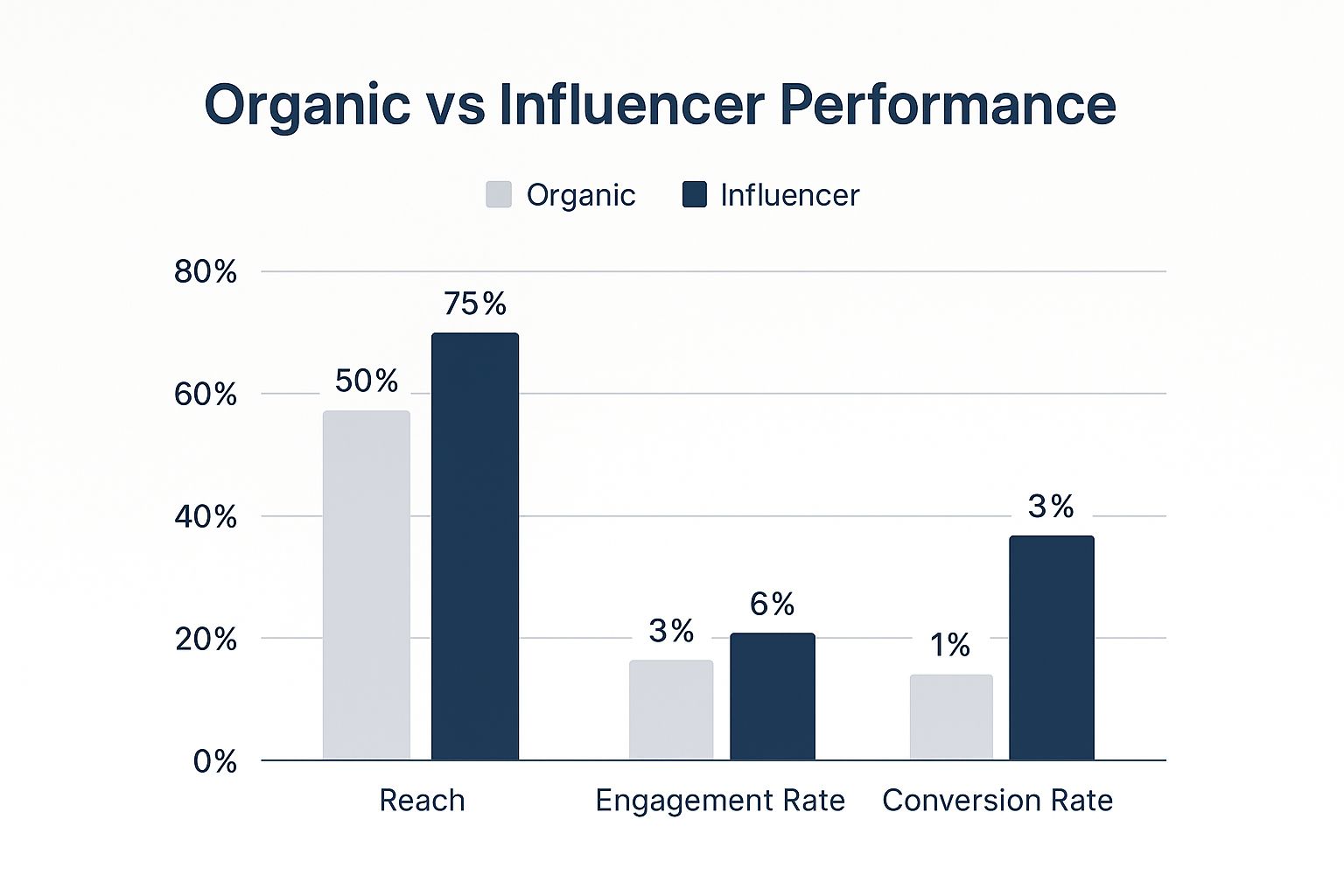
As you can see, creator collaborations consistently leave standard organic posts in the dust when it comes to engagement and conversions. It's clear evidence of their power to not just capture attention, but to inspire action.
Why Social Influence Isn't Just an Option—It's Essential

Let's face it: the old way of advertising is broken. In a world overflowing with digital noise, consumers have gotten incredibly good at ignoring brands. Just look at the numbers—a staggering 42% of internet users now use ad-blockers. Shouting louder just doesn't cut it anymore.
This is where social influence marketing changes the game. It works by switching the messenger from a faceless company to a real person someone already knows and trusts.
The strategy taps into a fundamental human behavior known as social proof. It’s the same reason you'll choose a restaurant with a line out the door over the empty one next to it. Online, creators build that same kind of buzz. Their endorsement tells their followers, "This is good. This is worth your time."
Why is that so powerful? Because creators invest years building genuine connections. Their followers see them as peers and experts, not just entertainers. That deep-seated trust is transferable—when they recommend your product, their credibility becomes your credibility.
Turning Authentic Trust into Real Sales
Authenticity is the most valuable currency in the creator economy. A creator’s recommendation feels like getting advice from a friend, not watching a slick TV commercial. And that genuine feeling is incredibly persuasive; research shows that 69% of consumers trust recommendations from influencers.
This trust doesn't just generate likes and comments; it directly drives business. It’s about moving people from discovering your brand to becoming loyal customers. A smart social influence campaign can hit multiple business goals all at once.
Think about how it works across the entire marketing funnel:
- Awareness: Your brand gets introduced to thousands of potential customers within a community that’s already engaged and interested in what you offer.
- Consideration: Authentic reviews and how-to videos answer customer questions and smooth over any doubts, often before they even come up.
- Conversion: Personalized discount codes and affiliate links make it easy to track sales directly, giving you a crystal-clear picture of your ROI.
- Loyalty: Ongoing partnerships with creators help build a community around your brand, encouraging customers to come back again and again.
When a creator seamlessly works a product into their content, it stops feeling like an ad. It becomes a helpful piece of advice. This is the magic formula: shifting from promotion to recommendation is what unlocks real, tangible growth.
The numbers back this up. For every $1 spent on influencer marketing, brands are seeing an average return of $5.78. That makes it one of the most effective ways to find and win over new customers today.
A Complete Solution for Today's Brands
The value doesn't stop at the initial sale, either. A great social influence marketing campaign gives you a treasure trove of authentic user-generated content (UGC). You can then repurpose this content for your own social media, email campaigns, and even paid ads, giving you a steady stream of marketing material that actually connects with people.
Picture a fitness brand working with a popular yoga instructor. Her followers see the brand’s gear in action during a real workout, not posed on a model in a sterile photo studio. That single piece of content is a product demo, a customer testimonial, and an aspirational story all rolled into one.
This approach also lets you get incredibly specific with who you reach. Forget about casting a wide net with broad demographics. You can tap directly into niche communities built around shared passions, whether it's sustainable fashion or vegan cooking. You’re not just reaching more people; you’re reaching the right people. By becoming part of these trusted communities, you build brand affinity that lasts, setting the stage for long-term, sustainable growth.
The Core Components of a Successful Campaign
A high-impact social influence marketing campaign doesn’t just happen. It's carefully built, piece by piece, on a foundation of clear, strategic components. Think of it like building a house—you can't just start putting up walls without a solid blueprint. Each part has to be planned and executed perfectly to make sure the final structure is strong and serves its purpose.
This framework is your practical roadmap, guiding you from the initial idea all the way to launch and making sure no critical detail gets missed. Without these core elements, even a campaign with the world's best creators can fall flat.
And that journey always starts with figuring out exactly what you want to achieve.
H3: Setting Clear and Measurable Goals
Before you even start thinking about creators or content, you have to answer one simple question: what does success actually look like for us? Vague goals like "going viral" aren't a strategy; they're a lottery ticket. Your objectives need to be specific, measurable, and tied directly to what your business is trying to accomplish.
Are you trying to get your brand in front of a whole new demographic? Maybe you need to drive more qualified leads to your sales team. Or perhaps the goal is much more direct, like boosting sales for a new product you're launching.
Each of these goals requires a completely different playbook. For instance:
- Brand Awareness: Success here is all about reach, impressions, and follower growth. The game is to get your brand name in front of as many of the right people as possible.
- Lead Generation: For this, you’ll be tracking metrics like email sign-ups, demo requests, or downloads. The main goal is to capture contact info from people who are genuinely interested.
- Direct Sales: This is the most straightforward. You're measuring conversions, revenue, and return on ad spend (ROAS), often by using unique discount codes or affiliate links.
Nailing down these goals from the very beginning will shape every single decision you make down the line, from the creators you pick to the content they produce.
H3: Identifying Your Audience and Finding the Right Creators
Once you know what you’re aiming for, the next step is to get crystal clear on who you're talking to. Who are they? What do they care about, what are their pain points, and where do they spend their time online? Knowing this inside and out is the key to finding creators whose followers are a perfect match for your ideal customer.
This is where understanding the different tiers of creators becomes so important. Each level brings something different to the table:
- Nano-influencers (1k-10k followers): These creators have sky-high engagement rates and a deep, personal bond with a small, niche community. They’re fantastic for building authentic trust with a very specific group.
- Micro-influencers (10k-100k followers): For many brands, this is the sweet spot. Micro-influencers give you a great balance of strong engagement and broader reach. They’re often seen as credible experts in their space.
- Macro-influencers (100k-1M followers): With a much larger audience, these creators are your go-to for big awareness campaigns. They can introduce your brand to a massive number of people, fast.
The best creator partnerships are built on alignment. It’s not about the size of their following but the fit of their audience and the authenticity of their voice. A perfect match amplifies your message in a way that feels natural and trustworthy.
Choosing the right fit means looking past the follower count. You need to make sure a creator's personal brand and values truly line up with your own.
H3: Crafting the Brief and Fostering Creative Collaboration
With your creators selected, the final piece of the puzzle is the creative brief. This document isn't a rigid script to be followed word-for-word; it's a collaborative guide. It should clearly lay out the campaign goals, key messages, deliverables, and any mandatory legal stuff, like using #ad or #sponsored.
But here’s the secret: the most successful campaigns give creators a ton of creative freedom. They know their audience better than anyone—they know what lands, what tone works, and what formats get the best results. If you micromanage their process, you’ll kill the very authenticity you’re paying for, and the content will feel like a stiff, corporate ad. To really connect with an audience and see a measurable impact, it’s critical to use compelling visual storytelling techniques that feel native to the creator’s style.
Treat it like a true partnership. Brainstorm ideas together, give them the product and information they need, and then trust them to work their magic. That balance of clear direction and creative liberty is what produces content that hits your goals while feeling completely genuine.
How to Find the Right Creators for Your Brand

Finding the right creator isn’t like casting a TV commercial; it's more like hiring a passionate brand ambassador. You're searching for a partner who genuinely gets your company’s values and can connect with your ideal customers in a way that feels completely natural. This is where the real magic of creator selection happens.
Not too long ago, the game was simple: go after the biggest follower count. Today, that approach is a fast track to a wasted budget and a campaign that falls flat. The true power of social influence marketing is unlocked when you find creators whose audiences are not just big, but deeply engaged and perfectly aligned with who you are as a brand.
Look Beyond Follower Counts
A massive follower number can be a vanity metric. It's often just noise and doesn't guarantee anyone is actually seeing, let alone acting on, a creator's posts. Instead of getting mesmerized by big numbers, you have to dig into the metrics that actually move the needle. Truthfully, a creator with 10,000 highly active followers is far more valuable than one with 100,000 who are barely paying attention.
Start by focusing on these crucial indicators:
- Engagement Rate: This is your first real clue. Look at the ratio of likes, comments, and shares compared to their total follower count. A healthy rate tells you there's a loyal community that's actively listening.
- Audience Demographics: Does their audience look like your target customer? You need to know their followers' age, location, interests, and gender to make sure you're talking to the right people.
- Comment Sentiment: Don't just count the comments—read them. Are people having real conversations and leaving positive feedback? Or is it all spam and generic emojis? The quality of the interaction speaks volumes about the creator's connection to their community.
Getting this part right is the bedrock of a successful partnership. To make this process even smoother, you can dive into our detailed guide on https://reach-influencers.com/how-to-find-influencers-for-your-brand/, which covers even more advanced techniques.
Finding the right creator is about discovering a genuine advocate. Their endorsement should feel like a natural extension of their personal brand, not a paid interruption. This authenticity is what drives real results.
The Strategic Value of Niche Creators
The entire industry is shifting away from mega-celebrities and leaning into creators with smaller, but incredibly dedicated, communities. The trend is clear: brands are choosing to work with micro and mid-tier influencers who deliver higher engagement and build more authentic connections. For instance, nano-influencers made up nearly 76% of Instagram's influencer base in 2024, and 47% of marketers are now focused on building long-term partnerships rather than one-off campaigns.
These smaller creators bring some serious advantages to the table:
- Higher Trust: Their recommendations feel more like advice from a good friend than a polished advertisement.
- Niche Authority: They’re often seen as the go-to experts in a specific field, whether it's sustainable fashion or vegan baking.
- Cost-Effectiveness: Working with them is generally more affordable, which means you can build a diverse portfolio of creators instead of blowing your whole budget on one big name.
Vetting Potential Partners Like a Pro
Once you have a shortlist of promising candidates, it’s time for a thorough background check. This vetting process is non-negotiable—it protects your brand and ensures the partnership is a good fit for everyone. Think of it as your final quality control step before you make it official.
Here’s what your checklist should cover:
- Content Quality and Consistency: Scroll through their recent posts. Is their content well-made, creative, and consistent with the brand they've built for themselves?
- Previous Brand Collaborations: Check out their past sponsored content. How did they weave the brand's message into their own? Did it feel natural or did it stick out like a sore thumb?
- Brand Alignment: Do their values and voice line up with your company’s? A mismatch here can feel awkward to their audience and end up hurting both of your reputations.
Platforms like REACH are built to make this entire discovery and vetting process much easier. They provide advanced filters that let you search for creators using specific criteria like engagement rates, audience demographics, and niche keywords, helping you pinpoint the perfect partners for your next campaign.
So, How Do You Know If It’s Actually Working?
Kicking off a social influence marketing campaign without a solid plan to measure it is like driving with your eyes closed. Sure, you’re moving, but who knows if you’re getting anywhere? To really prove your efforts are paying off, you have to dig deeper than just follower counts and get to the data that actually moves the needle for your business.
It’s about shifting from surface-level stats to understanding your real return on investment. There’s a world of difference between knowing people saw your campaign and knowing it actually got them to do something. To truly grasp the value here, it's worth learning how to measure social media ROI the right way.
Match Your Metrics to Your Mission
The first rule of measurement is simple: connect your KPIs (key performance indicators) directly to the goals you set in the beginning. Different goals need different scorecards. The trick is to organize your metrics so they tell a complete story about how your campaign performed.
Let’s break down the most common goals and the numbers that matter for each:
- For Brand Awareness: The mission here is pure exposure—getting your brand in front of new, relevant people. You’ll want to watch your reach (how many unique people saw the content) and impressions (the total number of times the content was seen).
- For Engagement: This is all about how well the content landed. Keep an eye on likes, comments, shares, and saves. A high engagement rate is a great sign that the creator’s post genuinely struck a chord with their community.
- For Conversions: This is where the magic happens. The goal is to drive a specific action, whether it's a purchase, a download, or a sign-up. This is the clearest, most direct way to measure the financial impact of your creator partnerships.
Measuring success isn't just about counting likes; it's about attributing real business outcomes to your creator partnerships. Clear tracking is what transforms your campaign from an expense into a proven revenue driver.
Tracking Conversions Like a Pro
To really know if your campaign is driving sales, you need a way to follow the customer’s path from a creator’s post straight to your checkout page. Without that direct line, you're just guessing where your sales are coming from.
Here are the most reliable ways to track conversions:
- Custom Promo Codes: Giving each creator a unique discount code (like "CREATORNAME15") is one of the easiest and most effective ways to see exactly who’s driving sales.
- Affiliate Links: These are special, trackable URLs that automatically credit a creator with a commission for every sale or lead they send your way. It’s precise, real-time data.
- UTM Parameters: Think of these as little tracking tags you add to a URL. They tell your analytics platform exactly where your website traffic came from, so you know which creator—and even which specific post—sent them.
When you use these methods, you get the hard data needed to calculate your campaign's true ROI. And speaking of ROI, the numbers here are often impressive. Recent data shows that in 2025, influencer marketing campaigns pulled in an average ROI of $5.78 for every $1 spent—a figure that blows most traditional digital ads out of the water. This is partly thanks to micro-influencers, whose 3.86% average engagement rate on Instagram handily beats the 1.21% seen from bigger macro-influencers. Discover more insights about influencer ROI on sprinklr.com.
Going Beyond the Basics
Once you have the fundamentals down, you can start using more advanced techniques to get an even richer picture of your campaign’s impact. These methods give you insights that raw numbers alone just can't provide. Our comprehensive guide on influencer marketing KPIs offers an even deeper look into these metrics.
- Brand Lift Studies: These are essentially before-and-after snapshots. They use surveys to measure how much your campaign increased things like brand awareness, ad recall, and purchase intent in the audience that saw it.
- Sentiment Analysis: This is about understanding the vibe. By analyzing comments and mentions, you can see if the overall feeling around your brand is positive, negative, or neutral. It tells you how people feel, not just what they did.
Got Questions About Social Influence Marketing? We've Got Answers.
Jumping into social influence marketing can feel like learning a new language. There are all these nuances and unwritten rules that you only seem to learn through trial and error. To save you some of that trouble, we've tackled the most common questions we hear from brands just like yours.
Think of this as your cheat sheet for navigating partnerships, from figuring out your budget to making sure your campaigns feel genuine.
How Much Does Social Influence Marketing Cost?
This is the million-dollar question, isn't it? The honest answer is: it completely depends. There’s no standard rate card here. The price can swing wildly based on who you're working with, which platform you're on, and what you're asking them to create.
A single Instagram post from a nano-creator with a small but mighty following might only cost you a few hundred bucks, or maybe just free product. But if you’re aiming for a big campaign with a macro-creator, complete with a series of high-production videos, you could easily be looking at a five-figure investment.
The best way to think about your budget is to work backward from your goals. Instead of just asking, "What does it cost?", ask, "What kind of return do I need to see?" Many brands find that building real, long-term relationships with a group of talented micro-creators gives them the best bang for their buck—great engagement, authentic content, and a solid return on their investment.
What Is the Difference Between a Creator and an Influencer?
You’ll hear these two terms thrown around all the time, often interchangeably. While they're closely related, there's a subtle but important difference in what they emphasize.
The term influencer has always been about exactly that—the ability to influence an audience’s buying habits. It's about their sway and credibility.
The term creator, however, puts the spotlight on their craft. These are people skilled at making compelling, original content, whether that's beautiful photos, hilarious videos, or insightful blog posts. The industry has been shifting toward using "creator" because it better captures their role as creative professionals and strategic partners, not just megaphones for a brand's message.
The real magic happens when you find someone who is both. They’re a skilled creator who makes amazing content, and that content genuinely influences their community. That's the combination that truly moves the needle.
At the end of the day, you're investing in both their creative skill and their hard-earned influence.
How Do I Ensure Authenticity in My Campaigns?
You can't fake authenticity. It has to be built from the ground up, starting with who you choose to partner with. The first step is to find creators whose personal brand, audience, and core values actually line up with your own.
Once you’ve found that perfect match, give them a clear brief. Tell them about your goals, your key messages, and any legal stuff they need to include. Then—and this is the important part—get out of their way. Give them the creative freedom to bring the campaign to life in their own voice.
Their audience follows them for a reason. They trust their style and their opinion. If you try to control every little detail, you’ll just get a stiff, awkward ad that everyone will scroll right past.
Another great way to build that authentic feel is to think long-term. One-off posts can feel transactional. But when an audience sees their favorite creator working with a brand over and over again, the partnership feels more like a genuine endorsement, and the recommendations hit a lot harder.
What Are the Biggest Mistakes to Avoid?
It's easy to stumble when you're starting out. A few common missteps can quickly turn a great idea into a wasted budget. Knowing what to watch out for can save you a world of hurt.
The biggest mistake we see? Choosing creators based on their follower count alone. A massive audience means nothing if it’s not the right audience or if they aren't actually engaged.
Here are a few other big ones to steer clear of:
- Providing Overly Restrictive Guidelines: Micromanaging a creator is the fastest way to strip all the personality and authenticity out of the content. You hired them for their unique voice—let them use it.
- Failing to Properly Vet Creators: Do your homework. Dig into their past content, read the comments, and make sure their brand is a safe and positive fit for yours. You don't want any nasty surprises later.
- Neglecting Clear KPIs and Tracking: If you don't set clear goals from the start, how will you know if you succeeded? Without a system for measuring results, you can't prove your ROI or get smarter for the next campaign.
Treat this as a strategy that's equal parts creative and data-driven. Every campaign is a chance to learn something new and make the next one even better.
Ready to stop guessing and start building partnerships that work? REACH gives you everything you need to discover the right creators, manage your campaigns, and track your ROI with total clarity. See how you can build partnerships that drive real growth by visiting https://reach-influencers.com.