 Skip to content


Social media influencer management is the strategic process of building and nurturing relationships with content creators to achieve specific brand objectives. It's far more than just paying for a few sponsored posts; it's a comprehensive system that includes finding the right partners, negotiating contracts, collaborating on content, measuring results, and building lasting loyalty.
For brands looking to master this discipline, a disorganized approach with spreadsheets and email chains simply won't work in today's competitive landscape. A structured, tech-powered strategy is essential for success. This is where a dedicated influencer marketing platform like REACH becomes invaluable, transforming chaotic workflows into a powerful engine for growth. This guide breaks down everything you need to know about effective social media influencer management.
From Chaos to Cohesion: The Evolution of Social Media Influencer Management
Think of social media influencer management like conducting a symphony orchestra. Your brand is the conductor, and every creator is a talented musician with their own unique style. Without a system—a shared score and clear direction—you just get a jumble of noise. But with a solid strategy and the right tools, you can create a masterpiece that truly connects with your audience.
Not long ago, most brands were trying to manage their influencer campaigns with a messy mix of spreadsheets, endless email chains, and manual payment methods. That might work when you're juggling one or two collaborations, but the industry exploded, and so did the complexity. Trying to track conversations, deadlines, and results across multiple platforms quickly became a huge headache.
This is where things fall apart. Important feedback gets lost in an email thread, contracts are a mess of inconsistencies, and it's almost impossible to prove you're actually getting a return on your investment (ROI).
The Shift to a Strategic System
Today’s creator world is packed, and that old, disorganized approach just doesn’t cut it. The influencer marketing industry is growing at an incredible pace, expected to hit $32.55 billion in 2025. This isn't just a trend; it's a major change in how companies are spending their money. In fact, around 74% of marketers are planning to dedicate even more of their budget to influencer marketing next year.
This massive growth tells us one thing: influencer marketing is no longer a side experiment. It’s a core marketing channel. As a result, social media influencer management has grown up, too. It’s moved from a simple checklist of tasks to a full-blown strategic function. Winning isn’t about one viral post anymore; it’s about building a network of authentic brand fans for the long haul. And for that, you need a system to manage those valuable partnerships. To really dive deep, check out our guide on influencer relationship management.
Why a Dedicated Platform Is Essential
This is exactly where a platform like REACH comes in. It acts as the conductor's podium, giving you the tools you need to bring harmony to every part of your campaigns. A good platform takes all that disorganized work and turns it into a clear, repeatable process. You trade the chaos for clarity.
Here’s what you gain by using a dedicated management platform:
- Centralized Communication: No more digging through emails. Every conversation, piece of feedback, and content approval lives in one spot.
- Streamlined Operations: Imagine automating the tedious parts—like finding creators, sending outreach, handling contracts, and processing payments. It frees up a ton of time.
- Data-Driven Decisions: With real-time dashboards, you can see exactly what's working and what's not, allowing you to fine-tune your campaigns for better results.
- Scalable Growth: A platform gives you the foundation to grow your program from just a few creators to hundreds of brand ambassadors without burning out your team.
By ditching the spreadsheets for a unified system, brands can transform messy collaborations into a powerful engine for growth and build the kind of lasting partnerships that deliver real business impact.
The Seven Stages of a Successful Social Media Influencer Management Workflow
Good social media influencer management is all about turning chaos into a predictable system. When you're just starting out, it can feel like you're reacting to everything—chasing random creators or jumping on trends. A structured workflow, however, puts you back in control. It saves an incredible amount of time and makes sure every single campaign is built on solid ground.
This little diagram says it all.
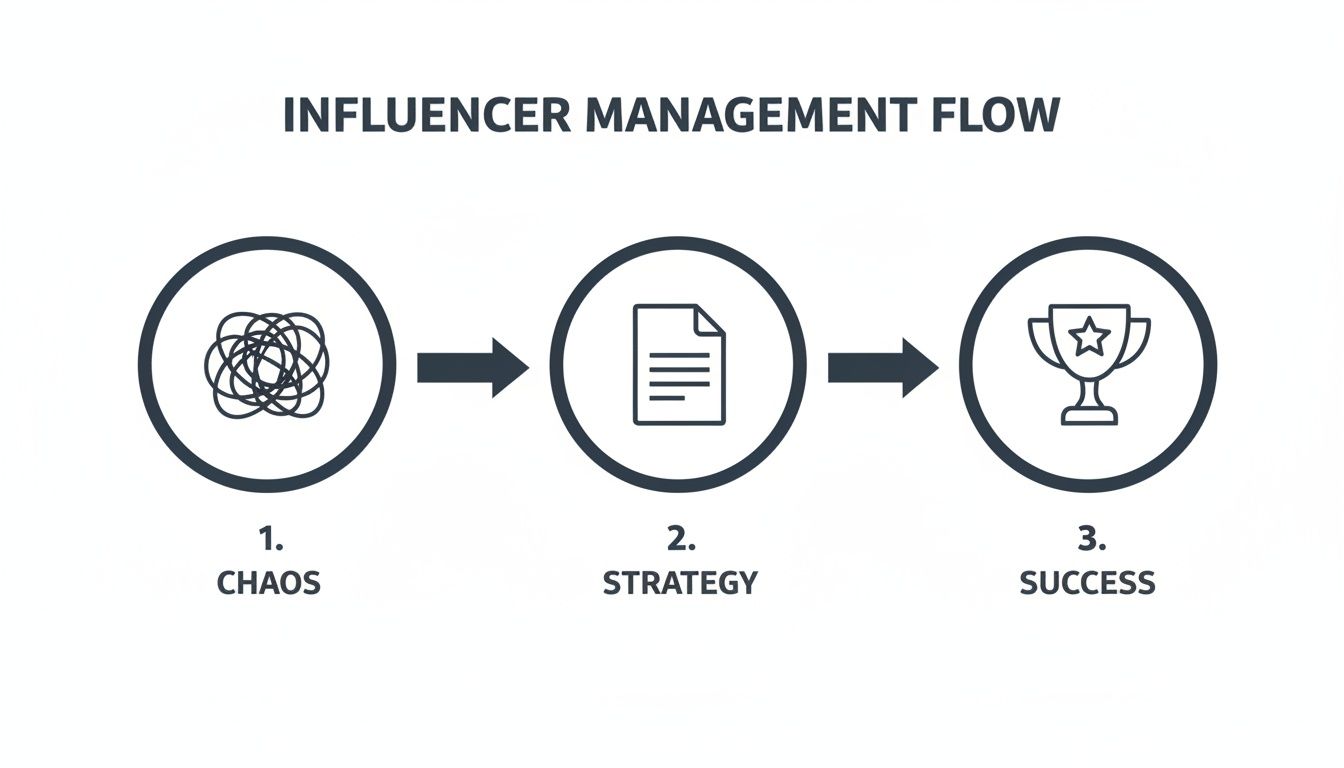
It’s a great visual reminder that real success isn’t an accident. It comes from having a clear system. We can break this whole process down into seven distinct stages. At each step, you have a choice: stick with manual, time-consuming tasks or bring in smart tools to make your life easier.
Stage 1: Defining Your Goals
Before you even think about which influencers to hire, you have to know what you’re trying to achieve. What does a "win" look like for this campaign? Are you trying to get your name out there (brand awareness), drive direct sales, or maybe just gather some great user-generated content?
The goal dictates everything that comes next. If you’re doing it the old-fashioned way, this means lots of brainstorming meetings and messy documents in shared drives. But if you use a platform like REACH, you can set those goals right inside the campaign brief. This becomes the north star for every decision you make, from discovery to reporting.
Stage 2: Finding and Vetting Creators
Honestly, this is where I’ve seen so many brands stumble right out of the gate. Manually scrolling through hashtags or picking through your competitors’ followers is a massive time sink, and the results are often disappointing. How can you really tell if a creator's audience is real or if their past campaigns actually performed well? You can't.
This is where a dedicated platform is a game-changer. The discovery tool in REACH, for example, lets you search and filter millions of creators. You can get super specific, looking for partners based on their niche, location, engagement rate, and even the nitty-gritty demographics of their audience. It’s a data-first approach that ensures you’re finding people who can truly connect with your ideal customers.
Stage 3: Crafting Your Outreach
So, you've got your shortlist of perfect-fit creators. Now you have to actually talk to them. The key here is personalization. High-quality creators get dozens of pitches a day, and they can spot a generic, copy-pasted message from a mile away.
Trying to manage all this in your email inbox is a recipe for missed follow-ups and sloppy communication. A proper management platform gives you a central command center to track every message, automate follow-ups, and handle conversations at scale without sounding like a robot.
Stage 4: Finalizing Contracts
Contracts are your best friend. They protect your brand, the creator, and set crystal-clear expectations for everyone involved. But drafting a new contract from scratch for every single influencer is slow, and frankly, risky. It’s easy to leave legal loopholes or create inconsistencies from one partnership to the next.
Platforms with built-in, lawyer-approved contract templates are an absolute lifesaver. You can generate a solid agreement, send it off, and get it e-signed in minutes. All the important stuff—deliverables, content usage rights, payment terms—is clearly spelled out.
Stage 5: Collaborating on Content
Once the deal is signed, the creative work begins. This back-and-forth requires clear communication and an approval process that doesn’t make you want to pull your hair out. When you’re trying to manage feedback through a messy thread of emails and DMs, things get lost, and deadlines get missed. It’s chaos.
A good social media influencer management tool solves this by giving you a dedicated portal for collaboration. Creators submit their content, and your team can leave time-stamped feedback directly on the asset. Everything is organized and easy to find.
Stage 6: Launching and Amplifying
With the content approved, it's go-time. A great launch is more than just the influencer hitting "publish." You need to coordinate the timing, make sure the post actually goes live, and have a plan to amplify that content across your own brand's social channels. Manually checking your phone all day to see if someone posted is not a good use of your time.
Platforms can automate this step completely. They’ll confirm when content goes live and pull the post right into your campaign dashboard, so you can see it without having to hunt for it.
Stage 7: Measuring and Paying
We've reached the finish line. This last stage is all about two things: proving the campaign's value and paying your partners for their hard work. If you're doing this by hand, you’re stuck screenshotting analytics and manually compiling data into a spreadsheet. Then comes the administrative headache of processing every single payment.
REACH wraps this all up beautifully. It gives you a real-time analytics dashboard that tracks all your key metrics in one clean view. And its built-in payment system takes care of everything from collecting tax forms to sending secure, on-time payments. It’s the perfect way to close the loop on a smooth, efficient, and successful campaign.
Finding and Vetting the Right Creator Partners
The success of any influencer campaign boils down to one thing: finding the right people to partner with. Get this wrong, and everything else falls apart. The old-school method of endlessly scrolling through hashtags or peeking at your competitors’ tagged photos is not just slow—it's a recipe for a bad match.
Your campaign’s fate rests on finding creators whose audience is your audience.
True influencer discovery today is part art, part science. It’s moved way past just glancing at follower counts. The best brand managers know that real influence comes from authentic connection, and that requires a much smarter way of vetting potential partners.
The Power of Smaller Creators
One of the biggest shifts we’ve seen in the industry is the move away from chasing mega-celebrities. Instead, brands are striking gold with nano-influencers (1k-10k followers) and micro-influencers (10k-100k followers). These creators have cultivated incredibly tight-knit communities built on trust and shared interests, giving them a voice that truly resonates.
And the data proves it. A recent study found that 54% of marketers now work primarily with nano-influencers (27%) and micro-influencers (27%). Why? Because these smaller creators pack a serious punch when it comes to engagement.
It's common to see engagement rates for smaller creators outperforming larger ones by a huge margin. This difference in performance often makes them a much more cost-effective choice.
Influencer Tier Engagement and Cost Comparison
| Influencer Tier | Follower Count | Average Engagement Rate (Instagram) | Relative Cost |
|---|---|---|---|
| Nano | 1k–10k | 5.0% | $ |
| Micro | 10k–100k | 2.5% | $$ |
| Macro | 100k–1M | 1.5% | $$$ |
| Mega | 1M+ | 1.1% | $$$$ |
As the table shows, while follower counts go up, engagement rates tend to drop significantly. This is why so many brands are focusing on nano and micro-influencers; the ROI is often much higher. This strategic shift means you have to look at the quality of an audience, not just its size.
Looking Beyond the Follower Count
A big follower number can be a vanity metric. It’s often bloated with bots, inactive accounts, or people who just aren't paying attention. To find a partner who can actually move the needle for your brand, you need to dig deeper.
Here’s what you should be analyzing:
- Audience Demographics: Does the creator’s audience actually match your ideal customer? Look at their age, gender, location, and interests. A creator with 50,000 followers is useless if 80% of them live in a country you don't ship to.
- Engagement Quality: Don’t just stop at the engagement rate. Read the comments. Are people having real conversations, or is it a wall of fire emojis and "Great post!" spam? Genuine chatter is a sign of a healthy community.
- Content and Brand Safety: Do a deep dive into their past content. Does their style, tone, and message align with your brand’s values? One problematic post from their past could become a major headache for you later.
A huge risk in this space is unknowingly partnering with someone who has bought fake followers. It's a complete waste of your budget and instantly kills the authenticity you're trying to build.
To protect your brand and your budget, you need to spot this kind of fraud. Learning how to identify red flags is a crucial skill. A quick way to start is by checking out our guide on spotting fake followers to see if a creator’s audience is legit.
Using Technology for Smarter Discovery
Let's be honest: vetting dozens of creators by hand is a massive time sink. This is where a powerful discovery platform completely changes the game. Tools like the REACH discovery engine can sift through millions of creators with incredible precision, turning a week-long headache into a few minutes of focused searching.
With an advanced platform, you can filter for exactly what you need:
- Specific niches (like "vegan skincare" or "sustainable fashion for men")
- Audience location, age, and gender
- Minimum engagement rate benchmarks
- Keywords in their bio or past posts
This data-driven approach takes the guesswork out of finding partners. You're no longer just picking people who look good on paper—you're building strategic partnerships with authentic creators who will drive real business results.
How Technology Has Changed the Social Media Influencer Management Game
Trying to run a modern influencer campaign without the right tech is like trying to build a house with just a hammer and nails. Sure, you might get it done, but it’s going to be slow, messy, and probably full of costly mistakes. The world of social media influencer management is moving fast, and specialized tools are no longer a nice-to-have—they're essential.
Technology, and specifically artificial intelligence (AI), isn't some far-off idea anymore. It's now at the heart of the most successful campaigns. For brands and agencies, this means you can automate the grunt work, get much smarter insights, and see a far better return on your investment.
Automated and Intelligent Discovery
Finding the right creators is always the first, and arguably most important, step. This used to be a painfully manual process of scrolling through endless feeds. AI has completely flipped the script.
Instead of all that manual sifting, AI-powered discovery engines do the heavy lifting for you. Platforms like REACH use smart algorithms to scan millions of creator profiles in an instant. This goes way beyond just matching keywords. AI can size up a creator's content quality, how often they post, what their audience really thinks, and their past performance to find partners who are a perfect fit for your brand's goals.
This kind of smart filtering helps you move from just hoping for a good fit to making a data-backed decision, making sure every partnership is set up for success from the start.
The impact here is huge. AI is now a core part of influencer marketing, with 59% of marketers already using it in their daily operations. The results speak for themselves—a massive 66.4% of brands report better campaign outcomes after bringing AI tools into the mix.
Predictive Analysis and Performance Forecasting
One of the most exciting developments in social media influencer management is the ability to predict how a campaign will perform before you spend a dime. Think of it like a weather forecast for your marketing budget. Predictive analytics looks at historical data from thousands of campaigns to estimate how a specific influencer is likely to perform for you.
By analyzing a creator’s track record—engagement rates, audience demographics, and content style—these platforms can project key metrics:
- Estimated Reach and Impressions: Get a good idea of how many people will actually see your content.
- Anticipated Engagement: Forecast the likes, comments, and shares a post is likely to generate.
- Potential Conversion Impact: Estimate how well a creator can drive real action, like clicks or sales.
This turns campaign planning from a guessing game into a calculated strategy, letting you put your budget where it will work hardest. After you've zeroed in on some promising partners, it's crucial to have a vetting process that includes solid social media content moderation strategies to ensure their past and future content reflects well on your brand.
Fraud Detection and Brand Safety
Let's be honest: influencer fraud is still a major headache. It costs brands billions of dollars every year. Fake followers, paid-for comments, and other shady tactics can completely tank a campaign and waste your money. This is another place where technology is your best defense.
AI-powered fraud detection tools scan an influencer's audience for red flags. They can spot things like sudden, unnatural follower growth, a high number of bot accounts, or a flood of generic comments. This automated check is a top concern for 67% of marketers, and for good reason.
By using an influencer marketing platform, you can automatically screen creators for this kind of activity. It ensures you're investing in authentic partnerships with people who have real influence, not just big numbers.
Measuring Your Campaign Success and Proving ROI
Likes and comments feel good, but they don't keep the lights on. The real test of any influencer program—the part that gets you more budget next quarter—is proving that it actually works. This is where we move past the vanity metrics and connect our efforts to real, tangible business results.
This is what separates the pros from the amateurs: tying every dollar spent on influencers back to a clear return on investment (ROI).
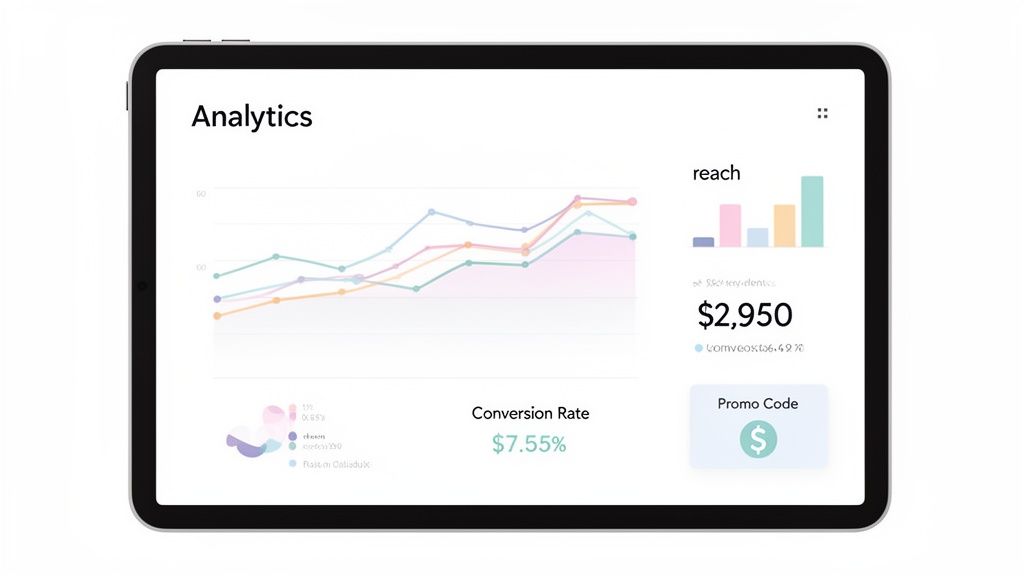
It sounds complex, but it's really about being smart with your tracking from the very beginning. To get a handle on what this looks like in practice, you have to understand the ins and outs of Modern Influencer Marketing Measurement.
Aligning KPIs with Campaign Goals
Before you can measure success, you have to define what success looks like for this specific campaign. The key performance indicators (KPIs) you watch have to be a direct reflection of your original goals. After all, a campaign designed to get people talking is going to look very different from one designed to drive sales.
Here’s a quick way to think about it:
If your goal is Brand Awareness: You're trying to get in front of as many new eyeballs as possible. Your focus should be on metrics like Reach (how many unique people saw the content), Impressions (how many times it was seen in total), and Share of Voice (how much your brand is being discussed versus your competitors).
If your goal is Audience Engagement: You want to spark a conversation and build a community. Here, you'll want to track things like Likes, Comments, Shares, and Saves. Don't just count the comments, either—look at the Comment Sentiment. Is the feedback positive? Are people genuinely excited?
If your goal is Driving Conversions: This is all about getting people to take action. The metrics that matter here are at the bottom of the funnel: Click-Through Rate (CTR), direct Website Traffic from influencer posts, Leads Generated from things like newsletter sign-ups, and of course, the big one—Sales.
The Tools of Accurate Attribution
So, how can you be certain that a specific sale came from Influencer A and not Influencer B? Guessing doesn't work. This is where attribution tools come in and do the heavy lifting for you.
Attributing sales and leads accurately is the cornerstone of proving ROI. Manually trying to connect the dots is nearly impossible and leads to unreliable data that stakeholders won't trust.
Here are the three most common and effective ways to track performance:
UTM Tracking Links: Think of these as custom URLs you create for each influencer. When someone clicks one, your analytics platform (like Google Analytics) knows exactly which creator sent them. This lets you see, without a doubt, who is driving traffic and who is converting that traffic into customers.
Unique Promo Codes: This is a classic for a reason. Giving each influencer a unique discount code (like "SARAH15") is dead simple for the customer and gives you a crystal-clear way to track which creator is driving sales at the checkout.
Affiliate Links: These work a lot like UTM links but are directly tied to a commission structure. They're perfect for long-term ambassador programs where you want to reward influencers with a cut of the sales they generate.
Bringing It All Together with a Centralized Dashboard
If you've ever tried to calculate ROI by pulling data from a dozen different spreadsheets, social media reports, and sales platforms, you know what a headache it is. It's not just a time sink; it’s a recipe for mistakes and makes it almost impossible to see the big picture. This is exactly the kind of mess an influencer management platform like REACH is designed to clean up.
The REACH platform gives you a real-time analytics dashboard that pulls all your important KPIs into one place. Instead of spending hours cobbling together reports, you can see everything with just a few clicks. The dashboard automatically tracks everything from impressions and engagement to clicks and sales, for every single creator in your campaign.
This means you can instantly identify your top-performing influencers, see what kind of content is driving the best results, and know your overall campaign ROI at a glance. You can walk into any meeting and show stakeholders exactly how your social media influencer management is impacting the bottom line—no spreadsheets required.
How to Scale Your Influencer Marketing Program
Moving from scattered, one-off campaigns to an “always-on” influencer program is a huge leap. It’s the difference between occasionally setting off a firework and actually building a powerful engine that drives steady growth. Making this jump takes a new way of thinking and, more importantly, a solid system to handle a growing list of creators.
The biggest hurdle you'll face when scaling is complexity. Let's be honest, managing five influencers with a spreadsheet is doable. Managing fifty? It’s an operational mess. The administrative work—juggling contracts, chasing down content for approval, and processing dozens of individual payments—piles up fast, burying your team and leaving zero time for actual strategy or relationship-building.
From Projects to Programs
The first real step to scaling is to stop thinking in terms of projects and start thinking in terms of programs. A project has a clear beginning and end, like a campaign for a new product launch. A program, on the other hand, is a continuous effort built to hit your brand's long-term goals.
This is where you graduate from one-off collabs to building a true brand ambassador program. These are long-term partners who become genuine fans of your brand, weaving your story into their content over months or even years. The authentic trust they build with their audience is something a single sponsored post can never achieve.
Of course, managing these ongoing relationships requires a central hub. You need one place to track performance over time, handle recurring payments, and keep the lines of communication open. Without a system, it's nearly impossible to keep your brand message consistent or measure your true impact.
The goal is to build an ecosystem of creators who are genuinely invested in your brand's success. That requires an operational backbone that can handle more volume and complexity without hurting the quality of your relationships.
Solving Operational Headaches with a Central Platform
This is exactly why a central platform becomes non-negotiable for effective social media influencer management at scale. A platform like REACH is designed from the ground up to solve the operational headaches that come with growth. Think of it as the single source of truth for your entire program.
Imagine having all of this in one place:
- A Unified Creator Database: All your past, present, and potential partners in a single dashboard, complete with their performance history and every conversation you've had.
- Automated Workflows: From sending the first outreach email to getting contracts e-signed and approving content, automation takes the tedious manual work off your plate.
- Batch Payments: Instead of cutting dozens of individual checks or processing separate invoices, you can pay all your creators at once with a single, secure transaction.
By bringing all these tasks together, you free up your team to focus on what really moves the needle: building great relationships with creators and refining your strategy.
Empowering Agencies to Scale Client Services
For marketing agencies, the scaling challenge is doubled: you have to manage growth for multiple clients at the same time. An agency might be running influencer programs for a beauty brand, a tech startup, and a CPG company—all with different goals, creators, and reporting needs. This is where agency-specific tools are a game-changer.
REACH gives agencies the tools they need for this exact multi-client world.
- Multi-Client Dashboards: Juggle unlimited client projects from one login, keeping every campaign neat, separate, and organized.
- White-Labeling: You can brand the entire platform as your own, from the login page to the reports you send clients. It makes your agency look polished and professional.
- Live Reporting: Give clients access to live, transparent dashboards showing exactly how their campaigns are performing in real-time. It’s the easiest way to prove your value.
These features help agencies turn influencer management from a time-consuming chore into a profitable and efficient service. It lets them deliver amazing results for every client, no matter how big their influencer programs get.
Your Top Social Media Influencer Management Questions, Answered
As you dive into the world of social media influencer management, a few key questions always seem to pop up. Let's tackle the big ones with some straightforward, practical answers to get you on the right track.
How Much Should I Pay an Influencer?
Honestly, there's no universal rate card. Influencer pay really depends on a mix of things: their follower count, how much their audience interacts with their content, the type of content you need, and their specific niche.
For a ballpark idea, a micro-influencer with 10,000 to 100,000 followers might ask for anywhere from $100 to $500 for a single post. Once you get into macro-influencer territory, that number can easily jump into the thousands.
The golden rule here is to base your offer on their actual performance data and what you need to achieve, not just their follower count. Using a platform like REACH gives you a huge advantage by showing you their historical metrics, so you can put together a fair offer that makes sense for your budget.
What Is the Difference Between a Platform and an Agency?
This is a great question. The easiest way to think about it is a tool versus a service.
An influencer platform like REACH is the software that puts you in the driver's seat. It gives your team all the tech they need to find creators, manage campaigns, and measure what’s working, all in-house. This is perfect for brands who want to maintain direct control and is often the more budget-friendly option.
An influencer agency, on the other hand, is a fully managed service. They become your outsourced influencer marketing team, handling everything from strategy and creator outreach to getting the campaign live and reporting back on the results. It's an excellent choice if your team is stretched thin and you'd rather hand off the entire process.
How Do I Create a Legally Sound Influencer Contract?
Never, ever skip the contract. It’s the single most important document for protecting both your brand and the creator. A good contract clearly spells out every detail: content deliverables, how and where you can use the content, posting deadlines, payment terms, and the mandatory FTC disclosure rules.
The smartest and safeset way to handle this is by using a system like REACH, which has attorney-vetted contract templates built right in. This ensures you've covered all your legal bases without the headache and expense of drafting a new agreement from scratch for every single creator you work with.
Ready to master social media influencer management and take control of your influencer marketing? REACH provides the tools you need to find the right partners, manage campaigns efficiently, and prove your ROI. Discover how REACH can transform your influencer strategy today.