 Skip to content

Think about all the repetitive, time-consuming tasks on your social media to-do list. Now, imagine offloading them to a smart assistant who works 24/7 without getting tired. That's exactly what social media marketing automation does—it puts your social media strategy on a smart, efficient autopilot. By leveraging powerful tools and AI, you can move from manually posting and reporting to running a sophisticated, scalable marketing engine that drives real business results.
A sophisticated influencer marketing platform like REACH Influencers perfectly illustrates this power, automating everything from creator discovery and outreach to campaign management and ROI tracking. It transforms the most complex parts of social media into a streamlined, data-driven operation. In this guide, we'll break down exactly what social media marketing automation is, how to implement it effectively, and why it's no longer just a nice-to-have, but an essential component of a modern marketing strategy.
Table of Contents
- So, What Is Social Media Marketing Automation?
- The Core Benefits of Marketing Automation
- Essential Social Media Automation Workflows
- How AI Is Changing the Game for Social Media Automation
- Best Practices for Your Automation Strategy
- How to Measure Your Automation Success
- Frequently Asked Questions
So, What Is Social Media Marketing Automation?
At its core, social media marketing automation uses software to handle social media tasks that you'd otherwise have to do manually, one by one. It's the digital command center that keeps your social presence running smoothly in the background, ensuring consistency and efficiency across all your channels.
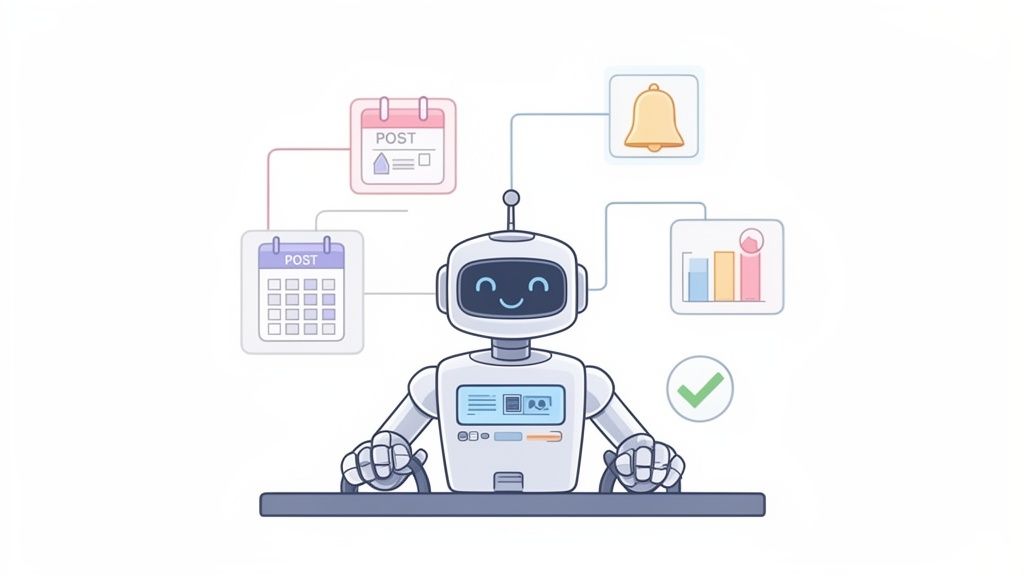
Instead of logging into Instagram, Facebook, and LinkedIn every single day just to post, you can sit down one afternoon and schedule an entire month’s worth of content. This isn't just about convenience; it's a strategic shift that frees you up for work that actually requires a human touch—like creative strategy and genuine audience engagement.
If you're just getting started with these concepts, this practical guide to social media automation is a great resource for building a solid foundation.
To really see the difference, let’s look at a quick before-and-after.
Manual Vs Automated Social Media Management
| Task | Manual Approach (The Old Way) | Automated Approach (The Smart Way) |
|---|---|---|
| Publishing Content | Log into each platform daily to post. | Schedule all content in advance from one dashboard. |
| Monitoring | Manually search for brand mentions and hashtags. | Receive real-time alerts for mentions and keywords. |
| Reporting | Spend hours pulling data into a spreadsheet. | Generate beautiful, comprehensive reports with one click. |
| Engagement | Try to respond to comments and DMs in real time. | Use automated rules to sort messages and send initial replies. |
As you can see, automation doesn't replace the strategist; it empowers them by clearing the busywork off their plate.
The Core Benefits of Automation
Bringing automation into your social media workflow pays off almost immediately, and the results go far beyond just clawing back a few hours in your week.
- Massive Time Savings: With repetitive tasks handled, your team can finally focus on the fun stuff—like brainstorming creative campaigns, analyzing trends, and having genuine conversations with your audience.
- Rock-Solid Brand Consistency: Automation ensures your brand voice, posting schedule, and aesthetic stay consistent across every platform. This is key to building a brand that people instantly recognize and trust.
- Efficient Scaling: As your brand grows, you can easily expand your social media efforts without your budget or team size spiraling out of control. Growth becomes much more sustainable.
It's no surprise that the market for these tools is exploding. In 2024, the social media automation market hit USD 4.5 billion, and it's expected to skyrocket to USD 12.8 billion by 2033. This growth shows just how critical efficiency has become for brands trying to keep up. You can explore more data on these trends and gain further insights on social media automation market projections.
A Perfect Example: Automation in Influencer Marketing
Nowhere is the power of automation more obvious than in a complex field like influencer marketing. Trying to manage relationships, track deliverables, and handle payments for dozens of creators can turn into a nightmare of spreadsheets and missed deadlines.
A platform like REACH Influencers is a prime example of automation done right. It streamlines the entire influencer marketing process, from finding the perfect creators with its AI-powered search tools to managing content approvals and automating payouts.
By bringing all these moving parts into one system, REACH transforms a chaotic, manual process into a well-oiled machine. It gives brands and agencies the power to run campaigns at scale, prove their ROI with clear analytics, and spend more time building strong, lasting relationships with their creators.
This is a perfect illustration that social media marketing automation isn't just about scheduling posts—it’s about building a smarter, more powerful marketing engine.
The Core Benefits of Marketing Automation
So, you’ve set up your first automation workflow. What's next? This is where the real magic happens. Automating your social media isn’t just about clawing back a few hours in your week—it’s about fundamentally changing how your marketing team works, thinks, and drives real growth. The impact shows up in three big ways: efficiency, intelligence, and profitability.
The most obvious win is a huge productivity boost for your team. When you hand off the repetitive grunt work—like scheduling posts, checking for brand mentions, and pulling reports—you give your marketers their most valuable asset back: time. This frees them up to focus on what humans do best: thinking up creative strategies, engaging with your community, and building innovative campaigns.
This newfound efficiency has a direct line to better leads and more sales.
Don’t just take my word for it. Research shows that companies nurturing leads through automation see a massive 451% increase in qualified prospects. On top of that, automation is tied to a 14.5% jump in sales productivity and a 12.2% cut in overhead costs. Teams also report an 80% improvement in lead generation. You can dig into more of the numbers and find other helpful marketing automation statistics to see the full picture.
Turning Messy Data into Smart Decisions
Without a good system, your marketing data is probably a chaotic mess of spreadsheets and siloed analytics dashboards. It's almost impossible to get a clear view of what’s working or prove the value of your efforts to anyone. A central automation platform completely flips this script, creating a single source of truth for all your social media activity.
Think about running an influencer campaign manually. You're juggling spreadsheets for outreach, endless email threads for content approvals, and trying to track performance by hand. It’s a recipe for headaches and missed opportunities.
This is where a platform like REACH Influencers comes in. It pulls all those scattered pieces into one clean dashboard, giving you:
- Real-Time Performance Tracking: You can see instantly which posts, campaigns, and influencers are actually driving clicks, engagement, and sales.
- Clear ROI Measurement: Finally, you can connect your social media work directly to business goals, making it easy to show your value to leadership.
- Data-Driven Decision-Making: Stop guessing. Use hard data to fine-tune your strategy and put your budget where it will have the biggest impact.
By bringing all your data together, automation turns your team from reactive task-doers into proactive strategists who can see the whole board.
Paving the Way for Scalable Growth
Ultimately, automation is what allows you to scale your marketing without having to constantly scale your team. You can manage more channels, run bigger campaigns, and work with more influencers without burning everyone out. That kind of scalability is the key to sustainable growth.
When your team can instantly show how a campaign moved the needle and connect their daily work to revenue, their role in the company changes. They're no longer seen as a cost center but as a critical part of the growth engine.
This ability to tie social media efforts directly to the bottom line is maybe the most powerful benefit of all. It’s the bridge between the day-to-day grind and real, measurable business success.
Essential Social Media Automation Workflows
Think of social media marketing automation less as a single, magical button and more like a set of specific, repeatable jobs you teach your software to do. These automated workflows are where the theory of automation gets real, handling the tedious, everyday tasks so you and your team can focus on the fun stuff: strategy and creativity.
The whole concept is pretty straightforward. You set up simple "if-then" rules that tell your software what to do when something specific happens. This turns tasks that used to take multiple manual steps into a smooth, automated process that runs around the clock. It's like setting your ship's course on autopilot instead of gripping the wheel all day.
Content Scheduling And Curation
The most common starting point for automation—and the one that delivers an immediate win—is content scheduling. Just picture it: you spend one afternoon scheduling a whole month's worth of posts for Instagram, Facebook, LinkedIn, and TikTok. Automation tools let you upload all your content, pick the dates and times, and then step away, knowing your channels will stay consistently active.
But it’s not just about scheduling your own stuff. Many platforms can also help you find and share great content from others.
- RSS Feed Integration: You can automatically pull in relevant articles from your favorite blogs or news sites, adding them straight to your posting queue.
- User-Generated Content (UGC): Set up a workflow to keep an eye on specific hashtags. It can spot high-quality customer photos or reviews and flag them for you to easily get permission and reshare.
This is how you keep your feed feeling fresh and dynamic without being chained to your desk.
Social Listening And Engagement
You can't be online 24/7, but your automation tools can. A social listening workflow acts as your eyes and ears, constantly scanning for mentions of your brand, your competitors, or important industry keywords. When it finds one, it can kick off a whole series of actions.
For example, say someone tweets, "Can anyone recommend a good project management tool?" Your automation can spot this as a potential lead. It could automatically add the tweet to a list for your sales team to follow up on, or even send a helpful (but still personalized) reply pointing the user to one of your blog posts.
This turns passive social monitoring into an active way to find new customers. As you can see below, these small, automated actions add up to big results.
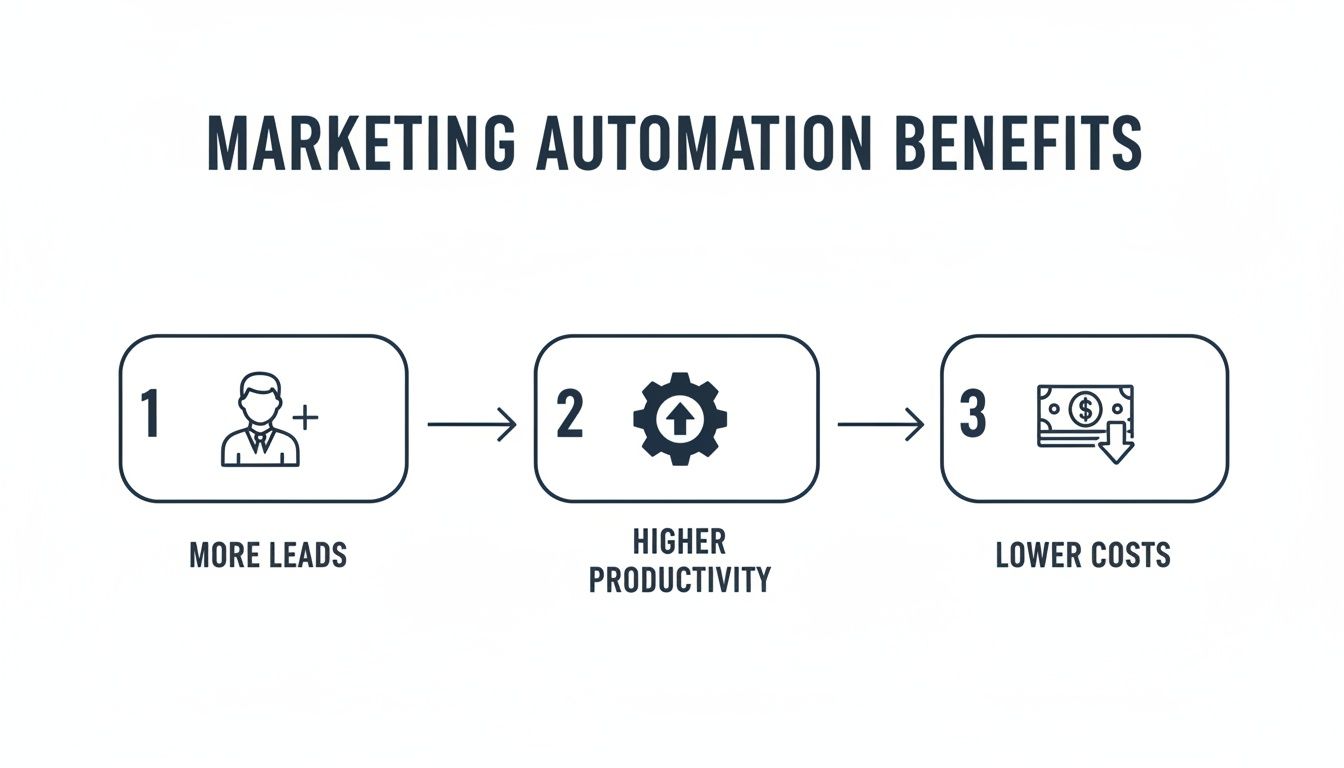
By automating these key tasks, you create a powerful cycle: you generate more leads, which makes your team more productive, and that ultimately brings down your costs.
To help you visualize how this works across different areas, here’s a quick breakdown of common workflows and the problems they solve.
Key Automation Workflows and Their Impact
| Workflow | Problem It Solves | Primary Benefit |
|---|---|---|
| Content Scheduling | Inconsistent posting and manual effort | Saves time and ensures a consistent brand presence |
| Social Listening | Missing brand mentions and sales opportunities | Proactive engagement and lead generation |
| Automated Reporting | Tedious, time-consuming data collection | Delivers instant insights and keeps stakeholders informed |
| Influencer Outreach | Manually finding and contacting creators | Scales influencer discovery and communication |
| Ad Campaign Sync | Disconnected social ads and CRM data | Better audience targeting and ROI measurement |
These workflows take the most repetitive parts of social media management and put them on autopilot, freeing up your team for higher-value work.
Analytics And Automated Reporting
Let’s be honest: manually building social media reports is a grind. You have to pull data from every platform, wrestle with spreadsheets, and then try to find a story in all those numbers. An automated reporting workflow completely takes this off your hands.
You can set it up to automatically generate a performance report every single week and email it directly to your boss and other key stakeholders. This report can show everything from engagement rates and follower growth to your top posts, all in a clean, easy-to-digest format. Everyone stays in the loop without you spending hours on manual data entry.
Streamlining Complex Influencer Marketing Workflows
If you want to see the real power of social media marketing automation, look no further than influencer marketing. Trying to manage these campaigns by hand is a logistical mess of spreadsheets and email chains. But a dedicated platform like REACH Influencers can automate almost every single step.
Here’s what that kind of automated workflow looks like in practice:
- Discovery: The system sifts through millions of creator profiles to find influencers who perfectly match your criteria for audience demographics, engagement rates, and niche.
- Outreach: You can send personalized outreach messages to hundreds of potential partners at once, while the system tracks who has opened your message, replied, or accepted the partnership.
- Content Approval: Creators submit their content directly through the platform. This automatically pings your team to review and approve it, leaving a clear and simple audit trail.
- Payment Processing: Once the campaign wraps up, the platform automatically handles payments to every creator, making sure everyone gets paid correctly and on time.
This level of automation transforms one of marketing's biggest headaches into a scalable, efficient system. If you want to put these ideas into action, our guide on building a marketing automation workflow dives into even more practical detail.
How AI Is Changing the Game for Social Media Automation
Think of traditional social media automation as setting your accounts on autopilot. It’s a great way to handle the basics. Now, imagine giving that autopilot a serious upgrade—a brain that can think, learn, and even predict what’s next. That's exactly what Artificial Intelligence (AI) is doing for social media marketing automation.
AI transforms automation from a simple tool that just follows orders into a smart partner. It’s the difference between telling a tool what to post versus having it tell you when and why you should post it for the best results.
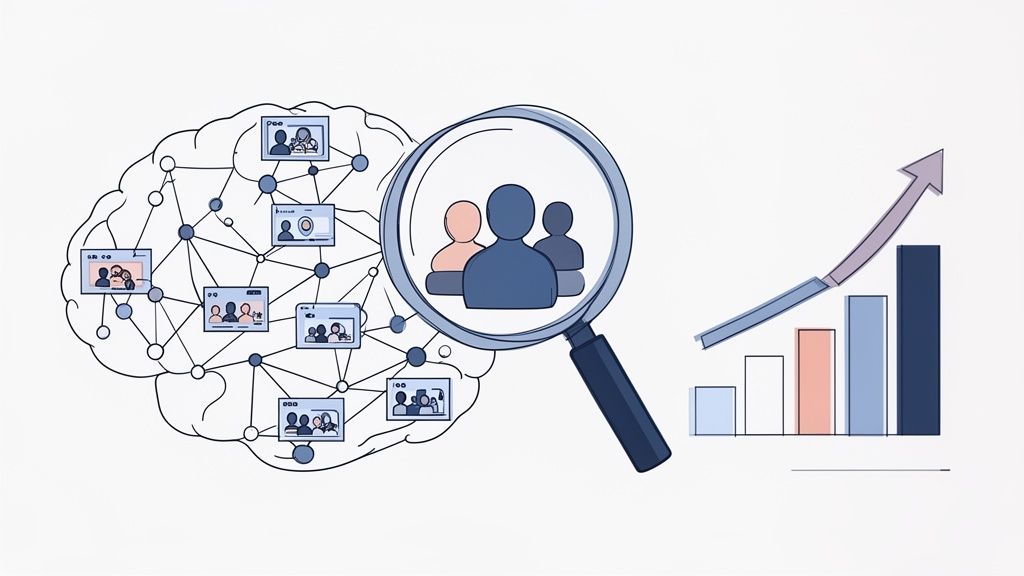
This isn't just some far-off idea; it's happening right now. It's estimated that by 2026, 25% of all branded social media posts will be generated with help from AI. Already, 80% of marketers are using AI for content creation, and an incredible 91% say it has completely changed how they work. These numbers tell a clear story: AI is here to stay. You can see just how fast things are moving by checking out these trends in social media marketing.
Moving from Guesswork to Predictions
One of the most powerful things AI brings to the table is its ability to look forward. Instead of just looking back at reports to see what worked last month, AI can actually forecast what's likely to work next.
- Predicting What Clicks: AI digs into your past posts, what’s buzzing online right now, and how your audience behaves to predict which topics, formats, and even headlines will grab the most attention. It essentially takes the guesswork out of your content strategy.
- Generating Content on Demand: Tools built on generative AI can draft social posts, brainstorm ideas for a new campaign, or even create simple visuals in just a few moments. This frees up your team to focus on the big picture and add a human touch where it matters most.
With AI, your automation tools are no longer just publishing content blindly. They’re actively making smart, data-driven suggestions to improve your entire strategy before you even hit "schedule."
This is just the beginning. The future of marketing automation is leaning toward even more intelligent, self-directing systems. For a deeper dive into where this is all headed, it’s worth exploring Agentic Workflows: The Ultimate AI Automation Guide.
Finding Your Audience with Pinpoint Accuracy
AI also gives you a much sharper lens for understanding and reaching your audience. Old-school automation might group people by basic demographics, but AI can see so much more. It can analyze the images people post, the words they use in comments, and their online habits to identify specific interests, whether they’re ready to buy, and how they feel about your brand.
This kind of smart segmentation lets you create campaigns that feel like they were made just for one person. You can move beyond targeting "women aged 25-34" and instead reach "women in that age group who recently liked posts about sustainable fashion and have a positive view of our brand." It’s a whole new level of personal.
AI in Influencer Discovery and Management
Nowhere is this intelligence more useful than in influencer marketing. Not long ago, finding the right creator meant endless scrolling and keyword searches. AI has completely flipped the script.
An advanced influencer platform like REACH Influencers, for instance, uses an AI-powered discovery engine that looks far beyond hashtags. It sifts through millions of data points to find the perfect partners by looking at:
- Real Engagement: AI is excellent at spotting fake followers and vanity metrics, so you can be sure you’re partnering with creators who have a real, active community.
- Audience DNA: It provides a deep analysis of an influencer’s followers to make sure they’re a perfect match for your ideal customer.
- Brand Safety: The AI automatically scans a creator's past content for anything that might not align with your brand’s values, protecting your reputation.
By bringing AI into the process, platforms like REACH make social media marketing automation smarter and more effective. It's the natural evolution from simply automating tasks to automating your entire strategy.
Best Practices for Your Automation Strategy
Alright, let's get practical. Knowing what social media marketing automation is is one thing, but making it work for you is where the magic really happens. A great automation strategy isn't about just turning on a piece of software; it's about being thoughtful and putting a human touch at the center of it all. These practices will give you a solid framework to make sure your automation saves you time without making you sound like a robot.
First things first: you have to know what you’re aiming for. Without clear goals, your automation is just a machine making noise. One study found that the top goals for marketers using automation are to optimize strategy (43%), improve data quality (37%), and pinpoint ideal customers (34%). So, ditch vague goals like "save time." Get specific. "Cut down reporting time by five hours a week" or "Boost qualified leads from social media by 15% in Q3" gives you a clear target to hit and a way to measure if you're actually succeeding.
Start Small and Scale Smart
The biggest rookie mistake I see is trying to automate everything all at once. It sounds exciting, but it almost always ends in chaos. A much better way is to find the most mind-numbingly repetitive tasks your team handles and start there. Go for the quick wins to see an immediate payoff and get your team on board.
Good starting points are usually:
- Content Scheduling: This is the easiest first step and an instant time-saver.
- Basic Social Listening: Set up automated alerts for your brand name so you can stop manually searching for mentions.
- Simple Reporting: Automate a weekly performance snapshot to go out to your key stakeholders.
Once you’ve got those running smoothly, you can move on to bigger things like automated lead follow-ups or influencer outreach campaigns. Taking it one step at a time makes the whole process feel manageable, not overwhelming.
Maintain the Human Element
Never, ever let your automation become a "set it and forget it" tool. The moment your brand feels cold and impersonal, you’ve lost. The whole point of automating the boring stuff is to free yourself up for more genuine human connection, not less.
The golden rule is simple: Automate the process, not the personality. Use tools to schedule posts, pull reports, and sort your inbox, but always be the one writing personal replies, jumping into conversations, and building real relationships.
For example, a chatbot can be great for answering basic FAQs, but a real person needs to be ready to step in when a problem gets tricky. This hybrid model gives you efficiency without ever sacrificing the quality of your customer's experience. We dive much deeper into this in our guide on marketing automation best practices, which shows you more ways to get this balance just right.
Choose the Right Tools for Your Goals
Not all automation tools are built the same. What works for a solo creator is completely different from what a global company or a specialized agency needs. When you’re shopping for a platform, judge it against your specific goals, your team’s size, and your budget. If influencer marketing is your main game, a generic scheduling tool is going to fall flat.
For that, you'd want a platform designed for the job, like REACH Influencers. It’s built specifically to automate the entire influencer marketing workflow—from discovering the right creators with AI and sending outreach at scale to handling content approvals and even automating payments. This way, you’re not just checking tasks off a list; you’re optimizing a vital part of your marketing for the best possible performance and a clear return on your investment.
How to Measure Your Automation Success
So you've got your automation running. Fantastic. But how do you know if your social media marketing automation is actually making a difference? Without the right numbers to back it up, you’re just using sophisticated tools without a clear purpose. The real win is when you can point to your automated workflows and show exactly how they’re contributing to business growth.
This means looking past surface-level stats like likes and follower counts. We need to measure what truly matters to the business. Automation isn't just about saving a few hours a week; it's about building a smarter, more efficient engine for bringing in leads and driving sales.
Key Performance Indicators That Matter
To prove the real value of your automation strategy, you have to track the KPIs that tell a story of growth. These are the metrics that shift the conversation from "look how much we're posting" to "look how much revenue we're generating."
Here are the numbers you should have on your radar:
- Lead Generation Rate: This is the big one. What percentage of your leads are coming directly from your automated social media activities? If this number is climbing, it’s a clear sign your automated content and engagement are hitting the mark with potential customers.
- Conversion Rate: Of all the leads your automation brought in, how many actually took action? We're talking about signing up for a demo, downloading a guide, or making a purchase. This is the ultimate proof that you’re not just getting attention, but you're turning that attention into results.
- Customer Acquisition Cost (CAC): How much are you spending to get a new customer through social media? Good automation should make your marketing more targeted and efficient, which means your CAC should go down over time.
- Return on Investment (ROI): This is the bottom line. It’s a simple but powerful formula: compare the revenue from your automated campaigns to what you spent on software and resources. An ROI of 5:1, for instance, means you’re making $5 for every $1 you put in.
Focusing on these business-first KPIs changes how everyone sees social media. It stops being a "nice-to-have" for brand awareness and becomes a critical part of how the company makes money. This is how you justify your budget and prove your strategic importance.
Proving ROI with a Centralized Dashboard
Trying to track all these metrics by hand is a recipe for a headache. You’re left bouncing between different platforms, wrestling with spreadsheets, and trying to glue together data that doesn't want to cooperate. This is where a great automation platform with a central dashboard becomes a game-changer.
For example, a platform like REACH Influencers makes proving ROI straightforward. Instead of wasting hours pulling reports, all of your most important data is organized in one spot. You can see in real-time how your influencer campaigns are tracking against your business goals.
With powerful reporting tools, you can generate live reports that are easy for anyone to understand, connecting your social media marketing automation efforts directly to revenue. If you're curious about how this works, you can learn more about the power of a unified social media dashboard and see how it takes the pain out of performance tracking. It means you can walk into any meeting and confidently show stakeholders exactly how your strategy is paying off, securing their trust and backing for what comes next.
Frequently Asked Questions
It's only natural to have a few questions when you're thinking about social media marketing automation. The space changes quickly, so let's tackle some of the most common concerns right away to clear things up.
Will Social Media Automation Make My Brand Sound Robotic?
This is probably the biggest worry we hear, and it's a fair one. But the answer is a firm no—as long as you use it smartly. The goal isn't to fake conversations; it's to get rid of the tedious, repetitive work so you have more time for the human stuff.
Think about it like this:
- Automate the mechanics: Things like scheduling posts for the week, pulling performance reports, and sorting incoming DMs.
- Humanize the interactions: Use all that time you just saved to write thoughtful replies to comments, have real conversations in messages, and build actual relationships with your audience.
Good tools are designed for this. They often include personalization features that let you add a custom touch to automated messages. For example, a platform like REACH handles the backend grind of influencer marketing—finding creators, sending contracts, and processing payments. This frees you up to focus on what really matters: building genuine, long-term partnerships with people. It’s a perfect example of automating the process, not the personality.
What Is the Difference Between an Automation and a Management Tool?
It’s easy to mix these up because they definitely overlap, but their main jobs are quite different. A basic social media management tool is like a central command post. It helps you manually organize and publish content from one spot—think of it as a fancy digital calendar for your posts.
A true social media marketing automation platform is a whole lot smarter. It moves beyond just scheduling and creates intelligent workflows that run on their own.
A management tool is a hammer; it helps you do a manual job more easily. An automation platform is a power tool; it does the job for you based on rules you set.
This means it can trigger actions based on what a user does (like sending a follow-up message after someone clicks a link), run complex analytics without you lifting a finger, and even sync up with your other business software, like your CRM. It’s designed to connect the dots and create a self-running marketing machine.
How Do I Choose the Right Social Media Automation Tool?
The fastest way to get overwhelmed is by looking at flashy features. Instead, the best way to choose the right tool is to start by asking yourself what you actually need to get done.
- Figure Out Your Main Goal: What's the number one problem you're trying to solve? Simple content scheduling? A complex system for generating leads? Or are you diving deep into influencer marketing? Your primary goal will point you to the right type of tool.
- Make a "Must-Have" List: Write down the features you absolutely cannot live without. Do you need powerful analytics, integration with your CRM, or tools for your team to collaborate? Solid reporting is always non-negotiable if you want to prove your ROI.
- Think About Growth: Will this tool still work for you a year from now? A cheap, simple option might seem great today, but it could hold you back as your business grows. It pays to think long-term.
- Take It for a Test Drive: Never commit without trying it first. Use the free trials to get a feel for the interface, test out the key features, and see if it feels right for your team’s daily workflow.
For instance, if influencer marketing is a big piece of your strategy, a general-purpose scheduler just won't cut it. You'd want a specialized platform like REACH Influencers that's built to automate the entire influencer journey, from discovery all the way to payment. When you match the tool to the job, your investment is far more likely to pay off.
In conclusion, effective social media marketing automation is the key to scaling your strategy, proving your ROI, and freeing up your team to focus on what matters most: building authentic connections. By choosing the right tools, setting clear goals, and always maintaining a human touch, you can transform your social media from a daily chore into a powerful growth engine.
Ready to stop chasing down influencer details and start running a scalable, automated program? With REACH Influencers, you can find the perfect creators, manage every campaign from a single dashboard, and track your ROI with analytics that make sense.
Book a demo today and see how our platform can give your strategy a serious boost.