 Skip to content

So, what is a marketing funnel? It’s not some abstract theory—it’s a visual roadmap of your customer’s entire journey. Think of it as the path you create to guide someone from a complete stranger who has never heard of your brand into a loyal, paying fan. Understanding this concept is the first step toward building a predictable, scalable marketing strategy.
Partnering with creators who have built authentic communities is one of the most effective ways to fill the top of your marketing funnel. This is where a platform like REACH Influencers comes in, giving you the tools to find the right influencers who can introduce your brand to an engaged and relevant audience. As we break down each stage of what a marketing funnel is, you'll see how this initial partnership can power the entire customer journey.
Table of Contents
- The Marketing Funnel Explained
- The Five Key Stages of the Modern Marketing Funnel
- Getting the Sale: The Conversion Stage
- Aligning Influencers with Each Funnel Stage
- How to Fix Your Leaky B2B Marketing Funnel with SEO
- Turning Customers into Your Biggest Fans
- Common Questions About the Marketing Funnel
The Marketing Funnel Explained
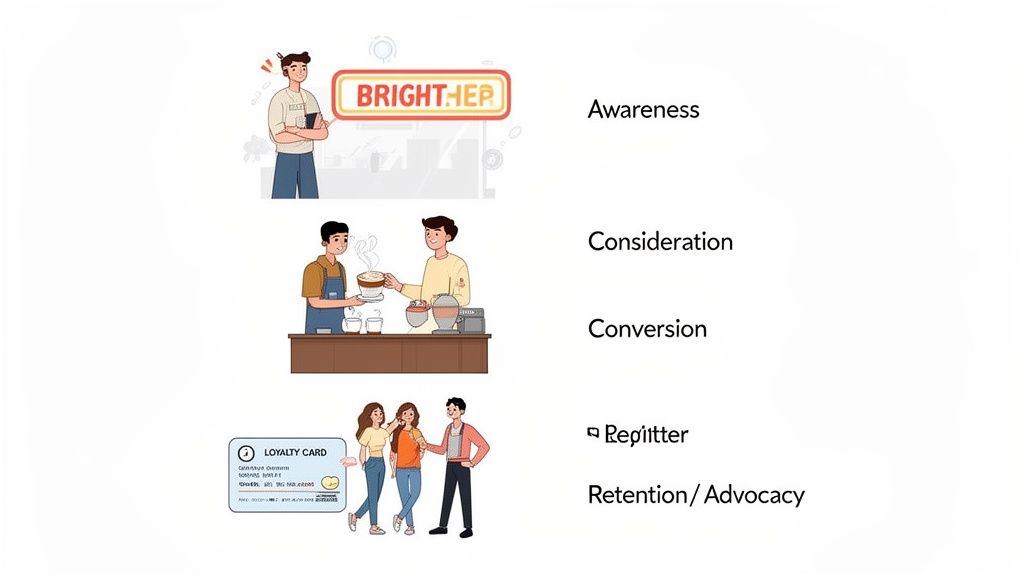
The classic analogy of a physical funnel works perfectly here. You pour a lot of interest in at the wide top, but only a smaller, more focused group of actual customers comes out the narrow bottom.
Your marketing funnel operates on the same principle. You’ll attract a broad audience at the beginning, and as they move through each stage, that group gets smaller and more qualified. What this really means is that you’re not just shouting into the void; you’re building a relationship, one step at a time. It allows you to deliver the right message to the right person at exactly the right moment.
The Marketing Funnel at a Glance
To give you a quick overview, here's a simple breakdown of the funnel's main stages. We'll dive much deeper into each one, but this table provides a great starting point for understanding how a customer's mindset changes as they move through their journey with your brand.
| Funnel Stage | Abbreviation | Customer Mindset | Primary Goal |
|---|---|---|---|
| Awareness | TOFU (Top of Funnel) | "I have a problem or a need." | Attract new audiences and make them aware of you. |
| Consideration | MOFU (Middle of Funnel) | "I'm researching my options to solve this." | Engage and educate prospects on why you're the best solution. |
| Conversion | BOFU (Bottom of Funnel) | "I'm ready to make a purchase." | Drive sales and turn prospects into customers. |
| Retention | Post-Funnel | "I love this product and the experience." | Create loyal customers who buy again. |
| Advocacy | Post-Funnel | "I want to tell everyone about this brand." | Turn happy customers into brand champions. |
Each stage represents a shift in what your potential customer is thinking and what they need from you. By understanding this, you can stop guessing and start marketing with intention.
Why Does This Matter for Your Business?
Without a clear funnel, marketing can feel chaotic. You’re posting on social media, running ads, and sending emails, but it’s hard to see how it all connects to actually making a sale. A well-defined funnel brings order to that chaos.
Here’s how it makes a real-world difference:
- You guide people, not just sell to them. The funnel gives you a framework for nurturing leads with helpful content, building trust before you ever ask for the sale.
- You get more sales from your efforts. By addressing a customer's specific concerns at each stage, you remove roadblocks and make it easier for them to say "yes."
- Your marketing budget works harder. You can invest in what’s actually working at each step, whether that’s top-of-funnel influencer campaigns or bottom-funnel retargeting ads.
- You can actually predict your growth. A measurable funnel turns your sales process into a reliable system. You start to learn that for every 1,000 people who discover your brand, you can expect a certain number to become customers.
The real power of the marketing funnel is that it turns marketing from a guessing game into a deliberate strategy. You stop hoping people will find you and start actively guiding them to your doorstep.
This journey has to start somewhere, and today, that often means showing up where your audience already is. Partnering with creators who have built authentic communities is one of the most effective ways to fill the top of your funnel. This is where a platform like REACH comes in, giving you the tools to find the right influencers who can introduce your brand to an engaged and relevant audience. As we break down each stage, you'll see how this initial partnership can power the entire customer journey.
The Five Key Stages of the Modern Marketing Funnel
If you want to get a real handle on what a marketing funnel is, you have to look beyond old-school models. It’s not just about pushing people toward a sale anymore. The customer journey has evolved into a continuous loop, and understanding each phase is the key to building a brand that lasts.
Let's walk through the five stages that really matter today.
1. Awareness: Getting on the Radar
This is your first handshake. The Awareness stage is the very top of the funnel (often called TOFU, or Top of Funnel), where your only goal is to get discovered. People here aren't looking to buy anything just yet. They’re just starting to realize they have a problem or are simply exploring a new interest.
Your job is to show up and introduce yourself as a relevant voice or a potential solution. Think of it as passive discovery. Someone might stumble upon your brand through an influencer’s story, a blog post they found on Google, or a friend’s recommendation.
For example, a person casually scrolling through their Instagram feed sees a creator they trust raving about a new sustainable skincare line. They weren't actively shopping for a new face wash, but just like that, your brand is now on their map. Success at this stage is all about reach and impressions—how many new eyeballs did you get in front of?
2. Consideration: Weighing the Options
Once someone knows you exist, they slide into the Consideration stage. This is where they shift from a passive browser into an active researcher. They’re now fully aware of their need or desire and are actively looking for the best possible solution. Their mindset is all about comparison and evaluation.
During this phase, they start digging. They’ll visit your website, scrutinize your product pages, hunt for reviews, and see how you stack up against competitors. They're asking themselves real questions:
- Does this actually solve my problem?
- Is it worth the money?
- What are other customers saying about it?
- Are there better options out there?
This is where you need to build trust by providing genuine value. In-depth blog posts, how-to videos, and honest comparison guides work wonders here. It’s also a perfect spot for influencer marketing, where a detailed product review from a credible expert can provide the social proof needed to win someone over. Finding those niche experts is exactly what a platform like REACH Influencers is built for, connecting you with creators who produce the authentic content that helps people make confident decisions.
3. Conversion: Making the Purchase
This is the moment of truth. After all that research, the person is ready to become a customer. The Conversion stage is where your focus narrows to one thing: making the sale as smooth and easy as possible. Their mindset has shifted to, "Okay, I'm ready to buy."
Don't let a clumsy process get in your way. This is where so many brands drop the ball. A confusing checkout, surprise shipping fees, or limited payment options are notorious for causing people to leave. In fact, nearly 70% of online shopping carts are abandoned before the purchase is complete.
Your job is to remove every single bit of friction. Offer a guest checkout option, show off trust badges, provide multiple ways to pay, and be completely transparent about costs from the start. A well-timed discount code from an influencer can also create the urgency needed to get them across the finish line.
4. Retention: Creating Loyal Customers
Thinking the funnel ends with the sale is a massive mistake. Your most profitable relationships are just beginning. The Retention stage is all about turning that first-time buyer into a loyal, repeat customer. Their mindset now is, "I had a great experience and I’m glad I bought this."
Your mission is to nurture that positive feeling and give them a reason to come back. This is where top-notch customer service, thoughtful follow-up emails, and loyalty programs shine. A simple thank-you note, an email asking for a review, or an exclusive discount on their next purchase can make all the difference. Nailing the post-purchase experience is how you build a real, long-term connection.
5. Advocacy: Spreading the Word
This final stage, Advocacy, is the holy grail. This is where your happy customers transform into your most powerful marketers. They’ve gone from being satisfied to being so thrilled that they want to tell everyone about your brand.
Advocacy is the goal because it creates a beautiful feedback loop that drives new, highly-qualified people right back to the top of your funnel. This kind of organic, word-of-mouth marketing is priceless because it's built on genuine trust. You can encourage it by creating easily shareable content, running referral programs, or launching ambassador programs that reward your biggest fans for spreading the love.
Getting the Sale: The Conversion Stage

This is it. After all the work you’ve put into grabbing attention and building interest, your potential customer is finally at the finish line. We call this the conversion stage, and it's where someone decides to take action.
They’re no longer just window shopping. Their mindset has shifted to, "I'm ready to buy." Your job now is to make that final step as easy and reassuring as possible. Any hesitation, confusion, or extra work on their part can stop a sale in its tracks, even seconds before it happens.
What Does a Good Conversion Rate Look Like?
It’s helpful to know what to aim for. While performance varies a lot by industry, recent ecommerce benchmarks show a typical conversion rate hovering between 2.5% and 3%. That means for every 100 visitors, only 2 or 3 will actually complete a purchase.
However, the best brands—the ones who obsess over making their checkout process perfect—can push that number to 4–5% or even higher. It might not sound like a huge leap, but jumping from a 2% to a 3% conversion rate is a 50% increase in sales from the exact same amount of traffic. Every little improvement here pays off big.
Get Out of the Way and Let Them Buy
So, what stops people from clicking that final button? More often than not, it’s friction. Think of it as putting hurdles in front of a sprinter just before they cross the finish line. Your goal is to clear the path completely.
Here are the most common obstacles to get rid of:
- Forced Account Creation: Don't make someone create a password just to give you their money. Always offer a guest checkout.
- Surprise Costs: Unexpected shipping fees or taxes are the number one reason people abandon their carts. Show the full cost upfront.
- Long, Complicated Forms: Only ask for what you absolutely need to complete the order. Every extra field you ask them to fill out increases the odds they'll just give up.
- Limited Payment Options: People want to pay how they want to pay. Make sure you offer popular options like credit cards, PayPal, Apple Pay, and Google Pay.
A great checkout experience is practically invisible. The customer should glide from their cart to your "thank you" page without a single moment of confusion.
How Influencers Close the Deal
This is where influencers can be incredibly effective. A glossy ad can spark interest, but a genuine recommendation from a trusted creator gives people the confidence they need to actually click "buy." They provide that final, crucial nudge.
Instead of just building awareness, you can use influencers for direct results. Give them an exclusive discount code to share with their followers. This not only creates urgency but also makes their audience feel like they're getting a special deal.
Authentic "how-to" videos or tutorials are also gold at this stage. They answer last-minute questions and show the product's value in a way that feels real and relatable.
With a platform like REACH, you can put real numbers behind this strategy. By giving each influencer a unique tracking link or coupon code, you can see exactly who is driving sales—not just likes. This data is priceless for figuring out which partnerships are truly moving the needle and delivering a real return on your investment. For more ideas, check out our guide on how to improve your website's conversion rates.
Aligning Influencers with Each Funnel Stage
Knowing what the marketing funnel is and actually putting it to work are two different things. This is where influencer marketing really shines—it gives you a powerful way to guide people along their entire journey, from the first time they hear about your brand all the way to becoming a loyal fan.
The trick is to stop thinking of influencer marketing as a single, isolated tactic. A one-size-fits-all campaign just doesn't cut it. Different creators and different types of content are better suited for specific moments in the customer's decision-making process. Let’s walk through how you can match your influencer strategy to each stage for a journey that feels both seamless and genuinely convincing.
Top of Funnel Influencers for Awareness
At the very top of the funnel (TOFU), your only job is to get on people's radar. You need to introduce your brand to as many new, relevant eyeballs as possible. This is the perfect time to bring in the big guns: macro-influencers and even celebrities. These are the creators with huge followings who can generate a massive wave of awareness with just a single post.
The content here shouldn't be a hard sell. It needs to be broad, engaging, and easy to consume. Think stunning lifestyle photos, entertaining videos, or an influencer joining a viral challenge while casually using your product. The goal isn’t to drive sales right away, but to plant a seed and make a great first impression.
For instance, imagine a fashion brand teaming up with a popular style icon for a "get ready with me" video. The focus isn't on the jacket's stitching or fabric; it's about connecting the brand to a cool, aspirational lifestyle that people admire.
Middle of Funnel Influencers for Consideration
Once someone moves into the middle of the funnel (MOFU), their mindset completely changes. They've gone from passively scrolling to actively looking for a solution. They know they have a problem or a need, and now they're comparing their options. This is where you need to build trust and show your value, and your best partners for this are niche and micro-influencers.
These creators typically have smaller, but incredibly dedicated, communities built around shared interests and expertise. Their followers hang on their every word because they're seen as authentic and knowledgeable. The content for this stage should be more detailed and educational:
- In-depth product tutorials that show exactly how your product works and what problems it solves.
- Honest reviews like unboxing videos or "first impression" vlogs that feel real and unscripted.
- Comparison content that stacks your product up against competitors and highlights what makes it unique.
A tech company, for example, could work with a specialized YouTuber to create a deep-dive review of their new software. This is the kind of content that directly answers the questions potential customers are already Googling.
When a trusted expert gives potential buyers the detailed proof they're looking for, it gives them the confidence to go from just browsing to being genuinely interested.
Finding the right expert can be tough, but a platform like REACH Influencers makes it much easier. Its discovery filters let you find influencers based on super-specific niches, audience demographics, and even how well their past content performed. This ensures you’re partnering with the perfect voice to create convincing content for serious buyers.
Bottom of Funnel Influencers for Conversion
When a customer reaches the bottom of the funnel (BOFU), they are right on the edge of making a purchase. All they need is one last nudge to get them over the finish line. This is where you can be more direct and give them a compelling reason to click "buy now."
The content here is all about creating a sense of urgency and making it incredibly easy to purchase. Some of the most effective tactics include:
- Exclusive discount codes: Giving an influencer a unique code makes their followers feel like they're getting a special deal and encourages them to act fast.
- Limited-time offers: Working with an influencer to promote a flash sale or special bundle.
- Testimonial-style content: Short videos or Instagram Stories where the influencer shares their personal success story with the product.
This stage is also the perfect place for affiliate marketing. By giving influencers a unique affiliate link, they earn a commission for every sale they generate. This gives them a powerful incentive to create content that really sells. A tool like REACH Influencers lets you manage these affiliate links, track sales as they happen, and see a clear ROI for every creator, proving exactly how your influencer efforts are impacting the bottom line.
Influencer Tactics Mapped to Each Funnel Stage
So, how does this all fit together? The key is to match the right tactic and the right creator to the right stage. This table breaks down exactly what that looks like in practice, from the content you create to the metrics you track.
| Funnel Stage | Influencer Tactic Example | Primary KPI | REACH Influencers Platform Feature |
|---|---|---|---|
| Awareness (TOFU) | Macro-influencer shares a lifestyle photo featuring the product. | Impressions, Reach, Engagement Rate | Discovery to find influencers with large, relevant audiences. |
| Consideration (MOFU) | Niche micro-influencer posts a detailed YouTube review and tutorial. | Link Clicks, Video View Duration, Audience Sentiment | Content Approvals to ensure reviews are accurate and detailed. |
| Conversion (BOFU) | Influencer promotes a limited-time discount with a unique affiliate link. | Conversion Rate, Sales, Cost Per Acquisition (CPA) | Tracking & Reporting to monitor sales and calculate ROI per influencer. |
| Retention | Brand features customer's post (UGC) on their own social media. | Repeat Purchase Rate, Customer Lifetime Value (CLV) | Reporting Dashboards to track long-term customer behavior. |
| Advocacy | Run an ambassador program with loyal customers who love the brand. | Brand Mentions, User-Generated Content (UGC) Volume | Outreach Tools to manage communication with brand ambassadors. |
By using this framework, you're no longer just throwing campaigns out into the world and hoping for the best. You're building a connected system that methodically guides people from being complete strangers to becoming not just customers, but true advocates for your brand.
How to Fix Your Leaky B2B Marketing Funnel with SEO
The B2B marketing funnel is a different beast altogether. Unlike the quick, impulsive buys we see in consumer markets, the B2B journey is a marathon, not a sprint. It involves long sales cycles, committees of decision-makers, and a deep need for trust before anyone even thinks about signing a contract.
In this high-stakes environment, one channel stands out as the undisputed heavyweight champion of lead generation.
When it comes to B2B, organic search is an absolute powerhouse. In fact, for B2B SaaS companies, it’s the single biggest channel, driving a staggering 44.6% of all revenue. This makes perfect sense—B2B buyers are researchers. They use search engines to diagnose their problems, find potential solutions, and vet vendors long before they ever fill out a form.
But here’s the problem. That same research reveals a huge leak in the typical B2B funnel. The conversion rate from a Marketing Qualified Lead (MQL) to a Sales Qualified Lead (SQL) is a dismal 13% on average. That’s the biggest roadblock most companies face.
Interestingly, leads that come from SEO tell a completely different story. They convert from MQL to SQL at a rate of 51%—nearly double the rate of leads from PPC. This shows that the quality of traffic you attract matters immensely.
The diagram below shows how you can use influencer marketing tactics at each stage to capture and nurture these high-value leads.
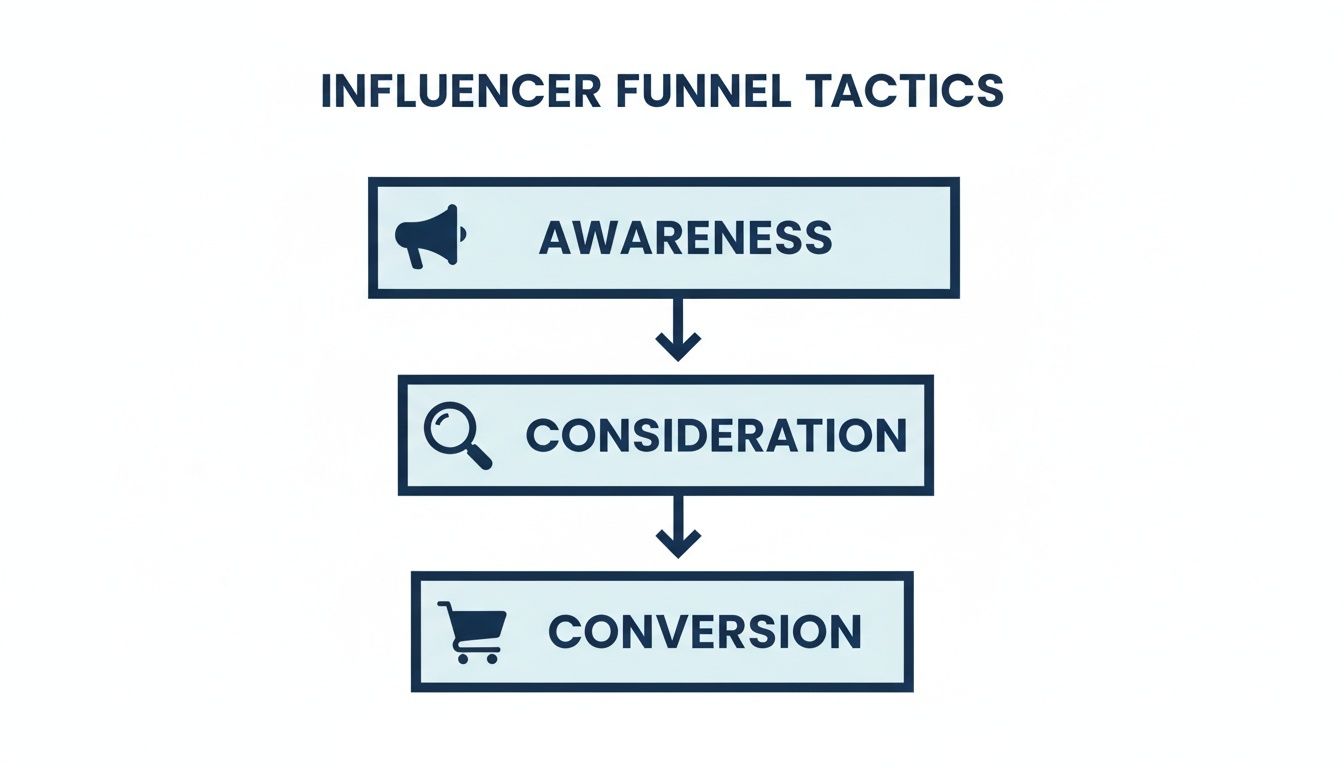
As you can see, this isn't just about shouting into the void. It’s a strategic process that guides potential customers from broad awareness all the way to a final decision.
Plug the MQL-to-SQL Gap with Expert-Led Content
So, what’s the secret to plugging that leaky MQL-to-SQL pipeline? You have to do more than just generate traffic; you need to attract the right kind of traffic and build trust before your sales team even gets involved.
This is where collaborating with respected industry experts can completely change the game.
Instead of cranking out another generic blog post, imagine partnering with the very people your ideal customers already listen to and trust. This is how you build a B2B marketing funnel that actually works.
Think about creating high-value, SEO-friendly content like this:
- Co-hosted Webinars: Team up with a well-known thought leader to host a live workshop that tackles a major pain point for your audience.
- In-depth Whitepapers: Co-author a detailed research paper or guide with a recognized expert, giving your content instant authority.
- Technical Article Series: Work with a specialist to publish a deep-dive series on a complex topic, proving your brand’s depth of knowledge.
This strategy kills two birds with one stone. First, you're creating exceptional, authoritative content that naturally ranks for the specific, long-tail keywords your best prospects are searching for.
Second, the endorsement from a trusted expert acts as a powerful pre-sale warmer. By the time these leads reach your sales team, they’re not just cold contacts; they're educated, engaged, and already convinced of your credibility. For more ideas on how to align influencers with your funnel, check out this A Complete Guide to Facebook for Influencers.
By weaving expert-led content into your SEO strategy, you’re not just filling the top of your funnel. You’re building a more efficient pipeline that delivers warmer, better-qualified leads to sales, ultimately shortening sales cycles and driving more revenue.
This is exactly what a platform like REACH Influencers is built for. You can use its discovery tools to find and vet the perfect subject matter experts for your niche. From there, you can manage the entire collaboration—from the initial outreach to the final content approval—all in one place. By implementing a marketing automation workflow on the back end, you can nurture these high-quality leads and make sure no opportunity slips through the cracks.
Turning Customers into Your Biggest Fans
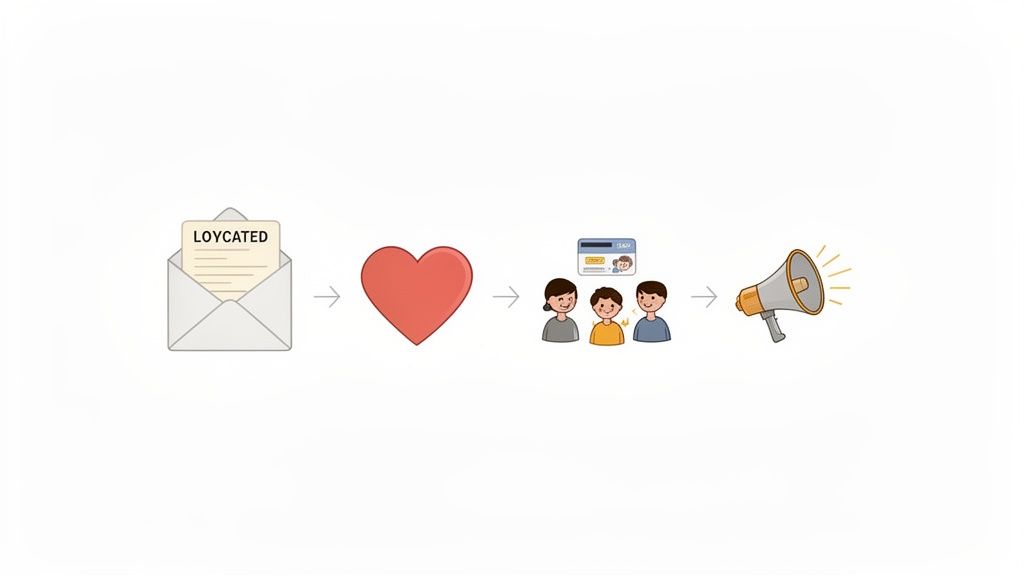
It’s a classic mistake. A customer clicks “buy,” and many marketers breathe a sigh of relief and consider their job done. But the conversion isn’t the finish line—it’s the starting block for the most profitable part of your funnel: Retention and Advocacy. This is where you turn one-time buyers into lifelong fans who go out and sell your brand for you.
Think about it: this bottom-funnel loop is where your best ROI is hiding. We all know that getting a new customer can cost five times more than keeping an existing one. That simple fact makes this stage absolutely critical for any brand that wants sustainable growth. Your focus has to shift from just making the sale to building a real relationship.
Keep the Conversation Going with Smart Communication
So, how do you build that relationship after the sale? Your best friend here is email. It’s your direct line to the customer, giving you a chance to prove your value long after the package has been delivered. And when you get it right, the financial returns are incredible.
Recent data shows that for every pound you put into email marketing, you can expect a return of £36 to £40. That’s an ROI of 3,600% to 4,000%. It's no surprise that email is consistently one of the top three channels for B2C brands. If you want to dig into the numbers, plenty of recent marketing statistics back this up.
But to get customers to actually open your emails, you need to offer real value, not just endless promotions. Try these approaches:
- Personalized Follow-Ups: Send them tips, tutorials, or care instructions for the specific product they just bought.
- Exclusive Offers: Make them feel special with early access to new launches or discounts just for existing customers.
- Ask for Feedback: Show you care about their opinion by asking what they thought of their purchase. It signals that you’re always looking to improve.
This kind of thoughtful contact keeps you on their radar and quietly reminds them why they chose you in the first place.
From Happy Customers to True Brand Ambassadors
The ultimate goal here isn't just repeat business; it's to create advocates. These are the customers who are so thrilled with your brand that they become your best marketers. They leave glowing reviews, tell their friends about you, and shout you out on social media. Your job is to find these people and give them a megaphone.
Your email list is the perfect place to start looking for them. Watch for customers who buy from you again and again, leave positive feedback, or always engage with your content. Once you've found these fans, you can invite them to join a formal brand ambassador program.
An ambassador program is just a structured way of encouraging word-of-mouth. You’re giving your biggest fans a reason and a way to spread the word, and you’re rewarding them for it.
This is where a dedicated platform can make all the difference. A tool like REACH Influencers lets you run your entire ambassador program in one place—from finding and reaching out to potential ambassadors, to tracking the content they create and managing their rewards. By turning your most loyal customers into an active marketing team, you create a powerful, self-sustaining loop that brings new, high-quality people right back to the top of your funnel.
Common Questions About the Marketing Funnel
Even with a solid grasp of what a marketing funnel is, a few questions tend to pop up again and again. Let's run through them to make sure you're ready to put these ideas into practice.
Is the Marketing Funnel Still Relevant?
Without a doubt. The way people buy has definitely changed—it’s not a straight line anymore.
Think of it less like a slide and more like a pinball machine. Customers bounce between social media, Google searches, and chats with friends. But the funnel still gives us a brilliant framework for making sense of that chaos. It helps you organize your marketing and make sure you’re showing up in the right places, no matter where a customer is on their journey.
What Is the Most Important Stage of the Funnel?
This is a classic question, but the truth is, there’s no single right answer. The "most important" stage really depends on your specific business goals at this moment.
- If you're a brand-new company, the Awareness stage is everything. If people don’t know you exist, the rest of the funnel is a ghost town.
- For an established brand in a crowded market, the Consideration stage becomes your battleground. This is where you prove you’re the best choice and build lasting trust.
- If your main goal is immediate revenue growth, then the Conversion stage is your top priority. Small tweaks here can have a huge and direct impact on your bottom line.
Ultimately, every stage needs to be healthy. A weakness at any point will cause problems for the entire system.
How Do I Know if My Funnel Is Working?
You simply can’t improve what you don’t measure. To know if your funnel is performing, you have to track the right metrics at each stage and, just as importantly, see how people are moving between them.
A common mistake is to get tunnel vision on final sales. A truly effective analysis looks at the conversion rates between each stage. What percentage of your audience moves from awareness to consideration? From consideration to purchase? This is the core of marketing attribution—figuring out which channels and campaigns are actually doing the heavy lifting.
Learning how marketing attribution models work is a fantastic next step if you're serious about getting the most out of your marketing efforts.
Understanding what a marketing funnel is provides the blueprint for sustainable growth, guiding potential customers from awareness to advocacy. By strategically using influencer marketing at each stage, you can build trust, drive conversions, and create loyal fans.
Ready to build a high-performing marketing funnel powered by authentic creators? REACH Influencers gives you the tools to find the perfect influencers, manage campaigns, and track your ROI at every stage. Discover how REACH can transform your influencer marketing today.