 Skip to content

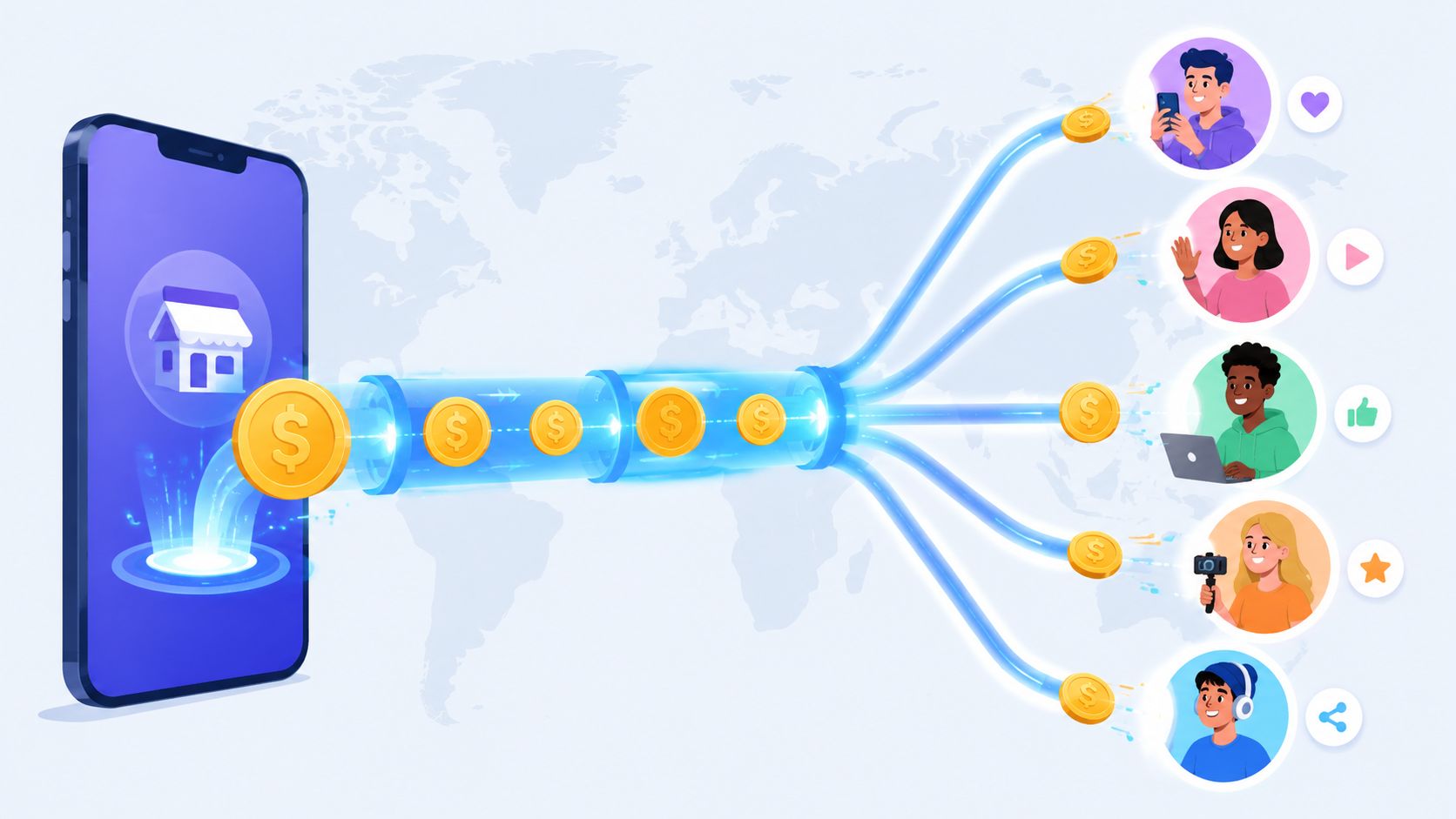
You're probably dealing with this right now. A campaign wrapped, creators posted on time, the client is happy, and then the admin work starts. One creator wants PayPal. Another sent bank details in a DM. Two still haven't submitted tax forms. One invoice doesn't match the agreed fee. Finance asks which deliverables were approved before payment goes out.
That's the part of influencer marketing people underestimate. The creative work gets attention. The payment workflow drains time, creates risk, and slows down the next campaign.
That's why payment processing solutions matter so much in the creator economy. They're not just fintech tools for checkout pages. For brands and agencies, they're the system that turns campaign obligations into organized, traceable, compliant payouts. If you're managing influencer work at any scale, payment operations stop being back-office admin and start affecting campaign speed, creator trust, and team capacity.
The Hidden Chaos of Manual Influencer Payments
A new coordinator usually sees the problem after the first busy month.
At first, manual payments look manageable. You've got a spreadsheet with creator names, rates, due dates, and payment methods. Maybe you pay a few people through PayPal, send a couple of bank transfers, and keep invoices in a folder. That feels fine when there are only a handful of creators.
Then the campaign mix changes. One creator bills in a different currency. Another needs a revised invoice. Someone posts late, but finance already scheduled payment. A creator manager says a Story was approved, but the performance lead says the required Reel never went live. Suddenly payment isn't one task. It's ten small tasks scattered across email, DMs, accounting software, and spreadsheets.
Where the mess usually starts
Manual influencer payment workflows tend to break in the same places:
- Approval gets separated from payout. Someone pays the invoice before confirming the deliverable.
- Creator records live in too many places. Rates sit in one file, tax forms in another, and bank details in a message thread.
- Finance has no campaign context. They see an amount owed, but not why it's owed.
- The team spends time chasing basics. W-9s, invoices, corrected names, and payout preferences all turn into follow-up work.
Practical rule: If you can't answer “what was delivered, approved, and owed” from one place, your payment process is already fragile.
This is one reason automated infrastructure has expanded so quickly. The payment processing solutions market was valued at USD 54.92 billion in 2024 and is forecast to reach USD 121.47 billion by 2032, a projected 10.43% CAGR, according to Airwallex's payment processing industry statistics roundup. That growth reflects a broad shift away from manual workflows and toward systems built for secure digital transactions.
If you want a quick comparison of what teams gain when they stop handling payouts by hand, this overview helps you discover payment automation benefits.
For influencer teams, the issue isn't just paying people. It's paying the right people, the right amount, after the right work is complete. If you need a plain-language walkthrough of the creator side of that process, REACH has a useful guide on how influencers get paid.
Why this matters to campaign operations
When payments stay manual, campaign management slows down. Coordinators spend their time reconciling documents instead of moving briefs forward. Creators wait longer, ask for updates, and lose confidence that the brand is organized.
That's why experienced teams treat payment processing as workflow design, not just finance admin. The smoother the payout process, the easier it is to scale creator campaigns without adding chaos.
How Payment Processing Solutions Actually Work
The easiest way to understand payment processing solutions is to think of them as a secure financial translator.
A creator, customer, or platform starts a payment. The system takes that request, checks whether it's legitimate, routes it through the right financial channels, and helps move the funds into the correct account. You don't need to memorize every technical term. You just need to know who handles what and where delays or errors can happen.
The five players in plain English
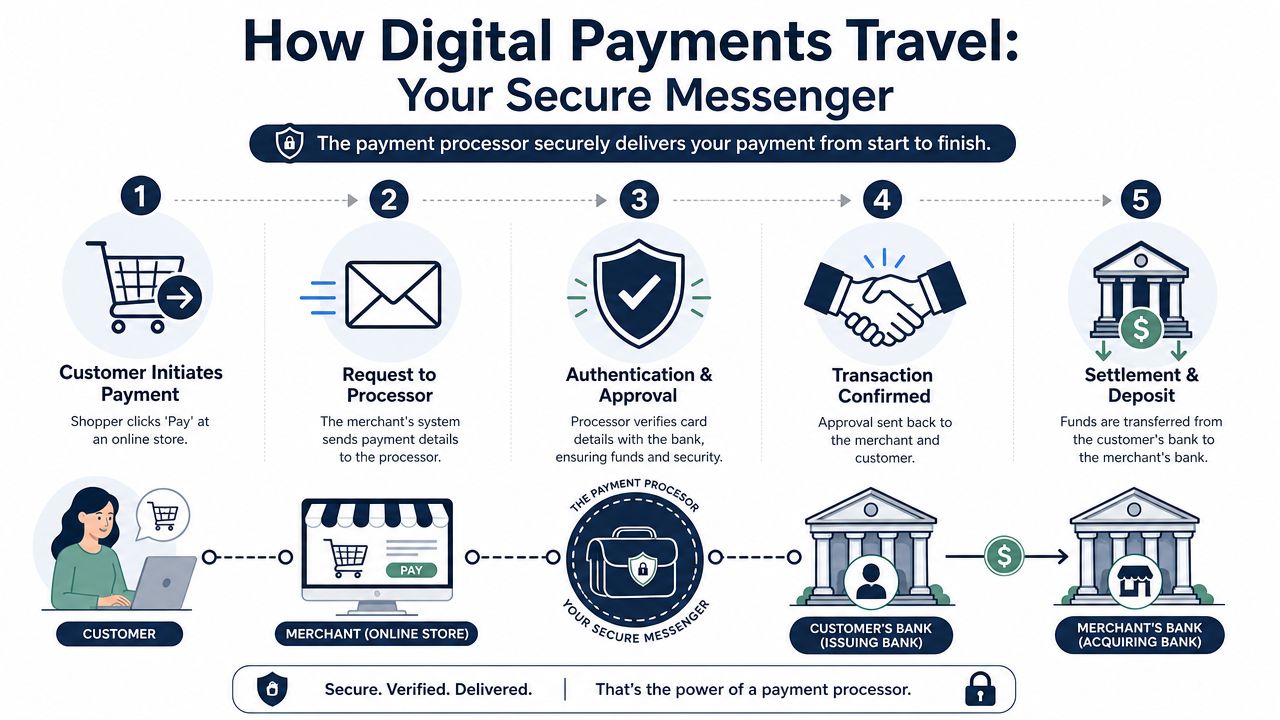
Here's the simple version:
- The payer starts the transaction. In e-commerce that might be a shopper. In influencer marketing, it could be a brand approving a creator payout.
- A gateway or payment interface captures the details. This is the form, button, or embedded payment step that collects the information securely.
- The processor routes the request. It passes the payment information through the right channels and checks whether the transaction can go through.
- Banks and card networks confirm or reject it. If the payment method is valid and the conditions are met, approval comes back.
- Settlement happens. The money is transferred and eventually deposited into the receiving account.
That's the backbone. Different tools package these steps differently, but the logic stays the same.
What a solution includes beyond the transaction itself
Often, people misunderstand that a processor isn't always the whole solution.
A full payment setup can include:
| Component | What it does | Why a campaign team should care |
|---|---|---|
| Gateway or payment interface | Collects payment details securely | Affects ease of use and error rates |
| Processor | Routes and validates transactions | Determines how money moves |
| Merchant or business account setup | Receives settled funds | Matters for reconciliation |
| Payout tools | Sends funds out to creators or vendors | Critical for mass payouts |
| Reporting and compliance layer | Stores records, statuses, and audit trails | Helps finance and ops stay aligned |
A payment tool that can move money but can't explain why it moved isn't enough for campaign operations.
In influencer work, this distinction matters because you're often not just accepting payments from customers. You're also managing outbound payouts tied to contracts, deliverables, and approvals. That means your “payment processing solution” needs to function as part of an operating system, not just a transaction pipe.
Why marketing teams should care about the mechanics
You don't need to become a payments specialist. You do need enough fluency to ask practical questions:
- Can this system handle both incoming and outgoing payments?
- Can finance see campaign-level records without chasing the marketing team?
- Does the workflow support approval before payout?
- Can we track status without checking five different tools?
That basic understanding saves a lot of cleanup later. It also helps you spot when a vendor solves one payment problem but leaves the workflow problem untouched.
Key Metrics for Any Payment Solution
When teams compare payment processing solutions, they often focus on the visible feature list first. That's understandable, but it's not enough. The better approach is to judge a payment system by how well it handles cost, control, security, and fit for your workflow.
Fee structure comes first
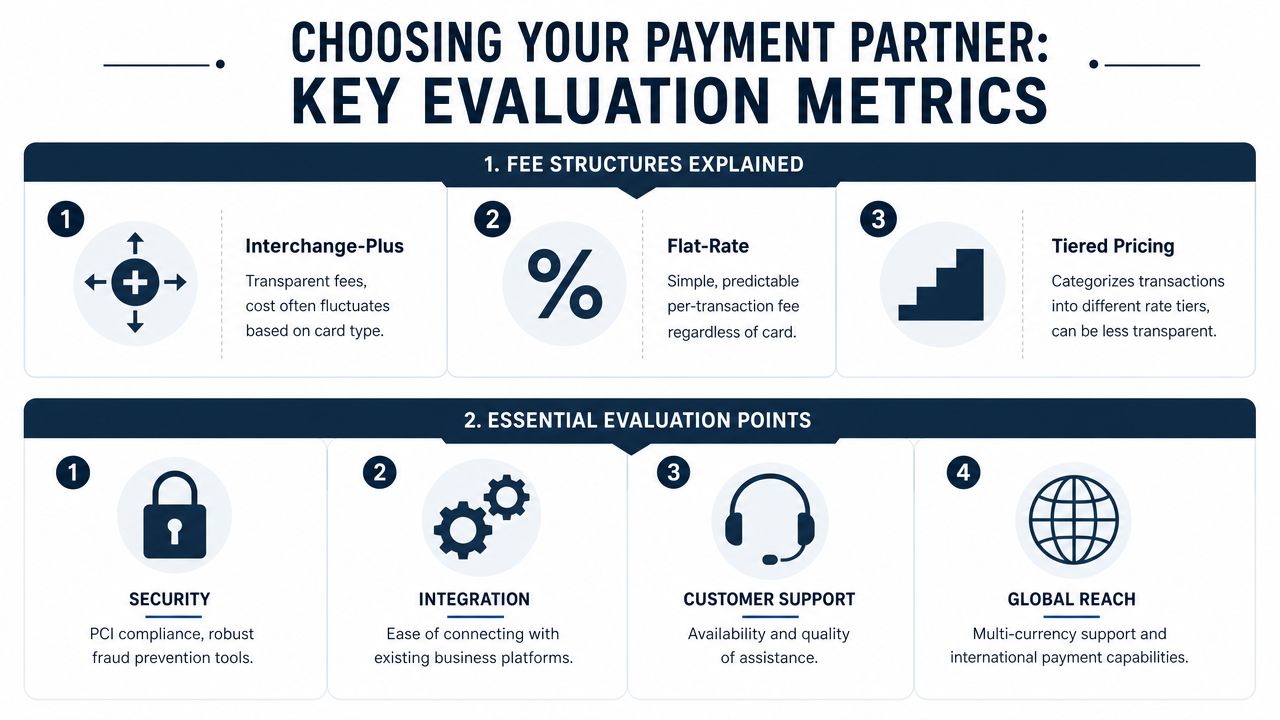
Not every pricing model works the same way. You'll usually run into three common approaches:
Interchange-plus
This model separates underlying card costs from the provider's markup. It can be more transparent, but charges may vary based on card type and transaction details.Flat-rate pricing
This is easier to understand and forecast. Many smaller teams like it because billing is simpler, even if it isn't always the lowest-cost structure.Tiered pricing
This groups transactions into categories with different rates. It can be harder to audit because the logic behind each tier isn't always obvious.
If you're paying many creators and vendors across campaigns, predictability matters. If you're processing larger invoice-style payments, transparency matters more. The right choice depends on how your team operates, not just which fee model sounds cleaner on paper.
Affordability and safety both matter
A payment workflow can technically “work” and still be a bad fit. The Boston Fed's 2024 research argues that underserved status in digital payments is about access, use, safety, and affordability, not just whether a business can transact at all. That matters because many businesses can accept digital payments but still face high fees or unsafe methods, which limits the full benefit of digital payment adoption, as discussed in the Boston Fed's research on underserved digital payment services.
For influencer campaigns, that shows up in practical ways:
- High-fee convenience tools may solve speed but hurt margins.
- Informal payout methods may feel easy but create risk and poor documentation.
- Disconnected systems may offer access without giving the team meaningful control.
Buyer lens: Don't ask only “can this tool send money?” Ask “can it do it safely, affordably, and with records we can trust?”
The metrics campaign teams should actually review
A coordinator or campaign manager doesn't need a dense payments checklist. You need a short list that catches the key issues:
Settlement and payout timing
Fast approvals don't help if creators wait too long to receive funds. Delays create support requests and relationship friction.
Global payout support
Creator rosters rarely stay local. If a tool struggles with cross-border payouts, your admin load goes up quickly.
Security and compliance
PCI compliance, fraud controls, and secure storage of payment information aren't optional. They protect both the brand and the creator.
Integration quality
A standalone payment product creates more work if it doesn't connect cleanly to your campaign process, accounting records, or approval workflow.
Support during exceptions
The test isn't the happy path. It's what happens when an invoice is wrong, a payment fails, or creator information needs correction.
A strong payment solution doesn't just process transactions. It reduces the number of questions your team has to answer after the transaction starts.
Why Standard Payment Solutions Fail the Creator Economy
A lot of standard payment tools were built for one of two jobs. Accept money from customers at checkout, or send money from one business to another. Influencer marketing sits awkwardly between those models.
You're not handling a simple retail purchase. You're coordinating many smaller business relationships at once. Each one has its own terms, deliverables, approval steps, payout details, and tax requirements. A generic payment tool can send money, but it often can't manage the workflow that justifies the payment.
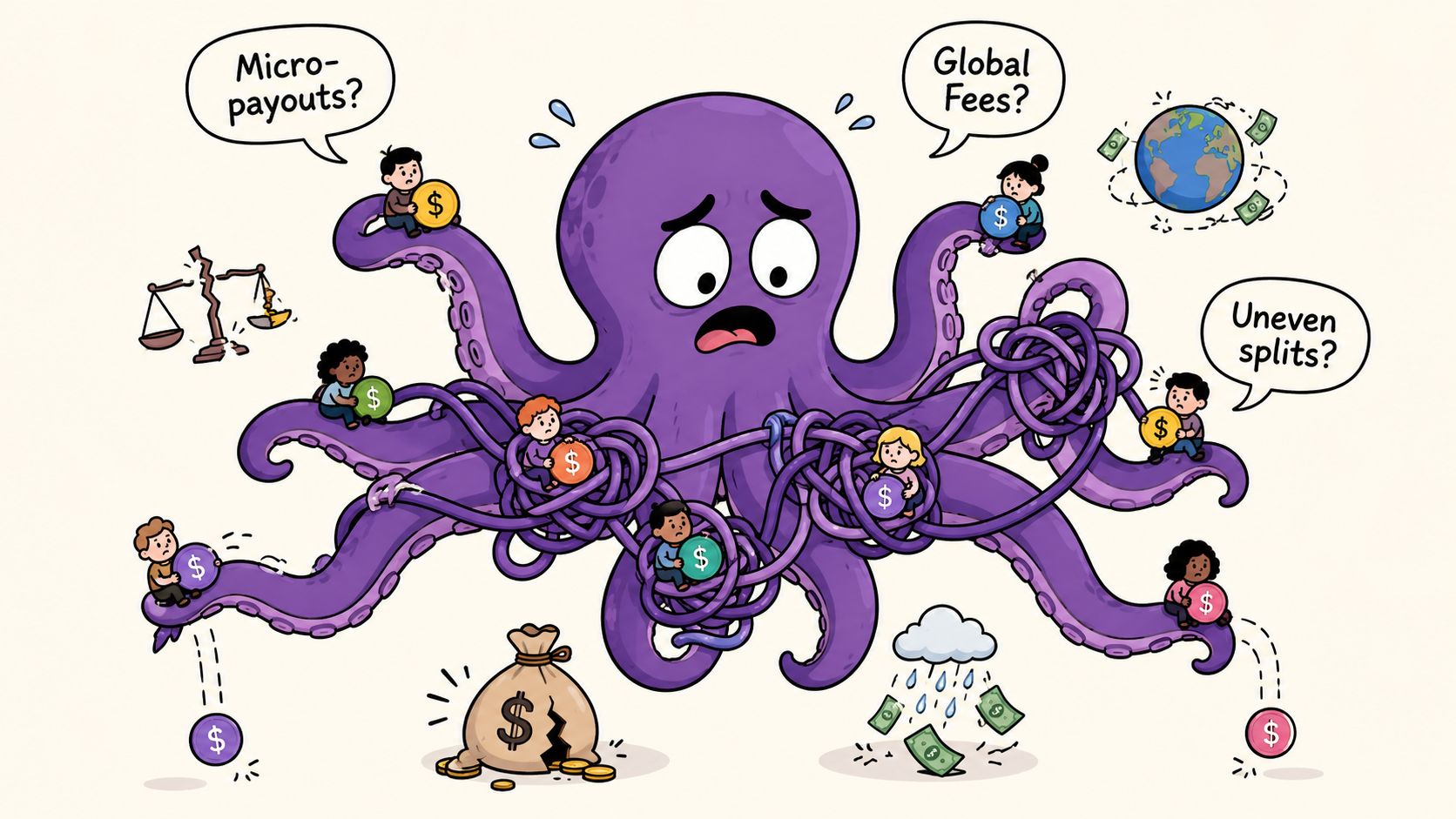
Mass payouts aren't the same as ordinary vendor payments
Finance teams often assume influencer payouts can fit into the same process they use for freelancers or suppliers. Sometimes that works for a tiny program. It falls apart when campaign volume grows.
Here's why:
| Standard payment setup | Creator economy reality |
|---|---|
| One invoice, one vendor, one approval path | Many creators, many amounts, many approval states |
| Payment tied to a traditional procurement process | Payment tied to content performance and deliverables |
| Limited payout methods may be acceptable | Creators expect flexibility and clarity |
| Records sit in finance systems | Campaign context sits with marketing or social teams |
The gap creates rework. Finance asks marketing whether a deliverable was completed. Marketing asks creator managers whether terms changed. The creator asks when payment is coming. Nobody sees the full picture in one place.
Deliverables and payment need to stay connected
This is the biggest operational miss in generic tools.
A creator payment isn't just a transfer. It's a conclusion to a campaign agreement. The brand agreed to pay for a feed post, a Story sequence, usage rights, a whitelisted ad asset, or some combination of those. If the payment system can't tie money to those approved outputs, your team ends up doing manual reconciliation every time.
That creates three common mistakes:
- Paying before approval
- Holding payment because no one updated status
- Paying the agreed fee without reflecting changes to scope
If campaign data lives in one system and payment data lives in another, your team becomes the integration layer.
Tax compliance turns into a year-end scramble
Then there's tax administration. Standard payment tools usually assume the business will handle documentation elsewhere. In influencer programs, that “elsewhere” often means inboxes, cloud folders, and frantic follow-ups.
The result is familiar:
- missing W-9s or W-8BENs
- mismatched legal names
- late form collection
- year-end 1099 stress
- manual checks between finance and campaign teams
Many marketers come to realize they never had a creator payment workflow, but rather a patchwork of payment actions.
The creator economy needs payment processing solutions that understand campaigns, approvals, records, and compliance as one continuous flow. Without that, every campaign gets harder to close cleanly.
Streamlining Payments with an Influencer Command Center
The practical fix is to stop treating payments as a separate admin task. In creator marketing, payment works better when it sits inside the same system that manages campaign activity.

That's what an influencer command center does. It combines outreach, deliverable tracking, approvals, creator records, and payouts so the team isn't bouncing between disconnected tools. One example is REACH's influencer payment automation tool, which places creator payments inside a broader campaign workflow rather than treating them as isolated finance events.
What changes when payments live inside the workflow
The difference isn't abstract. It shows up in the tasks your team stops doing manually.
Instead of checking a spreadsheet to see who should be paid, the platform can show which creators have approved deliverables and are ready for payout. Instead of searching for tax documents at the end of the year, the system can collect and organize those records as part of onboarding. Instead of sending one-off updates to finance, campaign data and payment status live together.
That means the payment process becomes:
- More traceable, because payment status is linked to campaign records
- Less manual, because the team isn't re-entering creator details over and over
- Easier to reconcile, because approvals, fees, and payouts are connected
- Cleaner for compliance, because documentation is gathered earlier
Teams that want a broader view of how automation improves payables work can compare creator payments to supplier workflows in Zaro's guide to AP automation.
Why this is better for creators too
Creators feel process quality immediately. They notice when expectations are clear, payment terms are visible, and payouts arrive without repeated follow-ups.
That matters because payment is part of the relationship, not just the transaction. A creator who gets fast, organized communication around compensation is easier to retain, easier to brief again, and less likely to flood your inbox with status questions.
Here's a quick look at the difference:
| Manual process | Integrated command center |
|---|---|
| Spreadsheet tracks who's owed | Platform tracks payout readiness |
| Email thread confirms approval | Deliverable status confirms approval |
| Tax forms collected ad hoc | Tax data collected in workflow |
| Finance asks for context | Context is attached to the payment record |
A short product walkthrough helps make that shift concrete:
The operational benefit people miss
While a better payment setup certainly saves admin time, the bigger gain is consistency.
When payment, compliance, and deliverable tracking run through one command center, your campaign process becomes easier to repeat. New coordinators ramp faster. Finance gets cleaner records. Creators get fewer surprises. That's what makes influencer programs easier to scale without turning every campaign into a custom operations project.
Choosing and Implementing Your Payment Workflow
If you're evaluating payment processing solutions for influencer work, don't start with the provider list. Start with the workflow you need.
A good decision usually comes down to five questions:
- Can the system support creator payouts at scale? You need more than one-off transfers.
- Can payments be tied to approved deliverables? If not, your team will keep reconciling manually.
- Does it collect and organize tax documentation? That work shouldn't wait until year-end.
- Can finance and marketing see the same records? Shared visibility prevents delay and confusion.
- Will it fit the rest of your stack? A payment tool that creates new silos won't solve much.
A simple implementation sequence
Don't roll out a new workflow by starting with every campaign at once. Use a smaller sequence:
- Map the current process. List where creator details, approvals, invoices, and tax forms live today.
- Identify handoff failures. Note where marketing waits on finance, or finance waits on campaign data.
- Choose one integrated system. For many teams, that means moving away from separate spreadsheets, inboxes, and payout tools toward a dedicated influencer marketing platform.
- Standardize creator onboarding. Collect payout and tax details before campaign closeout.
- Review bookkeeping alignment. If your finance team also wants cleaner downstream records, this look at an automated bookkeeping platform is a useful companion read.
For broader context on payment infrastructure and market direction, the payment processing solutions statistics roundup is helpful, and for technical detail on commercial-card data requirements, NMI's explanation of Level 2 and Level 3 payment data is worth reviewing.
The core takeaway is simple. In influencer marketing, payment isn't the last administrative step. It's part of campaign execution. Teams that build the workflow correctly spend less time chasing paperwork and more time running programs that scale cleanly.
If you're tired of juggling spreadsheets, payout notes, approval threads, and tax form follow-ups, take a look at REACH. It gives brands and agencies one place to manage creator campaigns from outreach through final payment, with deliverable tracking and compliance steps kept in the same workflow.