 Skip to content

The average cost per impression is what you pay to get your ad in front of one thousand people. This metric, known in the marketing world as CPM (Cost Per Mille), is the bedrock for measuring how efficiently your campaigns are building brand awareness. For brands looking to maximize their budget, understanding and lowering this cost is critical.
Think of it like paying for a billboard—your goal is pure visibility, getting as many eyes on your message as possible. A lower average cost per impression means your marketing dollars are working harder, reaching more potential customers without increasing your spend. In this guide, we'll explore exactly what drives this cost and how platforms like REACH Influencers can provide a more efficient path to high-quality visibility.
What Does Average Cost Per Impression Actually Mean?
Picture your ad as one of those massive billboards along a busy digital highway. Every time a car passes by and someone inside sees it, that’s an impression. The average cost per impression tells you the price tag for every 1,000 sets of eyeballs that noticed your ad.
This metric is almost always called CPM, which stands for "Cost Per Mille"—with "mille" being the Latin word for thousand. It's one of the most basic, yet most important, concepts in advertising because it boils down to a simple question: how much does it cost to just be seen?
Quick Guide to Average Cost Per Impression (CPM)
To make this crystal clear, here’s a quick-reference table breaking down the essentials of CPM. It's a handy guide for understanding the core components at a glance.
| Metric | Definition | Simple Formula | Typical Range (Social Media) |
|---|---|---|---|
| CPM | The cost an advertiser pays for one thousand views or impressions of an advertisement. | (Total Campaign Cost / Total Impressions) x 1,000 | $2 to $20+ |
This table serves as a great starting point, but remember that actual costs can swing widely based on your industry, audience, and the ad platform you're using.
Impressions vs. Clicks: Knowing the Difference
It’s easy to mix up paying for views (CPM) with paying for actions (CPC, or Cost Per Click), but they serve totally different purposes. A low CPM means you're getting your brand name out there cheap. A low CPC means you're getting people to visit your website without breaking the bank.
Here’s when you'd use each one:
- CPM (Impressions): This is your go-to for brand awareness. If you're launching a new product or just want to become a household name, your goal is to get your message seen by as many people as possible.
- CPC (Clicks): This is all about driving action. You only pay when someone is interested enough to click your ad and land on your website or product page.
One isn't better than the other; they're just different tools for different jobs. A big launch campaign might lean heavily on CPM to create buzz, while a flash sale will focus on CPC to get immediate sales.
"Understanding CPM is the first step in mastering your ad budget. It answers the simple but critical question: 'How much am I paying just for people to see this?' Before you can measure clicks or conversions, you must first measure visibility."
Why This Metric Is So Foundational
Tracking your average cost per impression gives you a crucial baseline for your entire advertising strategy. It helps you compare the real cost of visibility across different channels. For example, is it cheaper to get 1,000 views on Facebook, or would you get more bang for your buck with an influencer?
This data helps you put your money where it works hardest.
Plus, a stable CPM is a good sign that your campaign is healthy. If you see it suddenly spike, it could be a warning that your audience is getting tired of your ad, your targeting is off, or competition has heated up. By keeping an eye on it, you can spot problems before they get out of hand. To get a really solid grasp of the basics, you can explore more about what CPM in advertising means.
The Influencer Marketing Advantage
This is where things get interesting. When you work with creators, you aren't just buying ad space; you're tapping into the genuine connection they have with their followers. An impression from an influencer's post often feels more like a trusted recommendation than a typical ad.
Tools like REACH Influencers help brands find creators whose followers are the exact people they want to talk to. This means the impressions you get are not only high in number but also incredibly relevant. An influencer campaign can often deliver a much better effective CPM and a more engaged audience, giving you a smarter, more powerful way to build your brand. To truly leverage this, it helps to deepen your understanding of social media impressions.
A Simple Guide to Calculating Your Ad Spend Efficiency
Alright, you get what an impression is. So, let's get down to business. You don't need a degree in advanced mathematics to figure out how efficiently your ad dollars are working. Calculating your average cost per impression, which we call CPM in the marketing world, is actually pretty simple.
Think of it as the price tag for getting a thousand pairs of eyes on your ad. All you need are two things you should already have handy: how much you spent and how many impressions you got.
The CPM Formula: (Total Ad Spend / Total Impressions) x 1,000 = Your Average Cost Per Impression (CPM)
This little formula is your best friend for benchmarking performance. It tells you exactly what it cost to serve your ad one thousand times.
Putting the CPM Formula into Practice
Let's make this real. Picture a small online shop launching a new product line with an Instagram campaign.
- Total Ad Spend: $500
- Total Impressions: 100,000
Plugging those numbers into the formula, we get:
($500 / 100,000) x 1,000 = $5.00 CPM
So, for every $5.00 they spent, their ad was shown to a thousand people. That single number is a game-changer for budgeting and seeing if your new campaigns are doing better or worse than your old ones. Of course, costs vary wildly across platforms, so it helps to have some context on how much Google Ads actually cost to see how your social campaigns stack up.
Calculating Effective CPM for Influencer Campaigns
The same core idea works for influencer marketing, but we usually call it "effective CPM" (eCPM). The name is slightly different because you're not bidding in an ad auction; you're paying a creator for their content and reach. Let's say you team up with a micro-influencer through the REACH Influencers platform.
- Influencer Fee: $750
- Total Impressions from their content: 125,000
Here’s how you’d calculate your effective CPM:
($750 / 125,000) x 1,000 = $6.00 eCPM
This tells you that your partnership delivered a thousand impressions for every $6.00 spent—a crystal-clear measure of its value. On the REACH platform, we make this dead simple by tracking impressions and engagement for you. You can see the cost-efficiency of every creator you work with right on your dashboard, making it easy to report on your budget's performance.
If you want to go deeper, we've got a complete guide on the calculation of CPM that will help you master this metric. By keeping a close eye on your CPM, you'll start making smarter, data-backed decisions that make your marketing budget work a whole lot harder.
Comparing Average Cost Per Impression Across Channels
Not all impressions are created equal. Far from it. An impression on TikTok is going to feel and cost completely different than a banner ad someone barely notices. Knowing where these costs diverge is the key to spending your marketing budget wisely.
Your average cost per impression will tell you a lot about the audience you're reaching and the platform you're on. To keep things simple and comparable, we usually talk about CPM, or Cost Per Mille, which is just the cost for one thousand impressions.
Here's the quick and easy math behind it:
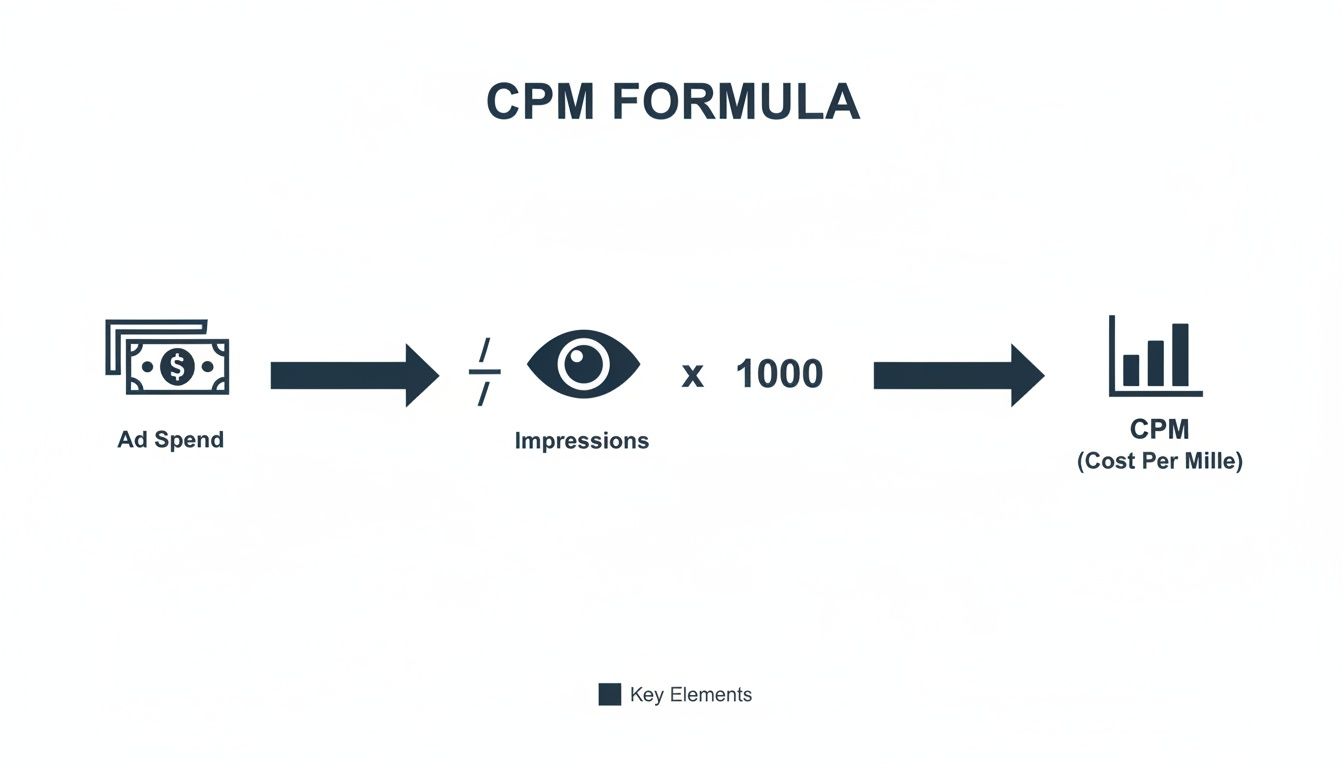
This simple formula lets you put every channel on a level playing field, so you can see exactly where your money is working hardest.
What You'll Pay on Social Media
Social media is usually the go-to for building brand awareness, but the costs can swing wildly from one platform to the next. Each one has its own unique audience and content style, and that directly shapes what you'll pay to get in front of them.
Instagram, for instance, is a visual playground. If you've got eye-catching content, you can often find an average CPM of around $6.70. On the flip side, Facebook's massive audience and competitive ad auctions can push the average CPM up to $14.40. Then you have TikTok, the new kid on the block, which offers access to a younger, hyper-engaged crowd for an average CPM of about $10.
Ultimately, the competition for eyeballs is fierce. Your final cost will always come down to who you're trying to reach and what industry you're in.
The Wild West of Programmatic Ads
Programmatic advertising—the automated bidding for ad space across the internet—can get your brand seen everywhere, but it comes with a major catch: the costs are all over the place. The price for a single impression can change in the blink of an eye based on real-time auctions, making it nearly impossible to predict your average cost per impression.
One day you might pay a few cents, the next you could be paying hundreds of dollars for the same ad spot. One deep dive into header bidding found advertisers paying as little as $0.01 and as much as a jaw-dropping $113.32 for a CPM. That same report found Google's average bids were the highest at $37.60, highlighting just how extreme the price swings can be.
This kind of volatility is a nightmare for any brand trying to stick to a predictable budget. You can easily get sucked into a bidding war that sends your costs through the roof without getting better-quality impressions.
A Better Way: The Influencer Alternative
This is where influencer marketing changes the game. Instead of throwing your budget into a chaotic, unpredictable auction, you work directly with creators who have already earned the trust of a dedicated audience. It’s a much more controlled and predictable way to manage your costs.
Working with influencers almost always delivers more valuable impressions, too. A random banner ad is easy to ignore. But when a creator you follow recommends something, it feels like a genuine suggestion from a friend. This leads to way more engagement and helps people actually remember your brand.
It’s about sidestepping the bidding wars to connect with high-quality, targeted audiences. This is exactly why understanding cross-channel marketing attribution is so critical—it shows you the real impact each type of impression has on your bottom line.
Average CPM Benchmarks by Platform and Influencer Tier
To help you see the bigger picture, here's a quick comparison of the typical CPM ranges you can expect across different channels and influencer tiers. This table should give you a good starting point for deciding where your budget will be most effective.
| Platform / Tier | Average CPM Range | Best For |
|---|---|---|
| Facebook Ads | $12 – $15 | Reaching a massive, diverse audience with broad demographic targeting. |
| Instagram Ads | $6 – $8 | Engaging younger audiences with strong, visually-driven campaigns. |
| TikTok Ads | $9 – $12 | Capturing Gen Z's attention with creative and authentic short-form video. |
| Programmatic Display | $1 – $100+ | Casting a wide net for brand visibility, but with highly volatile costs. |
| Influencer Marketing | $5 – $25 (eCPM) | Building authentic trust and reaching dedicated, niche audiences. |
As you can see, programmatic ads might offer immense reach, but influencer marketing provides a far more stable and often more impactful path to getting your brand in front of the right people. It’s a fundamental shift from just buying eyeballs to earning the attention of an audience that genuinely wants to listen.
Factors Influencing Your Average Cost Per Impression
Ever watched your ad spend bounce around and wondered what’s going on behind the curtain? The average cost per impression isn't some fixed number—it's a live price tag that moves based on a few powerful market forces. Getting a handle on these is the first step to controlling your budget and making sure you’re not just throwing money away.
Think of it like buying plane tickets. The price for the exact same seat can be wildly different depending on when you book, who else is trying to fly, and whether you want to be in first class or the back row. Your ad costs are no different. The more valuable the audience or the ad space, the more you're going to pay.
Your Target Audience's Value
The single biggest thing that moves the needle on your costs is who you're trying to reach. In the advertising world, not all audiences are created equal.
-
Broad vs. Niche: Targeting a huge, general audience—say, adults aged 18-65 across the country—is usually pretty cheap because the pool of people is massive. But what if you want to reach a very specific group, like software engineers in San Francisco who also love rock climbing? Your cost per impression is going to jump. The supply of those people is tiny, and the demand is high.
-
Demographic Value: Some demographics are just flat-out more valuable to advertisers, usually because they have more money to spend or are actively looking for expensive products. Targeting people with higher incomes, specific job titles, or clear signals they're ready to buy will always be more expensive.
An impression served to a potential high-value customer is worth more than ten impressions shown to a random audience. The goal isn't just to find a low average cost per impression, but to find the right impression at a fair price.
This is actually where influencer marketing offers a pretty clever alternative. Instead of getting into a bidding war over a niche audience on a big ad platform, you can partner with a micro-influencer who has already built a loyal community of those exact people. Using a platform like REACH Influencers lets you find these creators directly, giving you a more direct—and often cheaper—path to your ideal customer.
The Impact of Seasonality and Timing
Just like holiday travel, advertising has its peak seasons. When you choose to run your campaign can have a huge effect on your costs, because you're suddenly competing with almost every other brand for eyeballs.
The most famous example is the fourth quarter (Q4). Once Black Friday, Cyber Monday, and the holidays get close, retailers dump enormous budgets into advertising. This flood of demand drives up the average cost per impression for everybody. It’s a well-known trend; social media ad cost analyses show that CPMs on Facebook and Instagram always spike in October and November. If you're curious about these patterns, you can explore detailed insights on social media ad costs.
If your product isn't seasonal, waiting for costs to drop in January can be a really smart play. Planning your campaigns outside these super-competitive windows is a simple but powerful way to protect your budget.
Competition Within Your Industry
Let's be honest: some industries are just more cutthroat than others. If you're in a crowded space like finance, legal services, or retail, you're always bidding against competitors with deep pockets for the very same audiences, and that keeps costs high.
For instance, the average cost-per-click for a financial advertiser on Facebook is $3.77, while an apparel brand might get away with paying just $0.45. That massive difference shows up in impression costs, too. When a dozen insurance companies are all fighting to show an ad to the same person, the auction price for that impression naturally goes through the roof.
The Role of Ad Placement and Quality
Finally, where your ad shows up and how people react to it will also shape your costs.
- Placement: An ad in the main Instagram feed is prime real estate and will cost you more than an ad tucked away in a less visible spot like the Audience Network. It's all about location, location, location.
- Ad Quality: Ad platforms actually reward you for making good ads. If your ad gets a lot of likes, shares, and comments and has a high click-through rate, the algorithm sees it as high-quality. As a thank you, it will often show your ad to more people for less money. On the flip side, a boring or irrelevant ad will see its CPM creep up as the platform penalizes it for creating a bad user experience.
Proven Strategies to Lower Your Average Cost Per Impression
Knowing what’s driving your ad costs is one thing, but actively bringing them down is what really counts. A high average cost per impression can feel like you're just burning cash, but it doesn't have to be that way. With a few smart tactics, you can take control and get way more visibility for your budget.
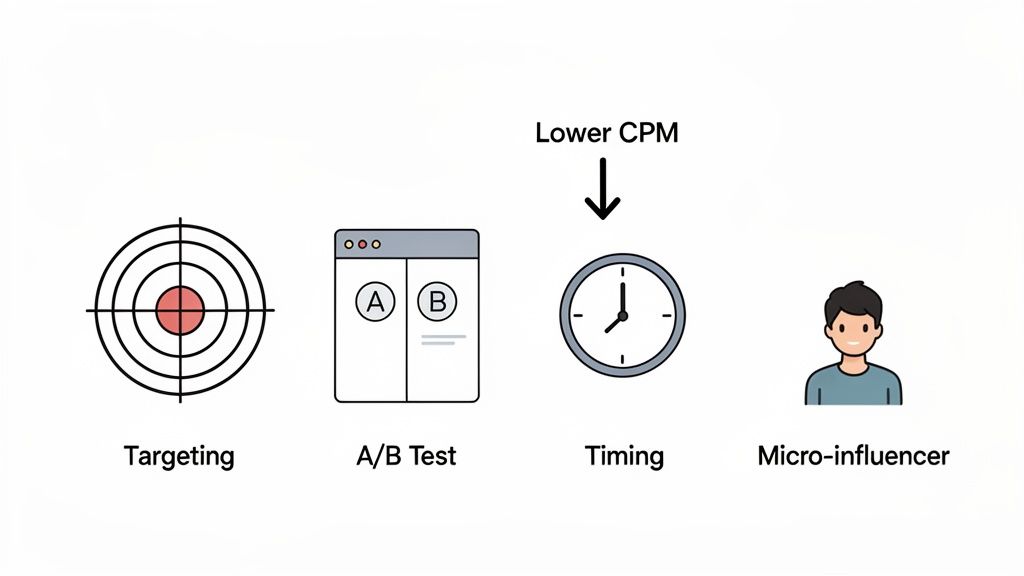
This isn't about cutting corners—it’s about spending smarter. By focusing on better targeting, smart timing, and the right partnerships, you can make your campaigns much more efficient and get your message in front of the right people without breaking the bank.
Refine and Sharpen Your Audience Targeting
The quickest way to slash your costs? Stop showing ads to people who couldn't care less about them. Casting a wide net with broad targeting might feel safer, but it’s often a recipe for wasted impressions and higher costs. The simple truth is that ad platforms reward relevance; the better your ad connects with its audience, the less you'll pay.
Dig deep into your customer data. Move beyond basic demographics and look at what people are actually interested in, their online behaviors, and their purchase history. When you create super-specific audience segments, your ad resonates on a different level. That boosts engagement and signals to the ad algorithm that you’re delivering value.
- Layer Your Targeting: Don't just target "fitness enthusiasts." Instead, target people who follow specific fitness influencers and have recently bought workout gear. This combination is much more powerful.
- Use Exclusion Lists: Be strategic about who doesn't see your ads. If you just acquired a new customer, add them to an exclusion list for your brand awareness campaigns. There's no point in paying to show them an intro ad.
A/B Test Your Creative Relentlessly
Think of your ad creative as your first impression. If it’s boring or irrelevant, people will scroll right past it, and your average cost per impression will climb as the platform penalizes its poor performance. The only way to find out what truly grabs your audience is to test, test, and test again.
Start with small, controlled experiments to see what actually moves the needle. The results might surprise you.
- Test Different Visuals: Pit a static image against a short video. Try a polished graphic versus a more authentic, user-generated-style photo.
- Experiment with Copy: Does a question in the headline work better than a bold statement? What about a long, detailed caption versus a short, punchy one?
- Vary Your Call-to-Action: Find out if "Learn More" gets a different response than "Shop Now."
Even tiny tweaks can cause a big jump in engagement, which has a direct and positive impact on your CPM.
Optimize Your Campaign Timing and Placements
When and where your ads show up is a huge deal. We already know that costs can skyrocket during busy seasons like the holidays. If your product isn't seasonal, try running awareness campaigns during quieter months like January. You can often get cheaper impressions when there's less competition.
And don't just trust the ad platforms to put your ads in the best spots automatically. Keep a close eye on your placement performance reports and cut the ones that aren't working. An ad in the main Instagram feed is prime real estate and costs more for a reason, but an ad tucked away in a less-seen spot might just be wasting your budget. Take control and manually select the placements that give you the best bang for your buck.
Embrace the Power of Micro-Influencers
Here’s a tactic that can help you outsmart bigger competitors. Instead of dumping your entire budget into the competitive and often-volatile ad auction, think about partnering with micro-influencers. These creators may have smaller followings, but their audiences are incredibly engaged and genuinely trust their recommendations.
By collaborating with micro-influencers, brands can tap into pre-built, high-trust communities. The result is often a lower effective CPM and a much higher level of engagement, bypassing the volatility of ad auctions entirely.
An impression delivered by a trusted micro-influencer can carry far more weight and authenticity than a standard ad. With a platform like REACH Influencers, finding these creators in any niche is straightforward. You can filter by engagement rate, audience demographics, and more to find your perfect match.
These collaborations can often secure impressions for a fraction of what you'd pay for social ads. For perspective, benchmarks show Instagram feed ads hover around $7.68 CPM and Twitter at $5.00 CPM. Micro-influencers can often deliver similar reach for 20-50% less, a point highlighted in these social advertising benchmarks.
Repurpose Influencer Content for Maximum ROI
Finally, one of the best ways to lower your average cost per impression over the long term is to get more mileage from your content. When you work with a creator, make sure you negotiate the rights to repurpose the content they create for you.
This user-generated content (UGC) is gold. It’s authentic, relatable, and tends to perform incredibly well in paid ad campaigns. You can use it in your social ads, on your product pages, or in your email marketing. This simple step extends the value of your initial investment, essentially giving you a library of high-quality creative that drives down your overall campaign costs.
Measuring Success Beyond the Impression
It’s easy to get caught up in chasing a low average cost per impression. Seeing thousands of views for just a few pennies feels like a huge win, but it's really just the opening move. Those impressive numbers don't mean much if they don't translate into real business results.
After all, the goal isn't just to be seen. It's to be seen by the right people—the ones who might actually become your customers.
This is where the conversation has to shift from pure quantity to genuine quality.
A slightly higher CPM to reach a highly relevant, engaged audience will always deliver a better return than a rock-bottom CPM for an audience that doesn't care about your brand. Quality impressions drive action; cheap impressions are just noise.
Think of your CPM as a starting point, not the finish line. It’s a vital metric for gauging how far your message is traveling, but true success is measured by what happens after the view. The clicks, conversions, and sales are what really move the needle, and those results almost always come from reaching a targeted, interested audience.
That's why a strategic approach is so important. Instead of just buying impressions, the real objective is to earn attention. This is the whole idea behind platforms like REACH Influencers. We help brands look past the vanity metrics by connecting them with creators whose audiences are genuinely listening.
Our platform gives you the tools to follow the entire customer journey, from an influencer's first post all the way to a completed sale.
Ready to measure what truly matters and drive tangible ROI? See how REACH can help you build campaigns that connect with the right people and deliver results that go far beyond the impression.
Frequently Asked Questions About Cost Per Impression
It's natural to have questions when you're digging into advertising metrics. Let's clear up some of the most common ones about the average cost per impression so you can move forward with confidence.
Is a Lower Average Cost Per Impression Always Better?
Not always. While a low CPM looks great on a spreadsheet and suggests your budget is stretching far, the quality of those impressions matters so much more.
Think of it this way: it’s better to pay a bit more to get your message in front of a highly relevant audience than to get a rock-bottom price showing your ad to people who will never become customers. The real goal is to find that sweet spot between cost and quality to get the best possible return on your investment (ROI). A cheap impression that gets zero engagement is just a wasted dollar.
How Does Influencer Marketing Affect the Average Cost Per Impression?
Influencer marketing plays by a different set of rules. Instead of fighting for ad space in a crowded auction, you're partnering directly with a creator to tap into their loyal, built-in audience. This is a game-changer.
You'll often find that the "effective CPM" from an influencer campaign, especially with micro-influencers, is not only lower but also far more valuable than what you’d get from traditional ads.
By comparing a creator's fee to the total impressions their content receives, you get a crystal-clear picture of cost-efficiency. Platforms like REACH Influencers can automate this for you, revealing the true value of every partnership.
What Is a Good CPM to Aim For in My Campaigns?
There’s no magic number here. A "good" CPM completely depends on your industry, who you're trying to reach, the platform you're on, and what you want to achieve.
A smart approach is to look up the general benchmarks we've discussed as a starting point. But your main focus should be on outdoing your own past performance. Instead of chasing someone else's number, aim to consistently lower your average cost per impression over time through smart testing and optimization.
Can I Calculate CPM for Marketing That Isn't Digital Ads?
Absolutely. You can figure out an "effective CPM" for almost any marketing channel, as long as you know two things: the total cost and the total impressions.
Here are a couple of examples:
- PR Campaign: Take the PR agency's total fee and divide it by the estimated readership of all the publications that featured your brand.
- Influencer Marketing: Divide the creator's total fee by the number of impressions their content generated.
This approach gives you a fantastic way to compare the cost-effectiveness of completely different marketing efforts on a level playing field.
Ready to move beyond just counting impressions and start tracking the metrics that actually grow your business? REACH Influencers gives you the tools to find the right creators, measure performance in real time, and prove your campaign’s ROI. Learn more about our platform and start building more impactful campaigns today.