
Branded content marketing is all about storytelling. Instead of a hard sell, it focuses on making a real, emotional connection with an audience. The goal is to associate your brand with content that people find genuinely entertaining, useful, or inspiring, which in turn builds trust and loyalty.
What Branded Content Marketing Really Means
Think of it like this: instead of walking into a party and handing everyone your business card, you host the party yourself. That's branded content marketing in a nutshell. It’s not about cornering someone to pitch your product; it’s about creating an experience so valuable and enjoyable that people want to be there. The brand is the host, making sure everyone has a great time, with the focus squarely on connection, not sales.
This is a world away from traditional advertising, which often feels like an interruption. Branded content is the main event. It cleverly weaves a brand’s values into a compelling story, a fascinating documentary, or a funny video, leaving you with a good feeling about the brand without you even realizing it. The key is that the brand’s involvement feels totally natural, not shoehorned in.

Differentiating Branded Content from Similar Concepts
To really get why this works so well, you need to see how it differs from other marketing tactics. On the surface, things like content marketing and native advertising can look similar, but their goals and methods are completely different. Mixing them up is a fast track to a campaign that just doesn't connect.
Let’s break down how branded content stands apart from its marketing cousins:
- Traditional Advertising: This is your classic, direct sales pitch. TV commercials, pop-up ads, and magazine placements are all shouting, "Buy this now!" Branded content takes a different route, whispering, "I've got a great story for you."
- Content Marketing: This is about positioning your brand as an expert by providing helpful, practical information—think blog posts, how-to guides, and white papers. Branded content, on the other hand, leans more into entertainment and sparking an emotional response.
- Native Advertising: This is sponsored content designed to blend in with the platform it's on. While it's meant to feel seamless, it's usually designed to get you to click or buy something right away. Branded content is playing the long game, building brand love over time.
In short, while other marketing forms ask for your attention, branded content marketing works to earn it by contributing something meaningful to the audience's lives.
Why This Strategy Is So Effective
The real magic of branded content is that it slips past our built-in ad-blockers. People are tired of being sold to constantly. When a brand gives them something genuinely interesting—a powerful documentary, a laugh-out-loud video series, or a beautifully written article—it’s not just marketing anymore. It’s culture. It’s a way for brands to cut through the noise by building authentic relationships around shared interests.
At the end of the day, great branded content doesn't just sell a product. It sells a feeling, an identity, and a sense of connection. By putting the story first, brands create an impression that sticks with you far longer than any 30-second ad spot. That foundation of trust is what turns a casual viewer into a passionate advocate for your brand.
The 3 Pillars of Memorable Branded Content
What's the difference between content that disappears in a day and a story that sticks with someone for years? It's not luck. The best branded content is built on a solid foundation of three core pillars. When these principles work together, they create an experience that feels real, helpful, and deeply human.
Nailing these pillars—authenticity, audience value, and emotional connection—is how you turn a simple marketing asset into something truly memorable. When a campaign gets all three right, it stops feeling like an ad and starts feeling like a gift. That's the secret to building real brand loyalty and trust.
Pillar 1: Be Genuinely Authentic
Authenticity is the foundation of it all. People today have a razor-sharp radar for anything that feels fake. True authenticity means your content flows directly from your brand's core values and mission.
Think of it this way: if your brand was a person, what would they talk about? What would they care about? A rugged outdoor gear company making a documentary on wilderness conservation? Makes perfect sense. That same company producing a series on high-fashion runway shows? It would just feel weird and out of place.
Before you even start creating, ask yourself these gut-check questions:
- Does this story line up with what our company actually stands for?
- Is this a topic we can talk about with real passion and credibility?
- Will this feel right to the people who already know and trust our brand?
Pillar 2: Offer Real Value to Your Audience
To capture anyone's attention, your content has to give them something worthwhile. Value isn't just about how-to guides or tutorials; it can be a good laugh, a moment of awe, or a spark of inspiration. The key is to give your audience something they’ll genuinely appreciate.
Your content should solve a problem, answer a question, or meet a need. This value exchange is the engine of great branded content. Instead of interrupting someone's day with a sales pitch, you're actually making it better.
The big idea here is generosity. Branded content wins when it puts the audience’s needs ahead of the brand’s need to sell. When you offer real entertainment or education, you build a positive connection that a traditional ad just can't match.
Take a finance software company, for example. They could create a documentary series about young entrepreneurs navigating their first few years in business. It's educational and inspiring for their target audience, and it never once says, "buy our software." It delivers huge value first, which builds the trust that earns business down the road.
Pillar 3: Create an Emotional Connection
This is the final, and most powerful, pillar. Facts and figures are fine, but emotion is what makes people care and inspires them to act. The campaigns we remember for years are the ones that made us feel something—joy, empathy, curiosity, you name it.
The secret ingredient is the incredible power of storytelling in marketing. It's what allows you to build a genuine bridge to your audience.
To create that spark, you have to truly understand your audience's hopes, fears, and dreams. What stories will they see themselves in? A brand that shares a story of overcoming adversity taps into a universal human desire for resilience and hope.
Instead of just listing product features, you tell a story with characters people can relate to. By focusing on the human side of things, you invite your audience into the narrative, creating a bond that’s much stronger than any simple transaction.
How to Build a Branded Content Strategy
A winning branded content strategy doesn't just happen. It’s not about throwing a bunch of cool ideas at the wall and hoping one sticks. It's a thoughtful process that connects what your brand stands for with what your audience genuinely cares about.
Think of it this way: a good strategy ensures every piece of content—whether it's an article, a video, or a podcast—has a clear purpose. This creates a cohesive brand story, not just a random collection of marketing assets. It all starts with knowing what you want to achieve and who you're talking to.
Define Your Strategic Goals
Before you even think about creative concepts, you have to define what winning looks like for your brand. What specific business objective will this content support? A fuzzy goal like "increase brand awareness" just won't cut it. You need concrete, measurable targets.
Your goals are the North Star for your entire strategy, influencing the stories you tell, the formats you choose, and the platforms you use. Here are a few examples of what strong goals look like:
- Boost audience engagement by hitting a 25% higher comment rate on video content compared to past campaigns.
- Improve brand sentiment by increasing positive social media mentions by 40% within six months.
- Generate qualified leads by driving traffic to a key landing page, with a target of a 10% conversion rate from everyone who engages with the content.
When you set clear goals, you turn your content from a simple creative project into a serious business driver. It gives you a benchmark to measure against, so you can prove the real-world impact of your work.
Understand Your Target Audience Deeply
Once your goals are locked in, it's time to get inside the heads of the people you want to reach. Who are they, really? What do they care about? What keeps them up at night?
This goes way beyond basic demographics like age and location. You need to dig into their psychographics—their values, their passions, and their pain points. When you truly understand their world, you can create content that hits home on an emotional level because it feels like you're speaking directly to them.
A successful branded content strategy is built on empathy. It's not about what you want to say; it's about what your audience truly wants to hear, see, and feel.
This deep understanding also guides your tone and style. The playful, meme-heavy approach that kills it with a Gen Z audience on TikTok would probably fall completely flat with C-suite executives on LinkedIn. Your audience research is the compass that keeps your creative instincts on the right path.
Choose Your Content Formats and Channels
Okay, you've got your goals and you know your audience. Now you can get into the "what" and "where" of your strategy. The format you pick should be the absolute best vehicle for your story and the most natural way to reach your audience.
The infographic below shows the core ingredients that make branded content memorable and effective.
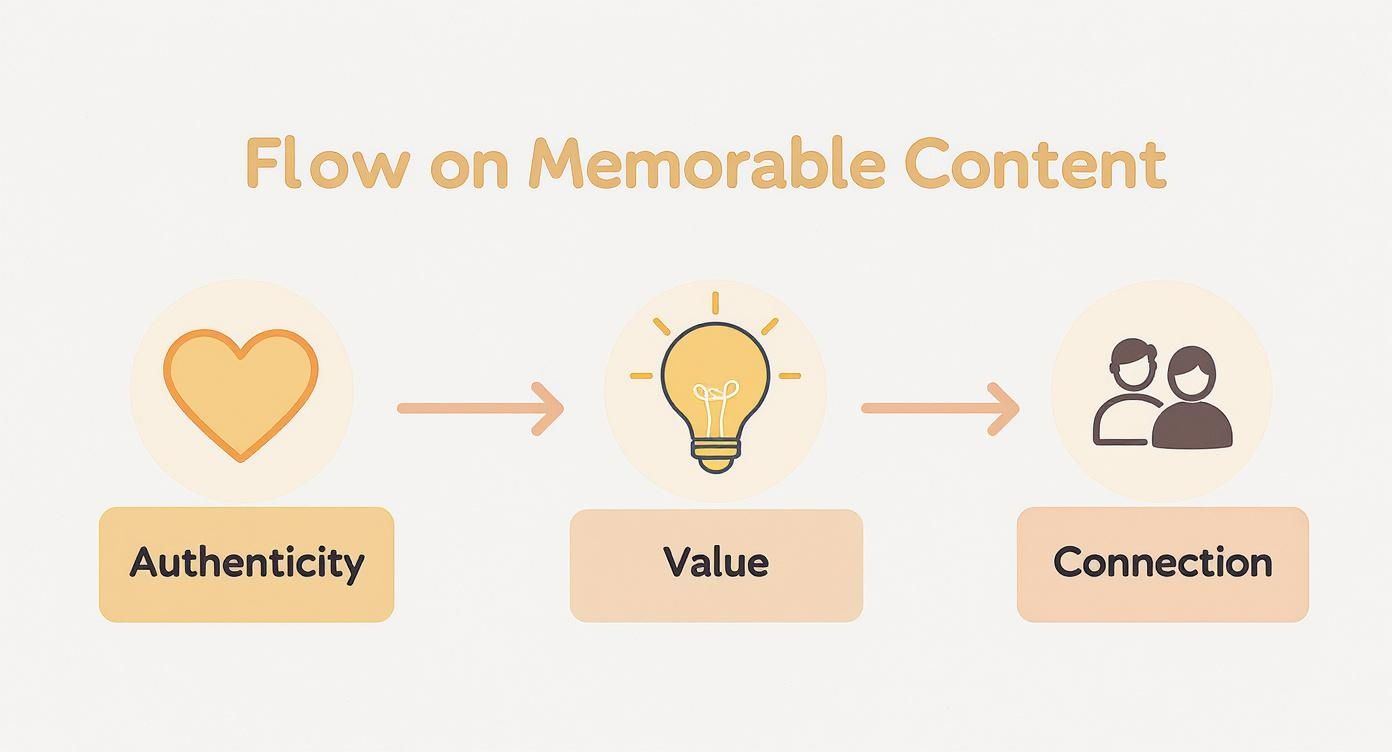
As you can see, it all comes down to creating a valuable and authentic connection. Your format is just the delivery system for that experience. A well-written creative brief is essential for making sure every piece aligns with your plan. If you need some help with that, check out our guide on how to write a creative brief to get started.
It's no surprise that the global content marketing market is projected to skyrocket from around $413.2 billion in 2022 to an astounding $2 trillion by 2032. That massive growth underscores just how vital content is for connecting with people today. You can dig into more of these powerful content marketing statistics and trends to see why having a solid plan is no longer optional.
Choosing the Right Format for Your Branded Content
To help you decide what's right for your campaign, we’ve put together a quick comparison of some of the most popular formats. Think about your goals, audience, and resources as you review your options.
| Content Format | Primary Strength | Best For | Resource Level |
|---|---|---|---|
| Video Series | Emotional storytelling, high engagement | Building brand affinity, showcasing values | High |
| Podcast | Intimate connection, in-depth topics | Establishing thought leadership, B2B | Medium |
| Articles/Blogs | SEO value, detailed information | Educating audiences, driving traffic | Low to Medium |
| Interactive Web Experience | Immersive engagement, data capture | Product launches, unique campaigns | High |
Ultimately, picking the right format and channel is all about meeting your audience where they already are. When you align your content with their habits, you dramatically increase the odds that your message will not only be seen but truly welcomed.
Branded Content Examples That Inspire
Sometimes, the best way to grasp the power of branded content is to see it in action. The most memorable campaigns aren’t just selling a product; they’re telling a story that pulls you in and leaves a lasting impression. By looking at how the best in the business do it, you can get some real, practical ideas for your own work.
These examples show what happens when authenticity, genuine value, and an emotional spark come together. Each one takes a different path, proving there's no magic formula. The one thing they all have in common? A deep commitment to the audience, creating an experience so engaging that the brand feels like a natural part of the story, not an interruption.

Nike and National Geographic: Breaking2
Nike's "Breaking2" project wasn't just an ad campaign; it was a masterclass in telling a story bigger than the brand itself. Instead of just hyping a new running shoe, Nike decided to document the monumental quest to break the two-hour marathon barrier—a goal many thought was physically impossible. They even partnered with National Geographic to produce a full-length documentary about the journey of three world-class runners.
The film was all about the human drama, the cutting-edge science, and the raw grit of the athletes. Sure, Nike's shoes were on their feet, but they were a supporting character, not the hero of the story.
- Why It Worked: It was a perfect marriage of Nike’s core ethos (pushing human potential) and genuinely gripping entertainment. The project inspired millions, runners and non-runners alike, and solidified Nike's reputation as a brand that champions incredible human achievement. The focus was squarely on the story, not the sale.
Blendtec: Will It Blend?
On the other end of the spectrum, Blendtec's "Will It Blend?" video series is proof that you don't need a Hollywood budget to strike gold. To show off just how tough their blenders were, the company's founder started filming himself blending… well, everything. iPhones, golf balls, you name it. The videos were quirky, weirdly satisfying to watch, and incredibly shareable.
What could have been a dry product demo became pure, unadulterated entertainment. The company’s own CEO, Tom Dickson, became the star, adding a friendly, humorous face to the brand.
This campaign shows that branded content doesn't always have to be deep and emotional. Blendtec created a viral hit that’s been going for over a decade simply by offering fun, simple entertainment that perfectly demonstrated the product’s biggest strength.
IKEA: The Home Tour Series
IKEA’s "Home Tour" series is a brilliant take on the ever-popular home makeover show format. In each episode, IKEA designers visit real homes to help solve everyday design and organization headaches using, of course, only IKEA products. It's practical, relatable, and genuinely useful for anyone trying to make their space better.
Instead of just showing off perfect, sterile showrooms, IKEA waded into real, sometimes messy, homes. This simple shift made the brand feel less like a massive corporation and more like a helpful, down-to-earth partner.
- Key Takeaway: By tackling real customer problems (like "my apartment is too small" or "how do I hide all this clutter?"), IKEA created content that was part service, part entertainment. This builds a ton of trust and positions IKEA as a problem-solver. For more ideas on crafting these kinds of narratives, check out these powerful brand storytelling examples that create real connections.
Apple: Shot on iPhone
Apple's "Shot on iPhone" campaign is a masterstroke in using its own customers' creativity as its best marketing tool. Why just tell people the iPhone camera is amazing when you can show them? The campaign features stunning photos and videos taken by everyday users from all over the world, plastered on billboards, social media feeds, and TV ads.
This strategy is so effective because it turns customers into the brand's most authentic and powerful advocates. It provides undeniable social proof, builds a global community of creators, and generates an endless stream of fresh content. The message is simple but incredibly powerful: Our product is so good, our customers make our ads for us.
Measuring the Real Impact of Your Content

Making great branded content is one thing, but proving it actually works is a whole other challenge. To keep your strategy sharp and justify the investment, you have to measure what really matters. It’s time to look past simple vanity metrics like likes and views and dig into the real impact your content is having.
The big question is this: is your storytelling actually connecting with people and driving business goals? Are you shifting how people see your brand? Are you building genuine loyalty? To get those answers, we need to look at deeper metrics that reveal what your audience truly thinks and feels after they’ve seen your work.
Moving Beyond Vanity Metrics
A high view count is nice, but it doesn't pay the bills. It tells you people saw your content, not that they cared about it. Real measurement is about tracking how your content changes audience behavior and perception over the long haul. This means shifting your focus from passive scrolling to active engagement.
Here’s where you should really be looking:
- Audience Engagement Rates: Don’t just count views; look at comments, shares, and how long people actually spend with your content. These actions show your story was compelling enough to make someone stop and think, not just glance and move on.
- Sentiment Analysis: What’s the vibe? Tools can help you track the tone of online conversations surrounding your content. A wave of positive mentions is a strong signal that your message is hitting home on an emotional level.
- Brand Lift Studies: This is the gold standard. These surveys compare brand awareness, perception, and purchase intent between people who saw your content and those who didn't. It’s one of the clearest ways to prove your campaign is changing minds.
By focusing on these deeper metrics, you can confidently demonstrate that your branded content isn't just being seen—it's making a real difference.
Tying Content to Business Outcomes
At the end of the day, the people holding the purse strings want to see a return on investment (ROI). Your job is to draw a straight line from your content's performance to core business goals, like generating leads or boosting customer loyalty. Making that connection is what secures the budget for your next big idea.
Part of this involves understanding the various proven content revenue streams that successful creators rely on. This helps you think more broadly about how your content contributes to the bottom line, whether it’s a direct sale or a long-term brand-building play.
To connect your work to business goals, you need a solid measurement plan from day one. This framework should spell out your key performance indicators (KPIs) and the tools you’ll use to track them. If you’re pushing content out on social media, for instance, you need to know how to properly measure social media performance to see the full picture. With a clear plan, you can finally stop guessing and start proving the incredible value your branded content brings to the business.
Got Questions About Branded Content? Let's Clear Things Up.
Even after you've got the basics down, a few questions always seem to pop up about branded content. That's completely normal. Nailing down the answers to these common sticking points is key to making sure your strategy is sharp, focused, and actually works.
Let's dive into some of the questions I hear most often and get you some straight, practical answers.
What's the Real Difference Between Branded Content and Native Advertising?
I like to think of it like this: branded content is the great movie you can't stop thinking about, while native advertising is the commercial break that's cleverly disguised to look like another TV show.
The whole point of branded content marketing is to build a genuine connection with your audience through storytelling. The brand is part of the story, but it’s not the star of the show; it's woven in naturally.
Native advertising, on the other hand, is a bit more direct. It's designed to blend in with the platform it's on—like a sponsored post in your Instagram feed or an "advertorial" in an online magazine. While it looks the part, its main goal is to get you to take a specific action, and you'll almost always see a "sponsored" or "promoted" label somewhere on it.
How Can I Pull Off Branded Content Without a Huge Budget?
This is a big one. You don't need a Hollywood-sized budget to create content that people love. The magic isn't in the production value; it's in the creativity and authenticity of your story. Often, the scrappiest ideas deliver the biggest punch.
Here are a few high-impact, low-cost ideas to get you started:
- User-Generated Content (UGC) Campaigns: Why not let your biggest fans tell your story for you? Encourage your audience to share photos, videos, or stories featuring your brand. It’s authentic, engaging, and practically free.
- Expert Interview Series: People love learning from the best. Start a simple podcast or blog series where you chat with experts in your industry. All you need is a decent microphone and some great questions.
- Behind-the-Scenes Stories: Pull back the curtain and show people what makes your company tick. A blog post about your creative process or a short video introducing your team can build a ton of trust and personality.
Which Social Media Platforms Work Best for Branded Content?
There’s no single "best" platform—the right choice always comes down to where your audience actually hangs out and what kind of content you’re creating. It's no secret that social media is a giant in this space; over 90% of brands are already there for a reason. With people spending hours a day scrolling, it's the place to be seen.
While Facebook is still a major player, visual platforms like Instagram and TikTok are goldmines for reaching younger crowds. In fact, 49% of Gen Z TikTok users have bought something they saw on the app. If you want to dig deeper into the numbers, these content marketing statistics to know in 2025 are worth a read.
Ultimately, the winning strategy is simple: go where your people are. Don't force a TikTok video on a LinkedIn audience. Create content that feels right at home on the platform you choose.
Ready to team up with the right influencers for your next campaign? With REACH, you can find creators who get your brand, run your campaigns smoothly, and see exactly what's working—all from one dashboard. Find your perfect partners on REACH and start making content that truly connects.