 Skip to content


When you’re learning how to write a creative brief that actually works, stop thinking of it as paperwork. It's your strategic blueprint. It’s where you hammer out your project goals, get laser-focused on your target audience, nail down the key message, and define the specific deliverables and deadlines. This isn't just a document; it's the single source of truth that keeps everyone on the same page and prevents those expensive, frustrating misunderstandings down the road.
Why a Solid Creative Brief Is Non-Negotiable
Let’s be real for a second. Creative briefs often get a bad rap—they're seen as just another piece of administrative busywork. But if you treat your brief like a box-ticking exercise, you're setting your campaign up for failure before it even begins.
A well-crafted brief is the strategic backbone that separates a killer influencer marketing campaign from one that just… fizzles out. It’s the difference between a campaign that hits its mark and one that wastes time, burns through your budget, and gets stuck in a soul-crushing cycle of revisions.
Without this vital guide, you're basically asking your creative partners—whether they're influencers, designers, or copywriters—to be mind-readers. And that ambiguity is where things go off the rails. A vague request like, "Hey, can you make a fun TikTok about our new skincare line?" is a recipe for disaster. You'll end up with content that misses your brand's tone, speaks to the wrong people, or completely whiffs on the actual business goal you were trying to achieve.
The True Cost of a Vague Brief
The fallout from a sloppy brief isn't just a headache; it hits your budget directly. Misaligned content means more back-and-forth, more edits, and more hours billed. That burns cash and pushes back your launch date. Even worse, it can sour your relationships with great creators who feel like you're not respecting their time or expertise.
On the flip side, a sharp, insightful brief is a game-changer. It becomes a north star for your entire team. It provides the strategic guardrails that empower creators to do what they do best: innovate freely and with confidence. This isn't about micromanaging or stifling creativity—it's about channeling it toward a clear, shared objective.
This infographic breaks down exactly how a clear, actionable brief sharpens efficiency and drives better campaign outcomes.
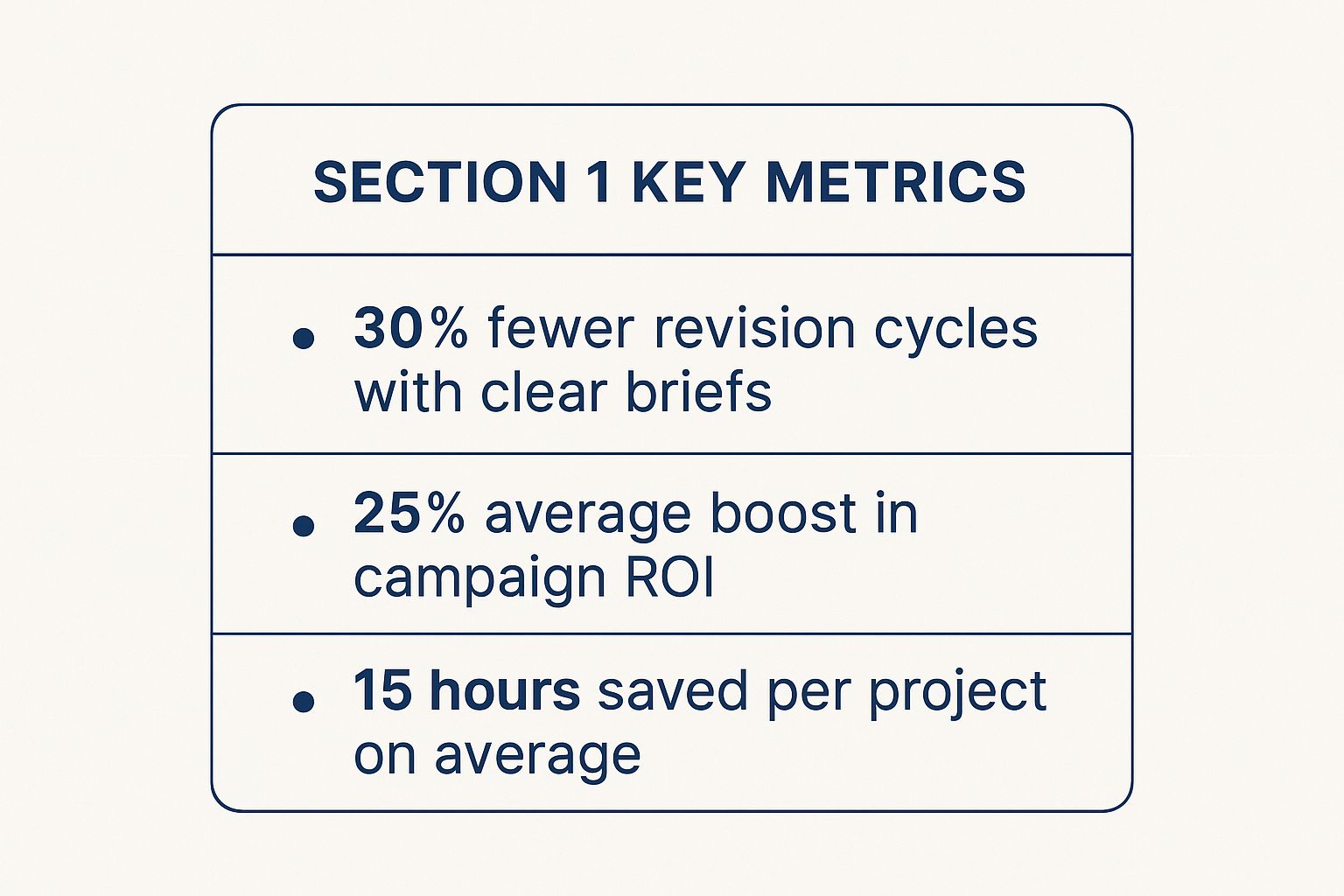
The numbers don't lie. Putting in the effort to build a quality brief upfront pays off massively in saved time, less stress, and, most importantly, better results.
A great creative brief doesn't just list requirements; it inspires action. It provides the why behind the what, giving creatives the context they need to produce their best, most impactful work.
To keep everything cohesive, your brief must be in lockstep with your company's core identity. If you haven't already, you should learn more about how to create brand guidelines in our detailed article. Think of it as the perfect companion piece to your briefing process. This alignment is what ensures every piece of content feels authentic and consistently reinforces who you are as a brand.
The Essential Components of a Powerful Creative Brief

Alright, let's get into the nuts and bolts of crafting a brief that actually gets results. A truly effective brief isn't a massive document; it's a focused, strategic guide. Think of it less like a checklist and more like the blueprint for a successful campaign—each part is essential for holding the entire structure together.
The goal is to have each section flow into the next, painting a complete and genuinely compelling picture for your influencer or creative partners. Let's break down the core pieces that elevate a brief from just "good" to genuinely great.
Project Background and Business Objectives
This is where you set the stage. It's your "why." Before anyone can even think about creative concepts, they need to understand the business context. Why this campaign? Why now? What’s the problem we’re solving or the opportunity we're chasing?
Give a quick, concise summary of the situation. Maybe you’re launching a game-changing new product, punching back at a competitor's latest move, or trying to win back a customer segment that’s gone quiet. This context is absolutely vital; without it, creators are just guessing.
Next, you need to nail down your business objectives. These are the hard, measurable outcomes you’re aiming for. Fluffy goals like "increase brand awareness" just won't cut it. You need specific, quantifiable targets that leave no room for interpretation.
For an influencer campaign, that might look like:
- Objective: Drive 500 direct sales of our new eco-friendly water bottle using unique affiliate links.
- Objective: Generate 20,000 new email subscribers for our newsletter through a gated offer influencers will promote.
- Objective: Boost user-generated content submissions by 30% with a branded hashtag challenge.
A brief without clear, measurable objectives is like a ship without a rudder. It might look busy, but it isn't going anywhere specific. Your objectives are the ultimate destination for the entire campaign.
The Single Most Important Thing
This is the soul of the brief. If your audience only remembers one thing from this entire campaign, what is it? This is your key message, and your job is to distill it into a single, powerful sentence. It’s often the toughest part of writing a brief, but it’s hands-down the most important.
This one sentence becomes the North Star for your creative partners. It’s the filter they'll run every idea through, ensuring that everything from a 15-second TikTok to a detailed blog post hammers home the same core idea.
For example:
- Weak Message: "Our new software is efficient and has lots of features." (So what?)
- Strong Message: "Spend less time on paperwork and more time on what matters." (Now we're talking.)
See the difference? The second one isn't just a statement; it's a promise. It taps into a real customer pain point and gives influencers a powerful emotional hook to build their content around.
Competitor Insights
Knowing your competition isn't about copying them—it's about finding your own lane. Who are the key players in your space, and what’s their angle? What are they known for?
Briefly break down their messaging and creative style. Where are they strong? Where are they vulnerable? Pinpointing these helps your team see where your brand can carve out a unique space. For instance, if all your competitors are buttoned-up and corporate, that’s a golden opportunity for your brand to be the fun, approachable one.
Toss in a link or two to relevant competitor campaigns. This gives your team a tangible feel for what you're up against and helps get the wheels turning on how to stand out.
To help you keep track, here's a quick rundown of what each component of your brief should accomplish.
Key Components of a Creative Brief at a Glance
| Component | What It Answers | Example Focus for an Influencer Campaign |
|---|---|---|
| Background & Objectives | Why are we doing this and what does success look like? | To drive trial for our new vegan protein bar, aiming for 1,000 redemptions of a unique coupon code. |
| Target Audience | Who, exactly, are we trying to reach? | Health-conscious millennials (25-35) who follow fitness and wellness creators and value clean ingredients. |
| The Single Most Important Thing | What's the one key message we want them to remember? | Our protein bar gives you sustained energy without the sugar crash. |
| Competitor Insights | Who else is in this space and how can we be different? | Competitor X uses pro athletes; we'll use relatable creators to show real-world energy benefits. |
| Deliverables & Timelines | What do we need and when do we need it by? | Two Instagram Reels and one 5-image carousel post, with first drafts due by EOD Friday. |
| Mandatories & Constraints | What are the absolute must-haves and must-avoids? | Must include the hashtag #ad. Must not show our product alongside sugary drinks. |
Think of this table as your pre-flight checklist. If you can confidently fill out each section, you're well on your way to a brief that will inspire great work.
Deliverables and Timelines
This is the "what and when"—the logistical core of your brief. You have to be brutally clear about what you expect influencers or creators to produce. Any ambiguity here is a direct invitation for scope creep and blown budgets.
Get specific with your deliverables list. Don't just say "social posts." Spell it out:
- 2 x Instagram Reels (60-90 seconds each)
- 1 x Static Instagram Feed Post with a 3-image carousel
- 5 x Instagram Stories with interactive elements (e.g., polls, Q&A)
- 1 x YouTube Video (8-10 minutes) reviewing the product
Of course, the "what" is useless without the "when." A clear, realistic timeline is non-negotiable. Industry data backs this up: one study found that 78% of high-performing briefs explicitly list key milestones and deadlines, compared to just 45% of average ones. If you want to learn more about the briefing standards used by top-tier marketing teams, there are some great resources out there.
A solid timeline should map out:
- Draft submission deadlines
- Feedback and revision windows
- Final approval dates
- Go-live or publishing dates
Mandatories and Constraints
Every project needs guardrails. This section is where you lay out the "must-haves" and the "absolutely-nots." This isn't about killing creativity; it's about preventing simple, avoidable errors that can derail a campaign.
Mandatories are the non-negotiables:
- Legal Disclaimers: Any required FTC disclosures like #ad or #sponsored.
- Branding Elements: Correct logo usage, specific brand colors, etc.
- Call to Action: The exact CTA to be used (e.g., "Swipe up to shop the new collection").
- Key Talking Points: Essential product features or benefits that have to be mentioned.
Constraints are just as critical. Are there topics, words, or visuals that are off-limits? A competitor you must never mention by name? Listing these things upfront saves everyone a mountain of time and frustration during the revision process.
Building an Audience Persona Creatives Will Understand

Let's be honest: generic demographics like "Women, 25-34" are where great creative ideas go to die. If you want to write a brief that actually inspires, you have to move beyond the basic "what" (age, location) and dig into the "why" that drives your audience.
The goal here is to paint a picture so vivid that an influencer or designer feels like they know exactly who they’re talking to. We're trying to build a human connection, not just target a data point.
Beyond Demographics: The Core of a Persona
Instead of a faceless statistic, give your persona a name, a backstory, and a personality. Think about "Eco-Conscious Emily," a 29-year-old graphic designer who lives for sustainability, shops at farmers' markets, and follows creators who promote mindful living. That’s immediately more tangible and inspiring than just "female millennial," isn't it?
To get this kind of detail, you need to go past surface-level analytics and explore the psychographics that shape their entire worldview.
- Values and Beliefs: What do they truly care about? Are they driven by convenience, ethics, or maybe status?
- Pain Points and Frustrations: What's a problem they're trying to solve in their daily life? How can your product be the solution?
- Media Habits: Where do they actually get their information? Who do they trust? Which podcasts, blogs, or YouTube channels are on their can't-miss list?
Answering these questions transforms a flat demographic into a three-dimensional person. If you want a more structured way to tackle this, our guide on https://reach-influencers.com/how-to-create-buyer-personas/ walks you through a complete framework.
Using Data to Add Rich Detail
Gathering these insights is part art, part science. You'll want a mix of hard numbers and human stories. Use social listening tools to see what conversations they’re having online. Dig into customer surveys to hear their challenges in their own words. Look at your absolute best customers—what common threads do you see in their behaviors and interests?
The impact of doing this detailed work is huge. To really nail this, you need a solid understanding of audience segmentation from the get-go. This isn't just theory; it's proven to drive better results.
An analysis of 500 global campaigns found that those using detailed audience personas in their briefs achieved a 15–25% higher click-through rate than those who stuck with generic demographic data.
Despite the clear upside, so many teams still skip this step. I’ve seen it firsthand. One study even found that only 60% of creative teams consistently get a written brief before starting a project, let alone one with a well-defined persona.
When you present a rich, relatable persona in your creative brief, you're not just giving your team data; you're giving them a muse. You’re handing them a real person to connect with, which leads to content that feels authentic, relevant, and far more likely to hit the mark.
Weaving Data and AI Into Your Briefs
The most effective creative briefs today aren't just built on gut feelings. They're a smart blend of human creativity and hard data. Relying purely on intuition is a risky bet; the real magic happens when you use analytics and AI to build a brief that's both strategically sound and genuinely inspiring for your creators.
This isn't just a fleeting trend. It’s a seismic shift in how top-tier teams operate. Back in 2015, only about 30% of briefs included real-time consumer data. Today? That number has skyrocketed to over 65%. Campaigns built on this kind of behavioral insight see an average of 40% higher conversion rates. If you want to dig deeper into these trends, GWI offers some fantastic insights on data-driven briefing.
Start by Looking Backward to Move Forward
Before you even think about writing a new brief, take a look in the rearview mirror. What actually worked last time? Dive into your analytics to pinpoint the content themes, formats, and messaging that truly connected with your audience.
Your own marketing dashboard tools are a treasure trove of information. Hunt for patterns in engagement, conversions, and click-through rates. You might discover, for example, that behind-the-scenes content consistently gets 2x more engagement than your perfectly polished product shots. Boom. You've just found a clear, data-backed direction for your next influencer campaign.
Tune In with Social Listening and AI
Your own data is just one piece of the puzzle. Social listening tools let you plug into the bigger conversation. What are people saying about your industry or your competitors right now? What cultural moments are taking hold? These insights are gold, ensuring your campaign feels relevant and timely, not like it’s a step behind.
A data-informed brief doesn't kill creativity; it gives it a launchpad. It provides a smarter starting point, freeing up creators to innovate within a framework that’s already proven to resonate.
This is where AI can be a game-changer. Roughly 45% of marketing teams are now using AI to sift through customer reviews and social media chatter, looking for common pain points and messaging ideas. You can use generative AI to digest thousands of comments and pull out a few powerful angles for your brief. For instance, feeding customer feedback into a tool might reveal that "ease of use" is a far more compelling message for your audience than "advanced features." If you're curious about what's out there, you can compare AI content tools to find a good fit for your workflow.
By grounding your brief in solid data, you elevate it from a simple to-do list to a powerful strategic document. This approach ensures your creative direction isn't just a shot in the dark—it's a calculated move designed to connect with the people you want to reach.
Common Briefing Mistakes That Kill Creativity

Knowing what to put in your creative brief is only half the battle. Just as important is knowing what to leave out. I’ve seen countless well-intentioned briefs completely sabotage a project because they fell into a few common traps that do nothing but drain inspiration and create confusion.
These missteps almost always come from a good place—a desire to be thorough and helpful. But in reality, they have the opposite effect. Learning to spot and sidestep these pitfalls is what separates a brief that empowers creators from one that boxes them in. Your job is to provide a clear roadmap, not a paint-by-numbers kit.
Mistake #1: Being Overly Prescriptive
This one is the absolute biggest creativity killer. It’s what happens when a brief stops defining the problem and starts dictating the exact solution. Instead of focusing on the "what" and the "why," the document gets bogged down in the micro-details of "how," leaving zero room for an influencer to do what you hired them to do: create.
Think of it this way. A great brief might ask a creator to make content that gets their audience genuinely excited about a new product launch. A prescriptive brief, on the other hand, tells them to use a specific Instagram filter, stand in a particular spot, and recite a pre-written line of copy word-for-word. One inspires authenticity; the other produces a stilted ad.
A brief should be a compass, not a GPS. It needs to set the direction and the destination, but it must let the creative team navigate the best path to get there.
Mistake #2: The Jargon and Acronym Overload
Every company has its own internal language. It's a shorthand of project codenames, technical jargon, and a never-ending stream of acronyms that makes sense to your team. But for an external partner like an influencer, it’s completely alienating.
When your brief is loaded with sentences like, "Leverage our Q3 GTM strategy to boost KSPs for the new SKU," you’re just creating a barrier. The creator has to waste precious time and energy trying to decode your internal language instead of actually thinking about the creative challenge.
- Instead of this: "Ensure content aligns with our Project Nightingale goals."
- Try this: "The main goal is to show how our product helps busy parents save time in the morning."
Always write for an outsider. A simple test: If your brief would confuse a brand-new hire, it’s too complicated.
Mistake #3: Unrealistic Timelines and Expectations
Your brief can have the perfect message and a crystal-clear objective, but if it asks for the impossible, it's dead on arrival. Demanding a viral-level video campaign on a shoestring budget with a 48-hour turnaround is a recipe for creative burnout and disappointing work.
This kind of mistake completely undermines trust and sets the project up for failure from the get-go. It's crucial to be realistic about what can actually be achieved within the given time and budget. A solid brief respects the creative process and the people behind it, which always leads to a stronger partnership and much, much better results.
Got Questions About Creative Briefs? We’ve Got Answers.
As you start putting a more formal briefing process in place, some practical questions will inevitably pop up. Getting these details right is what turns a creative brief from a bureaucratic hurdle into a truly useful tool for your team.
Let's clear up some of the most common sticking points.
How Long Should a Creative Brief Be?
There's no hard-and-fast rule here, but aim for the sweet spot: one to two pages. The goal is always clarity, not length. Your brief has to be detailed enough to give the full picture but punchy enough for a busy creator to digest quickly.
If you see your brief stretching past three pages, take that as a warning sign. You're probably getting lost in the weeds with too much granular detail or, just as likely, repeating yourself.
A great brief inspires action; it doesn't dictate every single step. Think of it as a strategic guide, not an exhaustive instruction manual. Someone should be able to read it in under ten minutes and know exactly what they need to do.
Who's Actually in Charge of Writing the Brief?
On paper, the brief is usually owned by someone on the brand or marketing side—think a brand manager, account executive, or a marketing strategist who lives and breathes the business goals.
But here’s the thing: the best briefs are never written in a silo. While one person might "hold the pen," they should be pulling in insights from others. Looping in creative leads, project managers, and key stakeholders early on is a game-changer. This collaborative approach gets everyone on the same page from the start, which prevents so many headaches down the line.
Should I Make a Different Brief for Every Influencer?
Yes. A thousand times, yes. While you should absolutely start with a master brief that outlines the core campaign details, a one-size-fits-all approach just doesn't cut it in influencer marketing. Authentic partnerships are the goal, and that begins with a brief that respects the creator’s unique style.
Your foundational elements—the business objectives, the core message, the absolute must-haves—will stay the same. But the creative execution part? That needs to be tailored. Acknowledge their specific style, maybe even reference a piece of their past content that you really liked. Give them the room to connect with their audience in a way that feels natural to them. It’s a small step that makes a world of difference.
Ready to streamline your entire influencer marketing workflow, from briefing to payment? REACH is the all-in-one platform that helps brands and agencies execute flawless campaigns. Discover how REACH can transform your influencer partnerships today.