
Budgeting for a US influencer campaign isn't about pulling a number out of thin air. It’s about being smart with your money, knowing exactly where it's going, and basing your spend on real goals and solid data. A well-planned budget is the foundation of a campaign that delivers measurable business outcomes, moving influencer marketing from an experimental cost to a predictable revenue driver.
You have to think about everything—from what you pay the creator to the rights to use their content later. This is where a robust influencer marketing platform like REACH Influencers becomes indispensable, offering data-driven insights from the very beginning to help you build a smarter budget. A good starting point for a test campaign is often somewhere between $5,000 to $25,000. This lets you see what works and measure your return before you go all in on a larger strategy for budgeting a US influencer campaign.
Table of Contents
- Understanding the Costs of a US Influencer Campaign
- Connecting Your Budget to Clear Campaign Goals
- Building Your Campaign Budget Line by Line
- How to Track and Optimize Your Campaign Spend
- Got Questions About Budgeting for a US Influencer Campaign?
Understanding the Costs of a US Influencer Campaign
Before you can nail down a budget, you have to get a handle on what you’re actually paying for. It’s so much more than just a creator’s follower count; it’s a whole ecosystem of value. The best way to build your financial plan is to start with your end goal and work backward.
This "goal-first" thinking helps you sidestep a classic mistake: throwing too little money at a campaign and then wondering why the results are so disappointing. When you know precisely what you want—whether that’s a flood of user-generated content (UGC), a spike in sales, or just getting your brand name out there—you can tie every dollar you spend to a specific, trackable outcome.
The Core Components of Your Budget
A few key variables will make or break your budget in the United States. Getting a feel for these early on is essential for any kind of accurate planning.
- Influencer Tiers: Creators are generally grouped by audience size—Nano, Micro, Mid-Tier, Macro, and Mega. You might pay a micro-influencer a few hundred dollars, but a macro-influencer could easily cost tens of thousands for a single post.
- Content Complexity: There’s a world of difference between a simple Instagram photo and a professionally shot and edited YouTube video. The more time, skill, and gear a creator needs, the more you can expect to pay.
- Platform Choice: The platform matters. A lot. Rates for a TikTok video are rarely the same as for an Instagram Reel or a dedicated blog post, even when working with the same person.
- Content Usage Rights: This one trips people up all the time. If you want to use the influencer’s content on your website or in your own ads, you’ll need to pay extra for those rights. This can sometimes cost as much as the original post itself.
Setting Realistic Spending Expectations
The influencer marketing world in the US is huge and only getting bigger. It helps to understand how creators think about making money, including their strategies for monetizing YouTube Shorts, to set fair and realistic rates.
This chart gives you a sense of typical spending buckets in the US market.
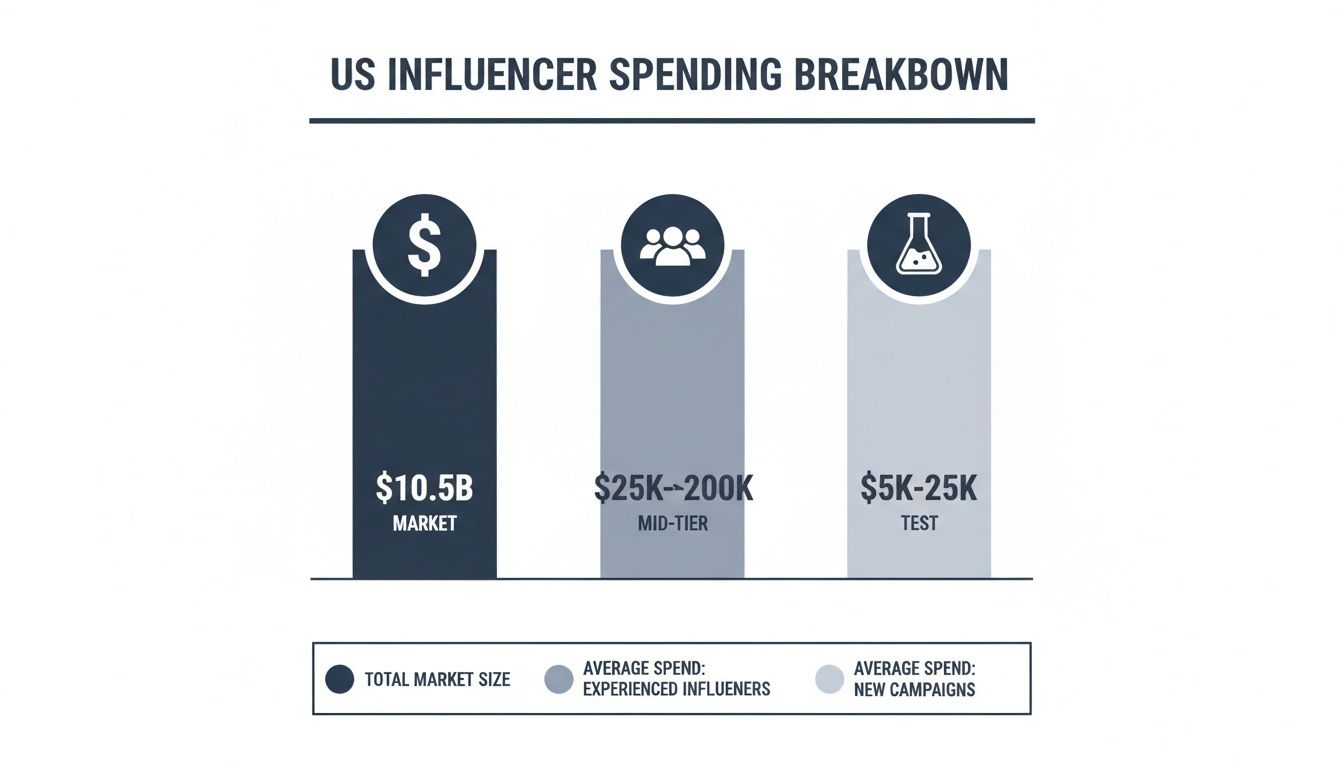
What this really shows is that even though the market is massive, you don’t need a massive budget to get started. By 2025, sponsored content spending in the US is expected to hit a staggering $10.52 billion, according to recent industry forecasts.
A proven strategy is to kick things off with a smaller test run, something in the $5K–$25K range. You can work with micro-influencers to generate authentic UGC, see what sticks, and then scale up to bigger programs that might run anywhere from $25K–$200K. If you want to dive deeper into specific numbers, check out our full guide on how much to pay influencers.
To give you a clearer starting point, here are some ballpark figures for what you might expect to pay creators on Instagram and TikTok.
Estimated US Influencer Rates by Tier and Platform
| Influencer Tier | Follower Count | Instagram Post Rate (USD) | TikTok Video Rate (USD) |
|---|---|---|---|
| Nano | 1K–10K | $10–$250 | $5–$150 |
| Micro | 10K–100K | $250–$1,500 | $150–$1,000 |
| Mid-Tier | 100K–500K | $1,500–$5,000 | $1,000–$4,000 |
| Macro | 500K–1M | $5,000–$15,000 | $4,000–$10,000 |
| Mega | 1M+ | $15,000+ | $10,000+ |
Keep in mind these are just estimates. The final price tag will always depend on the creator’s engagement, niche, and the specifics of your campaign.
This is where a platform like REACH Influencers becomes so valuable. From day one, it gives you the transparency you need to estimate these costs. Our discovery tools let you filter creators by niche, engagement rates, and their typical fees, helping you build a budget grounded in data, not guesswork. It’s the first real step toward launching a US influencer campaign that delivers genuine business results.
Connecting Your Budget to Clear Campaign Goals for Your US Influencer Campaign
Throwing money at an influencer campaign without clear goals is a surefire way to waste it. You’ll get some nice-looking content, sure, but you won't have a clue if it actually did anything for your business. The best way to approach budgeting a US influencer campaign is to flip the script: figure out what you want to achieve first, then build your budget to get you there.
This means every single dollar needs a job to do. Forget vague goals like "increase brand awareness." We need to get specific and define the Key Performance Indicators (KPIs) that truly matter to your bottom line. Doing this up front turns your budget from a line item expense into a powerful strategic investment.

Defining Your Primary Campaign Objective
First things first, what's the one big thing you need this campaign to accomplish? You can absolutely have secondary benefits, but having one primary goal keeps your strategy sharp and your spending efficient. Most US influencer campaigns boil down to one of two main objectives.
Each one has its own playbook, its own metrics, and a totally different way of thinking about where your money goes.
- Awareness-Focused Campaigns: The goal here is simple: get your brand in front of as many of the right people as possible. You're trying to generate buzz, start conversations, and just make sure people know you exist.
- Conversion-Focused Campaigns: This is all about getting people to do something. We're talking tangible actions like making a purchase, signing up for your email list, downloading an app, or registering for a webinar.
Knowing which path you're on is everything. A startup launching a new product line will probably lean heavily into awareness. An established e-commerce store heading into Black Friday, on the other hand, is going to be all-in on driving sales. This choice shapes every decision that follows—who you hire, what they create, and how you'll know if it worked.
Tying KPIs to Your Budget
Once your main goal is set, you can pick the right KPIs to measure your progress. These metrics are what connect your spending to your results, telling you in plain language whether your investment is actually paying off.
Let's walk through how this looks with a real-world example. Imagine two different brands, each with a $20,000 budget.
Scenario 1: The Awareness Campaign
A new sparkling water brand wants to make a splash in a crowded market. Their objective is pure, unadulterated awareness.
- Primary KPI: Impressions (the total number of times their content is seen).
- Secondary KPIs: Reach, engagement rate, video views.
- Budget Focus: They'll spend their $20,000 on a handful of mid-tier influencers who have large, broad audiences. Success is measured by their Cost Per Mille (CPM), or the cost for every thousand impressions. The lower the CPM, the better.
Key Takeaway: For an awareness play, your budget is all about maximizing visibility. You're buying eyeballs, and a low CPM means you're getting more of them for your money.
Scenario 2: The Conversion Campaign
A direct-to-consumer skincare brand is launching a new anti-aging serum and wants to drive immediate sales.
- Primary KPI: Sales generated via unique discount codes or affiliate links.
- Secondary KPIs: Click-through rate (CTR), conversion rate, cost per acquisition (CPA).
- Budget Focus: They'll partner with micro-influencers known for having deep trust with their highly-engaged followers. Success is all about Return on Ad Spend (ROAS). If they spend $20,000 and generate $100,000 in sales, their ROAS is a fantastic 5x.
This is exactly where a platform like REACH Influencers can be a game-changer. Instead of drowning in spreadsheets trying to track everything, you get a single dashboard to monitor it all. For that awareness campaign, you can see real-time impression and engagement data. For the conversion campaign, the platform’s integrated tracking links show you precisely how many clicks and sales each influencer is driving.
Having this data in one place lets you make smart decisions on the fly. If one creator is pulling in an insane ROAS, you can instantly decide to put more budget behind their posts to amplify what's working. This is how you make sure every dollar works as hard as it possibly can, and it's absolutely essential for effective budgeting a US influencer campaign.
Building Your Campaign Budget Line by Line
Alright, you've got your goals locked in. Now comes the fun part: putting actual dollars to your plan. This is where you move from the "what" to the "how much," building a realistic financial roadmap for your campaign. A solid budget is what keeps you on track and prevents those nasty, unexpected costs from derailing your efforts.
The biggest chunk of your budget will almost always be influencer compensation. That’s the heart of the investment, but it’s far from the whole story. A rookie mistake I see all the time when budgeting a US influencer campaign is only accounting for creator fees. To really succeed, you have to think bigger and map out all the expenses, especially the ones hiding in plain sight.
Let's walk through the key areas you absolutely need to cover.
Direct Influencer Compensation
This is what you're paying the creators for their time and talent. It's not a one-size-fits-all deal, so understanding the different models helps you build partnerships that actually make sense for your brand.
- Flat Fees: This is the most straightforward and common approach. You agree on a set price for specific deliverables—say, one Instagram Reel and three Stories. It keeps things predictable and simple for everyone.
- Performance-Based Pay: Think affiliate commissions or pay-per-click. This is a fantastic option if your campaign is all about driving sales, as it directly ties your spending to tangible results.
- Product Gifting (Product-for-Post): You'll see this a lot with nano and micro-influencers. You send them free products in exchange for content. Just remember, the retail value of whatever you're sending is still a very real cost to your business.
A hybrid approach often hits the sweet spot. Try offering a modest flat fee combined with a performance bonus. The creator gets some guaranteed income, and you get an extra-motivated partner who’s invested in driving results.
Beyond the Basics: The So-Called "Hidden" Costs
Here’s where a lot of brands get tripped up. The costs outside of direct creator payments can easily tack on an extra 25-50% to your budget if you aren't prepared. Let's shine a light on them.
Content Production and Amplification
First off, think about the kind of content you're asking for. If you need a high-quality video that requires a professional crew, travel, or specialized equipment, that's on your dime. You need a dedicated line item for these production expenses.
Next, and this is crucial, is paid media amplification. Don't let amazing content just wither away on an influencer's feed. The real magic happens when you put some ad spend behind your top-performing posts to reach a much larger, highly targeted audience. I always recommend earmarking at least 20-30% of your total budget for this.
Pro Tip: Using a platform like REACH Influencers is a game-changer here. You can see which posts are taking off in real-time, allowing you to quickly funnel your ad dollars toward the content that’s already proven to connect with people. It’s the smartest way to maximize your return.
Logistics and Management
Don’t get so focused on the creative that you forget the practicalities. The cost of goods sold (COGS) for any product you send out is a direct expense. So are all the shipping and handling fees, which can really add up when you're working with dozens of creators across the country.
And what about managing all this? If you’re working with an agency or using an influencer platform, their fees are a key part of the budget. These services typically cost 15-30% of your total campaign spend, but the time they save you on discovery, negotiation, payments, and reporting is immense. Platforms like REACH Influencers often bundle these costs, giving you discovery tools, payment processing, and analytics all under a single, clearer fee structure.
To help visualize this, here's a sample breakdown for a hypothetical mid-sized campaign.
Sample US Influencer Campaign Budget Breakdown
This template shows how a $50,000 budget might be allocated. Think of it as a starting point to adapt for your own campaign's needs.
| Expense Category | Budget Allocation (%) | Estimated Cost (USD) | Notes & Considerations |
|---|---|---|---|
| Influencer Fees | 50% | $25,000 | Mix of micro and mid-tier creators. Includes a buffer for negotiation. |
| Paid Media Amplification | 25% | $12,500 | Boosting top-performing content on Instagram and TikTok to a wider, targeted audience. |
| Agency/Platform Fees | 15% | $7,500 | Fee for using a platform like REACH for discovery, management, and reporting. |
| Product & Shipping (COGS) | 5% | $2,500 | Cost of product kits and shipping to 30 influencers across the U.S. |
| Contingency Fund | 5% | $2,500 | For unexpected costs, last-minute creator swaps, or extra content opportunities. |
| Total | 100% | $50,000 |
This kind of detailed breakdown is what separates a well-run, strategic campaign from one that's just "spraying and praying."
US-Specific Compliance and Legal Fees
When you're running a campaign in the United States, you can't afford to ignore the rules. Compliance with the Federal Trade Commission (FTC) guidelines isn't optional. While this is more of an operational task, it's wise to budget a small amount for a legal review of your contracts and content briefs. This ensures all your disclosure language is buttoned up and protects your brand.
Properly budgeting a US influencer campaign is no longer an experimental side project; it's a core marketing discipline. The data shows it, too. For 2025, a whopping 75.6% of brands have dedicated budgets for influencer marketing. In the US, 22.8% of marketers are now allocating between $100,000 and $500,000 for their campaigns, which shows a serious commitment to the channel. You can find more insights on this in PR Newswire's 2025 influencer marketing trends report.
By building your budget line by line—from creator payments and production to platform fees and compliance—you create a financial plan that's not just a guess, but a strategic tool. This detailed approach is what turns hopeful spending into a smart, measurable investment.
You’ve got your budget mapped out. Now comes the part that can make or break your campaign's ROI: the deal-making. Smart negotiation isn't about trying to get the lowest possible price from a creator. It's about building a partnership that feels like a win for everyone involved.
Getting this right is a huge piece of the puzzle when you're budgeting a US influencer campaign. Too many brands get fixated on the initial fee, but that’s just one part of the equation. The best negotiations dig deeper, covering everything from deliverables and content rights to exclusivity. This is where you can make your budget work harder without cutting corners on quality.
Framing an Offer That Actually Lands
When you reach out to an influencer, think "partnership," not "transaction." Creators get flooded with requests, so you need to stand out. Show them why working with your brand is a good long-term move.
- Think Beyond Cash: Can you offer performance bonuses? Affiliate commissions? Maybe even a chance to co-create a product down the line? These things show you’re invested in their growth, not just paying for a post.
- Highlight the Exposure: If your brand has a big, engaged audience, that’s a valuable asset. Let them know you'll be cross-promoting their content, which can help them grow, too.
- Stay Flexible: Don't just hand over a rigid creative brief. The creator knows their audience inside and out, so listen to their ideas. In fact, 65% of influencers say they prefer to have a hand in the creative process.
When a creator feels valued and heard, you get more authentic content. You also get a partner who is genuinely excited about your brand and often more willing to find common ground on the final terms.
Key Points to Nail Down in a Negotiation
Never go into a negotiation unprepared. Before you hit "send" on that first email, you should know your absolute must-haves and where you can give a little. This clarity is your best defense against misunderstandings and ensures you get the assets that will truly drive your campaign forward.
Here are the big-ticket items you need to iron out:
- Get Specific on Deliverables: "One Instagram post" is way too vague and leaves room for error. Instead, define it clearly: "One in-feed Instagram Reel, 30-60 seconds long, showing the product in use, plus three accompanying Instagram Stories with a swipe-up link."
- Talk Content Usage Rights: This is a huge one. How long can you use the content? 6 months? A year? Forever? And where can you use it? Organic social media is standard, but what about paid ads, your website, or email newsletters? Broader rights will cost you more upfront but can provide incredible value over time.
- Define Exclusivity: Do you need the influencer to avoid working with your direct competitors for a while? An exclusivity clause protects your campaign but comes at a premium. Be crystal clear about the timeframe and which specific brands are off-limits.
One of the most common slip-ups I see is brands assuming usage rights are baked into the base fee. Always, always negotiate this upfront. It will save you from surprise costs and legal headaches later on.
The Must-Haves for a US Influencer Contract
A handshake deal is a recipe for disaster. A formal, written contract is absolutely essential to protect both your brand and the creator. This document needs to be straightforward, fair, and legally sound, especially when operating in the US.
At a minimum, your contract must cover:
- Payment Terms: Lay out the total compensation, the payment schedule (50% upfront, 50% on completion is common), and how they’ll be paid.
- Content Approval Process: Define the timeline for content submission, how you’ll provide feedback, and how many rounds of revisions are included.
- Intellectual Property (IP): Specify who owns the content. Typically, the creator retains ownership, and the brand gets a license to use it.
- FTC Disclosure Rules: Your contract must require the creator to use clear and conspicuous disclosures like #ad or #sponsored on all posts. For a full breakdown, check out our guide to FTC compliance in influencer marketing.
Let's be honest—this can all feel like a lot of administrative work. That’s why platforms like REACH Influencers exist. We take the pain out of this process with lawyer-vetted contract templates that cover all these critical details. Plus, our secure payment system handles everything automatically, ensuring creators get paid on time and protecting you from any financial mix-ups. It lets you get back to what you do best: building great relationships with creators.
How to Track and Optimize Your Campaign Spend
Launching your influencer campaign isn't the finish line; it’s really just the starting block. A truly smart budget is never set in stone. Think of it as a living, breathing plan that you adjust based on the data flowing in. This is where you shift from planning to performing, and honestly, it’s the most critical phase for guaranteeing a solid return on your investment.
The goal here is simple: measure the financial success of your campaign as it happens. That means looking past vanity metrics like likes and comments and tying every piece of content directly back to tangible business results. It’s all about knowing what’s working, what isn’t, and being agile enough to do something about it.
Measuring What Matters Most: Your Campaign ROI
Return on Investment (ROI) is the ultimate metric for justifying your spend. For every dollar you put in, how many did you get back? Calculating this accurately is the key to proving your campaign’s value and making a strong case for future budgets.
To pull this off, you need the right tools in place from day one.
- Custom Tracking Links: Using UTM parameters or platform-generated links is a must. It’s the only way to see exactly how much traffic and how many sales each individual influencer is driving to your site.
- Unique Promo Codes: This is one of the cleanest ways to track direct sales. Assigning a unique code to each creator—something simple like
CREATORNAME15for 15% off—makes attribution a breeze. - Platform Analytics: This is where a dedicated tool becomes a lifesaver. Instead of juggling dozens of spreadsheets, a platform like REACH Influencers centralizes all this data. You get a live dashboard showing clicks, conversions, and sales for each influencer, making ROI calculation simple and instant.
The formula itself is straightforward: (Revenue Generated – Campaign Cost) / Campaign Cost x 100. So, if you spent $10,000 and brought in $30,000 in sales, your ROI is a very healthy 200%. According to industry benchmarks, a strong influencer campaign can earn an average of $5.78 for every dollar spent.
Shifting Your Budget for Maximum Impact
Now, tracking data is only half the battle. The real magic happens when you use that information to actively optimize your spending while the campaign is still running. This proactive approach is what separates a decent campaign from a wildly profitable one.
Let's walk through a real-world scenario. Imagine you're two weeks into a month-long campaign. Your analytics dashboard shows that Influencer A is driving sales at a remarkable $5 Cost Per Acquisition (CPA), but Influencer B is lagging way behind at a $50 CPA.
With this insight, you can make a strategic pivot. You could shift some of the budget originally set for Influencer B’s content and use it to boost Influencer A’s top-performing post with paid ads. This move amplifies what's already working, making sure your money is funneled toward the highest-performing assets.
Key Insight: Don’t wait until the campaign is over to analyze the results. Mid-campaign optimization is your secret weapon for maximizing ROI. A dynamic budget allows you to double down on your winners and cut your losses early.
The Power of Real-Time Reporting
This level of active management is nearly impossible without a centralized system. Platforms like REACH Influencers give you the real-time reporting you need to make these quick, data-backed decisions. You can see at a glance which creators are crushing their goals and which content formats are really clicking with your audience.
This continuous feedback loop does more than just improve your current campaign; it gives you invaluable intel for budgeting your next US influencer campaign. You'll learn which creator archetypes deliver the best results for your brand, which platforms give you the most bang for your buck, and how to structure offers that truly drive action.
To manage all these moving parts, it's vital to have a solid system in place. For brands looking to improve their financial oversight, learning how to effectively track business expenses is a foundational skill that pays dividends far beyond a single campaign.
Ultimately, tracking and optimizing are about turning your budget into a precision instrument. It’s about transforming your spending from a fixed cost into a flexible investment that adapts to deliver the best possible outcome. To get a head start on your financial planning, you can use our simple tool to calculate your potential influencer ROI and set clear benchmarks for success. This hands-on management is the final, crucial step in ensuring your influencer marketing budget not only works hard, but works smart.
Got Questions About Budgeting for a US Influencer Campaign?
Even with the best plan in place, it's natural to have questions when you're dealing with the financial side of influencer marketing. Getting the right answers upfront is what separates a smooth, successful campaign from a stressful one. Let's tackle some of the most common questions brands ask when putting together a budget for a US-based campaign.
Diving into these details will make a huge difference in how you plan and execute your strategy.
How Much Should a Small Business Actually Budget?
If you're a small business just starting out in the US market, a budget between $5,000 and $15,000 is a fantastic starting point. This gives you enough capital to collaborate with a handful of high-impact nano or micro-influencers. These creators are often the unsung heroes of the industry, delivering amazing engagement without the celebrity price tag.
Think of this first campaign as a testing ground. You can experiment with different messages and content formats on platforms like TikTok or Instagram to see what resonates. The goal here isn't just about driving immediate sales; it's about building a library of authentic, high-quality User-Generated Content (UGC). You can then repurpose that content across your own social channels, website, and even paid ads, squeezing every bit of value out of your investment.
What Are the Biggest Hidden Costs I Should Know About?
The fee you pay an influencer is just the beginning. Several other costs can pop up and derail your budget if you're not ready for them. Knowing what they are is the first step to keeping them under control.
Keep an eye out for these common budget busters:
- Product & Shipping: Don't forget to account for the retail value of the products you send out, plus the cost of packing and shipping them. It seems small, but this can add up fast, especially if you're working with dozens of creators.
- Content Usage Rights: This is a big one. If you want to use the influencer's awesome content in your own paid ads or on your website's homepage, you'll likely need to pay an extra licensing fee. This can easily be 50-100% of the original post fee, so make sure you negotiate this upfront.
- Management & Platform Fees: Whether you're working with an agency or using a platform like REACH Influencers, expect to add 15-30% to your total spend for their services. It’s an extra cost, but the time you save on finding influencers, managing contracts, and pulling reports is often well worth it.
- Paid Amplification: The smartest marketers set aside a portion of their budget to boost the best-performing influencer posts as ads. This is where you can really scale your results, but it’s an expense that’s often forgotten in the initial planning phase.
The most effective budgets are the ones that account for everything. When you plan for these extra costs from day one, you won't have to make tough decisions later, like cutting your ad spend or going over budget.
Are There Any US-Specific Tax or Legal Rules to Worry About?
Yes, definitely. Working with US-based influencers comes with a few compliance hurdles you need to clear.
From a tax standpoint, if you pay a US-based influencer $600 or more in a calendar year, you are required to issue them a Form 1099-NEC. This doesn't necessarily add a direct cost to your budget, but it does mean your team needs to handle the admin work of collecting W-9 forms and filing the paperwork. It’s a detail you can’t afford to miss.
On the legal front, every sponsored post has to follow the Federal Trade Commission (FTC) guidelines. This means influencers must clearly disclose their relationship with you using hashtags like #ad or #sponsored. While this isn't a line item in your budget, it's an operational cost—your team will need to spend time reviewing content to make sure it’s compliant, which protects your brand from fines and bad press.
Ready to stop guessing and start building a smarter influencer campaign? Successful budgeting a US influencer campaign requires data, strategy, and the right tools. REACH Influencers gives you the platform to find the right creators, handle contracts, track your ROI in real-time, and manage payments and tax compliance without the headache. Plan, launch, and grow your influencer marketing with total confidence.