 Skip to content

The formula for calculating CPM, or Cost Per Mille, is pretty simple. You just take your total ad spend, divide it by the total number of impressions your ad gets, and then multiply that number by 1,000. The result tells you exactly what you're paying for every thousand times someone sees your ad.
What Is CPM and Why It Actually Matters
Before we get into the number-crunching, let's nail down what CPM really stands for. The "Mille" is just Latin for thousand, so CPM is your cost per thousand impressions. It’s a go-to metric for figuring out how cost-effective your advertising is, especially when your main goal is to boost brand awareness and get more eyeballs on your content.
This metric really took off with the digital advertising boom back in the mid-90s. Around 1995, it gave marketers a standardized way to price and measure ad displays, shifting the focus to pure visibility rather than clicks or direct actions.
CPM as a Universal Benchmark
I like to think of CPM as a universal language for ad costs. It creates a level playing field, letting you compare how efficiently different campaigns and platforms are performing. For instance, is that TikTok campaign giving you more views for your dollar than your ads on a traditional display network? CPM gives you the answer.
This makes it incredibly useful for a few key things:
- Smarter Budgeting: You can forecast how much you'll need to spend to hit a specific impression target.
- Performance Comparison: It provides a true apples-to-apples way to compare costs across completely different channels.
- Campaign Optimization: If you see your CPM creeping up, it could be a sign that your audience targeting has become too restrictive or that people are starting to get tired of seeing the same ad.
CPM isn’t just about the cost; it’s about the efficiency of your reach. It reveals how far each advertising dollar stretches in getting your brand in front of potential customers. It’s the starting point for any awareness-focused campaign.
To really get a handle on CPM, it helps to see where it fits in with other common pricing models. Understanding the differences between CPM, CPC, and CPA is key to choosing the right strategy for your specific campaign goals.
How To Calculate Your CPM
Alright, let's get into the nuts and bolts of the CPM calculation. It might sound technical, but the formula itself is surprisingly simple once you see its parts. It all boils down to a bit of division and multiplication.
Here’s the formula you’ll use: (Total Ad Spend ÷ Total Impressions) x 1000
Think of it this way: first, you need to know your Total Ad Spend. This is the full, all-in cost you’ve put behind a particular ad or campaign. It's your baseline.
Then, you need your Total Impressions. This is the raw number of times your ad was displayed on a screen. Every single view counts. Getting this number right is key, so it helps to understand how different platforms track their social media impressions.
Putting the Formula Into Practice
Let's walk through a practical example. Imagine a local bakery drops $200 on a Facebook ad campaign to show off its new seasonal pastries. After a week, they check their ad dashboard and see the campaign racked up 50,000 impressions.
Here’s how they’d calculate their CPM:
- First, divide the cost by the impressions: $200 ÷ 50,000 = $0.004.
- Next, multiply that number by 1,000: $0.004 x 1,000 = $4.00.
Just like that, we have a CPM of $4.00. This tells the bakery it cost them exactly four dollars for every 1,000 times their ad was shown. Multiplying by 1,000 is what makes CPM a standard metric, allowing you to compare an ad seen by 10,000 people to one seen by 10 million.
The good news is you rarely have to dig for these numbers. Platforms like Google Ads or Meta Business Suite lay out your total spend and impressions right there in your campaign reports.
CPM is fantastic for measuring the cost of eyeballs on your brand. But remember, it's just one piece of the puzzle. To see if those views are actually turning into customers, you’ll want to look at other metrics. For instance, learning how to calculate Cost Per Acquisition (CPA) can give you a much clearer picture of your campaign's true financial performance.
Calculating CPM in Real-World Scenarios
Okay, let's move past the theory. The best way to get comfortable with CPM is to see it in action. Seeing the formula work with real numbers from different types of campaigns will help you connect the dots and apply it to your own work.
Example 1: The Instagram Stories Campaign
Let's imagine you're launching a new lifestyle app. You set aside a budget of $1,500 for an Instagram Stories ad campaign, targeting users aged 18-34 who are into wellness and tech. Once the campaign wraps up, you check your Meta Business Suite and see the ads delivered 300,000 impressions.
The math here is pretty simple:
- Total Cost: $1,500
- Total Impressions: 300,000
- Calculation: ($1,500 / 300,000) * 1,000 = $5.00 CPM
So, what does this mean? It cost you exactly five dollars to get your ad in front of a thousand eyeballs in their Instagram Stories feed.
This graphic breaks down a similar calculation, showing how the total spend and impressions come together to give you that final CPM number.
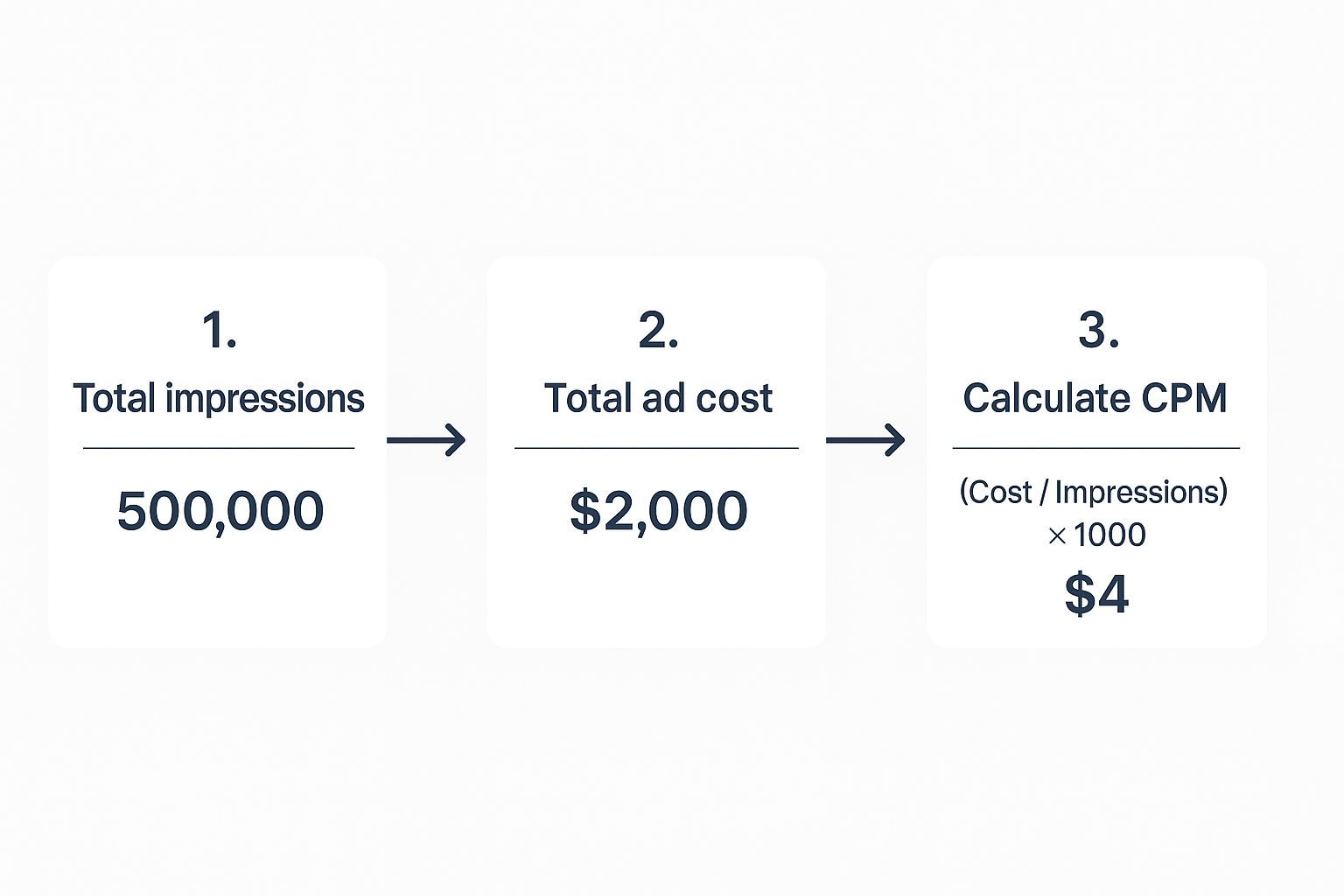
As you can see, a $2,000 ad spend that hits 500,000 impressions works out to a very efficient $4.00 CPM. It’s a great visual for that direct relationship between cost and reach.
Example 2: The Programmatic Display Ad Buy
Now for a bigger-picture example. A national e-commerce brand is running a massive programmatic display campaign to push a big seasonal sale. They put a serious budget behind it—$50,000 over a two-week period. At the end of the run, their ad network reports a staggering 12,500,000 impressions.
Let's run the numbers:
- Total Cost: $50,000
- Total Impressions: 12,500,000
- Calculation: ($50,000 / 12,500,000) * 1,000 = $4.00 CPM
Notice that even with a much larger budget, their cost per thousand impressions is actually lower. This is pretty common in high-volume display advertising, where you often gain efficiencies of scale.
Example 3: The Influencer Marketing Scenario
Figuring out CPM for an influencer campaign can feel a bit different since you're not getting a clean impression report from an ad platform. But you can still get a really solid estimate.
Say you partner with a micro-influencer for a sponsored post and pay them $500. You won't have an exact impression count, but you can use their average post reach as a stand-in. If this influencer consistently reaches about 80,000 people with their posts, you can just adapt the formula.
Pro Tip: In influencer marketing, using average reach is a practical way to estimate your CPM. It gives you a benchmark to compare how cost-efficient an influencer is versus your other paid media channels.
Here's how that would look:
- Total Cost: $500
- Estimated Reach (as Impressions): 80,000
- Calculation: ($500 / 80,000) * 1,000 = $6.25 CPM
This calculation gives you a crucial metric for evaluating your influencer partnerships. It lets you compare apples to apples, ensuring every dollar in your marketing budget is being measured and justified.
Making Sense of Your CPM Results
So, you’ve run the numbers and have a CPM staring back at you. That’s the easy part. The real work is figuring out what that number actually means for your campaign. Is a $5 CPM a home run, or a sign that you're striking out?
The honest answer? It depends. There’s no universal “good” CPM because the metric is completely dependent on context. Think about it: a B2B tech company targeting CFOs on LinkedIn is playing a totally different game than a fashion brand running a flash sale on TikTok. The audience, platform, and even the ad placement quality will cause that number to swing wildly.
Your goal shouldn't be to chase some mythical, perfect CPM. Instead, learn to use it as a diagnostic tool—a health check for your campaign’s efficiency.
What Your CPM Is Telling You
A high CPM isn't automatically bad, and a low one isn't always good. You have to read between the lines to understand the story your CPM is telling.
- A High CPM Could Mean: You're reaching a very specific, high-value audience. Targeting C-level executives is expensive, but the potential ROI is massive. It could also just mean you're in a highly competitive space, fighting for the same eyeballs as everyone else.
- A Low CPM Could Mean: You're getting a great deal and reaching a broad audience for cheap. Awesome! But it could also be a red flag that your targeting is too wide, meaning you're wasting impressions on people who will never convert.
The real secret is looking at CPM alongside other crucial metrics. A super-low CPM is just a vanity number if it doesn't lead to clicks, engagement, or sales. And a high CPM can be a fantastic investment if it's driving high-quality leads. For a deeper look, check out our guide on essential digital marketing performance metrics.
Industry benchmarks can also give you a much-needed reality check. For instance, in early 2024, the average global social media CPM was sitting around $6.00, but this changes all the time. Seasonality is a huge factor. During the holiday rush, TikTok's CPM often hangs out near $5.00 as consumer spending spikes. To see more detailed data on these trends, you can explore the latest reports on social media ad costs.
Using CPM To Compare Different Ad Channels

This is where CPM transforms from a simple metric into a seriously powerful strategic tool. It gives you a common denominator to compare the cost-efficiency of completely different platforms, helping you make smarter, data-driven decisions about where your budget should go.
For example, a programmatic display ad might have a rock-bottom CPM, giving you cheap and broad reach. At the other end of the spectrum, a TV ad spot during a major live event will come with a massive price tag and a sky-high CPM.
High CPM Doesn't Automatically Mean Bad Value
It’s easy to assume that a high CPM is a bad thing, but that’s a common misconception. Often, a higher CPM just means you’re paying for access to a highly valuable, engaged, and hard-to-reach audience. A premium placement can easily justify its cost with better impact and higher-quality eyeballs.
Take the NFL, for instance. During the 2021–2022 season, the average CPM for an ad was around $75 during regular season games. That number jumped to $92 in the playoffs. These figures might seem staggering compared to most digital ads, but they reflect the cost of getting in front of a massive, captivated audience that you just can’t find anywhere else.
Key Takeaway: CPM measures the cost of impressions, not conversions. A channel with a high CPM might actually lead to a lower overall customer acquisition cost if it connects you with the perfect audience.
Comparing CPMs across channels helps you understand the trade-offs you're making. This evaluation is a critical first step before you dive deeper into a full customer acquisition cost calculation to measure the real bottom-line impact of your ad spend.
Got Questions About CPM? Let's Clear Things Up.
Once you start digging into CPM, a few questions always pop up. It's totally normal. Getting the hang of these nuances is what separates a decent campaign from a great one. Let's tackle some of the most common things people ask.
CPM, CPC, CPA… Which One Actually Matters?
This is a big one. Marketers often get hung up on whether they should be watching their CPM, CPC (Cost Per Click), or CPA (Cost Per Acquisition). The truth is, it's not a competition. The right metric depends entirely on what you're trying to achieve.
Think of it this way: CPM is your go-to for brand awareness. If your main goal is just to get your name in front of as many relevant people as possible, CPM tells you how cost-effectively you're doing it. On the other hand, CPC is all about engagement, and CPA zeroes in on conversions. They each tell a different part of the story.
Why Is My CPM All Over the Place?
If you've noticed your CPMs jumping around, you're not alone. They're almost never static, and that’s because you're essentially bidding for ad space in a live, competitive auction. Several things can make that price swing:
- Who You're Targeting: The tighter and more valuable your audience, the more you'll pay. Trying to reach VPs of Marketing is going to have a much higher CPM than targeting cat lovers in general.
- The Time of Year: Competition gets fierce during big commercial moments. Think Black Friday, the holiday season, or even the Super Bowl. More advertisers are fighting for the same ad space, which naturally drives prices up for everyone.
- Where Your Ad Shows Up: Placement is huge. A banner ad at the top of the New York Times homepage will always command a premium CPM compared to a small ad tucked away at the bottom of a niche blog.
A fluctuating CPM isn't a red flag on its own. It's simply a reflection of the market. The key is to understand why it’s changing and decide if the cost still makes sense for the value you're getting from those eyeballs.
At the end of the day, think of CPM as a diagnostic tool. It’s fantastic for comparing the cost-efficiency of different channels or campaigns. Just make sure you're always looking at it within the larger context of what you're trying to accomplish.
Ready to streamline your influencer campaigns and track performance with precision? REACH provides the tools you need to discover partners, manage content, and prove your ROI. See how our platform can elevate your strategy.