 Skip to content

Picture your marketing efforts for a moment—email blasts, social media posts, digital ads, and all your content. Think of them as a skilled orchestra. Campaign management software is the conductor, making sure every instrument plays in perfect harmony to create a single, powerful customer experience. It acts as the central hub for your marketing, turning a bunch of separate activities into a cohesive strategy that actually grows your business.
What Campaign Management Software Really Does
At its heart, campaign management software is a platform built to help you plan, execute, analyze, and fine-tune your marketing campaigns across different channels, all from one dashboard. It helps teams finally ditch the scattered spreadsheets and disconnected tools for a single, organized environment. This isn't just about making things tidier; it's about getting everyone on the same strategic page.
Instead of running an email campaign in one tool and a social media ad in another, these platforms pull everything together. This unified view gives you a clear picture of the entire customer journey, helping you see which touchpoints are working and make smart, data-backed decisions on the fly.
To put it simply, these platforms are the backbone of your marketing operations. They handle the complex logistics so you can focus on the big picture.
Let's break down the core functions to see how all the pieces fit together.
Core Functions At a Glance
The table below gives a quick overview of what these platforms are designed to do, showing how they support every stage of your marketing initiatives.
| Core Function | What It Does for You |
|---|---|
| Centralized Planning | Maps out entire multi-channel campaigns in one place, from budget to timeline. |
| Execution & Automation | Schedules and launches coordinated messages across email, social, and ads. |
| Audience Segmentation | Groups your audience based on behavior or demographics for personalized messaging. |
| Performance Analytics | Gathers data from all channels into a single dashboard to track ROI and KPIs. |
| Optimization Tools | Provides features like A/B testing to help you refine and improve campaign results. |
Ultimately, a good campaign management platform takes care of the operational heavy lifting, giving you the insights needed to make smarter strategic moves.
Moving Beyond Simple Task Management
It's really important to understand that this software is not just a glorified to-do list. While a project management tool helps you track tasks, campaign management software is purpose-built for the entire lifecycle of a marketing initiative. Its features are specifically designed to handle the unique needs of marketers, like audience segmentation, A/B testing, and detailed performance analytics.
The real power of campaign management software is its ability to connect your marketing actions directly to business outcomes. It finally answers that critical question: "How did all our combined efforts actually contribute to our goals?"
In essence, this software becomes the engine that builds and refines your automated sales funnel, guiding potential customers smoothly from awareness to purchase. By taking repetitive tasks off your plate and delivering deep insights, it frees you and your team up to focus on strategy and creativity instead of getting buried in manual work. That's what makes it a strategic necessity, not just another operational tool.
This technology gives your team the power to:
- Plan Cohesively: Outline every single step of a campaign, from the initial idea to the final report, keeping everyone aligned.
- Execute with Precision: Launch perfectly timed and coordinated efforts across email, social media, paid ads, and more.
- Analyze Performance Holistically: Get a single source of truth for all your campaign data, making it easy to measure ROI and spot your winning strategies.
- Optimize for Better Results: Use real data and insights to make your next campaigns even better by improving your targeting, messaging, and overall approach.
The Real Business Impact of Centralized Campaigns
Sure, saving time is great, but the real power of campaign management software is what it does for your bottom line. Without a central hub, marketing efforts can feel like a bunch of separate conversations happening in different rooms. The result? Inconsistent messaging, a blurry picture of the customer journey, and a real headache when you try to prove ROI.
Picture a growing e-commerce brand. The social media team is running Instagram ads, the email folks are sending newsletters, and the content team is pushing out blog posts. Each group is in its own bubble, using its own tools and only seeing a tiny slice of the customer's world. This makes it almost impossible to figure out which touchpoints actually convinced someone to buy.
This is the chaos that campaign management software is built to solve. It breaks down those walls and creates a single source of truth that changes how you do business.
From Disjointed Efforts to a Unified Strategy
By bringing all your data and workflows under one roof, these platforms offer benefits that go way beyond just being more organized. For instance, good software can make a huge difference in team collaboration by streamlining workflow approvals and keeping everyone on the same page.
Instead of guessing what's working, marketers get a clear, 360-degree view of campaign performance. This clarity is what allows you to make smart decisions that actually drive revenue and build loyalty. You can finally connect the dots between your team's actions and the company's results.
Centralizing your campaigns isn't just an organizational tweak; it's a strategic shift. It enables deep personalization at scale, which directly contributes to higher customer lifetime value (CLV) and a stronger return on investment.
This strategic edge is exactly why the market is exploding. Projections show the ad campaign management software market growing from $13.65 billion in 2024 to an incredible $27.40 billion by 2029. This surge is fueled by the need for smarter customer targeting and a consistent experience across all channels.
Connecting Features to Bottom-Line Results
So, how do the features of this software translate into actual, measurable business impact? It all starts with having that solid, centralized foundation for reporting and analysis.
- Boosted Efficiency: Automation takes care of the grunt work—scheduling posts, sending follow-up emails, you name it. This frees up your team to focus on strategy and creativity, getting more done without burning out.
- Actionable Customer Insights: When all your data lives in one place, you can finally see who your most profitable customers are and what makes them tick. This leads to much smarter targeting and less wasted ad spend.
- Increased ROI: By clearly seeing which channels and messages are winners, you can confidently shift your budget to what works. A big part of this is understanding https://reach-influencers.com/what-is-marketing-attribution/ and how it shows the value of each step in the customer's journey.
Ultimately, this software turns your marketing from a series of disconnected gambles into a predictable engine for business growth. It's about being deliberate and data-driven in everything you do.
Essential Features Your Software Must Have

When you're shopping for campaign management software, it’s easy to get lost in a sea of features. Every platform claims to do it all. The trick is to ignore the shiny objects and zero in on the core functions that solve the real-world headaches marketers face every day.
Think of this as your non-negotiable checklist. These aren't just tools; they're solutions. Without them, you might as well stick with your spreadsheets, because you won't get the unified view or strategic power you need to actually move the needle.
Omnichannel Orchestration and Automation
A true campaign management platform has to do more than just send emails or schedule social posts. It needs omnichannel orchestration. This is the secret sauce that lets you build a single, connected customer journey across every place they interact with you—from a Facebook ad to a follow-up email and even a retargeting banner on a news site. Your message stays consistent and intelligent, building on every last click.
Here’s a real-world example: someone ditches their shopping cart on your site. A great platform instantly kicks off an automated sequence. Maybe it’s an email reminder an hour later, an SMS with a small discount code the next day, and a social ad showcasing that exact product a few days after that. That’s how you turn a bunch of separate marketing tactics into a cohesive, powerful strategy.
This kind of coordinated experience is no longer a "nice-to-have," which is why the market is exploding. The global campaign management system market was valued at USD 5.50 billion in 2025 and is on track to nearly double, hitting USD 10.86 billion by 2032. That massive growth tells you just how essential these tools have become. You can find more insights on this growing market and what's driving it over at Coherent Market Insights.
Advanced Segmentation and Personalization
If you try to talk to everyone, you end up connecting with no one. That's why advanced segmentation is an absolute must. This is your ability to slice and dice your audience into super-specific groups based on their behavior, what they've bought, where they live, or how they interact with your brand.
For instance, instead of blasting a generic "sale" email to your entire list, you could create a segment of customers who bought a specific product in the last six months. Then, you could send them a perfectly timed offer for a complementary item. This is what makes marketing feel helpful and relevant, not like spam.
Effective segmentation is the foundation of modern marketing. It's the difference between shouting a message into a crowd and having a meaningful, one-on-one conversation with a potential customer.
Robust Analytics and Reporting
Let's be honest: without good data, you're just guessing. Any campaign management tool worth its salt must provide robust analytics and reporting. This means pulling performance data from all your channels into one clean, easy-to-read dashboard. This is the only way you can truly measure your return on investment (ROI).
Make sure the software you choose has:
- A/B Testing Capabilities: So you can test different headlines, images, or calls-to-action to see what actually gets a response.
- Attribution Reporting: To finally figure out which channels and touchpoints are doing the heavy lifting and driving sales.
- Integrated Budget Management: To track spending against campaign results in real-time and shift your money to what’s working.
These analytical tools are what empower you to make decisions based on facts, not feelings. You can stop burning cash on campaigns that are going nowhere and double down on your winners. This is how marketing stops being an expense and becomes a predictable engine for growth.
Seeing Campaign Management in Action

The theory is great, but what does campaign management software actually look like on a day-to-day basis? Let's step away from the abstract and dive into a few real-world scenarios.
You'll quickly see how these platforms become the mission control for turning big ideas into coordinated, successful campaigns, regardless of the industry or the end goal.
Example 1: The B2C Product Launch
Picture a popular retail brand gearing up to launch a new line of athletic wear. Their goal is massive: create a tidal wave of excitement that crests on launch day and leads to a sell-out. Trying to juggle influencers, social media calendars, and paid ads with spreadsheets and email chains would be pure chaos.
This is where their campaign management software shines. They map out a multi-phase plan right inside the tool:
- Phase 1 (The Teaser): A series of mysterious, coordinated posts are scheduled across Instagram and TikTok, all managed from a single, unified calendar. No more jumping between apps.
- Phase 2 (The Influencer Blitz): The platform keeps track of influencer outreach, content approvals, and deadlines. On reveal day, a dozen key influencers post their unboxing videos at the exact same time, a move orchestrated by the software.
- Phase 3 (Launch Day): An automated email sequence goes out to a segmented list of loyal customers, while targeted ads—managed and monitored within the same system—go live across all channels.
The result? A perfectly synchronized launch that feels seamless to the outside world. Better yet, the software's analytics dashboard instantly shows which influencer drove the most traffic and which ad creative converted best, giving them solid data for the next campaign. For a launch this heavily reliant on social media, having the right tech stack is non-negotiable. You can get a sense of what's out there by exploring some of the top social media campaign management tools on the market.
Example 2: The B2B Lead Nurturing Journey
Now, let's switch gears to a B2B tech company selling high-ticket enterprise software. Their sales cycle is long and complex, demanding multiple touchpoints to educate prospects and build the trust needed to close a deal.
Their campaign management software becomes the engine for a sophisticated lead nurturing workflow. The moment a user downloads a whitepaper, a fully automated journey kicks off:
- Immediate Follow-Up: The prospect receives a personalized thank-you email right away.
- Smart Content Delivery: Over the next two weeks, the system automatically sends them relevant case studies and an invitation to a webinar, all based on the job title and industry they provided in the form.
- Behavior-Based Triggers: If a lead clicks through to the webinar, the software tags them as "highly engaged" and sends a personal follow-up from a sales rep with a demo offer.
This entire sequence runs on autopilot, yet it feels completely personal to the lead. The platform gives the sales team a complete, chronological history of every interaction, empowering them to step in and have truly meaningful conversations.
This kind of smart automation is what prevents high-value leads from falling through the cracks. It turns a series of random interactions into a guided journey that leads directly to a sale.
Example 3: The Non-Profit Fundraising Drive
Finally, think about a non-profit organization running its annual fundraising campaign. The biggest challenge isn't just asking for donations; it's personalizing the "ask" to different donor segments to maximize contributions and make people feel valued.
Here, the campaign management software is absolutely essential. The team segments its database into distinct groups: "first-time donors," "lapsed donors," and "major contributors."
From there, the platform automates a unique multi-channel appeal for each group. This ensures every single person receives a consistent, compelling message tailored just for them, whether it's through email, social media, or a direct mail trigger.
How to Choose the Right Software for Your Team
Picking the right campaign management software feels like a big deal because, well, it is. Get it right, and you’ve built the command center for your entire marketing operation. Get it wrong, and you're stuck with a tool that creates headaches, wastes money, and holds your team back.
Instead of getting lost in endless vendor lists, the best approach is to take a step back and start with a plan.
First things first: look at what you’re already using. A quick audit of your current marketing stack will show you where the real friction is. Are your people spending hours every week manually stitching together reports from five different tools? Is your brand's voice all over the place because teams can't see what others are doing? Nailing down these specific pain points is the key to figuring out what you actually need.
Once you know the problems, you can build a list of must-haves. This isn't just a wish list of cool features; it's your blueprint for success.
- Essential Integrations: What other software is non-negotiable? Think about your CRM, e-commerce platform, or analytics tools. The new system has to play nicely with them.
- Team Size and Skills: Be honest about your team's comfort level with technology. Do you need something super intuitive that anyone can pick up in an afternoon, or do you have a team of power users ready for a more complex system?
- Budgetary Constraints: Work out a realistic budget. Remember to factor in not just the monthly subscription but also any one-time setup fees and the cost of training your team.
- Future Scalability: Think a few years down the road. Will this platform still work for you when your team is bigger and your customer base has doubled? You need a solution that can grow with you.
This decision tree gives you a great starting point for thinking through your options based on your company’s size, budget, and what you need the software to do.
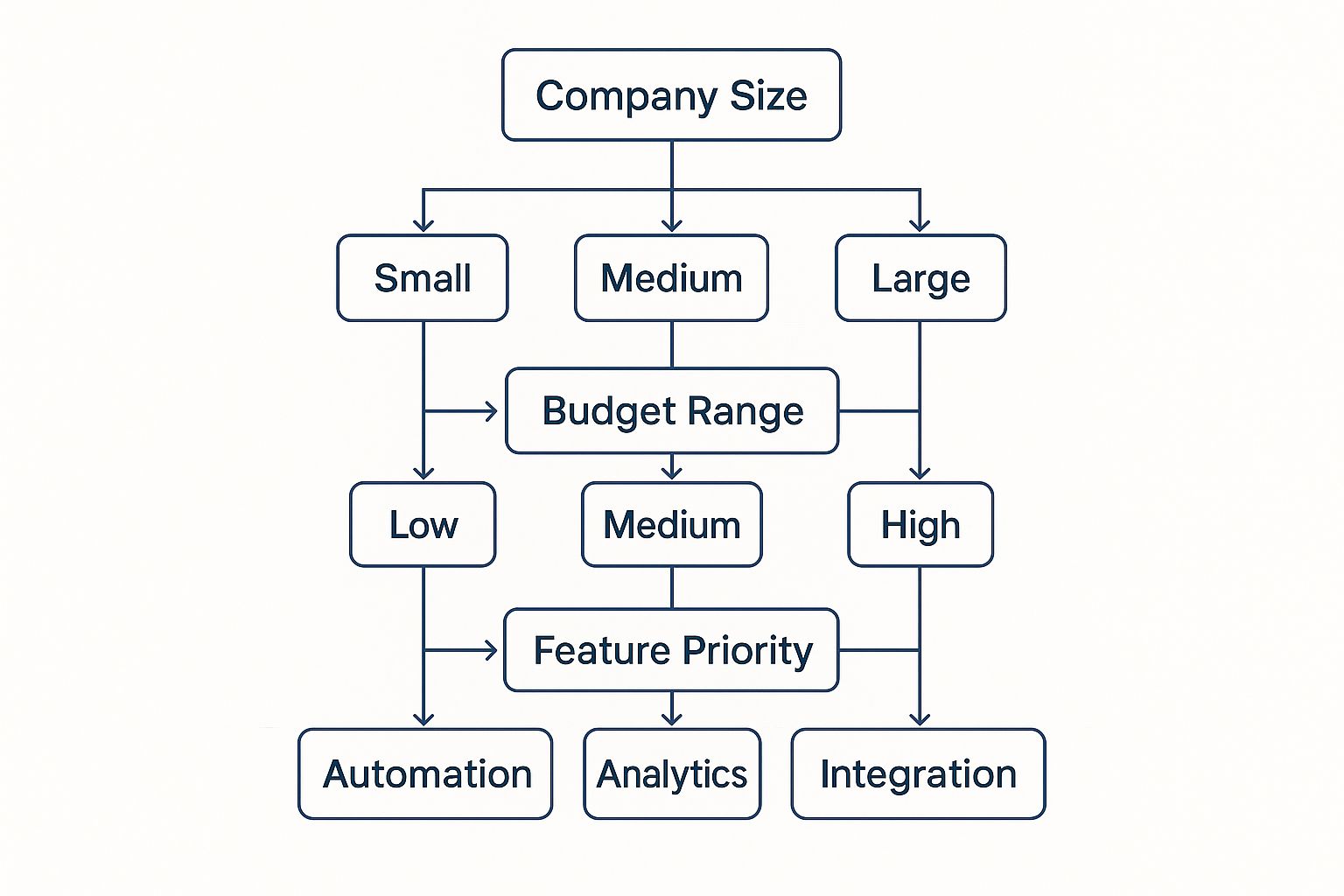
As you can see, different types of businesses naturally gravitate toward different solutions. This helps you start cutting through the noise right away.
All-in-One Suites vs. Best-of-Breed Tools
One of the biggest forks in the road is deciding between a single, all-in-one platform that promises to do everything and a collection of specialized "best-of-breed" tools that are masters of one thing. There’s no right or wrong answer here—it all comes down to your team’s unique situation.
This table breaks down the core differences to help you think through which path makes more sense for you.
Choosing Your Software Type: All-in-One vs. Best-of-Breed
| Factor | All-in-One Suites | Best-of-Breed Solutions |
|---|---|---|
| Functionality | Broad range of features under one roof (e.g., email, social, analytics). | Deep, expert-level features for one specific function (e.g., an advanced email platform). |
| Integration | Everything is built to work together, so data flows smoothly from day one. | You have to connect different tools, which can be complex and sometimes fragile. |
| User Experience | One consistent interface to learn and use for all marketing activities. | Your team will need to learn and constantly switch between multiple different logins and interfaces. |
| Cost | Typically one larger subscription fee that covers everything. | Can be more budget-friendly if you only need a few specific tools, but costs can add up. |
Ultimately, it’s a trade-off. An all-in-one suite gives you convenience and simplicity. A best-of-breed stack gives you incredible power and flexibility, but it requires more work to manage.
Making the Final Decision
Once you have a clear picture of your needs and the type of solution you're leaning toward, you can start looking at specific vendors. It helps to know you're not alone in this search. The campaign management software market was valued at around $10,090 million in 2025 and is on track to more than double to $21,310 million by 2033.
This explosive growth shows just how essential these platforms have become. If you're curious about the trends, you can explore the full research about the campaign management software market here.
In the end, the right choice is the one that fits seamlessly into your team's workflow and helps you hit your goals. If your biggest challenge is keeping complex projects and multiple stakeholders on the same page, you might also benefit from our guide on marketing collaboration software, as these tools often work hand-in-hand with campaign platforms.
By taking a structured approach, you can move forward confidently and find a platform that truly empowers your team to do their best work.
Frequently Asked Questions
https://www.youtube.com/embed/tKz_pQ8Q3cg
Stepping into the world of marketing technology can feel a bit overwhelming, and it's natural to have questions. Let's clear up some of the most common ones that come up when people are looking into campaign management software.
What’s the Difference Between a CRM and Campaign Management Software?
This is a great question, and it's easy to see why people get them confused. The best way to think about them is as two different specialists on the same team, each with a distinct job.
A Customer Relationship Management (CRM) platform is all about the one-to-one. It’s your master file for every individual customer, tracking every interaction, sales call, support ticket, and meeting note. Its focus is managing and deepening existing relationships.
Campaign management software, on the other hand, is built for one-to-many communication. Its entire purpose is to plan, launch, and measure marketing initiatives that reach a broad audience through channels like email, social media, and paid ads.
Simply put, a CRM is for managing relationships, while campaign management software is for creating and nurturing them at scale. They're a powerful duo when they work together—the CRM provides the rich customer data that allows the campaign tool to send incredibly relevant messages.
Is This Software Affordable for Small Businesses?
Yes, absolutely. There's a persistent myth that these powerful tools are only for giant corporations with bottomless budgets, but that's really not the case anymore.
Today, many providers offer tiered pricing specifically designed for growing businesses. You can start with a basic, affordable plan that covers the essentials—like a campaign calendar and email automation—and then scale up to more advanced features as your company grows. You only pay for what you need.
It's helpful to think about it in terms of ROI. The right tool doesn't just cost money; it makes it. When you factor in the time saved by automating manual work and the extra revenue from more effective campaigns, the subscription fee often pays for itself many times over.
How Difficult Is the Implementation Process?
It’s probably not as bad as you think. Gone are the days of clunky, on-premise software that took months to install. Modern, cloud-based platforms are built for a much quicker and smoother setup.
The whole process usually breaks down into three main steps:
- Data Migration: This is just a fancy way of saying you need to import your contact lists. Most tools have straightforward import wizards to help you pull in your data from spreadsheets or other apps.
- System Integration: You'll want to connect the software to your other key tools, like your CRM or website. This creates a seamless flow of information so you're not constantly switching between tabs.
- Team Training: The final piece is getting your team comfortable using the new system. Good vendors provide plenty of tutorials, webinars, and support to get everyone up to speed quickly.
While it does take a bit of planning, most teams are up and running in a few weeks, not a few months. That initial investment of time sets a strong foundation for every campaign you run in the future.
Ready to unify your influencer marketing efforts and prove your ROI? REACH provides the centralized dashboard and powerful analytics you need to manage campaigns from start to finish. Discover how REACH can transform your strategy.