 Skip to content


Ready to see how your marketing really stacks up? Understanding click through rate benchmarks by industry is the first real step to figuring out if your campaigns are hitting the mark or just getting lost in the noise. The average click-through rate across all industries is about 6.64% for search ads and a much lower 0.57% for display ads. But those are just averages—the numbers can swing wildly depending on your sector.
This guide will break down the essential CTR benchmarks for your industry across search, social, and email marketing. We'll also show you how partnering with creators through a top influencer marketing platform like REACH Influencers can help you not just meet these benchmarks, but shatter them.
What Are Industry CTR Benchmarks, and Why Do They Matter?
Before you even think about tweaking ad copy or landing pages, you need a compass. That's what industry benchmarks are. Think of your click-through rate (CTR) as a direct signal from your audience—it tells you how well your message is landing with the people you’re trying to reach. A higher CTR means you’re on the right track.
But here’s the thing: a "good" CTR is never a one-size-fits-all number. It’s a moving target. The channel you're on, the industry you're in—it all changes the definition of success. A campaign for a local restaurant just won't perform the same way as one for a global software company.
Comparing your performance to the right standard is crucial for setting realistic goals and making smart decisions. Without this context, you're flying blind, unable to tell a winning campaign from one that's quietly draining your budget.
If you want to dig deeper into the fundamentals, our guide on what is a good click-through rate is a great place to start.
A Data-Driven Look at Click Through Rate Benchmarks by Industry
To set the stage, let's look at some hard numbers. Overall, the average CTR is 6.64% for search ads and a more modest 0.57% for display ads.
But the real story is in the details. The Arts & Entertainment industry, for example, knocks it out of the park with a huge 11.43% CTR on search. On the flip side, a highly competitive field like Attorneys & Legal Services sits at just 4.24% on search. Meanwhile, E-commerce is right in the middle, hovering around 5.50% for search and 0.51% for display, showing just how different user intent is when they're actively searching versus passively browsing.
This chart breaks down the click-through rate benchmarks by industry across search, display, and email, giving you a clear visual of where everyone stands.
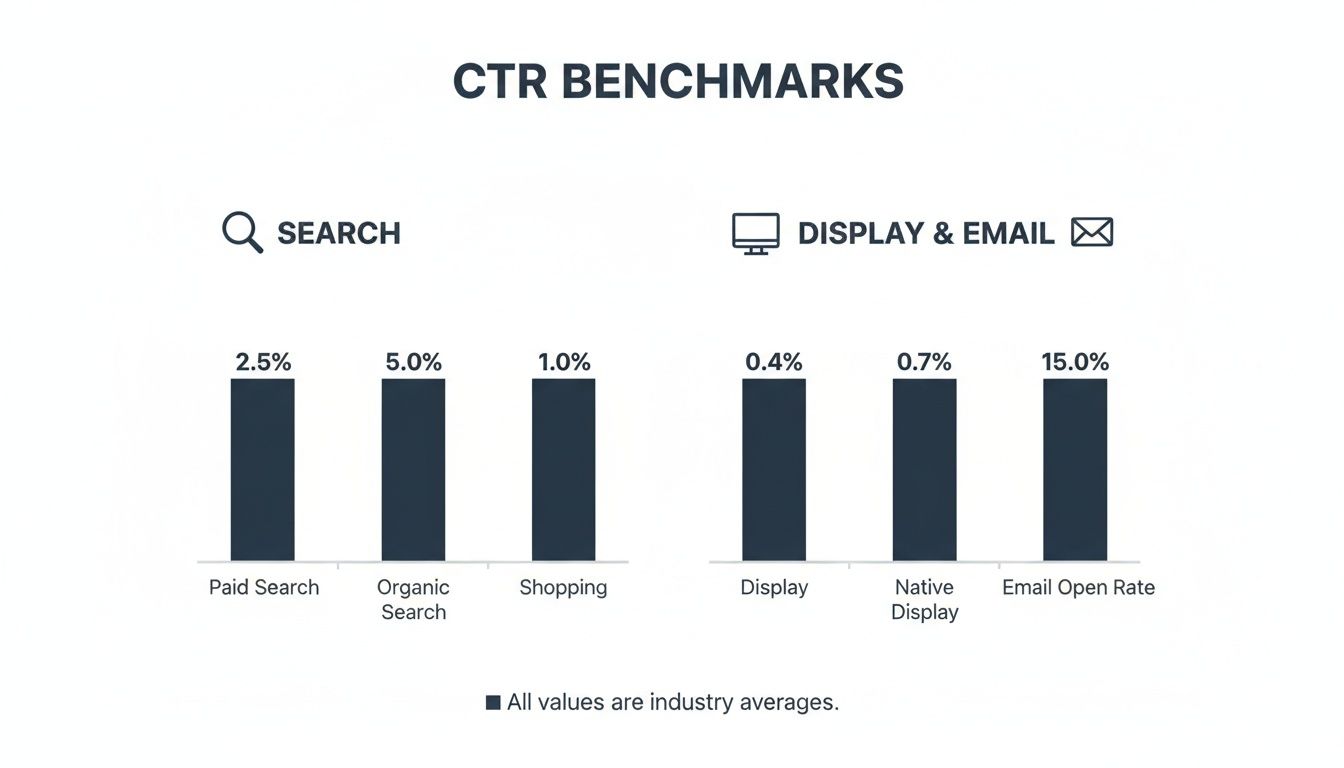
As you can see, search ads consistently come out on top. It just goes to show the power of being there the exact moment someone is looking for a solution you offer.
Average Click Through Rate (CTR) Benchmarks Across Key Industries
Here’s a table that summarizes the average CTRs for Google Search Ads, Google Display Ads, and Email Marketing across major industries. It’s the perfect baseline to see how you measure up.
| Industry | Google Search Ad CTR (%) | Google Display Ad CTR (%) | Email Marketing CTR (%) |
|---|---|---|---|
| Arts & Entertainment | 11.43 | 0.65 | 4.39 |
| Attorneys & Legal Services | 4.24 | 0.59 | 2.92 |
| E-commerce | 5.50 | 0.51 | 2.51 |
| Education | 6.84 | 0.57 | 3.59 |
| Finance & Insurance | 6.91 | 0.52 | 3.12 |
| Health & Medical | 6.94 | 0.59 | 2.94 |
| Real Estate | 9.92 | 1.08 | 2.50 |
| Restaurants & Food | 7.95 | 0.57 | 2.11 |
| Technology | 4.67 | 0.44 | 2.76 |
| Travel & Hospitality | 9.17 | 0.53 | 3.01 |
These numbers give you a solid starting point for evaluating your own campaign performance within your specific niche.
How Benchmarks Can Guide Your Strategy
Knowing these numbers is more than just a fun fact—it's a strategic advantage. When you understand the average performance in your field, you can:
- Set Smarter Goals: Stop chasing impossible targets or, even worse, settling for mediocre results. Benchmarks give you a grounded starting point for your key performance indicators (KPIs).
- Spot Opportunities: Is your CTR way below the industry average? That’s not a failure; it’s a flashing sign pointing directly at where you can improve—be it ad copy, targeting, or creative.
- Justify Your Work: When reporting to clients or your boss, you can use industry data to put your campaign performance in context. It shows you know your stuff and helps manage everyone's expectations.
Ultimately, the goal isn't just to meet the industry benchmark. It's to beat it. By understanding where the baseline is, you can build a smarter strategy that drives clicks that actually matter—the ones that lead to conversions.
When you look at the click through rate benchmarks by industry, the differences can be jarring. Why does an ad for a dating app get clicks so easily, while one for a law firm has to fight for every single one? It’s not just about having a clever ad. The real answer lies in the deep-seated differences in how people buy things in different parts of their lives.
Getting a handle on these factors is the first step to setting goals that actually make sense for your business. After all, a click isn't just a click—it's a reflection of a customer's mindset, and that mindset changes dramatically from one industry to the next. Some products tap into an immediate "I want it now" feeling, while others are part of a long, careful decision-making process.
Audience Intent and Urgency
By far, the biggest reason for CTR gaps is audience intent. Think about it like this: are you buying a snack or a house? An ad for a concert pops up, and the user's desire is immediate and urgent. They want to be entertained, and the decision to click is easy. This is exactly why the Arts & Entertainment sector pulls in an average search CTR of 11.43%.
Now, flip that around. Someone searching for a financial advisor is starting a long, complicated journey. They aren't looking to buy right away; they're in research mode. They’ll be cautious and analytical, and they definitely won't click the first ad they see. This slower, more considered approach is why industries like Finance & Insurance see a more modest CTR of 6.91%.
Emotional vs. Logical Decision Making
Is the purchase coming from the heart or the head? That question makes all the difference. Industries that sell on feeling, desire, and aspiration almost always have higher click-through rates.
- Emotional Triggers: The Travel & Hospitality industry (9.17%) isn't just selling hotel rooms; it's selling adventure and escape. Fashion and beauty brands tap into our desire for confidence. These emotional pulls are incredibly powerful and get people to click fast.
- Logical Triggers: On the other hand, things like B2B services, legal help (4.24%), or industrial manufacturing demand a logical breakdown. The buyer needs to weigh features, calculate the return on investment, and probably get approval from a team. A click is just the first tiny step.
When a decision is based on logic, people naturally spend more time reading the ad copy and thinking things over before they even consider clicking.
The lower your industry's benchmark, the more your strategy needs to focus on building trust and providing value over demanding an immediate click. Your ad is the start of a conversation, not the end of a sale.
Sales Cycle Length and Perceived Risk
The time it takes for a customer to go from curious to committed has a huge effect on their clicking habits. Industries with quick sales cycles and low risk naturally get more clicks. Buying a new shirt is a pretty low-stakes decision; if you don't like it, you can just return it.
But choosing a real estate agent (9.92%) or a new doctor (6.94%) is a big deal with real financial and personal consequences. The sales cycle is much longer, and customers need a lot more reassurance. No one clicks on these ads impulsively. They do their homework, read every review, and carefully size up the competition.
For businesses in these high-stakes fields, borrowing trust from a credible source can be a game-changer. This is where influencer marketing platforms like REACH Influencers come in. When you partner with a creator who has already built a strong, trusting relationship with their audience, you give potential customers a powerful reason to believe in you, making that click feel a whole lot safer.
A Look at Social Media CTR Benchmarks by Industry
Moving from search engine ads to social media is like going from a quiet library to a buzzing coffee shop. The whole vibe is different. People on social media aren't actively looking for a specific answer; they're there to connect, be entertained, and stumble upon new things. This shift in what a user wants fundamentally changes how we should think about the click through rate benchmarks by industry.
On platforms like Facebook and Instagram, you have to be a thumb-stopper. Success comes down to great visuals and a genuine feel that makes someone pause their endless scroll. Unlike a simple text ad, your content has to grab attention in a split second. It's no surprise that industries with eye-catching products or strong emotional hooks tend to have an edge here.
Facebook and Instagram Industry Performance
It makes sense that visual industries do well in a visual world. Recent data shows sectors like apparel and footwear are crushing it, pulling in some of the highest engagement rates. It's not just about posting pretty pictures, though. The real magic happens when content feels like it belongs there—it's aspirational, relatable, and doesn't scream "I'm an ad!"
This is exactly why working with creators through a platform like REACH Influencers can be a game-changer compared to traditional ads. When an influencer shares a new outfit in their own authentic style, it feels less like a sales pitch and more like a tip from a friend. That genuine excitement is contagious, and it’s why their audience is so much more likely to click.
Social media CTR isn’t about interrupting someone's feed. It's about becoming a welcome part of it. Authenticity is the price of entry for earning that click.
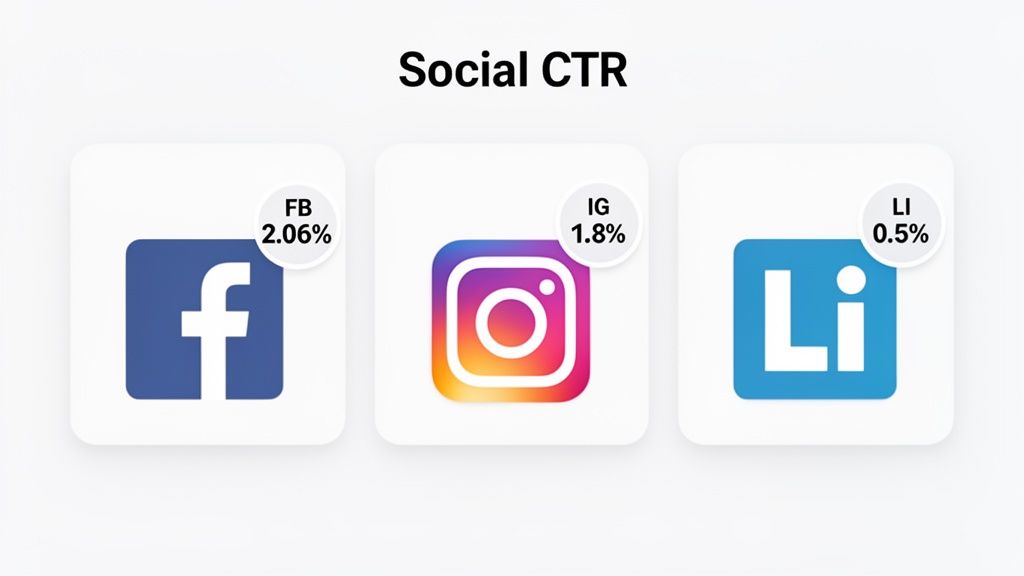
So, let's talk numbers. A Statista report from March 2023 showed the apparel and footwear industry leading the pack on Facebook with a global ad CTR of 2.06%. Generally, the average CTR for Facebook and Instagram ads hovers around 1.5%, but a really solid campaign can easily push past 2.5%. You can dig into these findings on Facebook advertising CTR to see how other industries stack up.
LinkedIn: A Different Playing Field
If Facebook and Instagram are the coffee shop, LinkedIn is the corner office. It’s a professional space with a completely different set of expectations. People are there to network, grow in their careers, and find business solutions, which makes it a goldmine for B2B marketers.
The click through rate benchmarks by industry on LinkedIn reflect this serious, career-focused mindset. Sponsored content CTRs on LinkedIn typically fall between 0.44% and 0.65% worldwide. Those numbers might seem low compared to Facebook, but don't be fooled. A single click on LinkedIn can be incredibly valuable, often representing a highly qualified B2B lead.
The format you use matters, too:
- Single-Image Ads: These see an average CTR of 0.56%.
- Message Ads: This is where things get interesting. Message Ads are a direct line to someone's inbox and can see open rates as high as 30% with click rates around 3%.
For any B2B company, those metrics are pure gold. One well-placed click on LinkedIn could lead to a major contract, making the platform an indispensable part of a professional marketing plan. If you want to get better at reading the signs, it helps to understand the key social media engagement metrics that define success on each platform.
The Power of an Authentic Voice
No matter which social platform you’re on, one thing is becoming crystal clear: real, human content wins. A polished corporate ad can easily get lost in the noise, but a post from a creator you trust cuts right through it. Their followers already believe in them, which makes their recommendations incredibly powerful.
When brands team up with the right influencers, they're essentially borrowing that trust. An influencer's endorsement gives users the social proof they need to stop scrolling and actually pay attention. It's a dynamic that's completely changing the game, proving that an authentic voice is the best tool for beating the standard click through rate benchmarks by industry and getting people to take action.
Understanding Email Marketing CTR Benchmarks by Industry
While social media is great for discovery, email marketing is still the king of direct communication. Getting someone to open your email is a good start, but a click? That’s a clear signal of real interest. It means your message didn't just land in their inbox; it actually connected and made them want to do something. Knowing the average click through rate benchmarks by industry is crucial for figuring out if your campaigns are hitting the mark or just getting lost in the noise.
Think about it: the inbox is a personal space. People let you in because they trust you. This creates a really interesting dynamic where industries that are great at building a strong sense of community or have a compelling mission often see the best engagement. For their audience, an email isn't an interruption—it's a welcome update. That personal connection is the secret sauce for driving clicks.
Why Certain Industries Win the Inbox
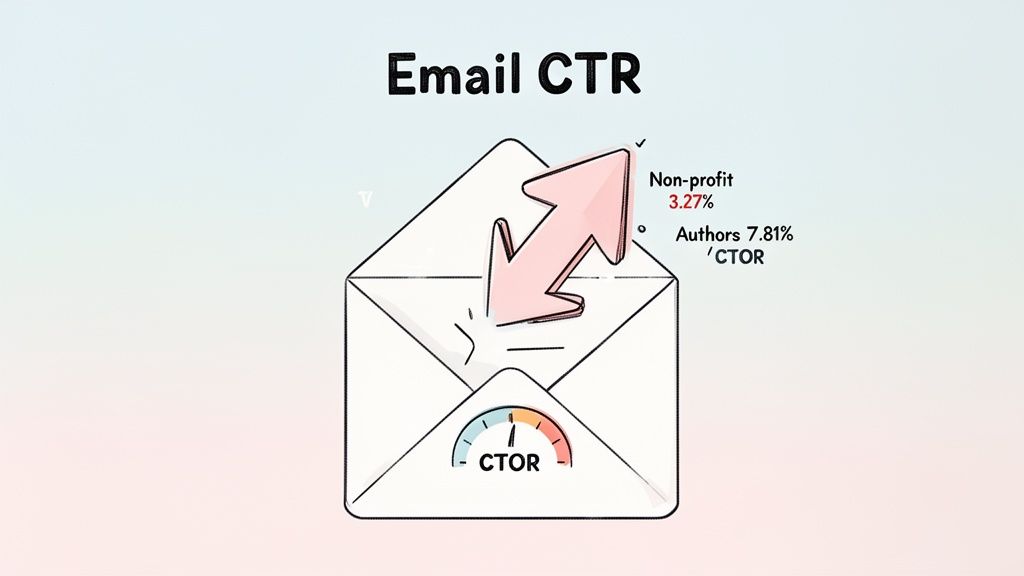
So, why do some emails get all the clicks while others are left unread? It almost always boils down to the relationship between the sender and the subscriber. Take non-profits, for example. They build their email lists around shared values and a common cause, which gives supporters a powerful reason to stay engaged. This strong bond is reflected in their impressive average click rate of 3.27%.
Authors are another great example. They use storytelling to build a loyal following. Their subscribers aren't just customers; they're genuine fans, eagerly waiting for the next chapter or a personal update. This sense of anticipation leads to fantastic engagement, which becomes even clearer when we look at a more precise metric.
Introducing a Smarter Metric: Click-to-Open Rate
While CTR measures clicks against everyone you sent the email to, the click-to-open rate (CTOR) gives you a much sharper picture. It tells you the percentage of people who clicked after they opened your email. This is a game-changer because it separates the effectiveness of your email's content and call-to-action from how well your subject line performed. A high CTOR means your message is compelling to the people who actually see it.
For instance, authors boast an average CTOR of 7.81%. That high number shows that once a fan opens the email, the content inside is incredibly effective at getting them to click. This metric helps you understand what your most active subscribers really care about.
CTOR tells you what your most engaged audience thinks of your content. A high CTOR means your message is hitting the mark, even if your open rates could be higher.
Recent data paints a clear picture of what's happening in the inbox. An analysis of over 3.6 million campaigns found the global average email click rate is 2.09%, with industries ranging from a low of 0.83% to a high of 4.90%. The average click-to-open rate (CTOR) sits at a much healthier 6-7%. In the US and Canada, the numbers are similar, with click rates averaging 2.14% and a CTOR of 6.73%. This just goes to show how valuable this deeper metric is for analyzing your campaigns. For more details, you can find additional insights in the full email performance metrics breakdown.
Uniting Influencers and Email for Better Clicks
Want to give your email CTR a serious boost? Start thinking beyond the inbox. Bringing influencer collaborations into your email strategy can create a powerful cycle of engagement that grows your list and drives more clicks.
Imagine an influencer you’ve partnered with teasing an exclusive discount on their social media. The only way their followers can get the code is by signing up for your newsletter. This strategy is brilliant for two reasons:
- It grows your email list with a highly engaged audience that already trusts the influencer’s recommendation.
- It creates immediate excitement for your next email, which dramatically increases the chance of both an open and a click.
By using an influencer marketing platform like REACH Influencers, you can find creators whose audience is a perfect match for your brand. This makes sure the new subscribers you gain aren't just names on a list—they're genuinely interested people, ready to click and become customers. This approach turns a simple email campaign into a much more connected and effective marketing engine.
How Influencer Marketing Can Beat Industry CTR Benchmarks
Knowing the standard click-through rate benchmarks by industry is a great starting point, but it should never be your final destination. Hitting those averages means you're competent, but real success comes from blowing past them. This is where influencer marketing stops being a buzzword and becomes a serious, click-driving machine.
Think about it: traditional ads interrupt what you’re doing. Influencer content is the experience. It’s woven right into the content you chose to watch, created by someone you trust. That trust is the secret ingredient for unlocking click-through rates that most display or search ads can only dream of.
Find Creators in High-Engagement Niches
First things first, you need to dig deeper than broad industry categories. It's all about finding specific, high-engagement niches. A general "beauty" influencer is fine, but a creator who focuses exclusively on "cruelty-free skincare for sensitive skin" has an audience that is way more dedicated and trusting. Their followers aren't just scrolling by; they're actively looking for specific advice.
When that hyper-focused creator shares a link, it feels like a genuine tip from a friend, not a sales pitch from a corporation. That authenticity is what makes people click. This is where a platform like REACH Influencers becomes indispensable. It lets you filter for creators not just by their follower count but by their specific niche, engagement rate, and audience demographics, so you can find the perfect match.
Co-Create Authentic Calls to Action
The single biggest mistake I see brands make is giving an influencer a stiff, corporate call-to-action (CTA). When a creator who is usually casual and fun suddenly says, "Click here to buy now!" it feels jarring and fake. Instead, work with your influencer to craft a CTA that sounds like them.
Great, natural-sounding CTAs often sound more like this:
- "I'm obsessed with this, you can grab one for yourself through the link in my bio!"
- "If you want to try it too, I have a special discount code for my followers."
- "Swipe up to see the full tutorial and find out where I got everything."
These flow naturally with the content, encouraging clicks without shattering the trust that creator worked so hard to build.
The goal is to make the click feel like the next logical step in the user's journey, not a jarring commercial break. Authenticity in the CTA is just as important as authenticity in the content itself.
The Untapped Power of Micro- and Nano-Influencers
Everyone wants to work with mega-influencers, but the real CTR magic often happens with micro-influencers (10k-100k followers) and nano-influencers (1k-10k followers). Why? Their smaller audiences are usually laser-focused on a specific topic and incredibly engaged. A recommendation from a nano-influencer can feel like getting advice from your best friend.
This tight-knit community dynamic means their followers have immense trust in what they say. In fact, one study found that micro-influencers can generate 22.2 times more weekly conversations than the average consumer. That’s a sign of a deeply engaged audience that’s ready to act. They are fantastic for driving qualified traffic that is far more likely to convert. And if you want to understand the full financial picture beyond just CTR, learning about calculating Earned Media Value (EMV) is a great next step.
Use Data to A/B Test and Optimize
Finally, don't just set your influencer campaigns and forget them. Treat every single one as a learning opportunity. When you partner with several micro-influencers for the same campaign, you’re essentially running a massive A/B test. You can see which content styles, messages, and CTAs truly connect with your audience.
By using the analytics dashboard in a tool like REACH Influencers, you can watch the click performance of each creator in real time. This data is pure gold. You’ll quickly see which influencer’s voice drives the most traffic and which CTA gets the best results. This data-driven approach lets you constantly refine your strategy, ensuring every campaign you run is better than the last and consistently leaves industry CTR benchmarks in the dust.
Your Action Plan to Improve Campaign CTR
Knowing the click-through rate benchmarks by industry is a great start, but numbers on a page don't change your results. Now it's time to turn that data into a real-world strategy to get more clicks on your campaigns. Think of those industry averages as the starting line, not the finish line.
This plan shouldn't be a one-and-done document. It should be a living, breathing part of your marketing that you tweak with every test and every new piece of data. The goal is to build a process that consistently matches your message to your audience's needs, uses voices they trust, and never stops improving.
Start with a Solid Foundation
Before you even think about launching your next campaign, run through this quick checklist. Nailing these basics upfront drastically improves your odds of beating the benchmarks and gives you a solid base for A/B testing later.
- Refine Your Audience Targeting: Are you absolutely sure you're talking to the right people? Dig deeper than just age and location. Look at their interests, how they've shopped with you before, and create lookalike audiences to find more people just like them.
- Align Ad Copy with User Intent: Your ad copy needs to be the answer to a question your audience is asking, even if they haven't typed it out. A great ad doesn't just list features; it solves a real problem and promises clear value.
- Optimize Your Calls-to-Action (CTAs): Don't just settle for "Click Here." Get creative and test different CTAs. Try something more specific and benefit-driven, like "Get Your Free Quote" or "Start Your Free Trial." The right phrase can make a huge impact.
Integrate Authentic Voices
One of the best ways to blow past industry CTR averages is to tap into the power of trust. This is where influencer marketing shines, giving you a direct connection to an audience that is already listening.
The goal isn't just any click; it's a qualified click from someone who is actually interested. An influencer's endorsement cuts through the noise, sending you traffic that's already warmed up and curious.
Working with creators through a platform like REACH Influencers helps you find those authentic voices whose followers are a perfect match for your ideal customer. When they share your brand, it lands as a genuine recommendation from a friend, not a disruptive ad. For a deeper look, check out our guide on how to improve click-through rates for more hands-on strategies.
Commit to Continuous Optimization
Getting a better CTR isn't a single project; it’s a constant cycle of testing, learning, and tweaking. For paid ads, this is especially true when it comes to understanding Google Ads Quality Score, which is heavily tied to your expected CTR. A better score means lower costs and better ad placement, so improving your CTR directly helps your bottom line.
Always be A/B testing your headlines, images, and ad copy to see what your audience responds to. Let the data tell you what's working, and never stop hunting for that next small improvement.
Got Questions About CTR Benchmarks? We've Got Answers
Even with all this data laid out, you probably have a few questions swirling around about how to actually use these benchmarks for your own campaigns. Let's tackle some of the most common ones I hear from marketers.
What’s Actually a “Good” Click-Through Rate?
Honestly, there's no single magic number. A "good" CTR is all about context—specifically, your industry and the channel you're using.
Think about it this way: a 7% CTR on a search ad might feel a little disappointing if you're in the Arts & Entertainment world, where the average is a whopping 11.43%. But if you're a lawyer? That same 7% would be incredible, blowing the 4.24% legal industry average out of the water.
The best approach is to aim for a CTR that consistently hits or beats your specific click through rate benchmarks by industry while also driving real conversions. Use the data in this guide as your baseline, your starting point for what's possible.
How Often Should I Check My CTR Against the Benchmarks?
For campaigns that are up and running, a quick weekly check-in is a great rhythm. It helps you catch trends and spot issues without getting bogged down by normal day-to-day blips. If you've just launched something new, you'll want to keep a much closer eye on it for the first 72 hours.
For bigger-picture strategy, I recommend a more formal comparison against the industry benchmarks every month or quarter. This is your chance to step back, see how you’re really doing, and make smarter decisions for the long haul. A platform with real-time analytics makes this whole process much smoother.
Is It Possible for a High CTR to Actually Be a Bad Thing?
Absolutely, and it happens more often than you'd think. A sky-high CTR can hurt your conversion rate if those clicks are coming from the wrong people.
If you're using misleading ad copy or clickbait-style headlines, you'll definitely get clicks, but they won't be from a qualified audience. This just leads to a high bounce rate, a low conversion rate, and a wasted budget. The goal isn't just clicks; it's qualified clicks.
This is where influencer marketing really shines. Creators build a trusted following of people who are already passionate about their niche. When they promote something, the clicks you get are from genuinely interested users who are much more likely to become customers.
Ready to stop guessing and start crushing your industry's CTR benchmarks? REACH Influencers gives you the data-driven tools you need to find authentic creators, manage campaigns seamlessly, and watch your click performance in real-time. By leveraging the power of trust, you can consistently outperform the standard click through rate benchmarks by industry and turn those clicks into loyal customers.