 Skip to content


At its core, calculating content marketing ROI (Return on Investment) is all about one thing: figuring out how much money your content is making compared to what you spent creating and promoting it. It's the ultimate report card for your content, translating creative work into the cold, hard numbers that matter to your bottom line. Getting this right is the key to justifying your budget, scaling your efforts, and proving the immense value of your marketing strategy.
Why Content Marketing ROI Is Your Most Important Metric
Let's cut through the noise. Content marketing ROI isn’t just some fancy formula; it’s the story of your success, told in the language that executives and stakeholders actually understand: revenue. For any marketer who needs to justify a budget or prove their team’s value, tracking this metric is non-negotiable.

Without a solid grip on ROI, your content can easily be dismissed as a "nice-to-have" creative expense instead of a core business driver. But the moment you can show a positive return, everything changes.
A strong grasp of content marketing ROI transforms your strategy from guesswork into a predictable revenue engine. It's the key to securing bigger budgets, earning a seat at the strategic table, and making smarter investment decisions.
Connecting Content to Business Goals
Every blog post, video, or social media update should have a purpose. But how do you prove it’s actually working? Shifting your focus to ROI moves the conversation away from vanity metrics like "likes" and "shares" and toward the numbers that truly move the needle for the business.
This is especially true for brands and agencies running campaigns with lots of moving parts. Take influencer marketing, for example. It's a powerful content strategy, but it can be notoriously difficult to attribute ROI. This is where a top influencer marketing platform like REACH comes in, offering clear, real-time analytics. Brands can see exactly which influencer posts are driving clicks, sign-ups, and sales, drawing a straight line from their investment to tangible results and proving the value of every campaign.
A clear focus on ROI helps you:
- Justify Marketing Spend: Show stakeholders exactly how their investment is paying off in revenue.
- Optimize Your Strategy: Pinpoint which content formats and channels are your heavy hitters so you can double down on what works.
- Improve Team Alignment: Get marketing and sales on the same page, united by the shared goal of driving profitable growth.
The Challenge of Modern Customer Journeys
Let's be honest—measuring content marketing ROI isn't always straightforward. Today's customer journey is messy and rarely follows a straight line. Someone might discover your brand through an influencer's video, read a few of your blog posts over a week, see a retargeting ad on social media, and then finally make a purchase a month later.
This winding path makes attribution—giving credit where credit is due—a huge challenge. How much of that sale should the blog post get? What about the final ad they clicked? Without the right tools, seeing the full picture is nearly impossible. This is why having a unified platform is so crucial; it pulls data from every touchpoint to give you a complete view of performance.
Even with these hurdles, the effort pays off. A 2023 HubSpot survey found that 14% of marketers named content marketing as the channel delivering their highest ROI, right up there with websites and social media (both at 16%). This just goes to show how powerful content can be in driving measurable returns when you make tracking it a priority. You can dig into more content marketing trends and statistics from their detailed report.
Choosing the Right Metrics to Measure Your Content Marketing ROI
You can't prove your content is working if you're not tracking the right things. The metrics you choose are the entire foundation for calculating content marketing ROI, but let’s be honest—not all data is created equal. To get a real picture of your performance, you have to learn how to separate the "vanity" metrics from the "sanity" metrics that actually affect your bottom line.
Think of it like a car's dashboard. Your speed is a vanity metric. It tells you how fast you're going, just like website traffic or social media likes. It looks impressive, but it doesn't tell you if you're actually headed in the right direction. Sanity metrics are your GPS and fuel gauge. They confirm you'll reach your destination. These are the numbers tied to leads, sales, and new customers.
Tying Metrics to Your Business Objectives
Before you track a single thing, you have to ask: what is this content supposed to do? Is it meant to build brand awareness? Generate qualified leads? Or drive direct sales? Each of these goals requires a completely different set of key performance indicators (KPIs).
A blog post written to attract new visitors at the top of the funnel should be judged differently than a case study designed to close a deal at the bottom. To really dig in and see what's working at each stage, it helps to use structured content analysis methods that show you what truly connects with your audience.
Here’s a simple breakdown of which metrics matter most, depending on what you're trying to achieve:
-
For the Awareness Stage: The main goal is to get your brand in front of new people. You'll want to focus on metrics that show reach and initial interest, like organic traffic, keyword rankings, social media reach, and the number of backlinks you've earned.
-
For the Consideration Stage: At this point, people know who you are and are weighing their options. You need to track metrics that show they're digging deeper. Think email newsletter sign-ups, gated content downloads (like ebooks or whitepapers), time on page, and comments.
-
For the Decision Stage: This is where you turn prospects into customers. The metrics here are the ones your CFO cares about, including conversion rates, demo requests, sales qualified leads (SQLs), and, of course, actual sales revenue.
Moving Beyond Simple Engagement
Likes and shares feel good, but they rarely translate directly to a positive content marketing ROI. Real engagement is when someone takes a meaningful action that moves them one step closer to buying from you. A post with a ton of shares is nice, but I'd rather have fewer clicks that lead to actual email sign-ups.
Measuring success isn’t just about counting clicks; it’s about counting actions that matter. A successful content strategy focuses on metrics that build a direct bridge between your content and your revenue goals.
This is especially true in the world of influencer marketing. An influencer's post might get thousands of likes, but did it send traffic to your landing page? And did any of those visitors convert? This is exactly what platforms like REACH were built to answer. They pull all of your campaign data—from clicks to sales—into a single dashboard so you can see which creators are driving business results, not just empty engagement. If you need a refresher, check out our guide on the most important social media engagement metrics to track.
Don't forget that the type of content you create also changes which metrics matter most. For example, recent data shows that 21% of marketers named short-form video as their top ROI driver. This just goes to show how important it is to adapt your measurement strategy to what's working now. By picking KPIs that reflect both your business goals and your content formats, you can finally build a framework that proves your content's true value.
How to Calculate Your Content Marketing ROI Step by Step
Alright, let's get down to brass tacks. Calculating your content marketing ROI isn't some mystical art form—it’s just math. At its core, it’s a simple formula that turns your marketing efforts into a number your finance team will actually understand.
The basic formula looks like this:
(Return – Investment) / Investment x 100 = Content Marketing ROI (%)
This little equation spits out a percentage that tells you how much you earned for every dollar you put in. If it’s positive, you’re making money. If it’s negative, you’re losing it. Simple as that.
Now, let's break down what actually goes into the "Return" and "Investment" buckets.
Tallying Up Your Total Investment
First things first, you need to know what you spent. And I mean everything. The biggest mistake I see marketers make is only counting the obvious stuff, which makes their ROI look way better than it actually is.
To get a real, honest-to-goodness number, you have to add up every single cost, both direct and indirect, that went into creating and sharing your content.
Your total investment should include things like:
- Content Creation Costs: Did you pay a freelancer? A graphic designer? What about the slice of your in-house team's salary that went toward this project? It all counts.
- Software and Tools: Those subscriptions add up. Think about your SEO tools (like Ahrefs or Semrush), design software (Canva, Adobe), and anything you use to manage the work (Asana, Trello).
- Promotional Spend: This one's a biggie. It’s all the cash you dropped on social media ads, Google Ads, or sponsored posts to get more eyeballs on your content.
- Influencer Fees: If you're working with creators, you need to include their fees, the cost of any products you sent them, and any agency fees you paid.
Getting this number right is the foundation of a credible ROI calculation. If you want to get even more granular with your spending, our guide on customer acquisition cost calculation is a great next step.
Putting a Price Tag on Your Return
This is where things can feel a bit fuzzy. How do you assign a dollar value to a new email subscriber or a PDF download? It all comes down to connecting your content to actual revenue.
Your "Return" is the money your content brought in. Sometimes it's obvious—someone clicks a link in your blog post and buys a $100 product. Easy. But more often, the path is a little longer, starting with a lead that turns into a customer down the road.
To figure this out, you'll need to know:
- How many qualified leads did your content generate?
- What percentage of those leads usually become customers? (Your lead-to-customer conversion rate).
- How much is a new customer worth to you over time? (Your average Customer Lifetime Value, or CLV).
When you multiply these numbers, you can confidently assign a dollar value to the leads your content generated.
A Practical Example Using REACH
Let's make this real. Imagine a DTC skincare brand launches a new serum and uses the REACH platform to run an influencer campaign. Their one and only goal is to drive sales.
1. Calculating the Investment:
- Influencer Payments: They work with five micro-influencers, paying them $1,000 each for a total of $5,000.
- Product Costs: Each influencer gets a product kit worth $100 ($500 total).
- REACH Platform Subscription: They attribute $200 of their monthly plan to this specific campaign.
- Ad Spend: They put $1,300 behind the best-performing posts to give them an extra boost.
Total Investment = $5,000 + $500 + $200 + $1,300 = $7,000
2. Calculating the Return:
This is where a platform like REACH really shines. The dashboard shows them exactly how many clicks and sales came from each influencer’s unique tracking link. No guesswork needed.
- The campaign drove 250 direct sales of their $60 serum.
Total Return = 250 sales x $60/serum = $15,000
3. Putting It All Together:
Now we just plug our numbers into that formula from the beginning:
- ROI = ($15,000 – $7,000) / $7,000
- ROI = $8,000 / $7,000
- ROI = 1.14
Multiply that by 100 to get your percentage:
- Content Marketing ROI = 114%
What does this mean? For every single dollar the skincare brand put into this campaign, they got $2.14 back. That’s a powerful, clear-cut number they can take straight to their leadership team to show what’s working and why they should invest even more next time.
Finding an Attribution Model That Works for You
Figuring out your content marketing ROI can feel like trying to solve a puzzle, especially when a customer sees a blog post, clicks an ad, and then watches an influencer video before finally buying something. Which piece gets the credit?
This is exactly what attribution models are for. Think of them as different rulebooks for assigning value to each marketing touchpoint that led to a sale. Picking the right one is the key to understanding what's really working.
Imagine your marketing efforts are a soccer team trying to score. The final purchase is the goal, but a lot of players (your content) had to pass the ball down the field to make it happen. An attribution model is just the system you use to decide which players get credit for the win.
This process flow breaks down the basic steps, from tracking your initial investment to measuring the final return.
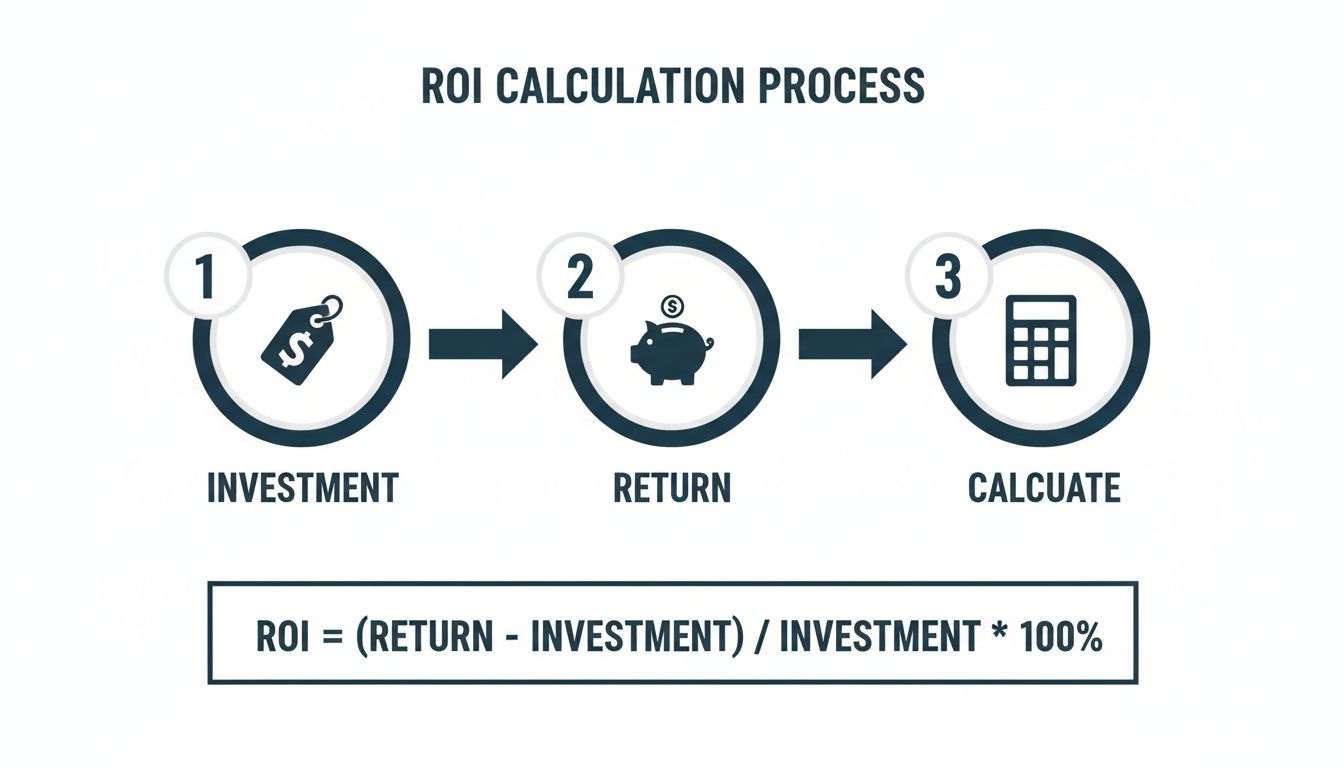
As the visual shows, you can't calculate your return without first having a crystal-clear picture of your investment.
Single-Touch vs. Multi-Touch Models
Attribution models really boil down to two main camps: single-touch and multi-touch. Each gives you a different lens through which to view your customer’s journey.
Single-touch models are the most straightforward. They give 100% of the credit for a sale to just one touchpoint.
- First-Touch Attribution: This model gives all the credit to the very first piece of content a customer ever saw. It's fantastic for figuring out which channels are your best conversation starters.
- Last-Touch Attribution: This is the default for many platforms. It gives all the credit to the final touchpoint right before the conversion. It’s simple to track but completely ignores all the hard work your other content did to nurture that lead.
In our soccer analogy, last-touch is like giving all the glory to the person who kicked the ball into the net, completely ignoring the midfielders who set up the perfect shot.
The Shift to Multi-Touch Attribution
While simple, single-touch models just don't capture the reality of how people buy things today. The customer journey isn't a straight line. That's why so many marketers are moving to multi-touch models, which spread the credit across several interactions.
Multi-touch attribution acknowledges that every blog post, social ad, and influencer video plays a part. It gives you a more balanced and honest view of what’s driving results, helping you make smarter bets with your marketing budget.
Here are a few popular ways to slice it:
- Linear Model: This one is the fairest of them all, splitting credit equally across every single touchpoint. The downside? It assumes every interaction was equally important.
- Time-Decay Model: This model gives more weight to the touchpoints that happened closer to the sale, working on the assumption that the most recent interactions were the most influential.
- U-Shaped Model: A nice hybrid, this model gives 40% of the credit to the first touch and 40% to the last, then divides the remaining 20% among all the interactions in between. It values both what started the journey and what closed the deal.
How Platforms Simplify Complex Attribution
Let’s be honest: trying to track every one of these touchpoints by hand is a nightmare, especially when you’re working with multiple influencers across different channels. This is the exact problem platforms like REACH were built to solve.
REACH gives you the detailed data you need to connect the dots. It tracks clicks, engagement, and sales from every creator, so you can see precisely which touchpoints are pushing customers forward. This level of insight makes it possible to finally move beyond simplistic last-click models and get a true picture of your content marketing ROI.
To dig a little deeper, check out our guide on cross-channel marketing attribution. When you have a system that connects the dots for you, you can finally understand the total value your content is creating.
Actionable Strategies to Boost Your Content Marketing ROI
So, you’ve got a system for measuring your content marketing ROI. Great. The next big question is, how do you make that number go up? Getting a better return isn’t always about a bigger budget; it's about being smarter with what you have. It’s about squeezing every last drop of value from your existing content and making shrewder bets on what you create next.

This mindset shift turns your content from a one-off expense into a long-term asset that keeps paying you back. Let’s walk through three proven strategies to get more from every dollar you invest.
Repurpose Your Winning Content
Not every piece of content needs to be a brand-new idea. In fact, your best-performing content is a goldmine waiting to be excavated. Think of it like a master chef who uses one set of prime ingredients to create a dozen different incredible dishes.
Take that one comprehensive blog post that’s bringing in tons of traffic. You can spin that gold in so many ways:
- Create a short-form video script for TikTok or Reels hitting the main takeaways.
- Design a killer infographic that turns your data into a shareable visual for Pinterest.
- Build a slide deck for LinkedIn, with each key point getting its own compelling slide.
- Record a podcast episode and go deeper, maybe even bringing on a guest to discuss the topic.
Repurposing breathes new life into your best work. You reach new people who prefer different formats and you drastically lower the cost to create each new asset. It's easily one of the quickest and most efficient ways to pump up your overall content marketing ROI.
Optimize Existing Posts for Long-Term Value
Some of your biggest growth opportunities are probably already live on your website, collecting digital dust. Those older blog posts aren't just artifacts; they're foundations you can build on. With a little strategic TLC, you can boost their organic traffic and conversion power for years.
This process, often called historical optimization, is pretty straightforward:
- Find the Hidden Gems: Dive into your Google Analytics and find posts that are stuck on page two or three of Google for keywords that matter. That's your low-hanging fruit.
- Give It a Refresh: Add new, relevant information. Update any stats that are getting stale. Fix broken links. Google absolutely loves fresh, accurate content.
- Sharpen the SEO: Take another look at your main keyword. Can you write a better title tag or meta description? Are there opportunities to add internal links to newer articles?
- Polish the Experience: Break up those giant walls of text. Add new images or a video. Make sure it looks and reads great on a phone.
A few hours spent updating an old post can trigger a major surge in traffic and leads. That's an incredible return for a minimal investment.
Leverage Influencer-Generated Content
Let’s be real: scaling content creation is tough. How do you create more without your quality and authenticity taking a nosedive? The answer lies in influencer-generated content (IGC). When you partner with creators, you're not just renting their audience; you're tapping into a scalable engine for high-quality, trustworthy content.
The real secret to maximizing your content marketing ROI here is picking the right partners. Big-name celebrities have their place, but the real magic often happens with micro- and nano-influencers. These creators have smaller, tight-knit communities that genuinely trust what they have to say.
Finding these high-impact creators is where a platform like REACH becomes a game-changer. Its discovery engine lets you slice and dice by engagement rate, audience demographics, and even specific keywords, connecting you with authentic partners whose followers are your perfect customers.
Working with a portfolio of these niche creators lets you:
- Generate Diverse Content: You'll get a flood of authentic photos and videos showing off your product from countless different angles.
- Reduce Production Costs: IGC is almost always more cost-effective than a full-blown professional photoshoot.
- Build Powerful Social Proof: Nothing sells better than seeing real people using and loving your product.
By strategically partnering with the right influencers, you can fill your content calendar with authentic, high-performing assets that drive real business results, giving your ROI a powerful and sustainable lift.
How to Present Your ROI to Get Executive Buy-In
Figuring out your content marketing ROI is only half the battle. The real challenge? Turning those numbers into a story that convinces the people holding the purse strings to keep investing in what you're doing.
Let's be honest, nobody in the C-suite wants to stare at a spreadsheet packed with metrics. You’ll lose them in seconds. Instead, you need to talk their language. Frame your results around what they actually care about: business growth, revenue, and beating the competition. A clean, visual report that draws a straight line from your work to those big-picture goals will always get their attention.
This is all about shifting the focus from what you did to why it mattered. Don’t just point to a spike in website traffic. Show them how that traffic turned into real, qualified leads that the sales team closed.
Frame Your Results Around Business Goals
Your presentation needs to start and end with the company’s objectives. Before you even show a single marketing metric, remind everyone in the room what business goals your content was meant to achieve. Were you trying to steal market share? Lower the cost of getting a new customer? Drive sales for a new product?
When you frame it this way, your results immediately become more relevant. It's not just a "marketing update" anymore; it's a report on business performance.
Build your story to answer three simple questions:
- What was our main business goal? (e.g., "Our goal for Q3 was to generate 500 new leads for the product launch.")
- How did our content help? (e.g., "Our influencer campaign was a huge driver, bringing in 35% of those leads.")
- What was the bottom-line result? (e.g., "This led to $50,000 in new revenue, giving us a 114% ROI on the campaign.")
This straightforward storytelling makes your impact impossible to ignore.
Visualize Your Data for Maximum Impact
We’re all visual people. A simple, well-designed chart will always beat a dense paragraph of text. Use clean graphs and charts to make your most important findings jump off the screen.
A great ROI report doesn’t just show data; it leads your audience to the right conclusion. Use visuals to tell a story of growth and success, making it incredibly easy for stakeholders to see the value you created.
For agencies, presenting this data clearly is the key to keeping clients happy. This is where a platform like REACH can be a game-changer. Instead of spending hours building reports from scratch, agencies can give clients live, white-labeled dashboards showing campaign performance in real-time. That kind of transparency builds serious trust and proves your agency’s worth around the clock.
Provide a Clear Path Forward
A strong ROI presentation shouldn't just be a look in the rearview mirror. It should use those insights to map out the road ahead. End your report with clear, data-backed recommendations for what to do next.
Lay out your strategic next steps:
- Double Down on What Works: "Our data shows that video content from lifestyle influencers gave us the highest ROI. We propose putting an extra 20% of our budget there next quarter."
- Optimize or Cut What Doesn't: "The static image posts on Platform X really didn't perform, generating a negative ROI. We think it’s best to pause spending there and move that money to a better channel."
- Outline a New Opportunity: "We noticed a whole new audience segment that loved our content. Our next campaign should be built to go after this group specifically."
When you come to the table with a forward-looking plan, you show you’re more than just a marketer—you’re a strategic partner invested in the company's future.
Got Questions About Content Marketing ROI? Let’s Clear Things Up.
If you're diving into the world of content marketing ROI, you probably have a few questions. That's a good thing—it means you're thinking critically about how to make your content work harder for you. Let's walk through some of the most common ones I hear from brands and creators.
"How Long Until I Actually See a Return?"
This is the big one, and the honest answer is: it takes time. Content marketing isn't like a PPC ad where you see results overnight. Think of it more like planting a tree.
You’ll start seeing early signs of life—like more traffic and better engagement—in about three to six months. But the real, measurable financial return? That usually takes six to twelve months to show up. SEO, in particular, is a long game that builds incredible value over time, turning your content into an asset that keeps paying you back long after you've hit "publish."
"What’s a 'Good' ROI, Anyway?"
There’s no magic number that fits every single industry, but a solid benchmark to aim for is a 5:1 ratio. That means for every $1 you put in, you get $5 back. That's a strong sign your content strategy is working.
But here’s a pro tip: don’t get too hung up on that number right away. The most important goal is simply to get better. Focus on improving your own ROI each quarter. Progress is the real win.
"How Can I Measure ROI for Top-of-Funnel Content?"
I get it—it feels tough to put a dollar value on a blog post or a viral video that's just meant to build awareness. But you absolutely can.
The key is to look for assisted conversions. That blog post might not have made the sale directly, but did it lead someone to sign up for your newsletter? Did they download a guide? You can then track what those subscribers and leads are worth over time. This is exactly where multi-touch attribution models shine, because they give credit where credit is due, even at the very start of the customer's journey.
Ready to stop guessing and start proving your content's value with hard numbers? REACH gives you the analytics and influencer tracking you need to connect every click, conversion, and sale back to your efforts. It’s time to see your exact content marketing ROI.