 Skip to content


Meta description: Do brand ambassadors get paid? Yes, but payment ranges from free products to retainers, commissions, and flat fees. Learn how ambassador pay works, what creators make in 2026, and how to handle contracts, taxes, and payment operations.
TL;DR: Yes, brand ambassadors do get paid, but not always through a simple salary. Compensation ranges from free product and small monthly payments to $10,000 to $50,000 per campaign for top-tier ambassadors, and it usually falls into four models: flat fees, commissions, product seeding, or hybrid perks.
If you're a brand building an ambassador program, you're probably trying to answer one practical question before anything else: what will this cost, and how do we pay people fairly without creating an administrative mess?
If you're a creator, the question is usually more personal. You got an offer that promises “exposure,” maybe some free product, maybe a code, maybe a monthly arrangement, and you need to know whether that's normal, underpriced, or worth declining.
The confusion is understandable. Ambassador pay doesn't work like a standard job offer, and it doesn't work like a one-off sponsored post either. Long-term creator relationships sit somewhere in the middle. That's why the operational side matters just as much as the headline rate. Payment model, tracking, invoicing, tax documentation, contract terms, and cross-border compliance all shape what an ambassador deal is really worth.
The Short Answer and The Full Story on Ambassador Pay
The direct answer to “do brand ambassadors get paid” is yes. The more useful answer is that they get paid in different ways, and the structure often matters more than the headline number.
A new creator might receive products and a commission code. A campus ambassador might be paid hourly for events. A B2B creator might work on a monthly retainer for LinkedIn content and webinars. A larger lifestyle ambassador might be paid per deliverable plus affiliate upside. These are all real ambassador arrangements, but they behave very differently in practice.
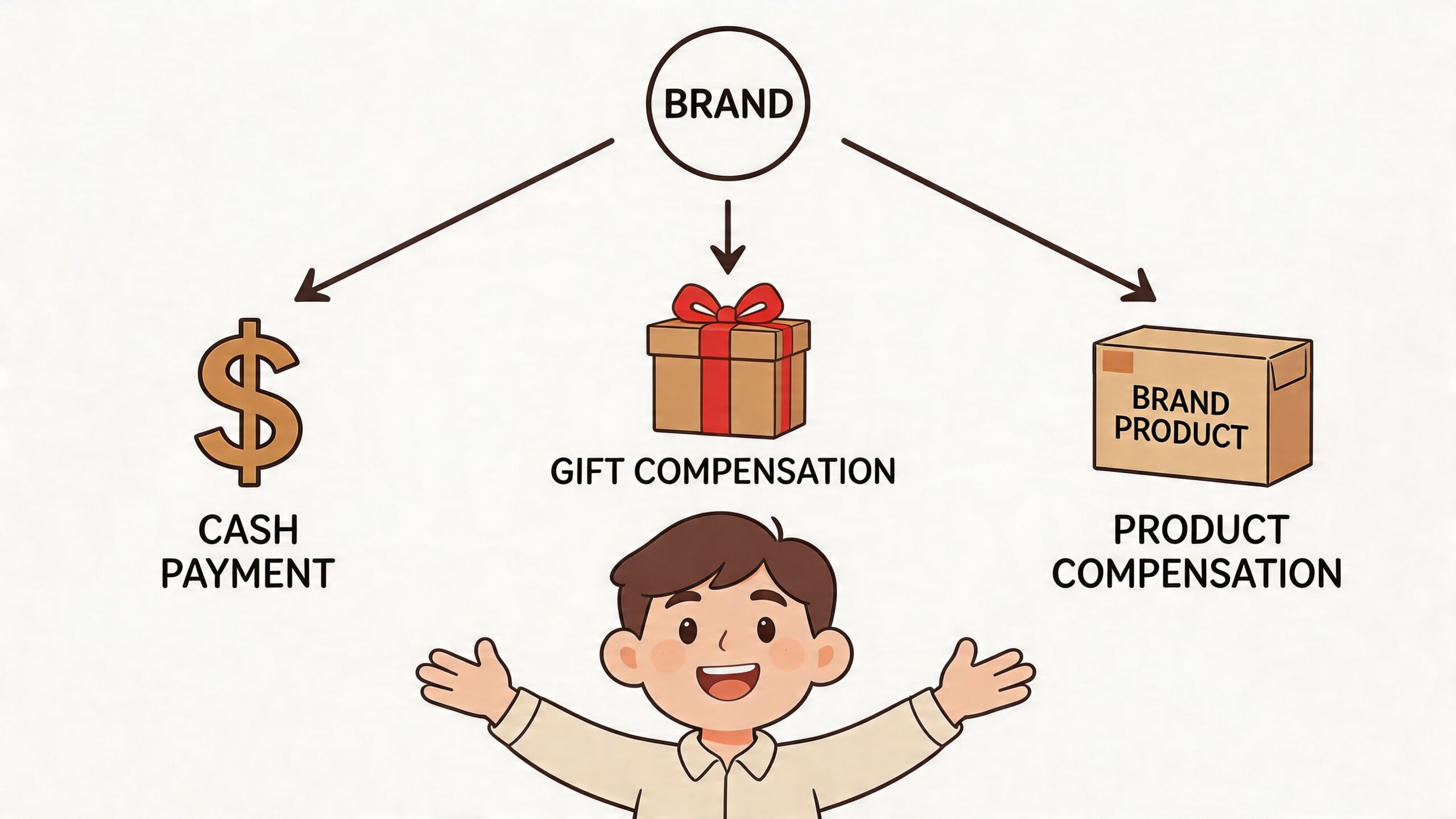
The first mistake brands make is treating ambassador compensation like a loose extension of gifting. The first mistake creators make is assuming every serious ambassador role should look like a salary. Neither view matches how the market now works.
Why the offer often feels confusing
Most ambassador offers mix several things at once:
- Content work: Posts, videos, stories, UGC, or livestreams
- Representation: Showing up at events, launches, webinars, or retail activations
- Sales contribution: Driving tracked purchases through links or codes
- Brand access: Early product drops, travel, community status, or partner perks
That mix is why many offers seem vague at first glance. The brand may be paying for content, not just endorsement. Or paying for conversions, not just audience access. Or trying to combine both.
Practical rule: If the payment model isn't clear in one sentence, the partnership isn't ready to sign.
For brands, that means writing offers with clean terms. For creators, it means asking direct questions about deliverables, ownership, timing, and payout triggers before accepting anything.
A useful starting point is a clear framework for how brand ambassador programs work. Once you understand the structure, the compensation starts to make sense.
What separates a good ambassador deal from a bad one
A good deal has alignment between effort and reward. If a creator is expected to post regularly, show up consistently, avoid competitors, and let the brand reuse content, then product-only compensation usually won't hold up.
A weak deal usually fails for one of three reasons:
- Too much labor for too little guaranteed pay
- No tracking system for commission or bonuses
- Loose contract language around usage rights and payment timing
The best ambassador agreements are simple enough to operate every month without renegotiating every detail. That matters more than flashy language in the pitch deck.
Understanding the Four Core Ambassador Compensation Models
A creator gets an ambassador offer that sounds attractive on the surface. Free product, a custom code, a small monthly fee, and "bonus opportunities" tied to performance. The important question is not whether compensation exists. It is which part is guaranteed, which part depends on tracking, and which part creates extra work the contract has not priced in.
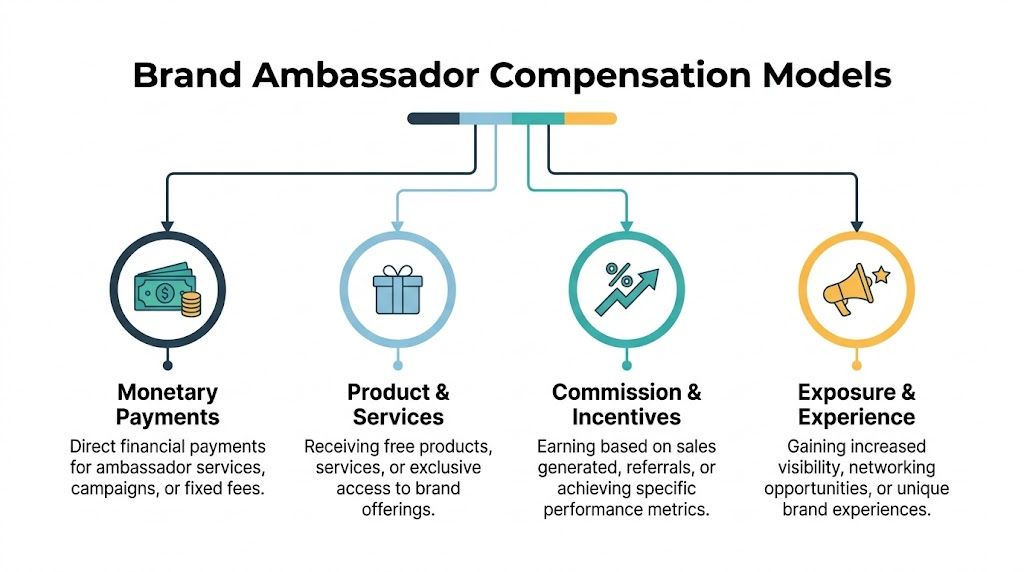
Flat fees and direct cash payments
Flat-fee compensation is the cleanest model to operate.
The brand pays a fixed amount for a defined scope: one post, a monthly content package, an event shift, or an ongoing ambassador retainer. This structure works well when deliverables, approval cycles, and usage rights are clear before work starts. Finance teams like it because the cost is predictable. Creators like it because they know what will hit their account and when.
Brands often estimate a flat fee from engagement history, conversion potential, production effort, and content rights. Some teams use rough internal formulas based on average engagement to pressure-test whether a proposed rate makes sense. That can be useful as a budgeting shortcut, but it should never replace an actual review of workload. A creator filming two polished short-form videos, handling revisions, and granting paid usage is not selling the same thing as someone posting a casual Story frame.
The operational benefit matters here too. Fixed payments are easier to invoice, approve, reconcile, and report across dozens of ambassadors, especially for teams building repeatable payment workflows through systems like this guide on how to pay influencers.
Commission-based compensation
Commission turns ambassador pay into a sales model.
The brand pays when a tracked action happens, usually a purchase, lead, app install, or qualified referral. The upside is obvious. Brands limit upfront spend, and creators with strong trust or niche authority can earn far more than they would under a one-time post fee.
The weak point is operations. Commission deals break down when code attribution is inconsistent, links are overwritten by last-click rules, cookie windows are too short, or payouts are held for long return periods without clear communication. I have seen solid creator-brand relationships go sideways over reporting delays, not because the campaign failed, but because nobody could verify what should be paid.
A usable commission structure answers three questions in plain language:
- What event triggers payment
- What system records that event
- What schedule releases the payout
If one of those terms is vague, the model is carrying more risk than it appears to.
Product seeding and gifted campaigns
Product-only compensation has a place, but the place is narrow.
It fits early relationship testing, low-lift UGC participation, or situations where the creator already wants the product and the brand is not asking for much beyond honest exposure. It stops being fair once the ask includes recurring posts, content editing, exclusivity, event attendance, detailed feedback, or any reuse rights that save the brand production costs elsewhere.
That distinction gets missed all the time. A gifted skincare package for optional posting is one thing. A six-month ambassador expectation with monthly reels, usage rights, and category lockout is paid work, even if the package value looks generous on paper.
For international programs, product seeding also creates backend issues that brands underestimate. Customs duties, declared value, failed deliveries, VAT handling, and local disclosure rules can turn a "free product" deal into an administrative mess for both sides if the program is not set up properly.
Hybrid models and perks
Hybrid compensation is the model that holds up best in mature programs because it matches how ambassador work creates value.
A creator might get a monthly base fee for agreed deliverables, commission on tracked sales, free product for content integration, and travel support for a launch event. That mix gives the creator minimum income certainty while still rewarding performance. It also gives the brand room to scale spend based on results instead of guessing all value upfront.
This model is harder to administer. Contracts have more moving parts. Payment files may include fixed fees, variable commissions, reimbursements, and non-cash benefits in the same cycle. Cross-border programs add another layer with tax forms, currency conversion, and local withholding rules. That is why operations matter as much as rate setting. Platforms like REACH are useful here because they centralize contracts, tracking, and payout administration instead of forcing teams to manage hybrid deals across spreadsheets, affiliate tools, and separate finance approvals.
Why these models create very different financial outcomes
Two ambassador offers can look similar in a DM and produce completely different income over six months.
A $400 monthly retainer with clear deliverables may outperform a "high earning potential" commission deal if the brand has weak conversion tracking. A product-plus-perks package may be fine for a new creator testing fit, but it usually falls apart once the brand starts asking for consistent content production. Hybrid deals often cost more to administer, yet they reduce churn because both sides understand where the guaranteed value ends and the incentive layer begins.
The compensation model is not just a pricing choice. It is an operating choice. It determines how contracts are written, how performance is tracked, how finance processes payouts, and how disputes show up later.
How Much Do Brand Ambassadors Actually Make in 2026
A creator signs what looks like a solid ambassador deal: free product, a discount code, and a promise of "performance upside." Three months later, they have posted six times, answered DMs, joined a launch call, and earned less than a part-time retail shift. Another creator in the same niche works on a smaller audience, but has a clear retainer, approved usage terms, and monthly payouts that arrive on schedule. The gap usually comes down to deal structure, attribution, and payment operations, not follower count alone.
The widest pay benchmark in this article comes from Scrumball’s 2026 global pay overview. Analysts there put the global median salary at about $36,000 USD. Their report also cites U.S. full-time equivalent ambassador roles at roughly $48,500 to $65,000 per year, event-based work at $25 to $55 per hour, and ZipRecruiter data showing a U.S. average of $42,047 annually in April 2026.
Useful numbers, but they flatten very different jobs into one category.
A campus ambassador promoting a consumer app, a field rep working retail activations, and a creator under a six-month hybrid contract may all carry the same title while earning in completely different ways. In practice, pay tracks with three things: how close the ambassador sits to revenue, how specialized the audience is, and how clearly the brand can verify results.
What pay looks like in the real market
Smaller creators usually start with product, affiliate commission, or a modest monthly fee. Once a creator proves they can deliver reliable content, conversions, or community access, cash becomes a larger part of the deal. At the top end, brands stop buying reach alone and start buying consistency, category credibility, content rights, and reduced execution risk.
A practical range looks like this:
| Creator Tier | Follower Count | Typical Compensation Model |
|---|---|---|
| Nano | Below established paid thresholds | Product seeding, affiliate codes, occasional small cash offers |
| Micro | 1K to 10K followers | Free product plus monthly cash, small commissions |
| Mid-tier | 10K to 100K followers | Monthly cash, per-post fees, commission, hybrid deals |
| Macro | Above mid-tier creator range | Retainers, campaign fees, affiliate upside, usage-based negotiations |
| Mega or celebrity | Top public-facing ambassador tier | Large campaign fees, retainers, brand representation agreements |
That table matters more than a single average salary because ambassador income is rarely a clean salary figure. One creator may earn a predictable $1,500 monthly retainer. Another may agree to $300 plus 15 percent commission and end up earning more, or far less, depending on tracking accuracy, refund windows, and the brand's conversion rate.
Specialization changes pricing faster than audience size
Scrumball's report also points to stronger rates in specialized segments. It notes that B2B tech ambassadors in San Francisco and Austin can earn retainers of $3,000 to $5,000 per month for work such as LinkedIn content and webinar hosting. The same report says high-profile fashion influencers can exceed $100,000 annually, a Live Commerce ambassador in Shanghai might earn $200,000 through commissions, and a field marketer in London may earn about £35,000 on salary.
Those examples show how the market prices ambassador work. High-intent audiences beat broad audiences surprisingly often. A creator who influences software buying committees, medical aesthetics clients, or repeat supplement buyers can out-earn a larger lifestyle account with weaker purchase intent.
I have seen this play out in budget reviews. Brands will pay more for an ambassador who drives qualified demos or repeat purchases than for one who only delivers polished content and light engagement.
What brands are really paying for
The rate card only shows part of the economics. Backend costs change the actual value of the deal.
A $2,000 monthly ambassador agreement may look straightforward until finance has to process product reimbursements, calculate commission adjustments, convert payouts into three currencies, and collect tax documentation from creators in different countries. The administrative load is one reason mature teams use an influencer payment automation tool instead of stitching together creator contracts, affiliate reports, and manual payout approvals.
For creators, this has a direct income effect. Delayed approvals slow commission payouts. Poor attribution lowers credited sales. Missing tax paperwork can hold funds for weeks. In Australia, for example, some ambassador income can trigger Personal Services Income rules, which affects how earnings are treated and what records need to be kept.
The benchmark that actually helps
Brands should budget against contribution, not generic averages. Creators should price against scope, rights, and payment risk, not the headline monthly number.
Use these questions to pressure-test any offer:
- Is the ambassador being paid for content, access, sales, or all three?
- Does the fee include usage rights, exclusivity, or live appearances?
- Can the brand track sales accurately enough to support a commission-heavy plan?
- How often are payouts approved and released?
- Will international taxes, withholding, or currency conversion reduce the take-home amount?
Two offers with the same top-line value can produce very different outcomes by month three. The better deal is usually the one with clearer deliverables, cleaner tracking, and a payout process that does not break once the program scales.
Navigating Contracts, Taxes, and Legal Compliance
A U.S. brand signs a six-month ambassador in Germany on a flat monthly fee plus commission. The posts go live on time. Sales come in. Then finance pauses the payout because tax forms are incomplete, the contract never clarified paid usage rights, and no one agreed on whether VAT applies. The campaign performed. The payment operation did not.

That gap causes real cost on both sides. Brands absorb delays, legal review, and avoidable finance work. Creators deal with late transfers, unclear deductions, and contract terms that effectively give away more rights than the fee justified.
Contract terms that deserve attention
A usable ambassador agreement does more than state a rate. It needs to define what is being bought, what happens if the workflow slips, and how payment gets approved.
Focus on the clauses that create disputes later:
- Scope of work: List content formats, posting dates, review rounds, appearances, links, and reporting expectations
- Usage rights: State whether the brand can repost organically, use the content in paid ads, edit it, or keep using it after the term ends
- Exclusivity: Define the restricted category clearly. "No competitors" is too vague if the creator works across adjacent product lines
- Payment terms: Set invoice rules, commission approval timing, currency, transfer method, and dispute windows
- Termination: Decide what gets paid if either side exits early, including completed content, earned commission, and licensed usage already in market
Rights are where underpricing happens fast. A creator may agree to three monthly posts for a fixed fee, then find the brand is also whitelisting the content for paid social across multiple markets. That is a different deal and should be priced that way in the contract.
Cross-border programs create backend risk
International ambassador programs fail in boring places. Tax residency forms are missing. Legal names on invoices do not match bank records. Finance withholds part of a payment without explaining why. A creator prices the deal in dollars, gets paid in local currency, and loses part of the fee to conversion spreads and transfer fees.
Tax treatment also changes by country, and brands cannot treat that as admin trivia after the campaign launches. The OECD's tax guidance for the gig and platform economy makes the broader point clearly: cross-border digital income creates reporting and compliance obligations that need to be handled systematically, not ad hoc. See the OECD's work on tax reporting rules for digital platforms.
For creators operating in Australia, it's also worth reading these Personal Services Income rules because influencer and ambassador income can raise classification questions that affect tax treatment.
A team running creators across the U.S., UK, EU, India, and Australia needs more than signed PDFs and invoice emails. It needs a documented process for collecting tax forms, validating payee details, tracking what was withheld, and reconciling commissions against actual payout records. That is why brands adopt an influencer payment automation tool once ambassador programs cross borders or mix flat fees with performance pay.
Where manual systems break
The first failure point is usually not strategy. It is recordkeeping.
A marketing manager approves content in Slack. The contract sits in email. Affiliate data lives in one dashboard. Finance receives invoices in five formats. Someone has to decide whether commission is calculated before refunds, after refunds, or after a 30-day hold. If that rule was never written down, every payout cycle becomes a negotiation.
Manual systems also create legal exposure. If disclosure requirements, usage rights, approval logs, and payment records live in separate places, it becomes harder to prove what was agreed, what was delivered, and what was paid. That problem gets worse when agencies, regional teams, and local distributors all touch the same ambassador program.
A short explainer on the operational side helps here:
The brands that handle this well treat contracts, tax intake, payout approvals, and rights tracking as part of the campaign build. Creators notice that discipline quickly. Clear paperwork and accurate, on-time payment make an ambassador program easier to stay in, and much easier to scale.
Best Practices for Negotiating Ambassador Agreements
A common failure looks like this. A creator signs a six-month ambassador deal because the monthly fee sounds fair. By month two, the brand expects two reels, four stories, comment replies, a live appearance, and paid usage rights on top. The creator feels underpaid. The brand feels the creator is underdelivering. The problem started in negotiation, not performance.
Strong ambassador agreements price the full job. That means content production, approval cycles, usage rights, sales incentives, exclusivity, and the admin behind getting paid.
For creators negotiating upward
Start with scope. A monthly ambassador role often includes work that never appears in the brief, such as product testing, script revisions, internal approvals, travel time, and limits on working with competing brands. If those obligations are real, they belong in the rate.
Use a checklist before you quote:
- Deliverables: Count each post, story set, video, event appearance, and round of revisions
- Time: Estimate filming, editing, admin, meetings, and community management
- Usage rights: Charge separately if the brand wants to run your content in ads or reuse it on owned channels
- Exclusivity: Put a price on category lockouts
- Performance pay: If sales are part of the ask, define the commission rate and what counts as an attributed sale
Then ask the operational questions that affect your actual income. How is commission tracked. Are refunds deducted. Is there a hold period before payout. Who handles cross-border payments and tax forms. A 10% commission offer can outperform a flat fee, or underperform badly, depending on those terms.
One more point matters. Payment friction is part of compensation. A decent rate with late invoices, unclear affiliate reporting, or international transfer fees can leave a creator earning less than the contract suggests.
For brands trying to make offers creators accept
The cleanest offers are clear enough that finance, legal, and the creator all read them the same way.
Base pay plus upside often works well because it matches how ambassador programs create value over time. The fixed fee covers reliable content output. The variable piece rewards measurable sales or lead generation. Impact’s guide to affiliate and influencer compensation models explains why performance-based structures remain attractive to brands. They tie payout to tracked outcomes instead of treating every creator as a pure media buy. See these contract negotiation tips if the commercial terms are getting muddy before the paperwork is drafted.
That said, hybrid compensation only works when the backend is defined. Brands should spell out attribution windows, coupon code rules, payout dates, commission treatment on canceled orders, and what happens if tracking breaks. If those rules stay informal, the savings from a performance model disappear in dispute handling and manual reconciliation.
In practice, I have seen creators accept a lower base fee when the agreement is easy to trust. Clear usage terms, a realistic revision cap, and predictable payment timing often matter more than squeezing the last 10% out of the headline rate.
Terms worth negotiating beyond cash
Headline compensation gets attention. The terms underneath decide whether the deal holds.
Creators should push on:
- Approval limits: Set a cap on revision rounds
- Payment timing: Define invoice terms and payout dates in writing
- Renewal triggers: Strong performance should lead to pre-agreed review points
- Usage duration: A 30-day repost right is different from perpetual paid media usage
- Exclusivity scope: Category, geography, and timeline should be specific
Brands should push on:
- Delivery standards: Deadlines, file specs, and response times
- Attribution method: Link, code, post view window, or platform-native tracking
- Content rights clarity: Organic reposting, whitelisting, and paid amplification should be separated
- Compliance obligations: Disclosure language and any market-specific legal requirements
For international programs, negotiation should also cover who carries the admin burden. If a creator in the UK is paid by a US brand through a patchwork of invoices, wire fees, and email approvals, the contract should say who collects tax documents, what currency governs payment, and how exchange-rate differences are handled. This is one reason larger programs shift these tasks into a platform like REACH. It gives brands and creators one place to manage agreement terms, payment records, and payout execution instead of renegotiating the same operational questions every month.
Good negotiation reduces ambiguity. That is what keeps ambassador programs profitable for brands and worth staying in for creators.
The Future of Ambassador Payments and How to Stay Ahead
Ambassador pay is getting more operational, not less. The casual era of “we'll send product and figure it out later” still exists, but it doesn't support serious programs for long. Brands want attribution. Creators want clarity. Finance teams want compliant documentation. Legal wants usable contracts. Those needs all point in the same direction.
The answer to “do brand ambassadors get paid” will keep getting more nuanced. Yes, they get paid. But the payment is increasingly tied to specific deliverables, measurable sales contribution, reusable content rights, and cross-border compliance realities.
That shift is healthy when it's managed well. It pushes both sides toward clearer agreements and stronger accountability. It becomes a problem only when brands adopt performance language without performance infrastructure, or when creators accept hybrid offers without understanding the backend.
Two habits help most:
- Treat every ambassador deal like an operating system, not a one-off collaboration
- Document the commercial terms early, then make payment and compliance easy to execute
If you're tightening your process, these contract negotiation tips are a useful supplement for structuring clearer commercial discussions before the paperwork gets messy.
The brands that stay ahead will use centralized tools for discovery, approvals, contracts, tracking, and payouts. The creators who stay ahead will choose partnerships that pay clearly, report cleanly, and don't leave tax surprises until year-end.
If you're running ambassador campaigns and need a cleaner system for discovery, workflow, and payouts, take a look at REACH. It gives brands, agencies, and creators one place to manage influencer relationships, campaign execution, and payment operations without relying on scattered spreadsheets and inbox threads.