 Skip to content


Let's break down what your engagement rate on Instagram actually means. Simply put, it's the number that tells you how many people are actually interacting with the things you post. It’s a direct measure of your content’s performance and your audience’s interest.
The formula is pretty straightforward: you take the total number of interactions on a post (that’s all the likes, comments, saves, and shares added together), divide it by either your follower count or the post’s reach, and then multiply by 100 to get a percentage. This single number is a powerful health check for your account.
What Really Is an Instagram Engagement Rate
Imagine your Instagram profile is a stage and you're the performer. Your follower count is just the number of people in the audience. Your engagement rate, however, is how loud they’re clapping. A huge, silent crowd isn't nearly as impactful as a smaller group that's cheering, shouting, and fully tuned in. Your engagement rate on Instagram is the measure of that applause.
It tells you whether your content is hitting the mark or just getting lost in the endless scroll. A high rate means you're starting conversations and building a real community. A low rate, even with a ton of followers, is a red flag that your message isn't connecting. This makes engagement a much more honest measure of your true influence than just your follower count.
If you want to zoom out and understand the concept more broadly, this resource on What Is Engagement Rate offers a great look at how the metric works across all sorts of platforms.
Moving Beyond Vanity Metrics
It's so easy to get hung up on follower numbers. But that's a classic vanity metric—it looks good on the surface but doesn't actually tell you much about your business impact. Engagement, on the other hand, is an actionable metric. It's directly linked to audience loyalty and, ultimately, your return on investment.
Think about the different layers of interaction:
- Likes: The quick nod of approval. It’s the most basic form of feedback.
- Comments: This is where things get interesting. A comment means your content was thought-provoking enough to make someone stop and type out a response.
- Saves: A huge signal to the Instagram algorithm. When someone saves your post, they're saying, "This is so valuable, I need to come back to it later."
- Shares: The ultimate compliment. A share means your content was so good that someone wanted to vouch for it with their own followers.
When you start focusing on these interactions, your entire strategy shifts. You stop just shouting into the void and start building a real, responsive community. That's where genuine influence comes from.
At the end of the day, a healthy engagement rate is your proof that people aren't just following you; they're actually listening. It validates your content strategy and shows that your audience finds genuine value in what you’re sharing. This is how you start turning casual followers into loyal customers.
Choosing the Right Way to Calculate Your Engagement
Calculating your engagement rate on Instagram isn't as straightforward as you might think. There isn't just one magic formula. Instead, think of it like using different camera lenses—each one gives you a unique perspective on your performance. The method you choose really depends on what you want to measure. Are you looking for a big-picture view of your account's health, or do you need a detailed close-up on how a single post landed?
Getting a handle on these different calculations is the first step toward unlocking real insights. One formula tells you how your content performs with your established follower base, while another reveals how engaging it was to the specific people who actually saw it. Let's walk through the three main ways to measure your success.
Comparing Instagram Engagement Rate Formulas
This table breaks down the three primary formulas for calculating your Instagram engagement rate, showing you when to use each and what it reveals.
| Formula Type | Calculation | Best Used For | Key Advantage |
|---|---|---|---|
| By Followers | (Total Engagements / Total Followers) x 100 | Tracking long-term community health and overall account performance. | Simple, consistent, and provides a good baseline for follower loyalty. |
| By Reach | (Total Engagements / Post Reach) x 100 | Assessing the quality and resonance of individual posts or campaigns. | The most accurate measure of how compelling your content is to those who see it. |
| By Impressions | (Total Engagements / Total Impressions) x 100 | Measuring the "stickiness" or repeat-view appeal of your content. | Reveals if a post is interesting enough to make people look more than once. |
Each of these formulas has its place, and the smartest marketers know how to use all three to get a complete picture of their Instagram performance.
Engagement Rate By Followers
This is the classic, most widely used formula. It pits a post's total engagement against your total number of followers, giving you a quick snapshot of how your core audience is responding.
The calculation is pretty simple: (Total Likes + Comments + Saves + Shares on a Post / Total Followers) x 100.
This method is perfect for a regular, consistent health check. It helps you see if your community's overall responsiveness is trending up or down over time. The main downside, however, is that it doesn't account for the Instagram algorithm. Not all your followers will see every post, so this formula can sometimes make your content's true engagement look lower than it actually is.
This chart drives home just how much "good" engagement can vary, which is why context is everything.
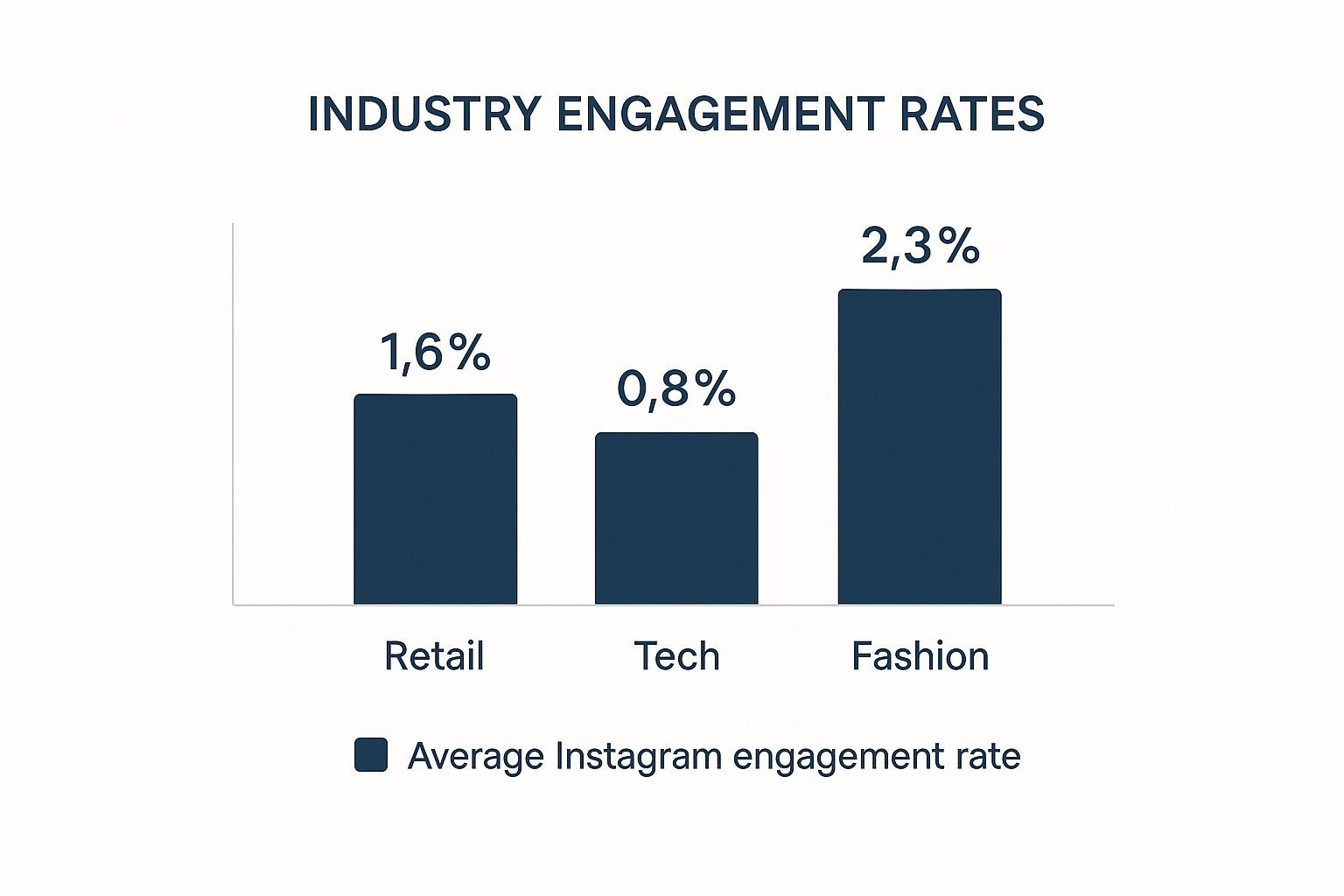
As you can see, what’s considered an average engagement rate in the Tech industry might be seen as pretty low in the Fashion world, where interactions are often much higher.
Engagement Rate By Reach
If you want a more honest look at how well a specific piece of content performed, calculating engagement by reach is your best bet. This formula measures interactions against the number of unique people who actually saw your post, not just your total follower count.
Here’s how you figure it out: (Total Engagements / Post Reach) x 100.
This formula is the ultimate truth-teller about your content's quality. It answers the most important question: "Of the people who saw this, what percentage found it interesting enough to actually do something?"
Using reach is perfect when you’re figuring out if a campaign was a hit or if a new content style truly resonated. Since reach often includes people who don't even follow you (thanks to hashtags, shares, and the Explore page), this metric is a powerful signal of how well your content travels beyond your immediate circle. If you want a quick way to run the numbers, a free influencer engagement rate calculator can handle this for you.
Engagement Rate By Impressions
Finally, you can measure engagement based on impressions. This is similar to using reach, but instead measures interactions against the total number of times your post was viewed. Because one person can see your post multiple times, your impression count will almost always be higher than your reach.
The formula is: (Total Engagements / Total Impressions) x 100.
This calculation is most useful when you want to know how "sticky" your content is. A post with high impressions compared to its reach is a great sign—it means people are coming back to look at it more than once. Think of a detailed infographic, a helpful tutorial, or a hilarious Reel. These are the kinds of posts that generate repeat views, and this formula is the best way to capture that level of interest.
So, Is Your Instagram Engagement Rate Any Good?

You’ve done the math and have your engagement rate. Now comes the big question: "What does this number actually mean?" This is where benchmarking saves the day. Without it, your engagement rate is just a number floating in a void, completely devoid of context.
Comparing your performance against industry averages tells you whether you're leading the pack, just keeping pace, or have some ground to make up. It turns an abstract percentage into a real measure of how well your content stacks up against your direct competitors.
But let’s be clear: a "good" engagement rate on Instagram isn't some universal, one-size-fits-all figure. While global averages offer a decent starting point, the real insights come from a more specific comparison that takes your unique situation into account.
What Is a Good Instagram Engagement Rate?
As a general rule of thumb, a solid engagement rate on Instagram usually falls somewhere between 1% and 5%. If you're consistently hitting numbers in that sweet spot, you're doing a great job building a healthy, interactive community. Anything above that is exceptional and signals that your content is truly resonating with your audience.
Of course, that’s just a broad guideline. Some data suggests the global average engagement rate on Instagram is around 5.86%, but this figure swings wildly depending on where you are in the world. For instance, Japan boasts rates over 11%, while North America is closer to 5.21%. You can dig deeper into these global engagement rate statistics to see just how much geography plays a role.
Ultimately, your primary goal should be to set your own internal benchmark and aim for steady improvement. Honestly, tracking your own month-over-month growth is often far more valuable than chasing a generic global average.
A good engagement rate isn't about hitting some arbitrary industry number. It's proof that your content strategy is working. It's a clear signal that you're turning followers into an active, invested community that actually cares about what you have to say.
Why Industry Averages Matter
While that universal average is a nice place to start, drilling down into industry-specific benchmarks will give you a much sharper picture. It just makes sense that different niches inspire different levels of interaction. A passionate community rallying around a nonprofit’s cause, for example, is naturally going to engage more than a B2B audience in the tech space.
Here’s a quick look at how average Instagram engagement rates can vary across different sectors:
- Nonprofit: Averages around 4.4%. This isn't surprising, as mission-driven content often inspires powerful reactions and comments.
- Education: Typically sees strong engagement at 4.2%, with institutions sharing community stories and genuinely useful information.
- Healthcare: Posts an average of 3.7%, building trust through educational content and supportive messaging.
- Technology: Generally has a lower rate, around 3.3%, which reflects a more professionally focused, less-chatty audience.
- Retail: Averages 3.0%, using eye-catching product posts and promotions to get people talking (and clicking).
These differences show why context is everything. If your clothing brand has a 3.5% rate, comparing it to the tech industry average might make you feel like a superstar. But stacking it up against the retail average of 3.0% gives you a much more realistic—and actionable—assessment of your performance.
Follower Count Changes Everything
One of the biggest factors that influences your engagement rate on Instagram is your follower count. It seems a bit backward, but it’s true: as an account’s follower base grows, its engagement rate almost always declines. This isn’t a sign of failure; it's just a natural result of scaling up.
Let's break down why this happens:
- Micro-Influencers (1K-10K Followers): These creators are the kings and queens of engagement. Their smaller, niche audiences feel a more personal connection, which leads to more genuine comments and interactions. They’re seen as peers, not distant celebrities.
- Macro-Influencers (100K-1M Followers): As the follower count climbs, the audience gets bigger and more diverse. The creator can’t possibly interact with everyone, and that intimate community connection starts to thin out, causing the rate to drop.
- Mega-Brands & Celebrities (1M+ Followers): At this massive scale, audiences are vast. While the raw number of likes and comments can be staggering, the engagement rate as a percentage of the total follower count is nearly always lower.
Understanding this reality is crucial for setting realistic goals. If you're a small business with 5,000 followers, trying to match the engagement rate of an account with 500,000 is like comparing apples to oranges. Instead, focus on nurturing the community you have. A smaller, highly engaged audience is almost always more valuable than a huge, passive one.
Understanding What Drives Your Engagement

Okay, you've calculated your numbers. Now the fun part begins: figuring out why they are what they are. Your engagement rate on Instagram isn't just a random metric; it’s a direct reflection of your content strategy. To make it better, you have to get to the bottom of what's working and what isn't.
Think of it like cooking. Your engagement rate is the final dish. The quality all comes down to your ingredients—your content format, posting schedule, hashtags, and captions. Each one plays a critical role in whether people scroll right past your post or stop to like, comment, save, or share.
Getting these elements right is how you go from just posting on Instagram to actually building a thriving community. Let’s dig into the levers you can pull to make a real difference.
The Content Format Showdown
Let's be clear: not all Instagram posts are created equal. The format you pick—a static image, a multi-slide Carousel, or a fast-paced Reel—signals something different to both your audience and the algorithm. Each one is built to encourage a different kind of interaction.
So, how do the different post types stack up against each other? The data paints a pretty interesting picture.
Average Engagement Rate by Instagram Post Type
It's clear that different content formats perform differently on average. This table breaks down what recent studies have found, giving you a baseline for what to expect from each type of post.
| Post Type | Average Engagement Rate |
|---|---|
| Photo | 2.69% |
| Video | 2.21% |
| Carousel | 1.16% |
Data sourced from a recent breakdown of engagement rates by post type on Statista.
At first glance, you might be tempted to ditch everything but single photos. But that would be a mistake. This data simply highlights that you need to be strategic and use each format for its unique strengths.
Your content format is a tool, not a rule. The goal isn't to find the one "best" format, but to use the right format to achieve a specific engagement goal, whether that's sparking conversation, encouraging saves, or maximizing reach.
Reels Versus Carousels Versus Single Images
Let's break down the unique job of each format. When you know their strengths, you can build a content calendar that’s balanced, effective, and keeps your audience hooked.
-
Single Images: This is your classic scroll-stopper. Single images are perfect for delivering one powerful message, grabbing attention with a stunning visual, or making a quick announcement. Their simplicity is their strength—they’re easy to digest and great for racking up likes.
-
Carousels: Think of Carousels as mini-guides or visual stories. The slide-through format is tailor-made for educational content, step-by-step tutorials, before-and-afters, or showing off different angles of a product. Their superpower is driving saves, a huge signal to the algorithm that your content is valuable and worth showing to more people.
-
Reels: Reels are your engine for discovery. Built for pure entertainment and reaching new people, this is your ticket to getting in front of audiences who don't follow you yet. The algorithm loves pushing Reels to the Explore page and Reels tab, making them perfect for generating comments and shares, telling brand stories, and even going viral.
Other Critical Levers for Engagement
Beyond the format, a few other crucial details can make or break your post's success. Nailing these can give your engagement rate on Instagram a serious boost.
Timing is Everything
This one is simple but so often overlooked. Posting when your audience is actually online is non-negotiable. If you share brilliant content while your followers are asleep or at work, it’s going to get lost in the feed. Dive into your Instagram Insights to pinpoint the peak days and hours your audience is most active and schedule your content around that.
Hashtags as Signposts
Stop thinking of hashtags as an afterthought. They are powerful signposts that help new, interested people find your content. The key is using a smart mix:
- Broad Hashtags: Use one or two popular tags to join a massive, ongoing conversation.
- Niche Hashtags: These are more specific to your industry or topic and connect you with a super-relevant audience that’s more likely to engage.
- Branded Hashtags: Create a unique hashtag just for your brand to collect user-generated content and build a sense of community.
Captions That Spark Conversation
Your caption is where you turn a passive scroller into an active participant. Don't just describe what's in the picture. Use that space to tell a story, ask a question, or share an opinion. A strong call-to-action—something as simple as "Tell us your favorite in the comments!"—can be the difference between a post that gets crickets and one that starts a real conversation.
Proven Strategies to Increase Your Engagement

Knowing your numbers is one thing, but actually making them grow is the real challenge. So, let’s get practical and dive into some proven tactics that will boost your engagement rate on Instagram. Think of these as small hinges that swing big doors—turning passive scrollers into a community that actively participates.
The secret behind every great strategy is a shift in mindset. You're not just posting content; you're starting conversations. This means you need to move beyond simply broadcasting your message and start creating posts that genuinely invite a response, build connections, and offer real value.
Write Captions That Demand a Response
Your caption is the most direct tool you have for sparking a conversation, but it's often treated as an afterthought. Don't just describe the photo. Use that space to ask a question, tell a compelling story, or prompt a specific action. A powerful caption can be the difference between a silent "like" and a thoughtful comment.
The trick is to have a clear call-to-action (CTA). Don't be vague and just hope people will comment—explicitly ask them to.
- Ask for opinions: "Which of these designs is your favorite? Let us know below!"
- Prompt storytelling: "This reminds us of our first office. What's a favorite memory from your first job?"
- Encourage tagging: "Tag a friend who needs to see this today!"
These simple prompts give your followers a clear path to engagement, making it easy for them to jump into the conversation. Writing strong captions is also a huge part of learning how to build a killer Instagram profile that keeps people coming back for more.
Master Interactive Instagram Stories
Instagram Stories are an engagement goldmine. They are absolutely packed with interactive features designed to get your audience involved. While your feed posts are great for polished, lasting content, Stories are perfect for those in-the-moment, low-stakes interactions that feel personal and direct.
Take advantage of the full suite of stickers that function as a direct line to your audience.
- Polls & Quizzes: These are quick, fun ways to get feedback. Ask about product preferences, test their knowledge on a niche topic, or just run a lighthearted "this or that" question.
- Question Stickers: Use this to host an "Ask Me Anything" (AMA) session. Not only does this generate a ton of interaction, but it also gives you priceless insight into what your audience really wants to know.
- Emoji Sliders: A simple slider is a super low-effort way for followers to gauge their feelings on a new idea or product. It’s easy for them, and it still counts as a valuable interaction for you.
By consistently using these features, you train your audience to interact with your content. They'll start to expect a two-way dialogue, which is the bedrock of any highly engaged community.
Run Giveaways That Build Community
A well-planned giveaway can make your engagement rate on Instagram skyrocket, but the real goal should be more than just a temporary spike. The best giveaways are structured to build a real, lasting community, not just attract people who are only there for the free stuff.
To do it right, design your entry rules to encourage meaningful interactions.
- Follow & Like: This is your standard entry requirement, the baseline.
- Comment & Tag: Ask entrants to comment on the post and tag one or two friends. This organically expands your reach to people who are probably interested in your content, too.
- Share to Stories: For a bonus entry, have participants share the giveaway post to their Story. This dramatically increases visibility and acts as a powerful social endorsement from your followers.
The key is to offer a prize that is highly relevant to your ideal follower. A generic gift card might attract a lot of people, but giving away your own product ensures you're attracting followers who will actually stick around long after the contest is over.
Embrace User-Generated Content
User-Generated Content (UGC) is the ultimate form of social proof. When you feature content created by your followers, you’re not just filling your content calendar—you're celebrating your community and showing them you see their contributions. This simple act fosters incredible loyalty.
Encourage your audience to create UGC by creating a branded hashtag and actively asking them to use it. When someone shares a post featuring your brand, ask for permission to re-post it and give them full credit in the caption. This creates a powerful feedback loop where more people are inspired to post about you, hoping for their own feature.
Despite Instagram's massive scale, recent data shows a challenging trend. The average engagement rate on Instagram has dropped to around 0.45%. However, Reels have been a major bright spot, generating significantly more engagement—especially comments—than other formats.
As you explore ways to lift your interaction levels, you might also look into strategies for using automated direct messages to boost engagement. This can be a smart way to connect with your audience at scale, as long as it’s done thoughtfully. By focusing on these authentic, community-first strategies, you can build an audience that truly cares.
Getting your engagement rate up is a great first step, but keeping it there is the real challenge. You can't just post something great and hope for the best; you have to pay attention to what's working and what isn't. It’s a constant feedback loop.
Diving into your data takes the guesswork out of your content strategy. It’s the difference between blindly creating content and strategically publishing posts you know your audience will love. Luckily, the best tool for the job is built right into the app.
Using Instagram Insights
For anyone with a Business or Creator account, Instagram Insights is your command center. This free, native tool is packed with information about who’s following you and how they’re interacting with your content. It’s the single best place to start turning numbers into a real strategy.
To access it, just go to your profile and tap the "Insights" button. You can filter by different timeframes to see your growth over time. Pay close attention to these three areas:
- Accounts Reached: This tells you how many unique people saw your content. If you see a big spike, it's a good sign that a post performed well with hashtags or hit the Explore page.
- Content Interactions: Here’s where you see the breakdown of likes, comments, saves, and shares for your posts, Stories, and Reels. It’s the nitty-gritty of engagement.
- Total Followers: Keep an eye on your follower growth and, crucially, find out the exact days and times your audience is most active.
The magic of Insights isn't just seeing the numbers; it's figuring out the story behind them. When you spot a pattern—like your behind-the-scenes Stories always getting more replies—you've found a key to making your content calendar even stronger.
Turning Data into Action
Numbers on a screen don't mean much until you do something with them. Think of every post as a small experiment. Test, learn, and repeat.
For example, let's say you post a Reel with a trending audio track and it gets triple the views of your other videos. That’s a clear signal from your audience: they want more of that. The next step is to create another Reel with a different trending sound and see if you get the same result.
This cycle of posting, analyzing, and adjusting is what drives sustainable growth. To get a deeper look into the mechanics of this process, our guide on how to measure social media engagement is a great resource that covers multiple platforms. By consistently checking what resonates, you can build a content plan that reliably boosts your engagement rate on Instagram.
Frequently Asked Questions About Instagram Engagement
It's totally normal to have questions as you start digging into your engagement rate on Instagram. Honestly, the platform is always changing, and what worked last month might not work today. Let’s clear up a few of the most common questions we hear from brands trying to crack the code.
"Help! Why Did My Instagram Engagement Suddenly Drop?"
That sinking feeling when you see your engagement numbers suddenly fall off a cliff? We've all been there. More often than not, it's not you, it's the algorithm. A sudden dip is often a sign that Instagram has tweaked something on their end.
Other common culprits include testing a new content style that just didn't land with your audience, or maybe your followers are just getting a bit of content fatigue if things have felt a little repetitive lately.
Your first move should be to open up your Instagram Insights. Put your recent posts side-by-side with your all-stars from the past few months. What’s different? Are you using a new format? Posting at a weird time? That comparison will almost always reveal the answer.
"Is It Better to Have More Followers or a Higher Engagement Rate?"
This is a big one, but the answer is surprisingly simple: engagement rate wins, hands down. A high engagement rate tells you that you have a genuinely interested and active community that actually cares about what you're posting. These are the people who will buy your products, recommend your brand, and stick with you for the long haul.
Think of it this way: a massive follower count with crickets in the comments section is like having a huge stadium full of people who are all looking at their phones. It's an empty metric. Today, brands, partners, and even Instagram itself see the engagement rate on Instagram as the real benchmark of influence and success.
"How Often Should I Bother Calculating My Engagement Rate?"
You don't need to obsess over it every single day. For a general health check on your account, running the numbers on a monthly basis is perfect. This gives you enough data to see the bigger picture and spot meaningful trends without getting bogged down by daily ups and downs.
The exception? When you're in the middle of a specific campaign or trying out a new content series. In those cases, you’ll want to calculate the engagement for those specific posts right away. It’s your fastest source of feedback to know if you've struck gold or if you need to pivot your strategy.
Ready to connect with influencers who have the engagement rates you're looking for? REACH simplifies the entire process. Find your perfect influencer match and manage campaigns seamlessly with REACH.