 Skip to content

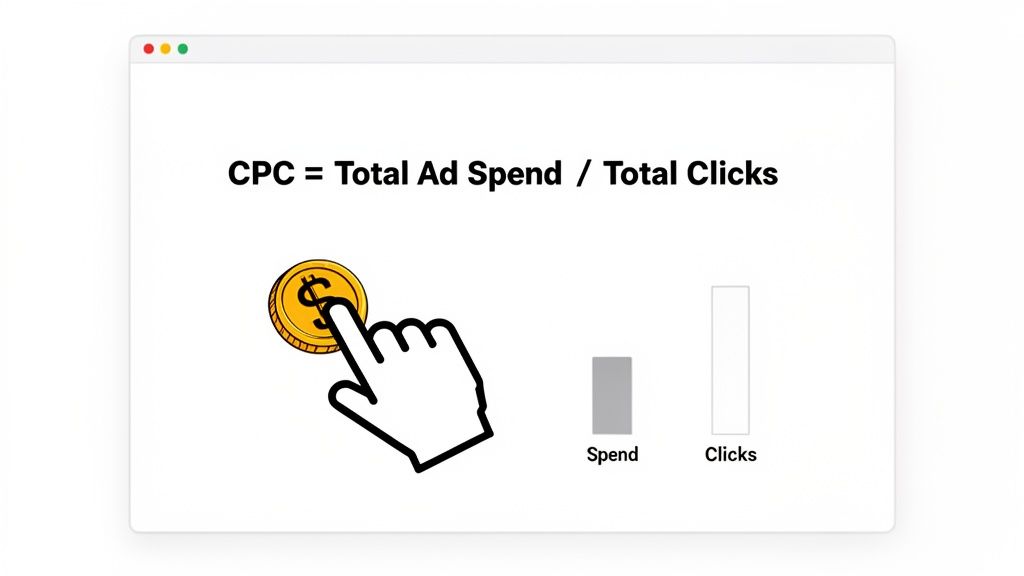
At its core, understanding how to calculate Cost Per Click (CPC) is wonderfully simple. You just take your total ad spend and divide it by the total number of clicks you received. So, if you drop $200 on a campaign and it gets 100 clicks, your CPC is $2.00.
Easy, right? This is the bedrock metric for pretty much any paid advertising you'll ever run. Learning how to calculate cost per click is the first step toward running smarter, more profitable campaigns, whether on Google or through influencer partnerships. This guide will walk you through the formulas, platform differences, and advanced strategies you need to master this essential metric.
Understanding How to Calculate Cost Per Click and Why It Matters
Let's cut right to it. Cost Per Click (CPC) is the exact price you pay for a single click on your ad. Getting a handle on this number is the first real step toward running smarter, more profitable campaigns. Think of it as your campaign's pulse—it tells you exactly how efficiently you're turning your budget into actual website traffic.
This isn't just marketing jargon, especially when you're the one managing the ad budget. A high CPC can bleed your funds dry with very little to show for it. On the flip side, a low CPC often signals fantastic efficiency and a healthy return on investment (ROI).
Knowing your CPC helps you do three critical things:
- Prove Your ROI: You can justify your marketing spend with hard numbers, not just hunches.
- Make Smarter Decisions: It becomes obvious where to allocate your budget—put the money where it performs best.
- Stop Wasting Money: You can quickly spot the expensive, underperforming ads and hit the pause button.
A Quick Guide to Calculating Basic CPC
To make it crystal clear, here’s a simple breakdown of what goes into the basic CPC calculation.
| Component | Definition | Example Value |
|---|---|---|
| Total Ad Spend | The total amount of money you spent on the ad campaign. | $200 |
| Total Clicks | The total number of times people clicked on your ad. | 100 |
| Cost Per Click (CPC) | The average cost for each of those individual clicks. | $2.00 |
This table shows the straightforward relationship between your spending and the clicks it generates, giving you that final CPC figure.
The Real-World Impact of CPC
To really get why this matters so much, it helps to understand the bigger picture of Pay-Per-Click (PPC) advertising. Every single PPC campaign, whether it’s on Google, Meta, or TikTok, lives and dies by its CPC.
And the cost of that click is always changing. Back in the first quarter of 2017, the average CPC for a search ad was about $0.50. Fast forward to Q1 2024, and that same click now costs around $0.62—that’s a 24% jump, mostly because the competition is just so much fiercer these days.
CPC is more than a metric; it’s a direct measure of your campaign's health. Tracking it helps you connect your ad spend to tangible actions, ensuring every dollar works toward your business goals.
Simplifying CPC for Complex Campaigns
Calculating CPC for a single ad is one thing. But what happens when you’re running a massive influencer marketing campaign with dozens of creators? Trying to manually track clicks and costs across every partner is a recipe for headaches and errors.
This is exactly where a top influencer marketing platform like REACH Influencers saves the day. It gives you a single dashboard with real-time analytics, automatically crunching the CPC for each influencer and the entire campaign. That kind of clarity lets you spot your top performers and tweak your strategy without missing a beat.
Of course, CPC is just one piece of the puzzle. To get the full picture of your marketing effectiveness, you’ll want to look at a related metric. Check out our guide on the https://reach-influencers.com/customer-acquisition-cost-calculation/ to see how it all fits together.
Getting to Grips With How to Calculate Cost Per Click Formulas
Alright, you've got the basic definition down. Now, let's get our hands dirty and talk about what really matters for your budget and campaign performance: the two core formulas you'll actually use. We're talking about Average CPC and Maximum CPC.
Think of them as two sides of the same coin. One tells you what you’re currently paying for a click, and the other tells you the absolute most you should ever pay for one. Mastering both is key to making sure your ad spend is actually making you money, not just noise.
Figuring Out Your Average CPC
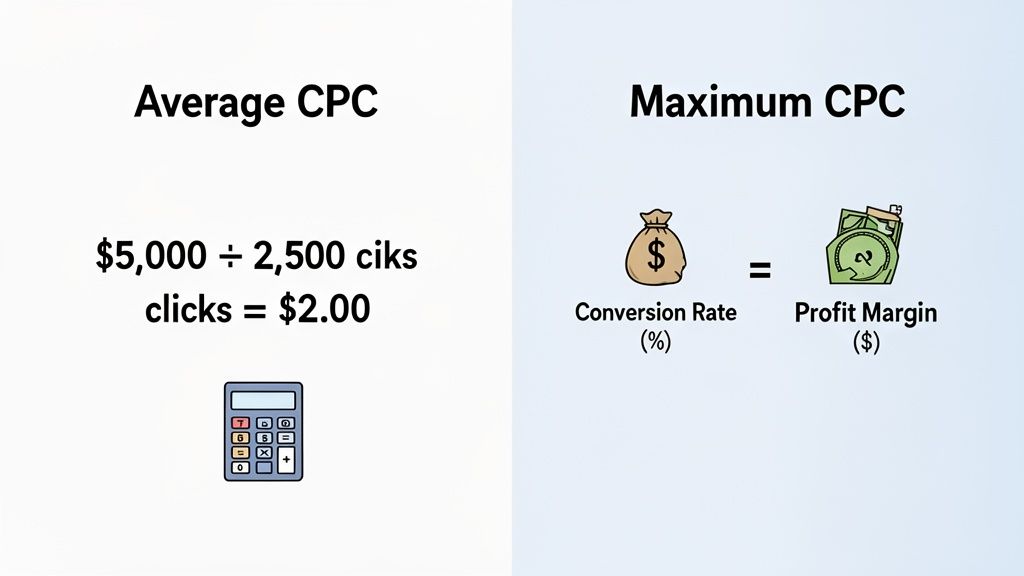
First up is the formula most of us know. It’s the simple, straightforward way to see the blended cost of a click across your whole campaign. You just take what you spent and divide it by the clicks you got.
Average CPC = Total Cost of Campaign / Total Number of Clicks
Let’s put this into a real-world context. Imagine a direct-to-consumer brand teams up with five influencers on the REACH Influencers platform to push a new product line. The whole collaboration costs them $5,000, and the campaign links bring in a grand total of 2,500 clicks.
Here’s the math:
- $5,000 (Total Cost) / 2,500 (Total Clicks) = $2.00 Average CPC
Simple. This tells the brand they paid, on average, $2.00 for every person who clicked through to their website. It's a quick and essential pulse check on your campaign's efficiency. And while you're digging into click-based costs, it's always a good idea to understand how impression-based metrics work, too. For that, check out our guide on the calculation of CPM (Cost Per Mille).
Finding Your Maximum CPC
Knowing your average CPC is one thing, but knowing your maximum profitable CPC is where you really start to get strategic. This formula is your secret weapon for figuring out the highest bid you can place before you start losing money on every single sale.
This one has a few more moving parts, but it’s worth it:
- Average Profit Per Conversion: The actual profit you pocket from a sale.
- Website Conversion Rate: The percentage of visitors who actually buy something.
The formula itself looks like this:
Maximum CPC = (Average Profit Per Conversion) x (Website Conversion Rate)
Let’s stick with our example. Say your product sells for $100 and your profit margin is 40%, which means you make $40 profit on each sale. You also know that your website typically converts 5% of its visitors into paying customers.
Let's plug those numbers in:
- $40 (Profit) x 0.05 (Conversion Rate) = $2.00 Maximum CPC
What does this tell you? It means you can afford to pay up to $2.00 for a single click and still break even on that customer's first purchase. If you bid any higher, you’re officially paying more to get a customer than you’re making from them.
Pro Tip: Whatever you do, don't set your starting bid at your Maximum CPC. That's your ceiling, not your floor. I always recommend using your past campaign data to set an initial bid somewhere around 50-75% of your max. This builds in a nice profit buffer and gives you wiggle room to optimize as the data rolls in.
How CPC Works on Different Platforms
Clicks aren't all the same. A click from a Google Search ad comes from someone actively looking for an answer, which is a world away from someone casually tapping on an influencer's TikTok video. Because the user's intent is so different, the cost and value of that click change dramatically depending on where it came from.
While the basic formula—Total Cost / Total Clicks—is universal, the context is everything. You have to know what a "good" CPC looks like on each channel to figure out if you're getting a great deal or just burning cash.
Search Ads (Google, Bing)
Calculating CPC on search engine platforms like Google Ads is pretty direct. The entire system is built around the CPC model, so the metric is front and center in your dashboard. Here, a click represents a user with high intent—they're literally typing in a problem you can solve.
This high intent is why search CPCs tend to be higher. For a competitive term, you might see a CPC of $2.50 or more. It sounds pricey, but these clicks often have a much better chance of converting into a sale. The ad platform handles the math for you, so your job is to focus on bidding smartly on keywords that bring in profitable customers.
Social Media Ads
On platforms like Instagram, Facebook, and TikTok, you're playing a different game. People are there to scroll, not to search. Your ad has to grab their attention and interrupt their flow, which means the intent behind a click is usually lower.
This "discovery" environment typically leads to a lower cost per click. Back in October 2021, Facebook's average CPC was around $1.72, while Instagram ads hovered between $0.70 and $1.00. Fast forward to 2024, and you'll see wild swings, especially during peak seasons. For instance, Facebook CPCs can bounce between $0.62 and $1.21 during the holidays. You can dig into more of these social media advertising stats on Statista.com.
A $0.75 CPC from a TikTok campaign might look fantastic on paper, but you have to make sure those clicks are actually turning into something valuable. It’s all about finding that sweet spot between a low cost and a high-quality audience.
To give you a better sense of where your campaigns might land, here’s a quick look at typical CPC ranges across the major players.
Average CPC Benchmarks by Platform
It's helpful to have a baseline when you're planning your budget. These numbers are just averages and can swing based on your industry, audience, and creative, but they provide a solid starting point for what to expect.
| Platform | Average CPC Range | Best For |
|---|---|---|
| Google Search Ads | $1.00 – $4.00+ | High-intent users, lead generation, direct sales. |
| Facebook Ads | $0.50 – $2.00 | Broad audience reach, community building, retargeting. |
| Instagram Ads | $0.70 – $2.50 | Visually-driven products, brand awareness, e-commerce. |
| LinkedIn Ads | $4.00 – $8.00+ | B2B marketing, professional services, high-ticket sales. |
| TikTok Ads | $0.25 – $1.00 | Gen Z and Millennial audiences, viral content, brand trends. |
| Pinterest Ads | $0.50 – $1.50 | E-commerce, DIY, visual discovery, long-term planning. |
Remember, the goal isn't just to find the cheapest click. The "best" platform is the one that delivers clicks that actually convert for your specific business.
Influencer Marketing Campaigns
Now for the tricky one: influencer marketing. There's no ad platform to spit out a CPC for you. Instead, you're typically paying an influencer a flat fee for a collaboration, which means you have to do the math yourself. This manual step is crucial for understanding your true ROI.
Let’s walk through a real-world example:
- The Campaign: A skincare brand pays an influencer $1,000 for a set of three Instagram Stories to promote a new serum.
- The Tracking: The brand gives the influencer a custom, trackable link (like a Bitly link or a URL with UTM parameters) to use in their Stories.
- The Results: That link gets 800 clicks while the campaign is live.
Here’s how the calculation works out:
$1,000 (Influencer Fee) / 800 (Total Clicks) = $1.25 CPC
Just like that, the brand knows they paid $1.25 for every single person the influencer sent their way. It’s a clean, powerful metric.
But what happens when you're working with ten or twenty influencers at once? Trying to calculate a blended CPC by manually wrangling a dozen spreadsheets is a complete headache.
This is where a dedicated platform like REACH Influencers saves the day. Instead of juggling countless links and data points, the REACH dashboard automatically pulls in the click data from all your creators in one place. It calculates a blended, real-time CPC for your entire campaign, letting you see exactly which influencers are driving traffic most efficiently—no spreadsheets required.
Advanced Factors That Influence Your CPC
If you think knowing how to calculate Cost Per Click is as simple as dividing total cost by total clicks, you're only seeing the tip of the iceberg. That basic formula gives you a number, sure, but it doesn't tell you the whole story.
Several other factors are quietly shaping your real CPC and the actual value you squeeze out of every dollar spent. Getting a handle on these is what separates the pros from the rookies. It’s how you go from just tracking CPC to actively managing it for better results.
Beyond the Basic Math: Quality Score
On platforms like Google Ads, your bid is just one piece of the puzzle. The real MVP is your Quality Score. Think of it as Google's rating for how relevant and helpful your keywords, ad copy, and landing page are to someone searching.
When you have a high Quality Score, Google rewards you. You can snag a better ad position and pay a lower CPC, even if your competitors are bidding higher. An ad with a stellar 10/10 Quality Score might get a 50% discount on its CPC. On the flip side, a poor score of 1/10 could see costs skyrocket by up to 400%.
It's Google's way of encouraging advertisers to create genuinely useful ads, not just outbid everyone else.
The Role of Click Attribution
Another piece of the puzzle is your click attribution model. This is simply the rule you use to decide which ad or touchpoint gets the credit for a sale.
Are you using a first-click model, where the very first ad a customer ever clicked gets all the glory? Or a last-click model, where the final ad they saw right before buying gets the credit? Your choice here dramatically changes how you value each click. A first-click model will make your awareness campaigns look like rockstars, while a last-click model will heavily favor your retargeting ads.
Neither one is inherently wrong, but you have to know which one you're using and how it's coloring your perception of what’s working. The chart below shows just how different the average CPC can be across platforms, which makes attribution even more critical.
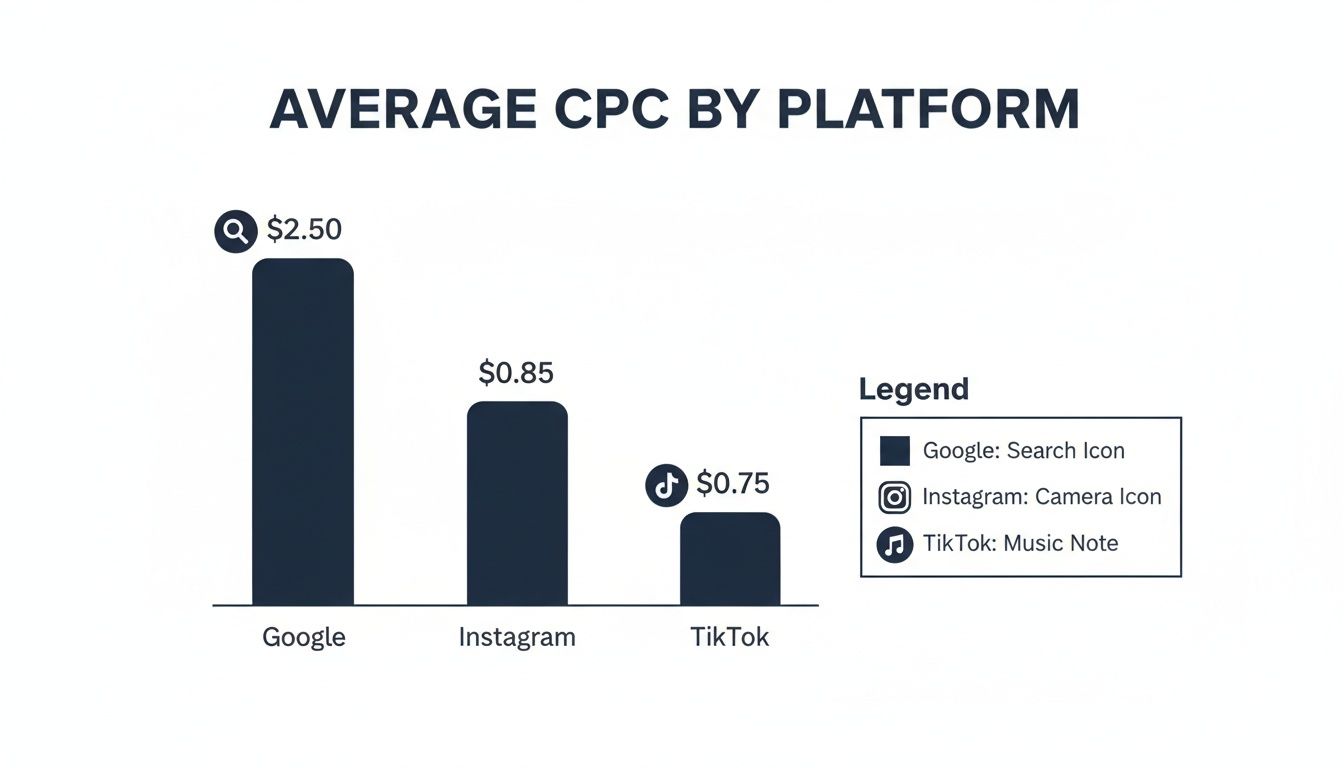
This is exactly why a blended attribution model often makes the most sense. It helps you give fair credit to high-cost, high-intent platforms like Google while still valuing lower-cost discovery channels.
Dealing With Invalid Clicks
Let's be honest: not every click comes from a real person who wants to buy your product. Invalid clicks, whether from bots or other shady activity, can seriously inflate your numbers and drain your budget. Ad platforms have systems to filter and refund these, but they don't catch everything.
This is especially important in influencer marketing. Using a platform like REACH Influencers adds a much-needed layer of verification. Its analytics help you see if you're getting clicks from real, interested followers or just a bunch of bots. This ensures your CPC reflects genuine engagement, not just noise.
Ultimately, CPC is just one part of a bigger performance picture. To see how it connects to the next level, you should dive into what is cost per acquisition.
Actionable Strategies to Reduce Your CPC
Knowing your Cost Per Click is the first step, but the real work starts when you try to lower it. Every dollar you can shave off your CPC is another dollar you can put back into your campaigns to get more traffic, more leads, and ultimately, more sales. This isn't just about chasing cheap clicks; it’s about making every penny of your ad spend work harder for you.
Let's get into some proven strategies that brands, agencies, and creators can use right away. These aren't just theories—they're practical tips to help you turn expensive campaigns into profit-driving machines.
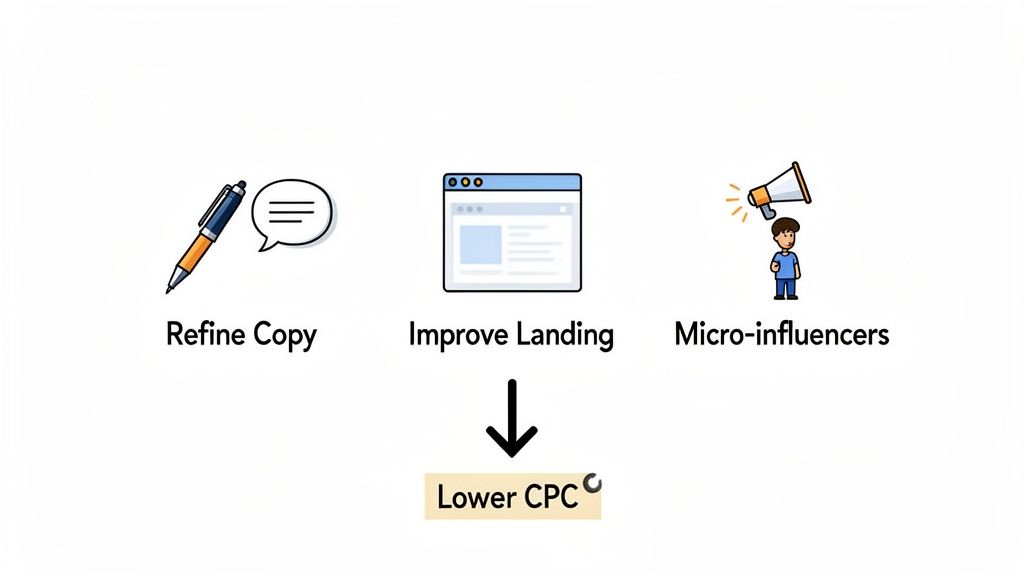
Strategies for Brands
If you're managing marketing in-house for a brand, the name of the game is relevance. The closer your ad and landing page match what a user is looking for, the lower your CPC will be. Simple as that.
- Refine Your Ad Copy: Your ads need to speak directly to your audience’s problems and desires. A/B test your headlines, descriptions, and calls-to-action (CTAs) relentlessly to find out what clicks. A higher Click-Through Rate (CTR) is a strong signal to ad platforms, often leading to a better Quality Score and a lower CPC.
- Improve the Landing Page Experience: Does your landing page deliver on the promise made in your ad? It needs to be a seamless transition. A relevant, fast-loading, and mobile-friendly page is no longer optional. Google and other platforms reward advertisers who provide a great user experience with lower ad costs.
These elements are central to effective PPC campaign management. A well-run campaign is always testing and tweaking these variables to improve performance.
How Agencies Can Lower CPC
For agencies managing multiple clients, efficiency is everything. One of the most powerful levers you can pull right now is tapping into niche influencers. They often deliver incredible engagement without the massive price tag of a macro-influencer.
This is where a tool like REACH Influencers can be a total game-changer. Agencies can use its discovery tools to pinpoint micro-influencers in very specific markets. These creators have built deep trust with their hyper-engaged audiences, which translates into higher-quality clicks at a much lower CPC.
By building a portfolio of these influencers, agencies can drive fantastic results for clients without blowing up the budget. The REACH dashboard simplifies everything by letting you track the blended CPC across all your creators, making it easy to prove the ROI of this targeted strategy.
Understanding why CPCs vary so much by industry is key to setting realistic expectations. The average Google Search CPC is $2.69, but in healthcare, advertisers might shell out $4.71—over 125% more. Meanwhile, real estate is closer to $2.10. This context is crucial when you're talking numbers with clients.
Tips for Creators to Drive Clicks
As a creator, you have a superpower: authenticity. Your personal connection with your audience is your best asset for driving clicks that actually convert.
- Craft Authentic Content: Don't just post an ad—tell a story. Show your followers how a product genuinely fits into your life. People follow you for your unique perspective, and authentic content will always perform better than a generic sales pitch.
- Use Clear and Compelling CTAs: Be direct. Tell your audience exactly what you want them to do next. Whether it's "Swipe up to see my review" or "Hit the link in my bio for a special discount," a clear instruction removes any guesswork and encourages action. This boosts your click-through rates and makes you a much more valuable partner for brands.
Answering Your Top CPC Questions
Even with the formulas down, a few questions always seem to pop up when it's time to actually calculate cost per click. Let's tackle some of the most common ones I hear from brands and agencies.
What Is a Good Cost Per Click?
This is the million-dollar question, and the honest answer is: it depends. A "good" CPC is completely relative to your industry, your profit margins, and the ad platform you're on.
For example, a $5.00 CPC could be an absolute bargain for a law firm trying to land a single case worth tens of thousands of dollars. But for an e-commerce store selling t-shirts with a $10 profit margin? That same $5.00 CPC would put them out of business fast.
The only true measure of a good CPC is whether or not it's profitable. Instead of getting hung up on the raw cost, shift your focus to the return. If the cost to acquire a customer is less than what that customer is worth to you, then you've found a good CPC.
How Is CPC Different from CPM?
It’s easy to mix these two up, but they measure fundamentally different things and are used for very different campaign goals.
-
CPC (Cost Per Click): You pay when someone takes action and clicks your ad. This is your go-to model for campaigns where the goal is a specific action, like driving sales, generating leads, or getting sign-ups.
-
CPM (Cost Per Mille): You pay a set price for every 1,000 times your ad is shown (an "impression"). Clicks don't matter here. This model is built for brand awareness campaigns where your main objective is just getting as many eyeballs on your ad as possible.
Think of it this way: CPC is for action, CPM is for attention.
Can I Calculate CPC for Influencers Without a Tool?
You can, but it's a messy, manual process that I wouldn't recommend. You’d have to give every single influencer a unique tracking link, like one from Bitly, and then manually pull the click data for each one. From there, you'd divide their fee by the clicks they drove.
The problem? It’s incredibly time-consuming, prone to human error, and gives you zero real-time insight. Comparing performance across a dozen creators becomes a spreadsheet nightmare.
This is exactly why purpose-built platforms exist.
A tool like REACH handles all of this automatically. It generates unique links, tracks every click from every creator in real-time, and calculates the effective CPC right in your dashboard. You get clean, reliable data to prove ROI without ever having to build a VLOOKUP formula again.
Ready to stop guessing and start measuring your influencer marketing ROI with precision? Now that you know how to calculate cost per click, it's time to automate the process. REACH Influencers provides the tools you need to track every click, calculate your CPC automatically, and optimize your campaigns for maximum profitability. Discover how REACH can transform your influencer strategy today.