 Skip to content


Learning how to find influencer partnerships that actually grow your business is one of the most powerful marketing skills you can develop. It's a common mistake to just jump onto TikTok or Instagram and start looking for popular accounts. That’s like going grocery shopping without a list—you'll end up with a cart full of stuff, but probably not what you actually need to make a meal.
The most successful influencer partnerships are built on a solid foundation. You need a clear blueprint of what success looks like for your brand first. This means getting specific about your goals, knowing exactly who you're trying to reach, and figuring out what you can realistically spend. While manual searching has its place, top-tier brands use advanced influencer marketing platforms like REACH Influencers to accelerate discovery, vetting, and management, turning a manual chore into a strategic advantage.
Table of Contents
- Defining Your Ideal Influencer Before You Search
- Smart Ways for How to Find Influencer Partners
- How to Vet Influencers and Avoid Red Flags
- Crafting Outreach That Actually Gets a Response
- Measuring Your Campaign and Proving ROI
- Still Have Questions About Finding Influencers?
Defining Your Ideal Influencer Before You Search
Let's move past vague goals like "more brand awareness." That kind of thinking leads to fuzzy, unmeasurable results. To do this right, you need to set sharp, concrete goals that will guide your search and, later on, tell you if the campaign actually worked.
Setting Sharp Campaign Goals
What do you really want to achieve with this campaign? Are you trying to sell a specific product, or are you hoping to grow your email list before a big launch? Each of these goals calls for a completely different kind of influencer and content strategy.
Your goals have to be specific and measurable. For example:
- Sales: Generate 200 sales of our new skincare line using a unique discount code within 30 days.
- Lead Generation: Get 1,000 new email subscribers for our weekly newsletter through a link in the influencer's bio.
- User-Generated Content (UGC): Collect 50 high-quality photos and videos from a campaign hashtag that we can reuse in our own marketing.
When you have precise targets like these, it becomes so much easier to spot the influencers whose content and audience are a natural fit for what you're trying to do. This simple infographic breaks down these crucial first steps.
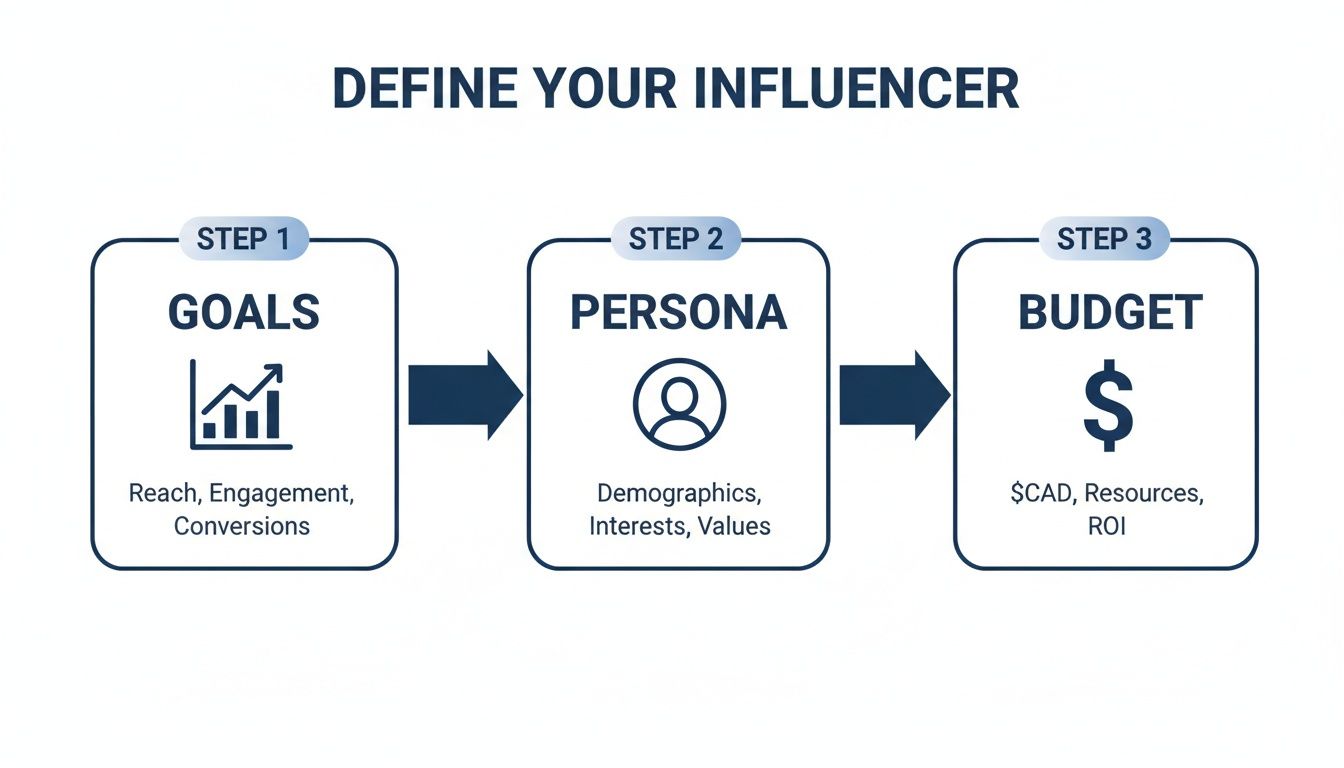
As you can see, nailing down your goals, persona, and budget is a foundational process. It makes sure your search is strategic from the get-go.
Creating a Detailed Audience Persona
With your goals in place, the next question is: who are you trying to talk to? It's not enough to just know their age and location. You have to go deeper and understand their interests, values, online habits, and what problems they're trying to solve.
The better you understand your target customer, the easier it becomes to recognize the influencers they already trust. An influencer is simply a proxy for the audience you want to reach.
Think about where your ideal customers hang out online. Are they binging long-form tutorials on YouTube, saving aesthetic inspiration on Pinterest, or consuming quick tips on TikTok? The platform they love will point you directly to the right type of creator. If you need help with this, you can learn more by checking out our guide on how to create buyer personas. Getting this clarity means you won't waste time vetting influencers whose followers will never become your customers.
Mapping Out a Realistic Budget
Finally, let's talk money. Your budget will pretty much decide the tier of influencers you can work with, from nano-influencers with small but mighty communities to macro-influencers with huge followings. And don't believe the myth that you need a massive budget to see results—you absolutely don't.
When planning your budget, think about:
- Compensation Model: Will you pay a flat fee? Offer a commission on sales? Just send free products (product seeding)? Or maybe a mix of these?
- Influencer Tier: For campaigns focused on driving sales, nano and micro-influencers often deliver a much better ROI because their audiences are so engaged.
- Campaign Scope: The cost will change depending on what you're asking for. A single Reel is much cheaper than a full package with five Stories and a static post.
Having a clear budget from the start keeps you from overspending and helps you make smarter decisions. By setting your goals, defining your audience, and establishing a budget upfront, you turn what could be a random hunt into a precise, strategic mission.
Smart Ways for How to Find Influencer Partners
Alright, you’ve got your campaign goals mapped out and know exactly who you’re trying to reach. Now for the fun part: finding the right influencers to partner with.
The old way of doing this—endless scrolling through Instagram feeds hoping for a lucky break—just doesn't cut it anymore. It’s a massive time sink, and frankly, it’s a shot in the dark.
While manual digging has its place, you can’t rely on it alone. Sure, checking hashtags and seeing who your competitors are working with can give you a starting point, but it's only scratching the surface. You won't get the deep audience data you need to make a smart, informed decision.
Getting Started with Manual Search Tactics
Look, most brands dip their toes into influencer marketing by searching manually. It's free and seems straightforward, so it's a natural place to begin. Here's what that usually looks like.
- Hashtag Research: You start by searching for tags relevant to your industry. Think #sustainablefashion, #veganrecipes, or #homegymsetup. This shows you who is creating content and driving conversations in your niche.
- Competitor Analysis: This is a classic move for a reason. Check out which influencers your competitors are tagging in their posts. It’s a quick way to find creators who are already trusted and effective in your space.
These methods can unearth a few potential candidates, but they hit a wall pretty quickly. You have no real way to filter by audience demographics, check for fake followers, or manage outreach efficiently. It’s more guesswork than strategy.
Why Manual Searching Doesn't Scale
The hard truth is that finding influencers by hand is a slow, painful process that simply won't work as your brand grows. Influencer marketing isn't a small niche anymore—a staggering 86% of marketers are investing in it. To get ahead, you need to be more precise and efficient than just scrolling through a feed.
The real challenge isn't just finding an influencer; it's finding the right one whose audience genuinely aligns with your brand. Manual searching often mistakes follower counts for influence, which is a costly error.
This is where data becomes your best friend. For instance, nano-influencers (1,000 to 10,000 followers) now make up 76% of all influencers on Instagram. They also pull in the highest engagement rate at 2.19%, blowing mega-influencers out of the water. You’ll never find these hidden gems without a proper tool.
The Power of Influencer Discovery Platforms
This is where a dedicated platform like REACH Influencers completely changes the game. Instead of spending days sifting through profiles, you can find your ideal partners in minutes with laser-focused, data-driven searches.
With a platform, you’re no longer guessing. You’re filtering a massive database of creators using criteria that actually matter to your bottom line.
Using a tool like REACH, you can search by:
- Specific Niche: Find experts in anything from rock climbing to gluten-free baking.
- Audience Demographics: Target creators whose followers match your ideal customer by age, location, gender, and interests.
- Engagement Rate: Instantly spot influencers with genuinely active communities, not just vanity metrics.
- Location: Pinpoint creators in specific cities or countries for geo-targeted campaigns.
A data-backed approach shifts your discovery process from a game of chance to a strategic advantage. It also pairs perfectly with other advanced tactics. For example, by using social listening for influencer discovery, you can identify creators who are already talking about your brand organically.
Let's break down the practical differences.
Comparing Manual Search vs The REACH Platform
| Feature | Manual Search (Instagram, TikTok) | REACH Platform |
|---|---|---|
| Search Efficiency | Hours or days of scrolling; very slow | Minutes to generate a targeted list |
| Audience Data | None; pure guesswork on follower demographics | Full breakdown of audience age, gender, location, & interests |
| Vetting Quality | Relies on surface-level metrics (likes, comments) | In-depth analytics, fraud detection, and past performance |
| Scalability | Not scalable; difficult to manage more than a few searches | Easily scalable for large, multi-faceted campaigns |
| Contact Info | Hit-or-miss; have to hunt for emails in bios | Verified contact information provided for easy outreach |
As you can see, the difference is night and day.
Platforms like REACH don't just find influencers faster; they give you the verified data you need to vet them with confidence. You get access to historical performance, audience authenticity scores, and a list of past brand collaborations. This is how you confidently find both authentic micro-creators and established talent, setting your campaigns up for success from day one.
How to Vet Influencers and Avoid Red Flags
You've got a list of potential influencers, which is a great start. But now comes the most important part of the whole process: figuring out who is the real deal and who isn't. This is where you protect your budget and give your campaign a fighting chance. It’s time to look past the big follower numbers and get into the data that actually moves the needle.
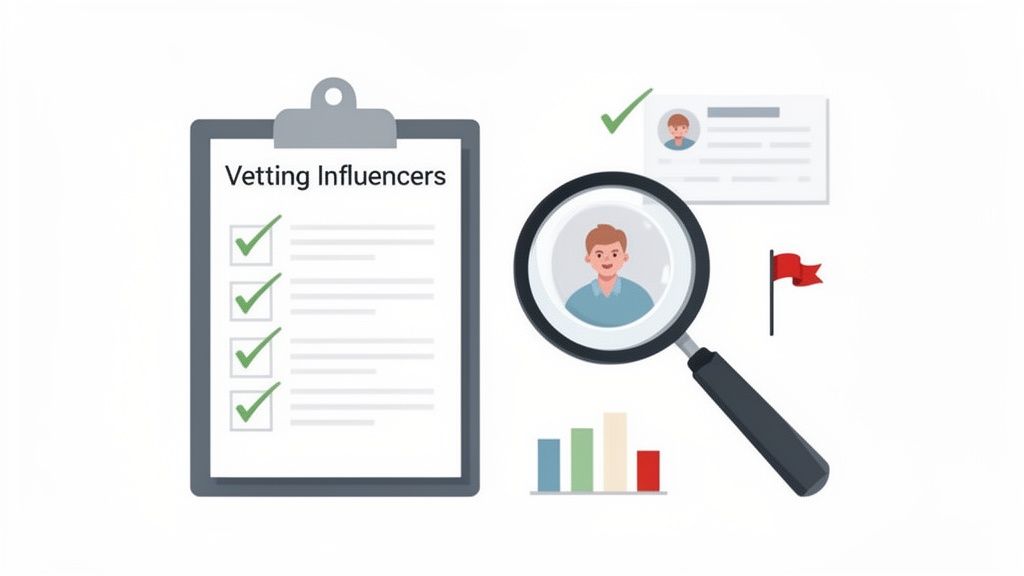
Let's be blunt: a huge following means nothing if it’s full of bots and ghost accounts. Influencer fraud is a massive problem, and if you fall for it, you'll burn through your money with nothing to show for it. That's why a rock-solid vetting process isn't just a "nice-to-have"—it's essential.
Analyzing the Metrics That Actually Matter
First things first, we need to stop obsessing over follower counts. They’re mostly for show. Think about it: a profile with 500,000 followers but a pathetic 0.5% engagement rate is way less valuable than an account with 15,000 followers and a solid 4% engagement rate. That smaller, fired-up community will always deliver better results.
The data backs this up. Nano-influencers, who make up a staggering 76% of all creators on Instagram, pull in an average 2.19% engagement rate—the highest of any group. In a market that’s already worth $24 billion and climbing, smart brands are focusing on quality over quantity.
So, what should you be looking at instead?
- Authentic Engagement Rate: Don't just count likes. Are people leaving real, thoughtful comments? Are they sharing the post? A wall of generic "Great post!" comments or emoji-only replies is a huge red flag for bought engagement.
- Audience Quality Score: Tools like REACH Influencers offer this metric, which is a lifesaver. It scans an influencer's audience for bots, inactive profiles, and other suspicious accounts, giving you a clear picture of who you're really paying to reach.
- Follower Growth Consistency: You want to see a steady, natural upward trend. Giant, overnight spikes in followers almost always mean they were bought. A healthy account grows organically over time.
Spotting the Telltale Signs of Fraud
Learning to spot a fake influencer is a skill you have to develop. The fraudsters are getting smarter, but they still leave clues if you know what to look for.
The biggest giveaway is a massive gap between their follower count and their actual engagement. If an account has 100,000 followers but each post only gets 50 likes and a few generic comments, something is very wrong. It’s a classic sign that their audience is either fake or totally dormant. It's also worth getting good at spotting images of fake people, as AI-generated personas are becoming more common.
A quick pro-tip: Don't let a verified blue checkmark fool you. It just means they're a notable public figure, not that their audience is real or engaged. You still have to do your homework.
Trying to check all of this by hand is a nightmare. This is where a good platform really proves its worth. For instance, you can run a profile through REACH's fake follower checker for an instant analysis. It does the heavy lifting so you can make decisions based on solid data, not just a gut feeling.
Doing a Content and Brand Alignment Audit
Okay, so the numbers look good. The audience is real. But there’s one last, crucial check: are they actually the right fit for your brand? This calls for a quick and simple content audit.
Scroll through their feed for the last few months and ask yourself a few questions:
- Does their tone match ours? If your brand is all about high-energy fun, a creator with a super serious, academic vibe is just going to feel weird.
- Are their values aligned with ours? Take a look at the other brands they work with and the causes they talk about. You don't want any nasty surprises or brand conflicts down the road.
- Is the quality there? Are their photos, videos, and captions up to your brand’s standards?
This is the stage where you transform that long list of potentials into a tight, curated shortlist of A-list partners. By mixing data-driven checks with a good old-fashioned content review, you can be confident that you’re reaching out to authentic creators who will genuinely connect with your audience.
Crafting Outreach That Actually Gets a Response
Alright, you’ve put in the work. You’ve vetted your list and have a handful of creators who feel like a perfect match for your brand. This next step is where the magic happens—or where you get lost in a sea of unread emails.
How you reach out is just as critical as who you reach out to. A generic, copy-paste message is a one-way ticket to the trash folder. I've seen it happen countless times.
Think about it from their perspective. Experienced influencers get dozens, sometimes hundreds, of pitches every single day. To cut through that noise, your outreach needs to be personal, professional, and get straight to the point. It’s your chance to show them you’ve done your homework and see them as a partner, not just another name on a spreadsheet.
The Anatomy of a Winning Pitch
A great pitch has three key ingredients: it shows you genuinely appreciate their work, clearly explains what you’re trying to achieve, and offers them something of real value. Think of it less like a sales pitch and more like starting a conversation.
Here’s a simple breakdown of what to include:
- A Personal Opener: Start with a real, specific compliment. Mention a recent post, video, or story that you actually enjoyed. "I loved your recent video on sustainable coffee brands" is a thousand times better than "I love your content." This instantly proves you’re not a bot.
- A Clear "Why": Briefly introduce your brand and explain why they are the perfect fit. Connect the dots for them. How does their audience or content style align with your brand’s mission?
- The Value Proposition: Be upfront about what's in it for them. Is this a paid collaboration? A generous product package? Mentioning compensation from the start shows you respect their time and profession.
This first email is your first impression. To make sure your messages land the right way, it's worth brushing up on some essential email communication best practices. A little professionalism goes a long way.
Navigating Negotiations Like a Pro
So, you got a reply! Great. Now the negotiation begins. Remember, this isn't about haggling for the lowest price. It's about finding a fair exchange of value that makes both sides excited to work together. The goal is a true partnership, not a one-off transaction.
During this stage, you need to get everything on the table. Be ready to talk about:
- Compensation: This could be a flat fee, free products (product seeding), an affiliate commission, or a mix of all three. Be flexible here; what works for one creator might not work for another.
- Deliverables: Be crystal clear about what you need. Don’t just say "a post." Specify exactly what you're looking for, like one Instagram Reel, three Stories with a link sticker, and one dedicated blog post.
- Usage Rights: This is a big one. Define how and where you can use their content. Can you repurpose it on your own social channels? In your email newsletter? For paid ads? Granting broader usage rights will almost always increase the cost.
Always remember you're negotiating with a creative professional. Approaching the conversation with respect and transparency is the fastest path to building a strong relationship that pays off for everyone in the long run.
Streamlining Communication and Contracts
Once you start working with more than a few influencers, things can get chaotic fast. Juggling different email threads, tracking down contracts, and approving content via DMs is a recipe for disaster. It’s inefficient and leaves a lot of room for error.
This is exactly where a centralized platform becomes a game-changer for any brand that’s serious about growing its influencer program.
The REACH Influencers platform, for instance, is built to solve this exact headache. It pulls all your campaign management and communication into one clean, organized dashboard.
Instead of drowning in emails, you can:
- Centralize All Communication: Every message, from the first pitch to the final content approval, lives in one thread tied directly to that influencer's profile. No more searching through your inbox.
- Automate Contracts and Payments: Use pre-built contract templates and handle all payments securely through the platform. This protects you and the creator.
- Approve Content Seamlessly: Influencers can submit drafts right in the dashboard. You can leave feedback and give the green light in a clear, documented way.
Managing the entire workflow in one place doesn't just save you a ton of time; it creates a much more professional and seamless experience for your partners. That efficiency is the secret to learning how to find influencer campaigns you can actually scale.
Measuring Your Campaign and Proving ROI
Your campaign is officially live. The content is out there, and your influencers are connecting with their communities. It’s an exciting moment, for sure, but the work is far from over. Now comes the most important part: connecting all that creative energy to real business results.
Launching a campaign without a solid measurement plan is like driving in the dark without headlights. You might be moving, but you have no real idea where you're heading or if you're even on the right road. This is the moment to pull out those specific KPIs you set from the very beginning and see how everything is performing in the wild.
Tracking the KPIs That Actually Prove Your Value
Vanity metrics like likes and views are nice to look at, but they don't directly impact your bottom line. To really show the value of your influencer program, you have to track the data that ties directly back to your business goals. This is how you prove to stakeholders that the investment is paying off.
Fortunately, there are a few simple and effective ways to attribute results directly to your influencer campaigns.
-
UTM Parameters for Web Traffic: These are just small bits of code added to a URL. By giving each influencer a unique UTM link, you can jump into Google Analytics and see exactly how many people clicked through and what they did on your website. It's a crystal-clear view of the traffic they're driving.
-
Unique Discount Codes for Sales: This is probably the easiest and most direct way to track sales. Just give each influencer their own unique code (like "ANNA15"). Every time that code is used at checkout, you know precisely who to thank for the sale.
-
Social Listening for Brand Sentiment: Beyond the hard numbers, you need to understand how the conversation around your brand is shifting. Social listening tools help you monitor mentions, gauge sentiment, and see if the influencer’s content is creating the positive buzz you were hoping for.
These methods turn abstract goals like "improving brand awareness" into concrete data you can use to build a powerful performance report.
The Power of Pilot Campaigns
Before you commit a big chunk of your budget to a new influencer, it’s always a good idea to run a smaller test. A pilot campaign is your low-risk way of finding out if a creator can actually deliver the goods. Think of it as a trial run that gives you real-world data on their performance, professionalism, and audience engagement.
This approach lets you test a handful of different creators at once without breaking the bank. You get to see whose audience responds best to your product and, just as importantly, who is easiest to work with. It's basically an audition. The top performers can then be brought on for larger, long-term partnerships with much more confidence.
Running a pilot campaign is the smartest way to spend your budget. It swaps guesswork for data, making sure you only double down on the partnerships that have already proven their worth.
Using a Platform to Simplify Measurement
The influencer marketing industry is growing fast—it’s projected to hit $32.55 billion. As the industry has grown, so has the scale of campaigns. In fact, 73.2% of brands now work with 10 or more influencers at a time, which makes trying to track everything by hand a nightmare. With over 6,900 service companies in the space, platforms are no longer a luxury; they're essential. You can dig into the full research on influencer marketing benchmarks to see just how big this has all gotten.
This is where a platform like REACH becomes your command center. It’s designed to handle all the messy details of tracking and reporting, freeing you up to focus on strategy instead of getting lost in spreadsheets.
REACH gives you real-time analytics, so you get an immediate snapshot of your campaign’s health. Clicks, conversions, engagement rates—it's all there in one straightforward dashboard. This lets you monitor what’s working, what isn't, and even tweak things while the campaign is still live.
For agencies and consultants, the ability to generate white-labeled reports is a huge win. You can create professional, data-packed reports with your own branding to show clients and stakeholders, clearly proving the ROI of your efforts. That level of transparency and proof is how you build trust and secure bigger budgets for the future. It turns your performance data into your most valuable asset.
Still Have Questions About Finding Influencers?
Even with a solid plan, jumping into influencer discovery can feel a little daunting. Let's tackle some of the most common questions that pop up when marketers are building their programs from the ground up.
What's the Single Biggest Mistake to Avoid?
Without a doubt, it’s chasing follower counts instead of focusing on true audience alignment. A massive following means nothing if those people aren't your ideal customers or if the engagement is all bots and fluff.
Always, always dig deeper. Prioritize the quality of an influencer's audience and their genuine engagement metrics over a flashy follower number.
The real value of an influencer isn't their follower count; it's the trust they've built with their community. Focusing on vanity metrics ignores the very thing that makes this marketing channel so powerful.
This is where having verified data is a game-changer. Tools like REACH Influencers help you look past the surface and find partners who can connect you with an authentic, relevant audience—the kind that actually drives results.
How Much Should I Actually Budget to Pay an Influencer?
There’s no magic number here. Influencer compensation is all over the map and really depends on their follower count, engagement rates, industry niche, and exactly what you're asking them to do.
As a very general starting point, micro-influencers (10k-100k followers) might charge anywhere from $100 to $500 per post. Once you get into macro-influencer territory, that number can easily jump into the thousands. Don't forget that many creators are also open to product-only collaborations or affiliate deals. The best strategy is to be flexible, have crystal-clear deliverables, and negotiate a partnership that both you and the creator feel good about.
Should I Work with Nano or Macro Influencers?
This one comes down entirely to your campaign goals. What are you trying to accomplish?
- Nano-influencers (1k-10k) and micro-influencers (10k-100k) are absolute powerhouses for driving conversions and building trust. They tend to have sky-high engagement rates and super-loyal, niche audiences.
- Macro-influencers (100k-1M+) are your go-to for massive brand awareness campaigns. If your main objective is simply to get your name in front of as many eyeballs as possible, this is where you'll want to play.
Honestly, the most effective strategies often blend different tiers. You can use a handful of micro-influencers to drive targeted sales while a macro-influencer provides that broader visibility.
How Many Influencers Do I Need for One Campaign?
There isn't a single correct answer, but the trend is definitely leaning towards "more is more." The data is pretty clear: over 73% of brands now work with 10 or more influencers per campaign to really amplify their message and impact.
If you're just getting your feet wet, starting with 3-5 carefully chosen micro-influencers is a fantastic way to test the waters. It's manageable and gives you enough data to see what's working. Once you start to scale, using a platform becomes almost non-negotiable for managing all those relationships and tracking performance without losing your mind.
Mastering how to find influencer partners is the key to unlocking scalable growth. Instead of guessing, it's time to use a data-driven approach. REACH Influencers provides the tools you need to discover, vet, and manage your campaigns with confidence, ensuring every partnership delivers real results. Schedule a demo today and see how our platform can supercharge your influencer marketing.