 Skip to content

You're probably in one of two situations right now. Either you've already run creator campaigns in other cities and assumed Los Angeles would be a bigger version of the same process, or you've started outreach in LA and found out very quickly that volume doesn't equal traction.
A Los Angeles influencer campaign breaks when the plan is too generic. The city is dense with creators, but it's also split into tight cultural pockets, platform-native scenes, and neighborhood-specific aesthetics that don't travel well unless the brief fits the audience. What works in a broad national campaign often lands flat in LA because the creator may be local, but the content isn't actually rooted in Los Angeles life.
That's why the useful question isn't “Who has followers in LA?” It's “Who has credibility in a specific part of LA, with a specific audience, for this specific offer?” Once you operate that way, discovery gets cleaner, vetting gets harder, outreach gets more professional, and performance gets easier to defend.
Why a Standard Influencer Strategy Fails in LA
Most failed LA campaigns start with a bad assumption. Brands treat Los Angeles like one market when it behaves more like a stack of adjacent micro-markets.
A creator posting from Silver Lake doesn't necessarily translate to Venice. A wellness-heavy Santa Monica audience won't always respond to the same framing as a fashion-first West Hollywood audience. If your brief says “share your lifestyle” and nothing more, you're asking the creator to do the strategic work you should've already done.
Coverage of influencer culture in LA often focuses on visibility, but the more useful operating insight is that local culture and geography shape creator strategy. LA creators often lean on recognizable neighborhoods, venues, and aesthetics instead of broad lifestyle content, which matters directly for campaign planning, as noted in this look at how LA culture shapes influencer behavior.
LA punishes lazy targeting
The city is mature enough that creators can spot weak briefs immediately. They know when a brand is blasting the same email to every “lifestyle” creator in town. They also know when a marketer has confused local relevance with ZIP code proximity.
That's why standard tactics fail:
- Broad creator categories miss subculture fit. “Food creator” is too wide when one account is built around Arts District openings and another is built around family dining in the Valley.
- Generic references signal low effort. Mentioning “love your content” won't work when the creator receives similar notes all week.
- National briefs flatten local nuance. If the campaign ignores neighborhood cues, venue norms, or LA-specific routines, the content feels imported.
Practical rule: In Los Angeles, relevance is usually more local than demographic.
What actually works
A strong LA campaign starts narrower than many expect. Build around local context first, then expand creator count later if the signal is there.
That means defining:
- The audience pocket you want, not just age or interest.
- The local scenes where that audience already pays attention.
- The kind of proof that would make the creator's endorsement believable.
If the audience can't tell why this creator would naturally talk about your product in their version of Los Angeles, the partnership usually underperforms.
Finding Your Niche Los Angeles Influencer
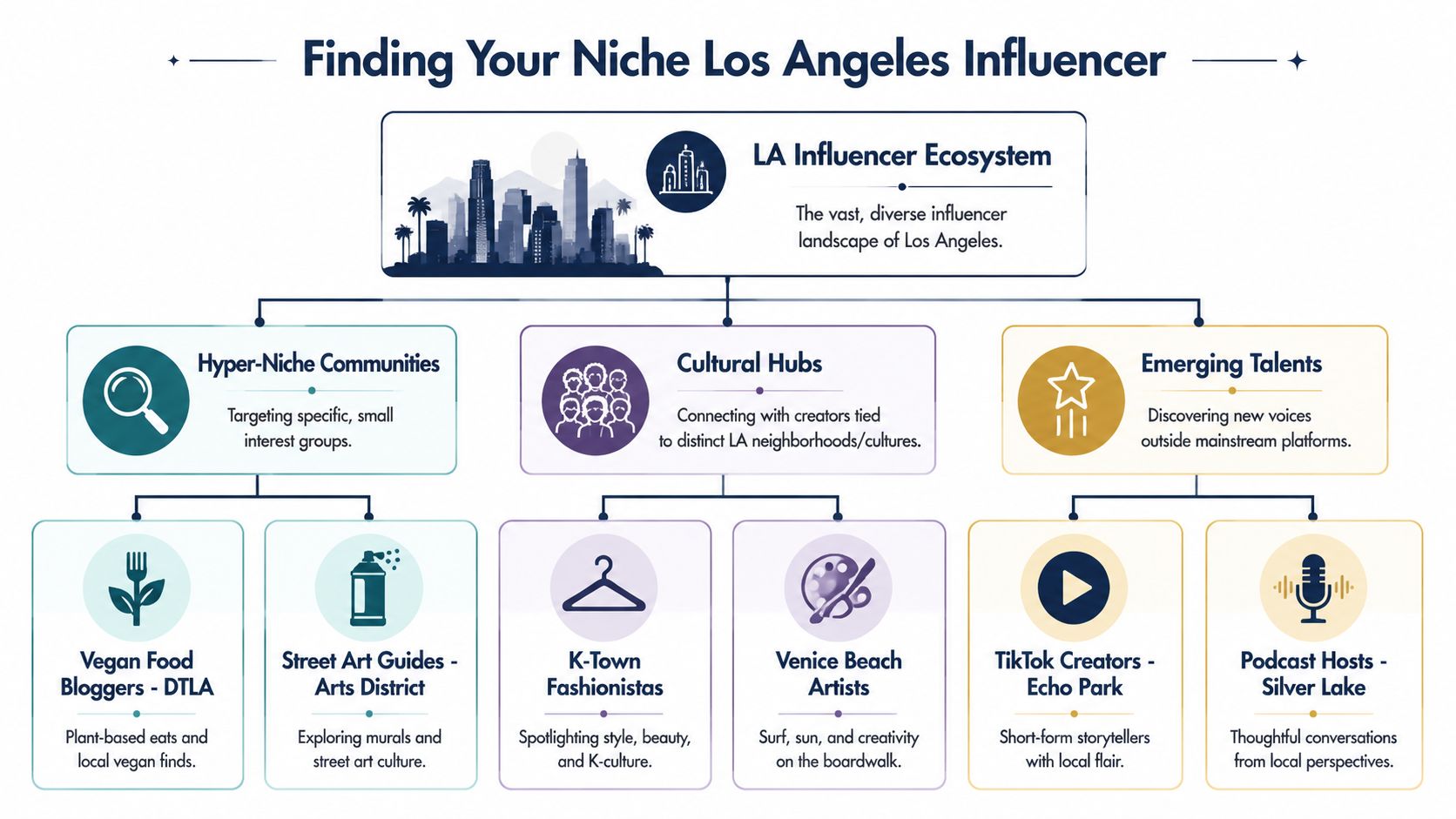
A discovery list for LA shouldn't start with follower count. It should start with a map.
Los Angeles is one of the largest creator-economy hubs in the United States. A 2026 snapshot from Sprout Social shows top local creators reaching massive scale, including Adam Rose with 3,730,214,330 total views, 190 posts, and 18.45% engagement, plus FootDocDana with 947,557,376 total views, 128 posts, and 8.29% engagement in the local market snapshot at Sprout Social's Los Angeles influencer directory. That scale is real, but it's not the first filter you should use.
Look for embedded creators, not residents
There's a big difference between a creator who lives in LA and a Los Angeles influencer whose content is woven into the city's routines.
The second group usually shows consistent signals:
- repeated use of the same neighborhoods, venues, or local references
- comments from people who clearly know the area
- content that makes sense only if you understand the local setting
- collaborations with other creators in the same scene
A macro creator can still be a fit. But if the campaign depends on local trust, embeddedness matters more than reach alone.
Build your list from the ground up
I'd build an LA creator list in layers instead of one giant scrape.
Start with place-based signals:
- Geotags that repeat. Look at restaurants, workout studios, markets, trails, galleries, and retail spaces tied to the audience you want.
- Follower overlap. Check who follows, comments on, and appears alongside local businesses and niche creators.
- Content clusters. Save creators into groups like Eastside food, coastal wellness, downtown arts, Korean beauty, sneaker culture, family activities, or nightlife.
Then pressure test each list with a simple question: could this creator make an LA-specific version of our message without forcing it?
If you need a wider starting pool before narrowing, SponsorRadar has a useful roundup to find LA's best influencers. It's not a substitute for vetting, but it helps surface categories and names you may not have captured yet.
Useful LA creator archetypes
These aren't hard categories. They're practical shortcuts.
The neighborhood-native creator
This creator's value comes from local trust. Their content often revolves around where to go, what's opening, and what feels current in a specific part of the city.
Best for brands that need local discovery and foot traffic logic.
The scene translator
This creator sits inside a niche and explains it in a way outsiders can still follow. Think fashion, music, food, wellness, cars, nightlife, or creative work.
Best for products that need context, not just exposure.
The aspiration-local hybrid
This creator has polished lifestyle content, but their authority still comes from recognizable LA references and routines.
Best for brands that want scale without losing location signal.
A good LA creator doesn't just show the city. They help the audience place themselves inside it.
Vetting Creators for Authentic Audience and Impact
Once the shortlist is built, the important work starts. Discovery in LA is easy. Vetting is where campaigns are won or wasted.
The most useful benchmark I've seen for a major-market campaign is audience authenticity. Expert guidance for influencer campaigns recommends targeting at least 70% real people in the audience, because the rest can include other creators or low-value accounts that don't convert efficiently, as explained in this audience authenticity guidance.
The checklist I'd use before spending a dollar
In Los Angeles, inflated numbers are expensive because rates rise fast once a creator looks established. If the audience quality is weak, overpaying happens quickly.
| Metric | Target Benchmark | Why It Matters in LA |
|---|---|---|
| Audience authenticity | At least 70% real people | High-rate markets punish wasted spend. This filters out low-value audiences before negotiation. |
| Comment quality | Qualitative review | Real local audiences leave specific comments, not generic praise or repetitive emoji strings. |
| Local content fit | Qualitative review | A creator should show consistent LA context if local credibility is part of the campaign. |
| Brand alignment | Qualitative review | In a crowded market, forced product integration gets ignored fast. |
| Posting consistency | Qualitative review | Reliable delivery matters when multiple creators and deadlines are involved. |
For a deeper read on spotting suspicious engagement patterns, this guide to vetting influencer authenticity is a solid companion to manual review.
What to inspect manually
I don't trust dashboards alone here. You need to read the account.
Check the comments on recent posts. Are people responding to the actual content, the location, the recommendation, the outfit, the restaurant, the joke? Or are they dropping vague praise that could appear on any account?
Then look at story behavior and partnership fit:
- Does sponsored content feel natural?
- Does the audience keep responding when a brand appears?
- Does the creator change voice when they're paid?
A healthy audience usually looks uneven in a normal way. Some posts hit hard. Others don't. That's fine. What worries me is artificial consistency, flat reactions, or engagement that doesn't match content quality.
Don't pay LA rates for a creator whose strongest audience is other creators watching each other.
Use hard filters before negotiation
Before you discuss scope or pricing, screen for audience quality, content reliability, and delivery discipline. If you skip that order, you'll negotiate based on vanity.
If your team needs a practical way to spot inflated audience signals early, REACH has a useful reference on fake subscriber count checks. It's a good reminder that follower totals don't tell you who's reachable.
Crafting Outreach That Secures Top LA Talent
Los Angeles creators don't ignore outreach because they're difficult. They ignore it because most outreach is sloppy.
The market has matured, budgets have risen, and creators have more ways to collaborate. A 2026 Los Angeles Times report said average reported annual influencer marketing budgets in Los Angeles rose 171% year over year, and it also highlighted Pearpop, a Los Angeles-based collaboration network built to help creators and brands work together more easily in a market where direct audience relationships matter more, according to the Los Angeles Times report on LA creator-economy trends. That means your message isn't competing only against other brands. It's competing against better-structured opportunities.
What weak outreach looks like
Most bad messages fail in one of three ways.
They're too broad. They sound automated. Or they ask for too much before establishing why the creator should care.
If you want to work with established LA talent, write like you're approaching a creative professional, not filling a slot in a spreadsheet.
A better outreach structure
Use a short email, not a rambling pitch deck in paragraph form.
- Lead with specific relevance. Mention a recent post, recurring content theme, or local angle that connects to your campaign.
- State the fit clearly. Say why this creator, for this product, for this audience.
- Keep the ask simple. Initial outreach should aim for interest, not full legal review.
- Show operational competence. Creators respond better when the process sounds organized.
A simple starting template works well:
Subject: Partnership idea tied to your LA content
Hi [Name],
I'm reaching out because your content around [specific neighborhood, format, or recurring theme] feels like a strong fit for [brand/product]. We're planning a campaign focused on [audience or use case], and your style of [reference to actual content approach] stands out.
We'd love to explore a paid partnership built around [brief concept]. If you're interested, I can send a concise scope covering deliverables, timing, and usage terms.
Thanks,
[Name]
A more polished outreach process also helps your internal team. If you need examples to tighten your first message, REACH has a helpful set of influencer outreach email templates.
One useful reference on outreach quality and relationship-building is below.
How to negotiate without damaging the fit
Don't open by pushing the rate down before clarifying scope. In LA, that often kills momentum with creators who have options.
Negotiate the package, not just the fee:
- deliverables
- timeline
- revision limits
- paid usage rights
- exclusivity
- whitelisting or boosting terms
That approach is cleaner because both sides can trade value without turning the conversation into a one-line price dispute.
Running Your Campaign with a Central Command Center
The easiest way to lose control of an LA campaign is to manage it through inboxes, notes apps, and disconnected spreadsheets. That might hold for a tiny test. It breaks once multiple creators, approvals, deadlines, and usage questions start moving at once.
I prefer to think of campaign operations like a production calendar. You need one place to hold the brief, communication, deliverables, approvals, and status updates. Otherwise the team spends more time reconciling information than running the campaign.
What clean execution looks like
A typical workflow is straightforward when it's centralized.
The team creates a brief with the product angle, audience, usage expectations, and content guardrails. Creators are invited into one workspace. Deliverables are visible by platform. Approvals happen in sequence. Payment status isn't buried in a finance thread. Everyone sees the same version of the campaign.
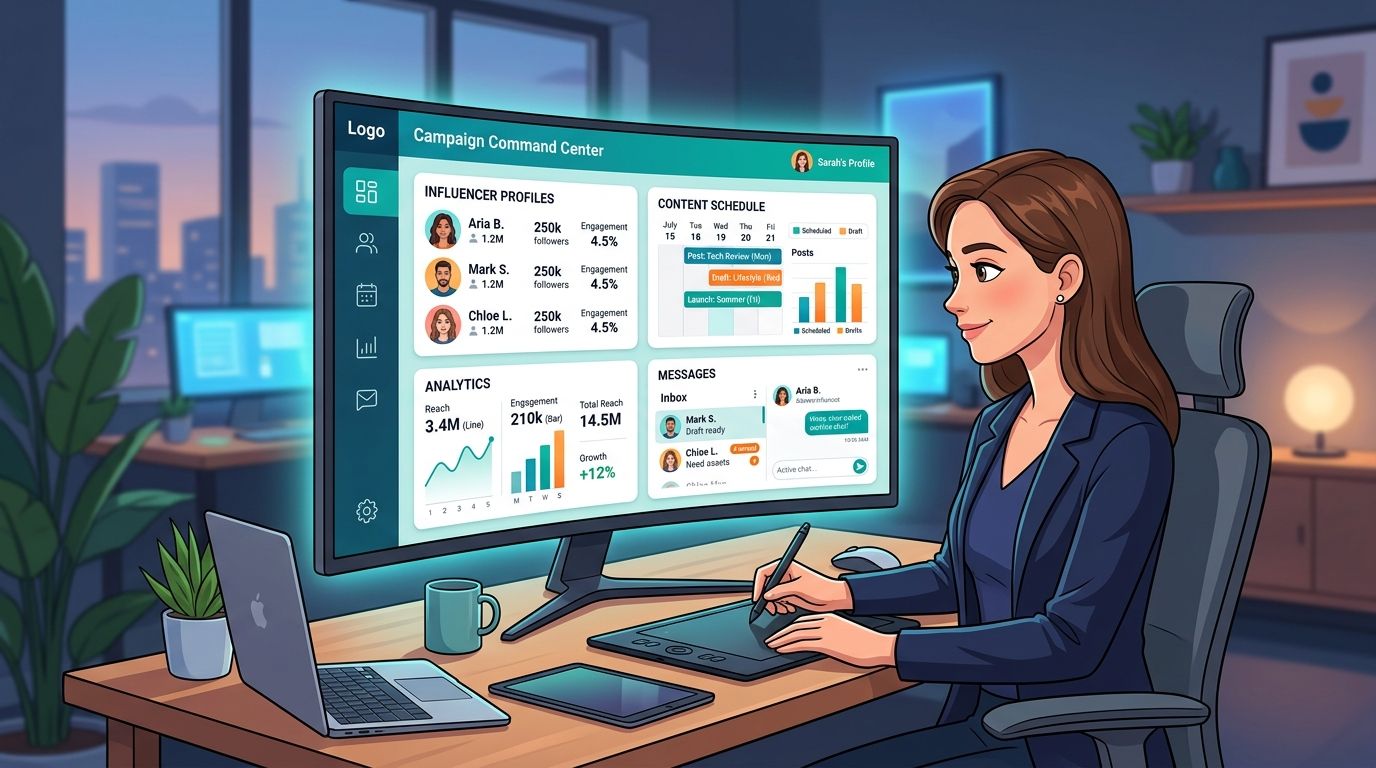
That's especially important in Los Angeles because campaigns here often involve creators with very different content styles and turnaround expectations. One creator may move fast on TikTok concepts. Another may need more structure for Instagram approvals. If the system can't handle both, the campaign drifts.
The operational gaps that cause most delays
The breakdowns are usually boring. That's why teams miss them.
- Brief drift. The creator saw one version, the strategist discussed another, and legal approved a third.
- Approval lag. Feedback lives in email, DMs, and comments across files.
- Missing deliverable status. Someone assumes a post is live when it's still awaiting changes.
- Payment confusion. Finance is waiting on details no one collected up front.
The campaign doesn't fail because the concept was weak. It fails because nobody could tell what was approved, due, or outstanding.
Why dashboard-first management matters
For teams experimenting with AI-assisted workflow design, this comprehensive guide to AI for fashion is useful because it shows how operators are using AI tools to tighten production and marketing systems, not just generate content.
That same principle applies here. Centralization matters more than novelty. If your team can open one workspace and see creator status, content status, communication, and reporting inputs together, you reduce preventable campaign errors.
A useful example of that setup is a dedicated social media dashboard for influencer campaign management. The main benefit isn't convenience. It's fewer missed handoffs.
Contracts Payments and Measuring True ROI
Contracts and reporting often get treated like cleanup work. In practice, they shape campaign quality from the beginning.
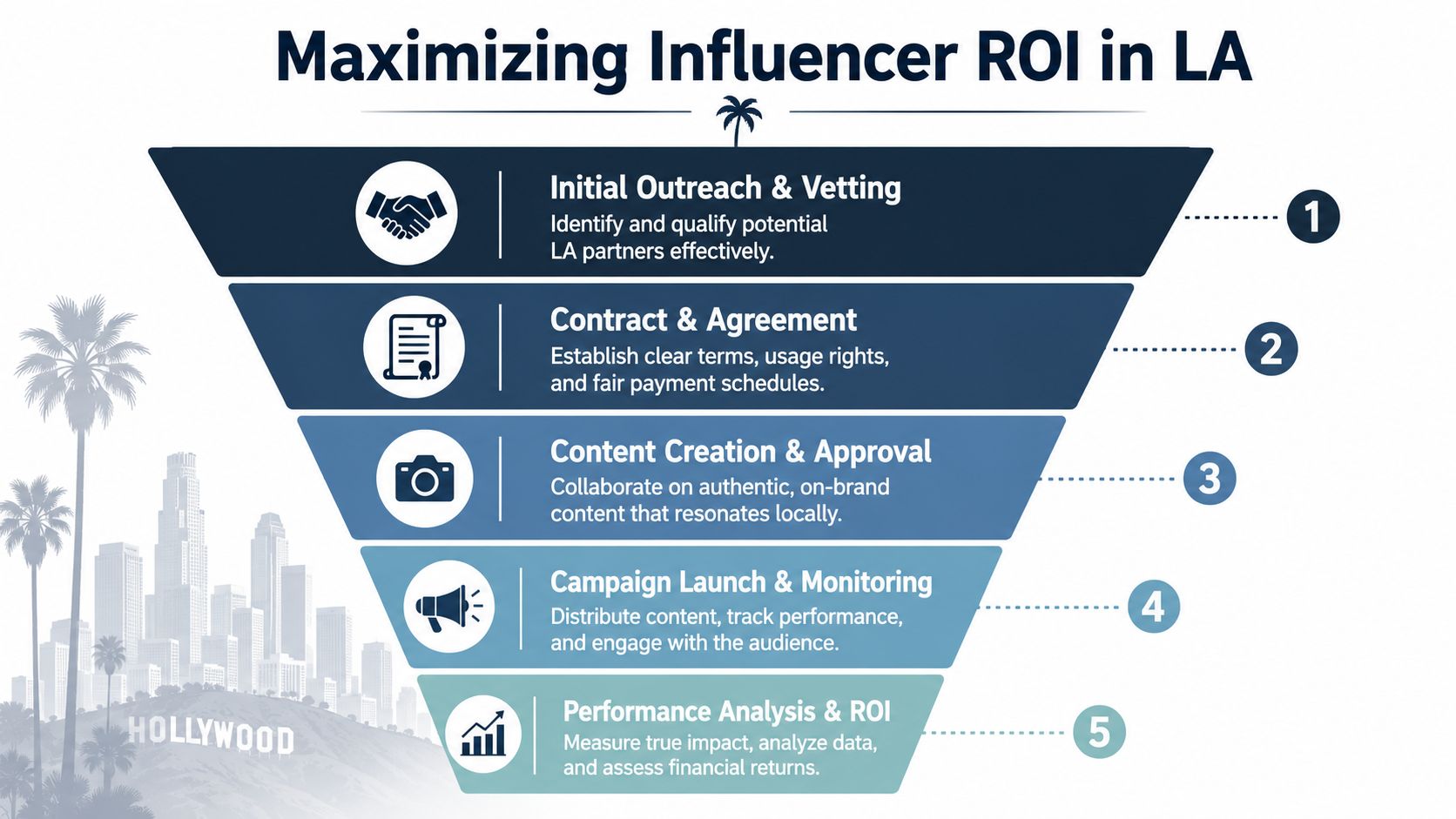
A clean creator agreement should spell out the deliverables, timeline, approval process, usage rights, payment terms, and any exclusivity restrictions. If those terms stay vague, small misunderstandings turn into expensive ones fast.
Measure performance like an operator
The strongest workflow doesn't rely on one vanity metric. It combines reach, impressions, engagement rate, CTR, and conversion rate with unique tracking links, promo codes, or an isolated product test, as outlined in this guide to measuring influencer success. The same guide notes that promotional posts can drive about 34% higher engagement than sponsored posts, and that first-person language can add about +3 percentage points to engagement. That's useful because it turns briefing and message framing into measurable decisions.
What the end-of-campaign review should answer
Don't end with a screenshot of likes and views. End with decisions.
- Which creator fit best for the audience and offer
- Which message framing worked best
- Which format held attention and drove clicks or conversions
- Which rights and payment terms are worth repeating next time
If you do that consistently, each Los Angeles influencer campaign becomes easier to price, brief, and scale.
If you want a simpler way to run creator campaigns without losing control of outreach, approvals, deliverables, payments, and reporting, take a look at REACH. It's built for the part of influencer marketing that usually gets messy after discovery, and it gives brands and agencies one place to manage campaigns from first brief to final payment.