 Skip to content

Think of a creative brief as the ultimate translation tool. It takes high-level business goals and turns them into a clear, actionable roadmap your creative team can actually use. The whole point is to ask the right questions before anyone starts designing, writing, or filming, making sure everyone is chasing the same definition of success.
Why a Solid Creative Brief Is Your Most Valuable Tool
Let's be real for a moment. Most projects that go sideways do so because of a flimsy or nonexistent brief. This isn't just about filling out a form; a truly great creative brief is the strategic compass for the entire project. It becomes the single source of truth that gets your team, your client, and your creatives all on the same page from the very beginning.
When you nail the brief, you sidestep those endless, soul-crushing revision cycles and ensure the final work genuinely solves the business problem you started with. It's a critical piece of any content marketing strategy, serving as the specific blueprint for each creative execution.
Fuel Creativity, Don't Restrict It
There's this common myth that a detailed brief suffocates creativity. I've found the exact opposite to be true. A clear, insightful brief doesn't hand creatives a paint-by-numbers kit; it provides the rich context and sharp focus they need to come up with breakthrough ideas. It’s about defining the sandbox, which paradoxically gives them the freedom to play more effectively within it.
A great brief is an invitation to solve a problem, not a set of instructions to follow. It provides the "what" and the "why," leaving the "how" to the creative experts.
Taking the time for this foundational step is what separates a project that meanders aimlessly from one that hits the target with precision and impact.
Aligning Teams in a Massive Industry
The need for this kind of clarity is only amplified when you consider the sheer scale of the creative world. The global creative economy was valued at around USD 2.2 trillion in 2023, with over 50 million people employed in the sector.
With digital media growing at a jaw-dropping 20% annually, the ability of a well-written brief to align diverse, multidisciplinary teams has never been more essential. If you want to dive deeper, you can find more insights about the creative industry's growth on wifitalents.com.
Anatomy of a Brief That Actually Works
A great creative brief is so much more than a simple checklist or a list of demands. Think of it as the strategic story of your project. Each section should flow into the next, building a complete picture that gives your creative team the context and clarity they need to knock it out of the park.
At its heart, a strong brief answers the big, foundational questions right up front. It needs to lay out the project's backstory, establish a clear, measurable business goal, and paint a super-vivid picture of the person you're trying to reach.
This is what it looks like when all the pieces come together.
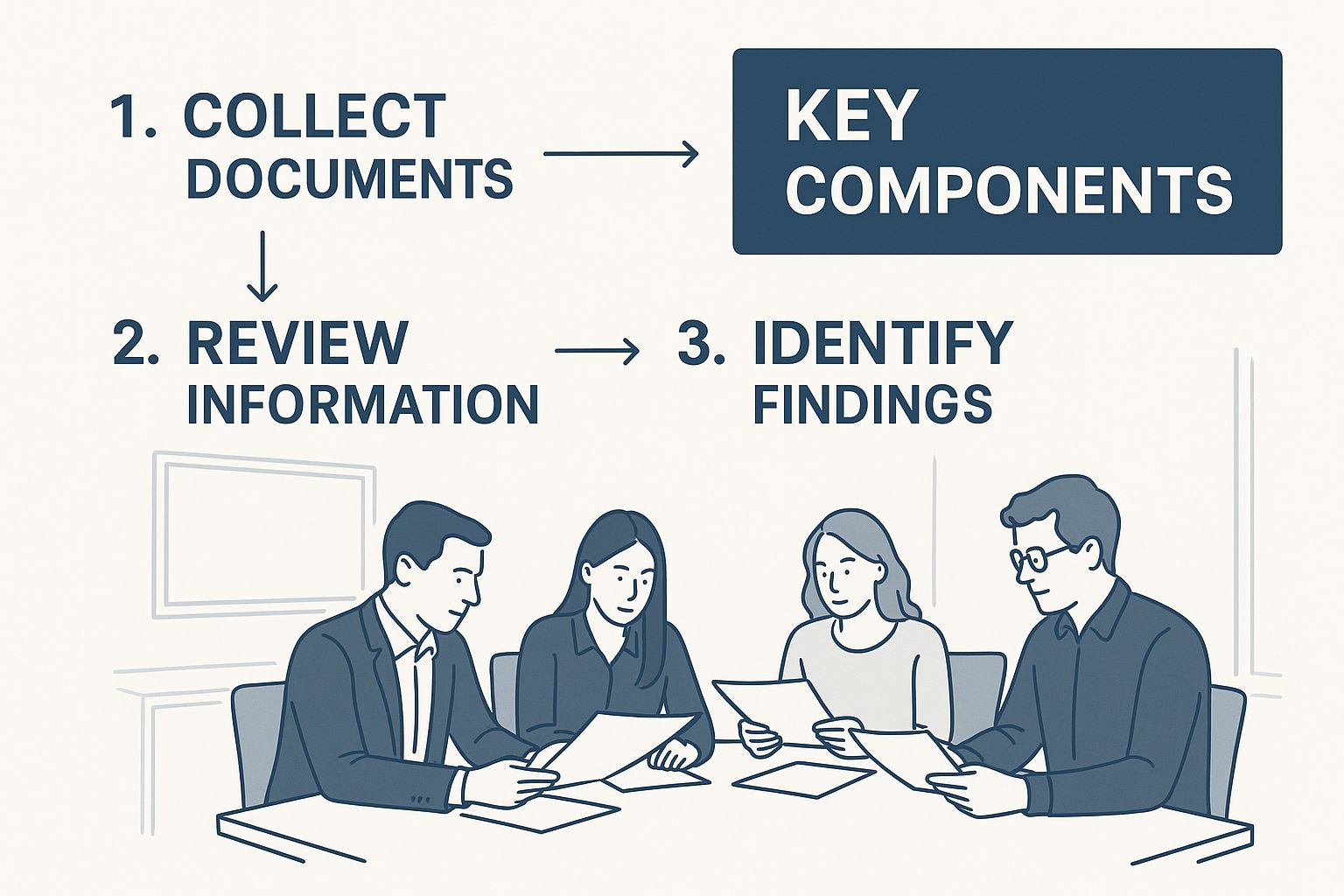
As you can see, the whole process moves from the big-picture business objectives down to the specific creative assets. This structure is your best defense against confusion and ensures everyone is on the same page from day one.
To give you a quick reference, here’s a breakdown of the essential parts of a brief and the one key question each part absolutely must answer for your team.
Table: Key Components of a Powerful Creative Brief
| Section | Core Question It Answers |
|---|---|
| Project Background | Why are we doing this, and why now? |
| Objective/Goal | What does success look like in measurable terms? |
| Target Audience | Who are we talking to, and what do they care about? |
| The Key Message | What is the single most important thing we need to say? |
| Tone of Voice | How should our message feel to the audience? |
| Competitors | What is everyone else doing, and how can we be different? |
| Mandatory Elements | What non-negotiable items must be included? |
| Deliverables & Specs | What are we actually making, and what are the technical details? |
| Budget & Timeline | How much can we spend, and when is everything due? |
| Stakeholders | Who needs to approve the work, and who has the final say? |
Each of these sections plays a vital role in guiding the creative process, preventing missteps and ensuring the final output is both brilliant and effective.
Core Strategic Elements
The sections that truly shape the creative direction are where you need to spend the most time. Getting these right often requires some serious thought and a bit of teamwork.
- The Key Message: This is it. The one thing you want your audience to remember. It has to be punchy, powerful, and act as the creative team's guiding light.
- Tone of Voice: How do you want to sound? Are you going for funny, serious, inspiring, or a little bit quirky? Nailing this down prevents the final work from feeling off-brand.
- Mandatory Elements: Be crystal clear about the non-negotiables. We're talking logos, taglines, legal disclaimers, or specific calls-to-action that have to be in the final assets. No surprises.
A brief's real job is to inspire, not instruct. Your goal is to define the problem so clearly that the creative solution feels almost obvious.
If you’re struggling to pull these thoughts together, using a comprehensive project briefing template can be a huge help in making sure you cover all your bases. The clarity you gain here becomes the foundation for creating a marketing campaign that works.
Finally, a truly solid brief will give a quick rundown of the competitive landscape and get specific about the final deliverables. Understanding what your competitors are up to is the best way to find a unique angle. And by defining exactly what you need—whether it’s video ads, a series of social posts, or a new landing page—you eliminate the guesswork and make sure the team delivers precisely what the campaign needs to succeed.
Going Beyond Demographics to Define Your Audience
It’s tempting to take a shortcut and define your target audience as "millennials in cities." We’ve all seen it. But that kind of vague description is a recipe for bland, forgettable creative work. If you want a brief that sparks a real connection, you have to move past the surface-level data and paint a vivid, empathetic picture of the people you’re trying to reach.
The real goal here is to capture their inner world on paper.
This means digging into psychographics—the attitudes, aspirations, and values that actually drive their decisions. Stop fixating on age and location. Instead, think about their hopes, their frustrations, and what’s keeping them up at night. What problem does your brand genuinely solve for them, beyond the purely functional?
Creating Actionable Personas
You don't need a massive budget to build a powerful user persona. It all starts by asking better questions—ones that reveal personality and motivation.
- What does a typical day really look like for them? Forget their job title for a second. What podcasts are they listening to on their commute? Where are they scrolling for news?
- What are their biggest challenges right now, personally or professionally? This is your chance to directly connect their problems to the solution you offer.
- What brands do they absolutely love, and why? This tells you everything about their values. Do they admire brands for their commitment to sustainability, their sharp humor, or their beautiful design?
Answering these questions transforms a flat demographic into a three-dimensional person. For example, "urban millennial" becomes "Ambitious Anya, a 28-year-old junior graphic designer who feels creatively stifled at her corporate job and follows independent artists on Instagram for inspiration." Now that's someone your creative team can actually design for.
The most powerful audience descriptions feel less like a marketing profile and more like a character sketch from a novel. They provide a human context that data alone can't offer.
Once you've defined your audience with this kind of depth in your brief, it becomes the foundation for building effective audience engagement strategies. This profound understanding is what makes creative work truly resonate, turning a simple message into a meaningful conversation.
Nailing the Single Most Important Message

If your audience only walks away with one thought, what should it be? This question is the acid test for the most difficult—and most vital—part of your creative brief: the single most important message.
This is often called the Single-Minded Proposition (SMP), and for good reason. It’s the one sharp, inspiring sentence that becomes the creative team’s North Star, guiding every single decision they make from that point forward.
Your job is to boil down all the research, goals, and audience insights into one powerful idea. This isn’t a summary. It's the core truth that everything else must orbit around.
From Vague to Valuable
Let’s be honest: a weak message breeds weak creative. It’s the difference between a slogan nobody remembers and a campaign that actually connects with people.
- Weak Message: "Our new software is innovative and user-friendly." (This is generic. What does it even mean?)
- Strong Message: "Our software gives small businesses the power of a full-time data analyst without the cost." (Now that's specific, benefit-driven, and gets the mind racing.)
Getting this right is a serious strategic asset. The creative industries market was valued at a massive USD 2.9 trillion globally in 2024, a number that's only set to climb. A powerful key message doesn't just make for a better ad; it fuels a multi-trillion-dollar global sector. You can dig deeper into the creative industries market on businessresearchinsights.com.
Your key message should be the sharpest tool in your brief. It must be simple enough for anyone to understand, compelling enough to spark ideas, and true enough to be believable.
This central idea is also a cornerstone of many successful influencer marketing campaign strategies. It gives creators that core concept they need to authentically translate for their own followers.
Common Brief-Writing Mistakes That Kill Creativity
Even the most well-meaning brief can torpedo a project right out of the gate. I’ve seen it happen countless times. A few common, easy-to-make mistakes can completely stifle great ideas and send your creative team on a wild goose chase. Learning to spot these pitfalls is just as important as knowing what to include.
Too Much Information (The "Kitchen Sink" Brief)
One of the biggest culprits is what I call the "kitchen sink" brief. This is where stakeholders try to cram every single message, feature, and goal into one document, hoping something sticks.
The result? A convoluted mess that gives zero clear direction. It forces the creative team to play a guessing game about what actually matters, and that’s a game you rarely win.
Being Too Prescriptive
Another classic mistake is being overly prescriptive. Remember, your brief should define the problem, not dictate the solution.
When a brief says, "We need a 30-second video ad of a family laughing on a beach," it completely shuts down creative thinking. There's no room for the team to explore a more innovative or effective concept that solves the real business challenge. You've hired them for their expertise, so let them use it.
Vague Language and Unclear Metrics
Corporate jargon is where creativity goes to die. Phrases like "synergistic marketing" or "next-generation solutions" are meaningless without concrete context. They sound important, but they don't tell anyone what to do. Stick to simple, direct language.
Finally, a brief is doomed if it doesn't define what success actually looks like. How can anyone know if the campaign worked without clear KPIs? Vague goals like "increase brand awareness" just don't cut it. You need specific, measurable outcomes. We go into a lot more detail on how to measure influencer marketing ROI in another guide.
Key Takeaway: A brief should be a springboard, not a cage. Define the destination, the audience, and the core message, then trust your creative team to find the best way to get there.
It's no surprise that a whole industry is popping up to help avoid these very mistakes. The market for AI tools that help generate briefs is projected to hit USD 13.24 billion by 2033. This just shows how critical it is to get the brief right from the very beginning. You can dig into more data on the Creative Brief Generation AI market on growthmarketreports.com.
Got Questions About Creative Briefs? We've Got Answers.

Even with a solid process, a few practical questions always pop up when you're in the trenches writing a creative brief. Let's tackle some of the most common ones I hear from teams trying to get this right.
Getting clear on these points can save a ton of time and prevent a lot of headaches down the road.
How Long Should a Creative Brief Be?
Keep it tight. The sweet spot is usually one to two pages. Your brief needs to be punchy enough for someone to absorb in a single sitting but still pack in all the necessary strategic context.
Think of it as a guide, not an encyclopedia. If you’re sitting on a mountain of market research or customer data, that’s great—just link out to it or add it as an appendix. Don't bog down the main document with it.
The goal is to inspire, not overwhelm. A brief that’s too long is a brief that won't get read properly, which defeats the whole purpose.
Who’s Supposed to Write This Thing?
Officially, this task often falls to an account manager, project manager, or brand strategist. But in reality, the best briefs are born from collaboration. You absolutely need input from key people in marketing, sales, and maybe even the product team.
Here's a pro tip: I've found that looping in a lead from the creative team early on is a game-changer. They can sanity-check the request and make sure it’s actually feasible, which prevents major roadblocks later. It matters less who holds the pen and more that the right people contributed to what's on the page.
Should I Use a Template for My Creative Brief?
Yes, you absolutely should. A template provides a solid framework and acts as a checklist so you don’t forget any critical components. It’s a fantastic starting point.
But don't just mindlessly fill in the blanks. The real magic happens when you adapt that template to the project at hand. A brief for a massive brand launch will naturally need more detail than one for a simple social media campaign. Always tailor the template to fit the project's unique challenges and goals.
Ready to connect with the perfect influencers for your next campaign? REACH takes the guesswork out of influencer marketing with powerful discovery tools, streamlined campaign management, and real-time analytics. Find your ideal partners and prove your ROI with REACH.