
A campaign launches on Tuesday. By Wednesday morning, comments are turning. A creator used the wrong tone, customers are piling onto an old complaint, and your team is checking Instagram, TikTok, X, reviews, and Slack at the same time. Nobody knows whether this is a passing flare-up or the start of something larger.
That's where social media reputation monitoring stops being a nice-to-have and becomes operating infrastructure. It isn't just about catching criticism. It's about knowing what your audience is reacting to, which signals matter, who needs to respond, and what should change internally so the same issue doesn't repeat.
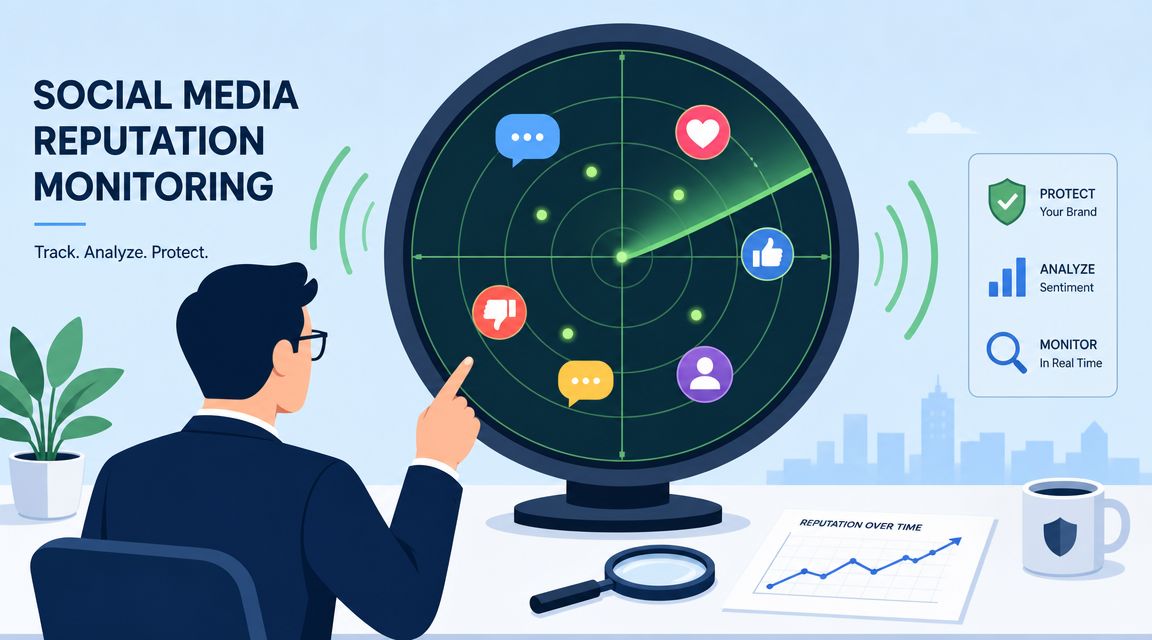
It functions as a radar system, helping you spot the obvious threat and steer better. Strong monitoring programs give marketing, customer experience, PR, and influencer teams a shared view of what's happening around the brand. If you're also trying to build your brand on X, that broader reputation context matters even more because public perception compounds fast across channels.
The practical shift is this. Reputation work used to be treated like reactive cleanup. Today, the best teams run it as an ongoing discipline with four jobs: listen, respond, shape perception, and learn from the data.
Introduction
Many organizations don't fail at reputation monitoring due to ignoring it. They fail because they treat it as scattered activity. Someone checks comments. Someone else handles reviews. The influencer manager watches creator posts. Support watches DMs. No one owns the full picture.
That fragmented setup breaks down as soon as attention spikes.
A stronger approach treats social media reputation monitoring as a working system. One team owns listening. Another owns response. A clear path routes issues to customer support, PR, legal, product, or campaign managers. The point isn't to reply to everything. The point is to know what deserves attention and what deserves action.
The four jobs behind the work
The modern model is simple:
- Monitoring: Track mentions, hashtags, branded terms, product names, reviews, and sentiment across channels.
- Responding: Decide when to reply, when to move a conversation private, and when to escalate.
- Building: Publish and amplify content that strengthens trust before you need it.
- Analyzing: Review patterns over time so the team can improve messaging, products, and campaigns.
Practical rule: If your monitoring process only produces notifications, you don't have a program yet. You have noise.
That distinction matters because reputation is no longer just a PR concern. It shapes customer trust, creator partnerships, hiring perception, and campaign performance.
What Is Social Media Reputation Monitoring
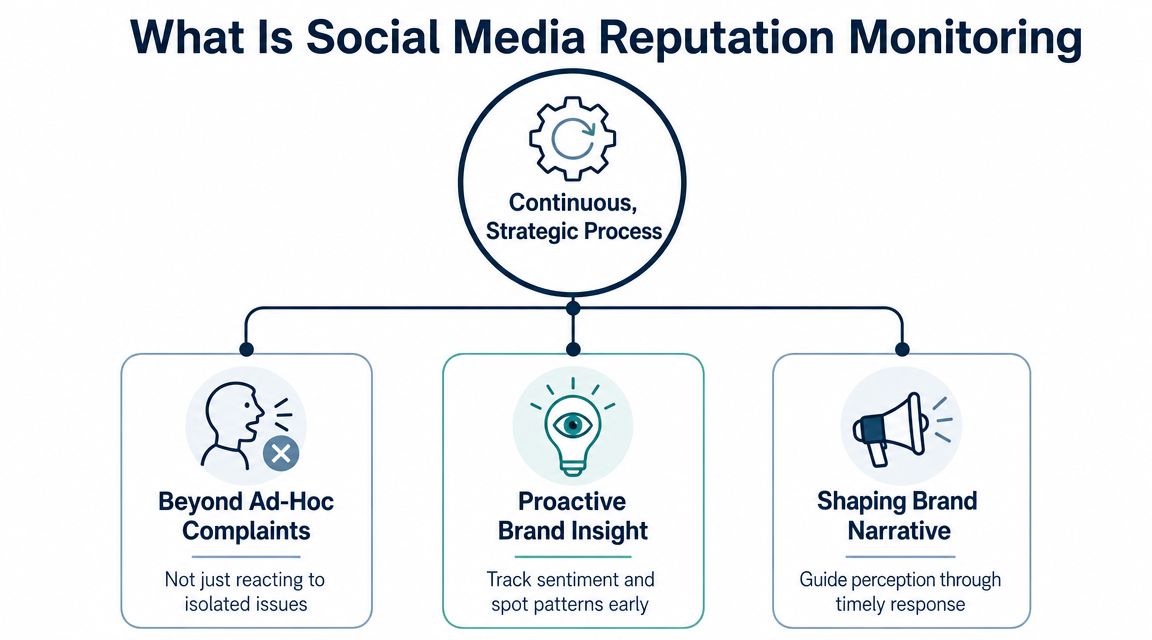
Social media reputation monitoring became a formal discipline when brands moved from ad hoc complaint handling to continuous social listening, with frameworks centered on monitoring, responding, building, and analyzing according to Sprout Social's guide to social media reputation management. That shift changed the job from occasional reaction to daily operational management.
It's not just complaint tracking
A lot of teams think monitoring means searching their brand name and answering angry posts. That's only the surface layer. Real monitoring also watches campaign hashtags, executive mentions, product names, common misspellings, review activity, and shifts in positive versus negative conversation.
That's why a simple platform-native check isn't enough. You need to understand how social media monitoring works at the workflow level, not just the tool level. The difference is whether your team can separate an isolated complaint from a pattern.
The dashboard that matters
The most useful reputation metrics aren't vanity metrics. Industry guidance identifies sentiment analysis, share of voice, mention volume, reach, engagement rate, and message penetration as the core indicators used to assess reputation health, as outlined by Meedius in its reputation analysis metrics overview.
Each metric answers a different question:
- Sentiment analysis tells you whether conversation quality is improving or worsening.
- Share of voice shows whether your brand is owning the conversation or getting crowded out.
- Mention volume helps you see whether attention is stable or spiking.
- Reach tells you how far a conversation may spread.
- Engagement rate shows whether people care enough to react.
- Message penetration shows whether the story people repeat is the one you intended.
Monitoring without analysis creates busy work. Analysis without response creates a report nobody uses.
Why it matters operationally
The old model relied on manual spot checks. The current model relies on dashboards, alerts, and clear thresholds. That change matters because reputation doesn't move in one place anymore. It shifts across creator content, comment threads, review sites, forums, and reposted clips that detach from the original post.
A practical program gives teams one shared view of those movements so they can respond with context instead of panic.
Key Metrics to Track for Reputation Health
If you can't measure reputation, you can't manage it. The mistake is trying to track everything at once. Start with a small set of metrics that tell you whether perception is stable, improving, or slipping.
One reason this matters so much is trust. Recent research reports that 91% of people aged 18 to 34 trust online reviews as much as personal recommendations, according to Reputation X. That means what people see around your brand directly affects whether they buy, click, or keep researching.
The KPI table to build first
| Metric | What It Measures | Why It Matters |
|---|---|---|
| Sentiment | Ratio of positive, neutral, and negative conversation | Shows whether perception is improving or deteriorating |
| Mention volume | How often the brand, campaign, or product is discussed | Helps detect spikes, launches, and emerging issues |
| Share of voice | How much of the conversation your brand owns relative to others | Reveals competitive visibility and attention |
| Reach | How widely a mention or narrative may spread | Helps prioritize issues with broader exposure |
| Engagement rate | How strongly people react to content or mentions | Distinguishes passive visibility from active response |
| Response time | Time from detection to first reply | Shows whether your team can act quickly enough |
| Message penetration | Whether your intended message appears in public conversation | Tests whether campaigns are landing as planned |
What each metric is really telling you
A rise in mention volume isn't automatically good. If sentiment drops at the same time, the brand may be getting attention for the wrong reason. Strong monitoring means reading metrics together, not in isolation.
Share of voice also needs context. More conversation can look like market momentum, but if the dominant theme is criticism, the brand isn't winning attention. It's absorbing risk.
For teams that want a tighter framework, this guide to social media sentiment analysis is useful because sentiment is usually the first metric leaders ask for and the easiest one to misunderstand.
A simple reading pattern
Use a three-part review every week:
- Volume check: What got louder or quieter?
- Quality check: Did sentiment improve, worsen, or split by channel?
- Narrative check: What are people saying in their own words?
That last step matters most. A dashboard can tell you that negative conversation rose. It can't tell you whether the problem is pricing, shipping, creator fit, customer support tone, or a campaign message that missed the mark unless someone reads the underlying conversation.
How to Build Your Monitoring Program
Most weak programs have the same problem. They bolt tools onto a messy process and hope the alerts will create order. They won't.
A reliable monitoring program starts with decisions. What are you tracking, how will you detect risk, and who acts when a threshold is crossed? The technology supports that system. It doesn't create it.
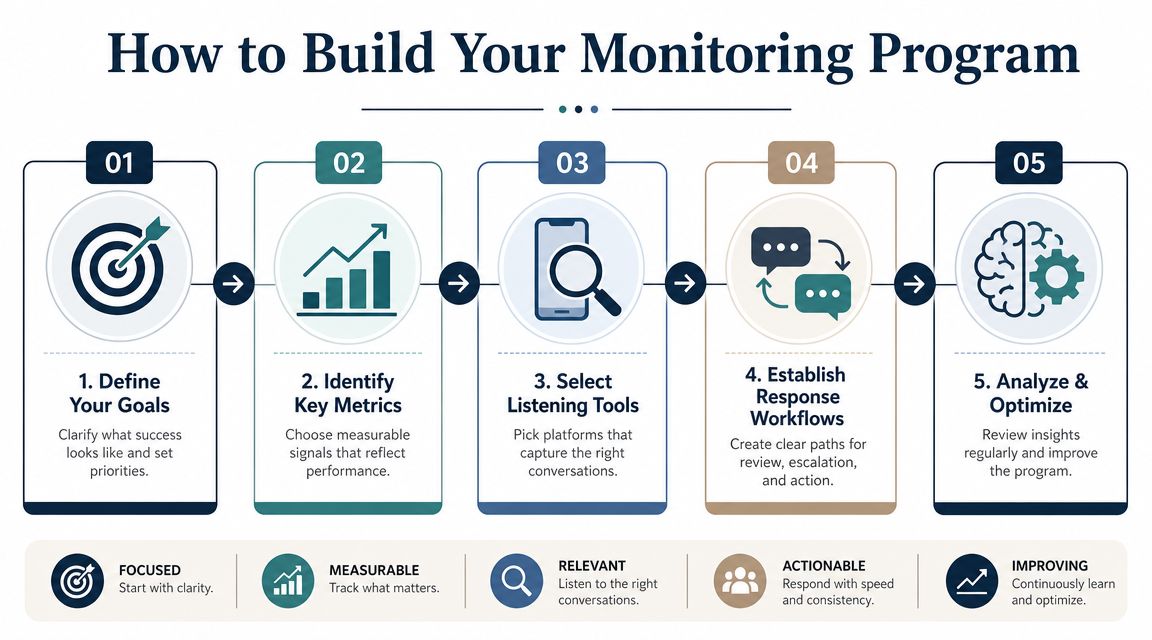
Phase one define the signals
Start with a signal map, not a keyword list.
Track the obvious items first, then expand:
- Brand terms: Company name, handles, campaign names, branded hashtags
- Product terms: Product names, model names, service lines, packaging names
- Variations: Misspellings, abbreviations, nicknames, old product labels
- People and partners: Executive names, spokespersons, creators, ambassadors
- Context terms: Competitor mentions, issue-related phrases, industry hashtags
A common breakdown occurs when teams track exact brand names and miss everything phrased indirectly. A technically sound stack should combine keyword tracking with NLP-based disambiguation and real-time alerts to separate relevant conversations from noise and reduce false negatives during emerging issues, as described by Truescope.
Phase two choose the stack
The wrong setup looks like this. Native platform alerts, a separate review tool, spreadsheets for influencer posts, and a Slack channel full of screenshots.
The better setup gives one operating view:
- Listening layer: Captures mentions, hashtags, reviews, and topic shifts
- Classification layer: Uses filters and language processing to separate signal from noise
- Alerting layer: Flags high-priority spikes based on sentiment, reach, or topic
- Action layer: Routes the issue to the person who owns the response
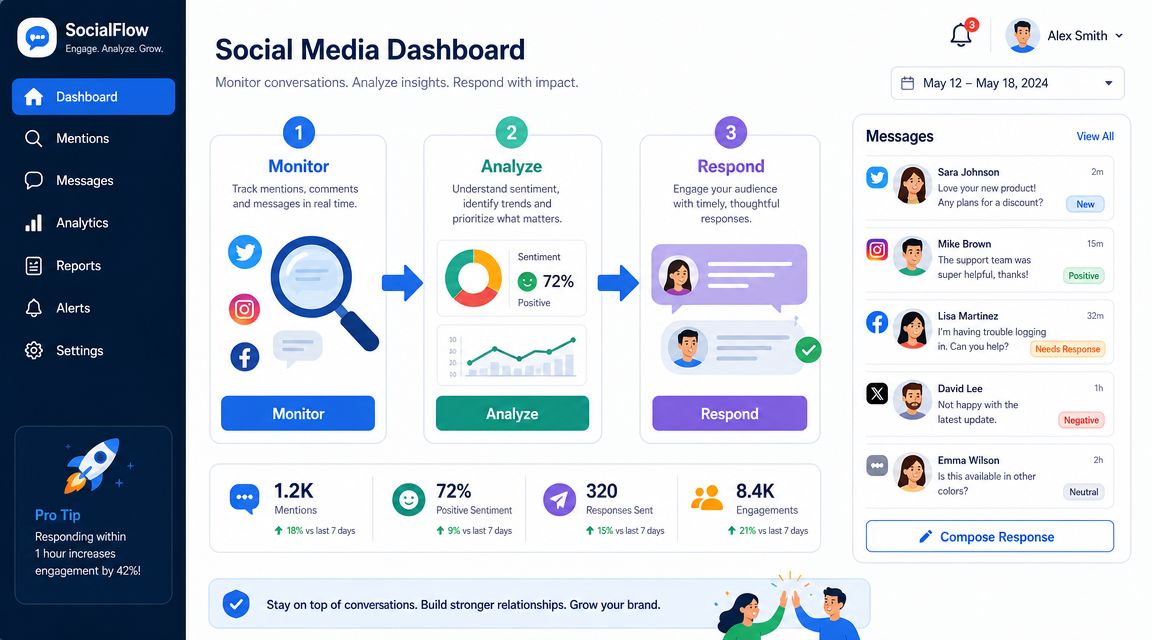
A centralized social media dashboard matters because disconnected tools create duplicate work. They also create dangerous delays when multiple teams assume someone else is handling the issue.
A short walkthrough helps if you're mapping this internally:
Phase three design the workflow
A monitoring program is only as good as the handoff.
Define:
- Who watches daily signals
- Who owns first response
- Which issues move to support, PR, legal, or leadership
- What response time target applies by priority
- How the team records outcome and root cause
The best alert is the one tied to a decision, not the one that makes the loudest noise.
A practical workflow also separates observation from escalation. Not every negative comment needs a public response. But every recurring complaint needs pattern tracking.
Tools and Response Workflows in Action
Once the system is built, the work becomes operational discipline. The daily question isn't “What tool do we use?” It's “How fast can we detect, classify, and route the issue without losing context?”
Some teams use broad social listening suites. Others combine platform-native tools with review monitoring and internal workflow software. What matters most is whether the team can work from one shared picture of the situation.
A response model that actually works
Use a simple escalation ladder:
| Priority | Typical signal | Owner | Response |
|---|---|---|---|
| Low | Single complaint, low reach, no pattern | Social manager | Reply, resolve, log theme |
| Medium | Multiple similar complaints or creator post drawing concern | Social lead plus support or campaign owner | Respond, investigate, monitor for spread |
| High | Rapid spike in negative sentiment, high-visibility creator issue, press pickup | PR, legal, leadership, campaign lead | Escalate immediately, align messaging, centralize updates |
Workflow discipline is essential for brand protection. Without a ladder, teams either overreact to small issues or underreact to serious ones.
How to connect monitoring to business outcomes
A useful rule is to connect each alert to one business question:
- Is this hurting trust?
- Is this affecting conversion?
- Is this exposing the brand to safety or compliance risk?
- Is this pointing to a fix in product, support, or campaign execution?
That's why teams should document outcomes, not just responses. If a creator post triggered confusion, the lesson might be briefing quality. If customers keep repeating the same complaint, the issue may sit in onboarding, shipping, or support handoff.
For teams building a higher-risk process around creators and partnerships, a dedicated social media crisis management workflow is often the missing layer between detection and action.
A good response solves the visible issue. A strong workflow reduces the chance of the next one.
Measuring ROI and Ensuring Brand Safety
Reputation monitoring earns budget when it stops sounding like brand protection and starts sounding like risk control, conversion support, and campaign quality assurance.
That framing is justified. One industry summary estimated the online reputation management market at about $175 million in 2022 and projected it to reach $585 million by 2030, while also reporting that 80% of consumers change their minds after reading a negative online review, according to Electro IQ's reputation management statistics roundup. That's why this work moved from a communications task to a revenue-protection function.
How to think about ROI without making it fuzzy
You don't need a complicated model to make reputation measurable. Start with three buckets:
- Loss prevention: Fewer unresolved public complaints, fewer campaign issues left unchecked, less wasted spend behind damaged creative
- Performance support: Better creator fit, cleaner campaign launches, stronger trust signals around conversion moments
- Operational learning: Faster routing to product, support, or marketing when patterns appear
If your team monitors creator content, this gets even more useful. Reputation data helps vet whether a creator is a fit before launch, whether campaign comments are turning after launch, and whether audience reaction suggests a mismatch between creator persona and brand promise.
Brand safety needs more than sentiment
Sentiment alone can miss quality problems. A mention spike may look positive on the surface but still come from low-trust or manipulative activity. That's one reason teams should review authenticity and account quality when an issue escalates, not just headline sentiment.
Cross-channel context matters too. If influencer campaigns are part of your mix, supporting reputation work with stronger creator communication and campaign controls can prevent unnecessary problems before they go public. For teams working in commerce-heavy channels, this article on influencer public relations for TikTok Shop is a useful read because it connects creator activity, public perception, and commercial execution.
The internal loop most teams miss
The highest-value monitoring programs don't stop at response. They route recurring themes into the business.
That means:
- Marketing adjusts messaging.
- Customer support updates scripts or policies.
- Product teams review recurring complaints.
- Campaign managers tighten creator briefs and approvals.
That's where monitoring starts paying back. Not when the brand replies faster, but when the same issue stops recurring.
Your Reputation Monitoring Implementation Checklist
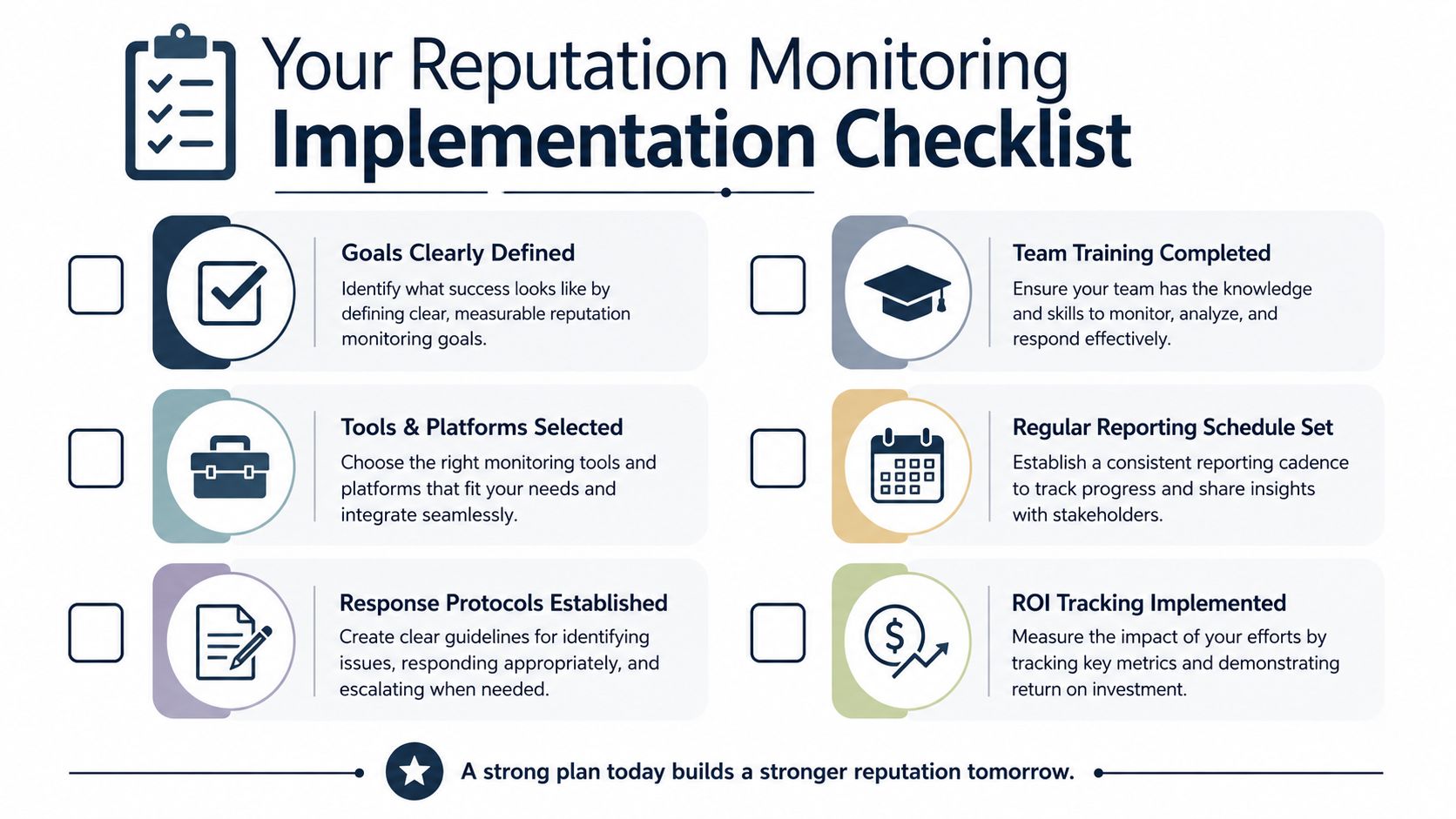
A good program doesn't need to be massive on day one. It needs to be clear, owned, and consistent. Start small, then add coverage as your team proves the workflow.
The checklist
- Define your risk areas: Brand terms, products, executives, creators, campaigns, and common misspellings
- Choose core metrics: Sentiment, mention volume, reach, share of voice, response time, message penetration
- Set alert thresholds: Decide what counts as low, medium, and high priority
- Assign owners: Monitoring, first response, escalation, and post-issue review
- Track beyond social: Effective monitoring should gather signals not only from social platforms but also from blogs, forums, and review sites, then route those insights to product or marketing teams to address root causes, as noted by Cision's guide to online reputation monitoring tools
- Review weekly: Look for patterns, root causes, and repeat issues instead of chasing isolated posts
The goal is control, not perfection. If your team can detect issues early, respond with context, and feed what it learns back into the business, your reputation program is doing its job.
If you want one place to manage influencer campaigns without losing control of brand risk, take a look at REACH. It gives brands and agencies a centralized way to manage creator deliverables, track content, organize communication, and keep campaign operations from slipping into spreadsheets and DMs. That kind of structure makes social media reputation monitoring easier because the execution side is already under control.