 Skip to content


So, what exactly is key opinion leader marketing? At its core, it’s about partnering with genuine industry experts to build unshakable brand trust. Forget chasing social media fame. This strategy focuses on professionals—think doctors, financial analysts, or veteran software engineers—whose influence comes directly from their proven expertise and professional standing. It’s a way to forge a deep, authoritative connection with an audience that values substance over style.
The Bedrock of Modern Marketing: Trust

We're all swimming in a sea of ads and sponsored content, which has made us more skeptical than ever. People are tired of the noise. They're looking for authentic voices they can actually rely on, and that's precisely where key opinion leader (KOL) marketing comes in. It offers a refreshing and powerful alternative to the usual influencer playbook by building campaigns on the solid ground of professional credibility, not fleeting trends.
Here’s a simple way to think about it. An influencer is like a popular friend telling you about a cool new coffee shop. You trust them, and their recommendation feels relatable. A KOL, on the other hand, is like a world-renowned cardiologist advising you on a heart-healthy diet. Their guidance carries the immense weight of years of education, hands-on experience, and peer-reviewed research.
The trust they command isn't just given; it's earned.
Where a KOL’s Influence Really Comes From
Unlike a typical influencer who grows an audience through lifestyle posts and personal charisma, a KOL's influence is a direct result of their professional life. Their authority was established long before a brand ever entered the picture. This is the fundamental difference that makes their endorsement so incredibly powerful.
This deep-seated authority is built on a few key pillars:
- Professional Credentials: They often have advanced degrees, specialized certifications, or professional licenses that prove their knowledge.
- Verifiable Experience: Their career is packed with years of practical work, groundbreaking research, or other significant achievements in their field.
- Industry Recognition: They are the people their peers look up to—the ones speaking at major conferences, publishing influential work, or leading their industry forward.
When your brand partners with a KOL, you're not just renting their audience for a post. You're borrowing their hard-won reputation. The strategy is to align your brand with their established credibility, creating an authentic stamp of approval that resonates with a smart, and often critical, audience.
A recommendation from a KOL feels less like an ad and more like a piece of professional advice. This shift in perception is a game-changer for brands in specialized industries like tech, healthcare, and B2B, where purchase decisions hinge on expert opinion and solid evidence.
Why It’s So Damn Effective
The real magic of key opinion leader marketing is its ability to slice right through the clutter of traditional advertising. Today's consumers have a finely tuned radar for inauthentic endorsements. But when a respected figure in a specific field puts their name behind a product, it doesn't feel like a sales pitch. It feels like a genuine validation.
This approach is especially powerful when your brand needs to:
- Educate the Market: Got a complex product? A KOL can break down the tricky details into clear, digestible information, giving customers the confidence to make a move.
- Establish Credibility Fast: If you're a new brand or entering a crowded space, aligning with a recognized expert is a shortcut to building trust.
- Influence High-Stakes Decisions: In fields like finance or medicine, where a wrong choice has real consequences, a KOL’s backing provides that critical layer of reassurance people need.
Ultimately, KOL marketing transforms a simple promotion into a valuable, trust-building experience. It’s about cultivating genuine belief in your brand, guided by the very voices your audience already turns to for expert advice.
Understanding KOLs vs Influencers
It's a common mistake to lump Key Opinion Leaders (KOLs) in with social media influencers. They might seem similar on the surface, but they’re playing two completely different games. Grasping this distinction is absolutely crucial before you even think about building a key opinion leader marketing strategy.
Let's put it this way: an influencer is like a popular fitness coach on Instagram. They inspire thousands with their personal transformation stories and motivational posts. People follow them because they're relatable and aspiring.
A KOL, on the other hand, is the renowned sports scientist who trains that coach. Their advice isn't just motivational; it’s grounded in years of peer-reviewed research, clinical practice, and a hard-earned professional reputation. One builds influence through personality, the other commands respect through proven expertise.
The Core Difference: Credibility vs Relatability
The real divide between a KOL and an influencer boils down to the source of their authority. An influencer’s power comes from their connection to their audience. Their relatability, lifestyle, and unique personal brand are the currency they trade in. Their followers feel like they know them.
A Key Opinion Leader’s influence is a direct result of their career. They are doctors, scientists, engineers, or financial analysts first, and content creators second. Their opinions matter because of their credentials and professional standing. People don't follow them for a peek into their daily life; they follow them for credible, authoritative guidance.
This expert-driven approach has a measurable impact on campaign performance.
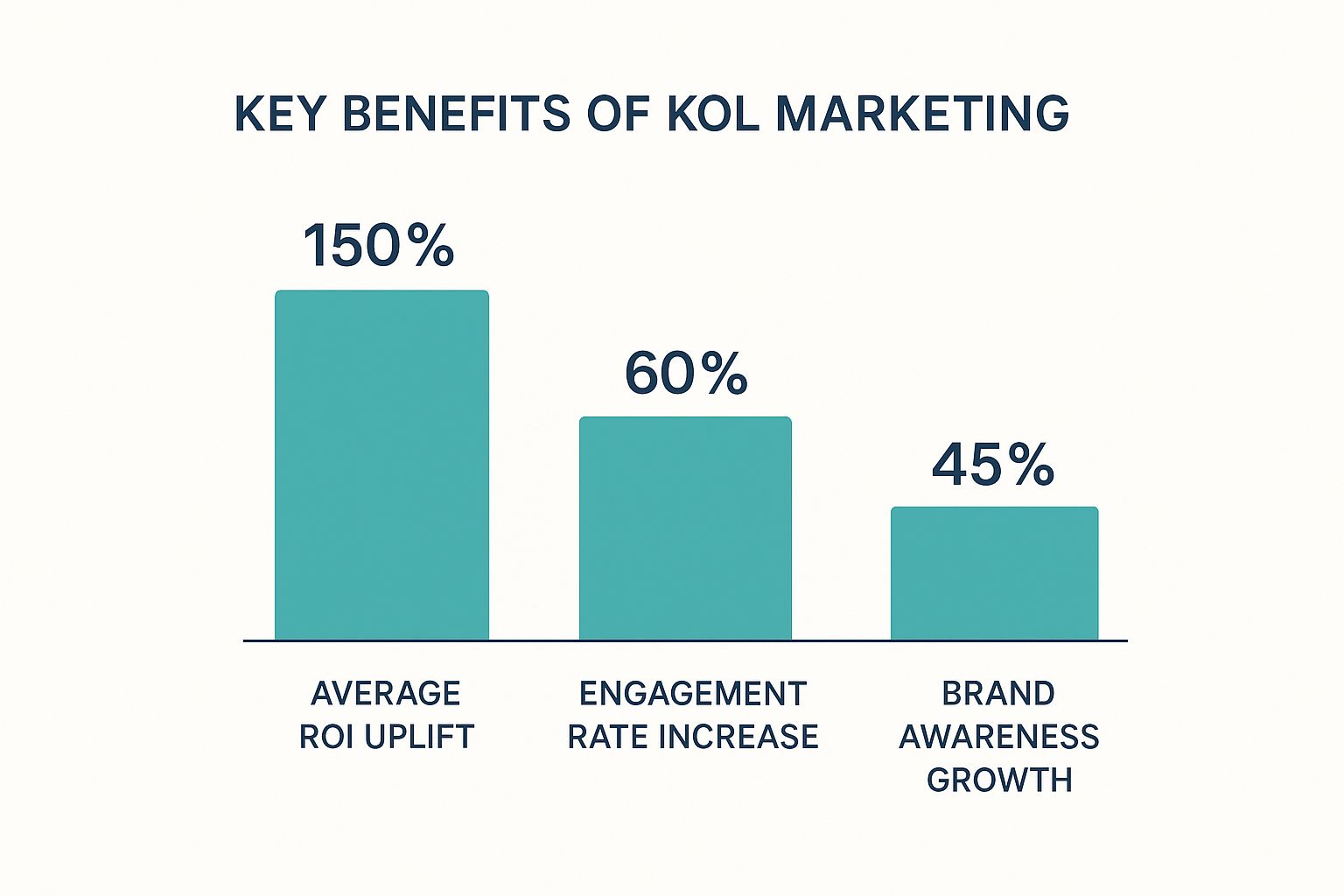
As you can see, when a campaign is built on a foundation of genuine expertise, it tends to drive a serious lift in everything from ROI to brand trust. For more context on the broader landscape, our guide on what influencer marketing is can help fill in the gaps.
KOLs vs Influencers: A Strategic Comparison
To help you see the difference in action, let's put them side-by-side. This table breaks down where each type of partner shines, helping you decide whether you need a KOL for deep impact or an influencer for broad reach.
| Attribute | Key Opinion Leader (KOL) | Influencer |
|---|---|---|
| Source of Credibility | Professional expertise, credentials, and industry reputation. | Personal brand, relatability, and content style. |
| Audience Motivation | Seeking professional advice, education, and trusted guidance. | Looking for lifestyle inspiration, entertainment, and product discovery. |
| Primary Platforms | Industry journals, conferences, LinkedIn, academic forums, targeted social media. | Instagram, TikTok, YouTube, personal blogs. |
| Content Focus | In-depth, educational, and evidence-based content (e.g., whitepapers, webinars). | Aspirational, entertaining, and visually driven content (e.g., tutorials, vlogs). |
| Best For | Building trust in technical fields, validating complex products, B2B marketing. | Driving mass awareness, launching consumer products, and creating trends. |
The market is certainly taking notice. The global Key Opinion Leader (KOL) marketing market was valued at around USD 73.25 billion in 2025 and is on track to hit USD 187.94 billion by 2034. That’s a compound annual growth rate of 12.5%, which shows just how much brands are investing in this strategy to build real, lasting trust.
It's not about whether a KOL or an influencer is "better." The real question is, what are you trying to achieve? An influencer can sell a new lipstick to thousands of followers, but a KOL is the one who convinces a team of dermatologists to recommend it.
Building Your First KOL Marketing Campaign
So, you understand what key opinion leader marketing is. Now comes the exciting part: actually launching a campaign. Moving from theory to practice requires a clear playbook, and it's about much more than just finding an expert and cutting them a check. We're talking about building a genuine partnership, one grounded in shared goals and mutual respect. A successful initiative starts long before you ever hit "send" on that first outreach email.
The whole game is about deliberate action. Your very first step is to get laser-focused on what you're trying to achieve. Fluffy goals like "increase awareness" won't cut it. You need sharp, measurable objectives that will guide every single decision you make from here on out.
Define Your Campaign Objectives
Before you can even think about finding the right partner, you have to define what a "win" looks like. Your goals will dictate the type of KOL you need, the kind of content you’ll create together, and the metrics you'll obsess over. Think of a well-defined objective as your North Star—it keeps the entire campaign on track.
Here are a few concrete goals you could set for your key opinion leader marketing efforts:
- Establish Market Credibility: Partnering with a respected academic to put a stamp of approval on the science behind your new skincare line.
- Generate High-Quality Leads: Collaborating with a B2B tech analyst to host a webinar that pulls in qualified, ready-to-talk prospects.
- Educate a Niche Audience: Working with a renowned financial expert to create a guide that finally makes a complex investment product easy to understand.
- Validate Product Claims: Bringing on a certified nutritionist to co-author a whitepaper on the real health benefits of your new food item.
By setting specific targets like these, you create a clear framework for measuring your return and proving the campaign's value. This clarity is a non-negotiable part of all good marketing, which we cover in our guide on how to start with influencer marketing.
Identify and Vet Potential KOLs
With your objectives locked in, the hunt for the perfect KOL begins. This part of the process is less like a quick Google search and more like investigative journalism. You're searching for true, earned authority, not just a big follower count.
You’ll need to dive deep into your industry's ecosystem to find the people who are genuinely shaping the conversation.
Where to Find Authentic KOLs
- Academic Databases and Publications: Scour platforms like Google Scholar or industry-specific journals. Who is publishing the most relevant, cited research?
- Industry Conference Speaker Lists: Look at who gets invited to speak at the major industry events. These are the experts your peers are paying to listen to.
- Professional Associations: Check out the leadership and board members of the key professional organizations in your field.
- LinkedIn and Niche Forums: Pay attention to the discussions. Who is consistently being tagged, quoted, and cited as a trusted voice?
Once you have a shortlist, the vetting process is absolutely critical. You have to look past the surface-level numbers. A KOL with 10,000 highly engaged peers is almost always more valuable than one with 100,000 passive followers.
The right KOL isn't just an expert; they are an expert whose audience perfectly matches your target customer. Alignment is everything.
Master Authentic Outreach and Partnership
How you approach a potential KOL sets the entire tone for the relationship. Remember, these are busy professionals with demanding careers, not full-time content creators. A generic, copy-paste pitch will get you ignored, fast. Your outreach has to be personal, respectful, and show them what's in it for them.
You're proposing a partnership, not just a transaction. Frame the collaboration as a unique opportunity for them to share their hard-won expertise with a new, relevant audience. Show them you've done your homework and explain exactly why their specific voice is the one you need.
The market itself shows just how important these strategic relationships are becoming. The global Key Opinion Leader management market was valued at USD 211.55 billion in 2024 and is on track to hit USD 686.96 billion by 2034. That explosive growth tells you everything you need to know about where the industry is headed.
Co-Create Compelling Content
Finally, the content itself has to be a genuine collaboration. The magic of key opinion leader marketing is rooted in the expert's authentic voice and perspective. If you try to script their every word, you'll kill the credibility you're paying for. Instead, work with them to develop content that meets your brand’s goals while honoring their professional integrity.
Some of the most effective co-created content formats include:
- Sponsored Research or Whitepapers: Lend your brand's resources to a KOL so they can produce a landmark industry report.
- Expert Webinars or Q&A Sessions: Host a live event where the KOL can interact directly with your audience and answer their toughest questions.
- Technical Product Reviews: Give them your product for an in-depth, unbiased review based on their expert criteria. No strings attached.
By following this structured, respectful approach, you can move beyond simple endorsements and build a powerful campaign that leverages an expert's credibility to earn lasting trust and drive real business results.
How Winning Brands Use KOL Marketing
It's one thing to talk about frameworks and strategy, but seeing key opinion leader marketing in the wild is what really makes the concept click. Let's look at how real brands are pulling this off, moving beyond theory and into tangible results.
These aren't just one-off promotions. They're smart, strategic partnerships built to create lasting trust, educate audiences, and carve out a position of authority. You'll notice a common thread in these examples: success happens when a brand’s goal perfectly aligns with a KOL’s genuine expertise.
B2B Tech: Building Authority with Co-Authored Research
Most B2B software companies struggle with the same problem: how do you prove your solution isn't just another tool, but a genuine game-changer? A cybersecurity firm was stuck in this exact spot. Instead of just pouring more money into digital ads, they tried something different.
Their mission was to be seen as the thought leader in data threat prevention. So, they found a top cybersecurity analyst—a KOL famous for her sharp, independent industry reports. They didn't just ask her for a quote or a quick endorsement; they pitched a real research partnership.
Here’s how they structured the campaign:
- The Joint Project: The brand opened up its internal data and resources, while the KOL supplied her analytical rigor and deep industry knowledge.
- The Co-Authored Whitepaper: They worked together to publish a detailed report on new and emerging data threats, offering it for free.
- The Rollout: The KOL shared the finished report with her exclusive network of executives and tech journalists. At the same time, the brand hosted a webinar with the analyst as the star speaker to promote it.
The results were phenomenal. The report was picked up and cited by major tech publications, and the webinar brought in thousands of qualified leads. But the biggest win? The brand’s name became linked with cutting-edge cybersecurity research, all because they tapped into the credibility of a true expert.
By creating something genuinely useful together, instead of just paying for a shoutout, the company turned its marketing into a valuable industry resource. That’s the core of great KOL marketing.
Consumer Goods: Earning Trust Through Expert Education
In the skincare world, shoppers are overwhelmed and, frankly, skeptical. They’ve heard it all before. A new skincare brand knew it had to build trust from the ground up by explaining the why behind its formulas. The goal wasn't just to sell a product, but to empower people to make smarter choices.
They connected with a respected dermatologist who had a strong social media following. She wasn't a typical lifestyle influencer; she was a board-certified doctor whose audience followed her for evidence-based, no-fluff skincare advice. Her credibility was her currency.
The entire collaboration was built around education. They launched a video series where the dermatologist broke down the science behind the brand’s key ingredients, explaining how they worked at a cellular level. She made complex topics easy to understand without ever dumbing them down, which kept her audience's trust intact.
This approach hit home with savvy consumers. The brand saw its sales and engagement climb, but the real victory was the trust they earned. If you scanned their reviews, you’d see countless customers saying they decided to buy because they watched the dermatologist's videos and felt they could finally trust the claims. In a market full of hype, expertise is what sets you apart.
Measuring The Real Impact of Your KOL Strategy

So, how do you actually prove that a strategy built on something as fuzzy as "trust" is working? Likes and shares are easy to count, but they barely scratch the surface of what a key opinion leader marketing campaign can achieve. To really get a handle on its success, you need to measure what actually moves the needle for your business.
This means looking past the easy-to-see vanity metrics and adopting a more sophisticated, multi-layered approach. A solid measurement plan tracks everything from the high-level shifts in your brand’s reputation all the way down to the direct impact on your sales figures. Let's break down the key areas you should be watching.
Quantifying Your Brand Authority
The first thing to measure is how the partnership is elevating your brand's reputation in the industry. I call these "Authority Metrics" because they track the ripple effect of the KOL’s credibility as it transfers over to you. They prove you're not just reaching people; you're earning their respect.
Think of it like building an academic reputation. It’s not about winning a popularity contest; it’s about the substantive achievements that prove you know your stuff.
Key Authority Metrics to track include:
- High-Quality Media Mentions: Are top-tier industry publications or news outlets picking up the content you created with your KOL? Every mention is a powerful seal of approval from a trusted third party.
- Backlinks from Reputable Domains: When other authoritative websites link back to your KOL content, it sends a massive signal to search engines that you're a credible source. This is SEO gold.
- Speaking Engagement Invites: Has the collaboration led to your internal experts or the KOL getting invited to speak at major industry conferences or webinars? This is a clear sign your message is resonating with the right people.
These metrics show, in no uncertain terms, that your brand is becoming a recognized voice in your field—a direct result of your partnership.
A single backlink from a top-tier university or industry journal, driven by your KOL’s research, can be more valuable for building long-term authority than thousands of social media likes.
Analyzing Meaningful Engagement
Next, it’s time to look deeper than just the raw interaction numbers. Real engagement isn't just a count; it's a conversation. When you analyze the quality and sentiment of the audience's comments and questions, you get a real feel for how deeply the KOL's message is connecting.
Here, you’re trying to understand the audience's mindset. Are they asking sharp, insightful questions? Are they sharing their own related experiences? This is where you find the proof of genuine interest and budding trust.
Dig into these deeper Engagement Metrics:
- Comment Sentiment Analysis: Are the comments overwhelmingly positive, thoughtful, and inquisitive? You can use tools to analyze the language and get a gut check on the audience's emotional response.
- Depth of Questions Asked: High-quality engagement often looks like a flood of detailed questions in a webinar Q&A or thoughtful inquiries in a blog's comment section. It shows people are seriously considering what you have to say.
- Share of Voice: Start tracking how often your brand and KOL are mentioned in key industry discussions compared to your competitors. A good campaign should make you a bigger part of the conversation.
Connecting a KOL Strategy to Business Goals
At the end of the day, every marketing dollar has to answer to the bottom line. This is where you connect the dots between your key opinion leader marketing campaign and actual business results. By putting the right tracking in place, you can draw a straight line from your KOL's activity to tangible outcomes like leads and sales. For a deeper dive into the financial side, resources on measuring your content marketing ROI can help you ensure every dollar spent is pulling its weight.
This final layer is all about proving clear financial value.
To do this right, you need to set up a few simple tools:
- KOL-Specific Landing Pages: Create unique landing pages for each campaign. This is the cleanest way to track traffic, form fills, and conversions that come directly from their audience.
- Unique Tracking Codes and URLs: Give your KOL a custom UTM link or a unique discount code. It’s one of the easiest and most effective ways to attribute sales directly back to their influence.
- Lead and Sales Attribution: Use your CRM and analytics to follow the customer's path. Did a new lead first watch your KOL’s webinar a month before they finally became a paying customer? Connect those points.
By diligently tracking these three tiers of metrics—Authority, Engagement, and Business Goals—you build a complete picture of your campaign’s success. For more on this, our complete guide to calculating influencer marketing ROI provides even more detailed insights. This data-driven approach lets you demonstrate not just reach, but real, measurable business value.
Of course, here is the rewritten section with a more natural, human-expert tone:
Navigating the Inevitable Hurdles of KOL Marketing
Let's be realistic: even the best-laid KOL marketing plans can hit a few bumps. The real trick isn't avoiding problems altogether—it's knowing what they are ahead of time so you can steer right around them. Think of it like a seasoned pilot navigating tricky weather; a little foresight goes a long way.
Ignoring these potential issues is a surefire way to undermine the credibility you’re working so hard to build. From finding a true expert to making sure they still sound like themselves, let's walk through the common challenges you'll likely face.
Sorting the Real Experts from the Pretenders
One of the biggest initial hurdles is figuring out who is a genuine authority and who just looks like one online. In an era of bought followers and puffed-up bios, follower count is a vanity metric. You have to dig much deeper to find out if someone's reputation is actually earned.
So, how do you do it? Look for tangible proof that they know their stuff:
- Peer-Reviewed Publications: Have they actually published research or articles in credible industry journals?
- Conference Appearances: Are they a regular on the speaker circuit at the industry’s most important events?
- Professional History: Does their resume or LinkedIn profile show a legitimate, long-term track record of achievement in their field?
This kind of background check ensures you're partnering with someone whose authority is built on real-world accomplishment, not just social media smoke and mirrors.
The Balancing Act: Authenticity and Compliance
Okay, so you've found your expert. Now comes the delicate part: collaborating without crushing the very thing that makes them valuable—their authentic voice. As soon as their content sounds like a corporate script, you've lost. Their audience trusts them for their genuine professional opinion, not to read your ad copy.
The real tightrope walk is preserving the KOL's authenticity. If their recommendation sounds like it came straight from your marketing department, you’ve already failed.
This isn't just a minor issue; it’s a huge concern across the industry. Fake followers are still a problem, affecting 48% of campaigns. On top of that, 42% of brands worry about regulatory compliance, and 37% struggle with content authenticity. These numbers paint a clear picture of the landscape. If you want to dig deeper, you can read more about the challenges facing the KOL market.
Speaking of compliance, it's not optional. Making sure every piece of sponsored content follows FTC guidelines with clear, unmissable disclosures is absolutely critical. This isn't just about avoiding legal hot water; it's about being transparent with the audience. Remember, both you and the KOL are on the hook for making the paid relationship crystal clear. By getting ahead of these challenges, you're not just protecting your investment—you're building a partnership that’s both powerful and principled.
A Few Common Questions About KOL Marketing
Stepping into a new strategy like this always brings up a few questions. When you're talking about key opinion leader marketing, getting straight answers is the only way to build a campaign that actually works and doesn't fall into the usual traps. Let's tackle some of the most common questions we hear from brands.
What's This Going to Cost Me?
There’s really no simple price tag for a KOL partnership. How much you'll invest depends entirely on the expert's reputation in their field, what you're asking them to do, and how much of their time you need.
Unlike standard influencer rates, KOL compensation is usually a bit more formal and can look a few different ways:
- Project-Based Fees: You agree on a flat fee for a specific outcome. This could be anything from co-authoring a whitepaper to being the keynote speaker at your annual user conference.
- Long-Term Retainers: For ongoing work, you might have a KOL on a monthly retainer. This is common when they act as an advisor, consistently create content, or serve as a long-term brand ambassador.
- Equity or Profit-Sharing: This is less common but happens, especially with startups or high-growth companies. A KOL might join forces in exchange for a piece of the company.
Where Do I Even Find These Niche Experts?
Finding a genuine expert means looking where they build their credibility, which often isn't on the usual social media feeds. You have to go where the real professional conversations are happening.
Start your hunt in places like these:
- Academic Databases: Check out platforms like Google Scholar or niche industry journals. You’ll quickly see who is publishing the research that everyone else is citing.
- Conference Speaker Lists: The people invited to speak at the biggest industry events are almost always the most respected voices in that space.
- Professional Associations: Look at who is on the board of directors or listed as a key contributor for the top organizations in your industry.
A quick tip: The best KOLs often have a smaller, highly engaged following of actual peers, not a massive, broad audience. You should be more interested in the quality of their network than the sheer number of followers.
Should I Do a One-Off Campaign or Build a Long-Term Partnership?
A short-term campaign can definitely give you a nice, quick lift. But the true magic of key opinion leader marketing happens when you build a lasting relationship. A long-term partnership creates a much deeper, more genuine connection between the expert and your brand.
Over time, their credibility starts to feel like a part of your company's DNA. That kind of continuous collaboration builds a level of audience trust that a single project just can't replicate.
Ready to find the right experts and build a powerful KOL campaign? REACH takes the guesswork out of the entire process, from discovery to payment. Find your perfect match and prove your ROI.