
Meta description: A practical guide to marketing beauty industry brands in 2026, covering segmentation, channel mix, influencer execution, analytics, and compliance with workflow advice for profitable campaigns.
The beauty business is large enough that small mistakes get expensive fast. McKinsey estimates the global beauty market at about $450 billion and says it is projected to grow around 5% annually through 2030 (McKinsey state of beauty). That scale changes how you should think about marketing beauty industry brands. You're not competing for attention in a niche. You're competing in a category where every launch, creator partnership, paid test, and retail push has real financial weight.
Most brand teams already know the broad playbook. Build a point of view. Work with creators. Post consistently. Support launch moments with paid media. The harder part is operational. Beauty marketing breaks down when teams run strategy in one document, creator outreach in DMs, approvals in email, reporting in spreadsheets, and payments somewhere else.
That's why execution matters more than theory. A good beauty plan is not the same as a profitable one. Profit comes from choosing the right audience, matching channels to margin reality, and keeping campaign operations tight enough that the team can learn and adjust quickly. If you're also sharpening your short-form content approach, these Beauty viral video marketing strategies are a useful companion resource because beauty discovery now depends heavily on repeatable visual storytelling, not one-off hero posts.
Introduction The Billion-Dollar Opportunity in Beauty Marketing
Marketing beauty industry products is different from marketing most consumer goods because buyers don't just purchase function. They purchase identity, routine, aspiration, trust, and visible results. That creates huge upside for brands that execute well, but it also creates friction. Consumers compare ingredients, price points, reviews, creators, packaging, and brand values in a single decision path.
The teams that win usually do three things well:
- They position clearly. Buyers can tell what the product is for, who it serves, and why it deserves space in a routine.
- They organize campaigns tightly. Launches fail when approvals lag, creators miss deadlines, and paid amplification runs on weak assets.
- They treat data as a working tool. Performance signals shape the next creative brief, creator mix, and landing page update.
Beauty marketing works when the customer experience feels cohesive from first impression to checkout. Most brands lose momentum in the handoff between those steps.
Many new brand managers often get tripped up, viewing beauty as a branding game when it's really a systems game. Strong packaging and good creative help, but profitable growth usually comes from disciplined segmentation, channel selection, and campaign management.
Understanding the 2026 Beauty Consumer and Market
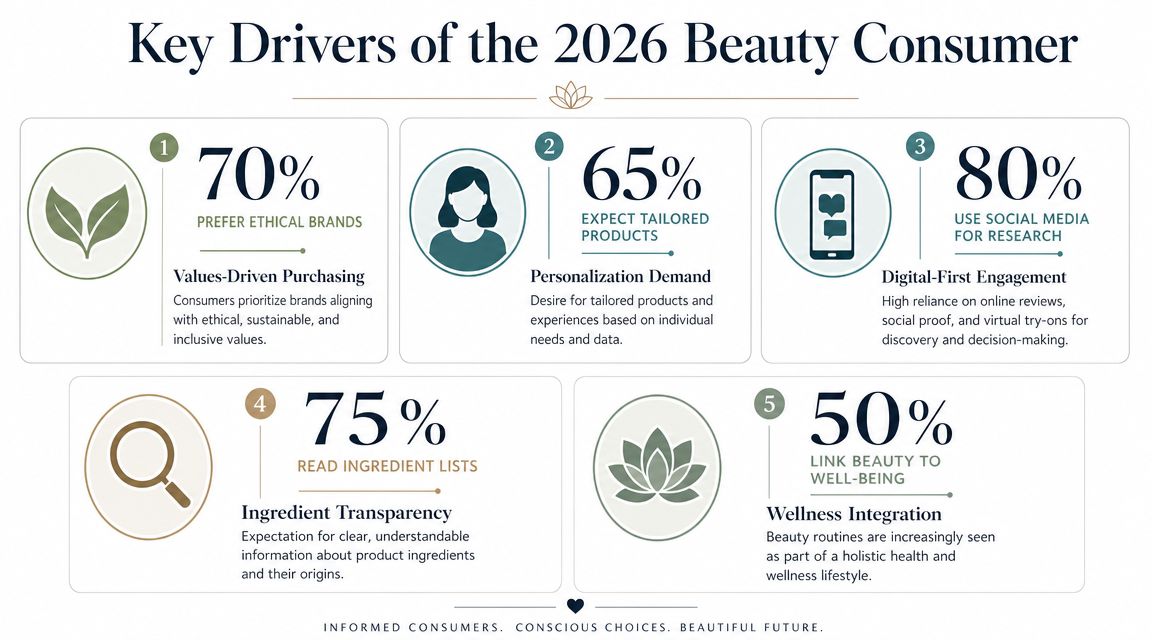
The modern beauty buyer is harder to impress and easier to lose. They expect the product to work, the message to feel relevant, and the brand to understand their needs without reducing them to a generic persona. In practical terms, that means broad “for everyone” positioning usually underperforms unless the brand has unusual distribution power or category dominance.
The bigger opportunity sits in the audiences many brands still treat as secondary. Coresight identifies five underserved U.S. beauty segments: non-white and multiracial shoppers, Gen Z, women 50+, male shoppers, and adaptive beauty shoppers. It also argues that inclusivity has to include accessibility, so campaigns and education work for people with disabilities too (Coresight underserved beauty segments).
What buyers actually respond to
Beauty consumers don't buy from a single motivation. They stack motivations. A shopper may want better skin results, lower routine complexity, stronger ingredient confidence, and content that shows realistic use on someone similar to them.
That creates several practical implications:
- Representation has to be functional. Diverse casting matters, but so does showing shade fit, texture, application method, and routine placement.
- Education has to reduce friction. Buyers want to know what the product does, how to use it, and whether it fits with what they already own.
- Accessibility has to show up in execution. Product education, site content, creator content, and visuals should all be easier to consume.
If you're mapping audiences by channel, this breakdown of social media platform demographics by platform is useful because channel choice only works when it reflects who you're trying to reach, not just where the marketing team likes to post.
Where brands still get consumer insight wrong
A common mistake is treating underserved segments as campaign themes instead of business segments. If you only acknowledge these customers in seasonal creative, you won't build a repeatable marketing engine around them. Teams need actual segment logic behind product bundles, creator selection, landing page copy, and retention messaging.
Practical rule: If a segment is important enough to mention in your brand deck, it should influence creative briefs, product education, and channel planning.
Another mistake is flattening older or overlooked consumers into dated stereotypes. Women 50+ don't all want the same language, and male shoppers don't all want stripped-down “clinical” branding. In beauty, lazy segmentation shows immediately.
The better approach is to ask sharper operational questions. Which segment has the clearest pain point? Which one has a routine problem your product solves? Which one is easiest to educate through creators? Which one can support your margin structure? Those questions lead to better decisions than generic talk about inclusivity.
Building Your Core Marketing Beauty Industry Strategy
A strong marketing beauty industry strategy starts with restraint. New brands often try to sound premium, mass, clinical, playful, inclusive, trend-led, and expert all at once. That usually produces bland creative and weak conversion. Buyers don't need more adjectives. They need a clear reason to care.
Start with positioning that can survive real-world channels
Your positioning has to hold up in four places: on a product page, in a creator brief, in a paid ad, and on retail shelves if you expand there. If the message changes wildly across those environments, the brand hasn't been defined tightly enough.
Useful positioning questions include:
- What problem do we solve first
- Who feels that problem most urgently
- What makes our solution easier to trust
- What kind of brand experience should the customer expect
A prestige skincare brand and an accessible acne brand can both win. The difference is that each needs a distinct message architecture. One may lead with ritual, sensorial experience, and premium cues. The other may lead with clarity, routine simplicity, and proof-friendly education.
Build segments around problems, not just demographics
Effective audience segmentation in beauty should be built around age, interests, income, and pain points, with creative and offers aligned to the likely customer problem. Guidance on beauty marketing segmentation notes that matching anti-wrinkle care to older cohorts versus acne solutions to younger ones improves relevance and purchase intent (Salt Agency cosmetic marketing guide).
That matters because demographics alone don't tell you enough. Two customers of the same age can behave completely differently if one wants ingredient transparency and the other wants visible transformation quickly.
A practical segmentation framework looks like this:
- Problem-led segment: Acne flare-ups, uneven tone, hair repair, sensitive skin, simplified grooming
- Behavioral signal: Searches, repeat content views, quiz responses, product page depth
- Economic reality: Entry product, refill pattern, bundle appetite, discount sensitivity
- Message angle: Clinical clarity, self-care ritual, convenience, confidence, accessibility
The best beauty segments are specific enough to guide creative, but broad enough to support scale.
Validation matters too. Don't lock the brand around assumptions from a brainstorm. Use site behavior, comment themes, creator audience fit, customer service questions, and search intent to pressure-test each segment. If a segment sounds attractive but produces weak engagement or confusing feedback, fix the offer or move on.
Choosing Your Key Beauty Marketing Channels
Channel strategy in beauty should be treated like portfolio construction. Each channel does a different job, carries different trade-offs, and creates different operational burdens. Teams get into trouble when they expect one channel to handle discovery, education, conversion, and retention equally well.
Health and beauty eCommerce sales are forecast to grow 77% between 2021 and 2026, reaching $358.4 billion, and 82% of beauty shoppers use Instagram daily, which is why visual and digital channels carry so much weight in discovery and brand building (beauty and cosmetic industry statistics).
Beauty Marketing Channel Comparison
| Channel | Primary Goal | Brand Control | Typical Cost |
|---|---|---|---|
| D2C website | Conversion, data capture, retention | High | Variable, driven by site, content, and media investment |
| Social commerce | Fast discovery to purchase | Medium | Variable, often content and platform dependent |
| Retail partnerships | Reach, credibility, physical trial | Low to medium | Higher operational complexity and trade spend |
| Influencer marketing | Trust, education, content creation | Medium | Variable by creator tier, gifting, usage rights, and management effort |
| Searchable content | Intent capture, education, long-tail conversion | High | Lower direct media dependence, higher content effort |
How to choose without overspending
A common mistake in marketing beauty industry brands is overcommitting to one visible channel. A founder sees a few strong creator posts and decides the answer is “more influencers.” Another team gets one retail placement and shifts attention away from owned conversion. Both moves can stall growth.
Instead, assign a job to each channel:
- D2C site: Own the transaction, the customer story, and the data.
- Social commerce: Reduce friction for impulse-friendly or creator-led purchases.
- Retail: Build credibility and support trial where physical presence matters.
- Influencers: Create trust and explain use cases in a more believable format.
- Searchable content: Capture demand from people already problem-aware.
If you're evaluating partner-driven sales paths, HiveHQ has a practical take on beauty affiliate marketing that helps clarify where affiliate mechanics fit alongside creators and owned channels.
The operational question is just as important as the strategic one. Can your team support the channel mix you choose? If you're adding creator content to commerce workflows, this overview of social commerce platforms is a good starting point because the mechanics of attribution, approvals, and content reuse often decide whether a promising channel becomes profitable.
How to Execute Profitable Influencer Marketing
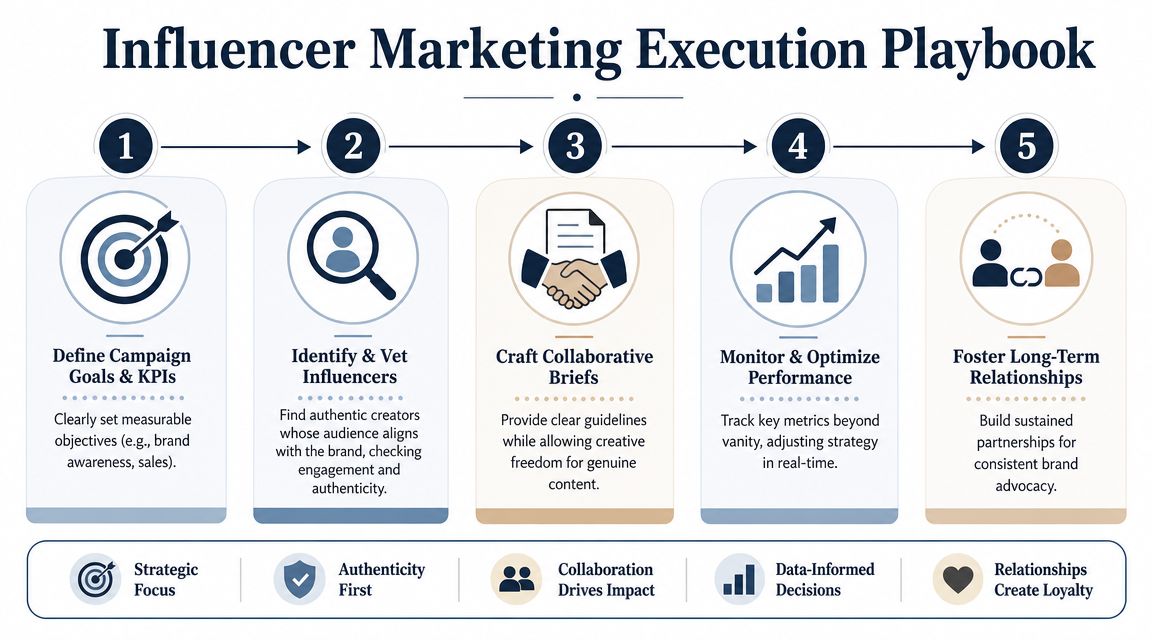
Beauty brands rarely fail at influencer marketing because they picked the wrong idea. They fail because they run the process loosely. The brief is vague. The wrong creators get approved. Usage rights aren't clear. Product seeding goes out late. Content arrives in the wrong format. Nobody knows which posts moved product. Then finance is chasing invoices while the brand team is already planning the next launch.
That's why influencer marketing in beauty needs an operating system, not just a sourcing list.
The profitable model is usually not celebrity-first
For beauty brands without massive budgets, a portfolio approach is more realistic. Business of Fashion cites data suggesting retail media networks can deliver up to 15% higher ROI in beauty, while also arguing for a mix of micro-creators and searchable content for brands that need better attribution and payment workflows (underserved marketing channels in beauty).
That aligns with what works operationally. Micro and mid-tier creators are often easier to brief, easier to test across segments, and more practical for sustained posting cadence. They also give the team more variation in hooks, tone, audience fit, and product demonstration style.
What good execution looks like
A clean workflow usually includes these steps:
Clear campaign goal
Awareness, conversion, creator whitelisting, UGC generation, retail sell-through support. Pick one primary goal.Creator shortlisting by fit
Match audience, product relevance, communication reliability, and content style. Don't choose on follower count alone.Briefing with room for authenticity
Include claims guardrails, usage instructions, mandatory deliverables, visual do's and don'ts, and examples of acceptable hooks.Live tracking
Monitor post timing, link usage, content quality, comment themes, and whether the message lands.Payment and compliance closeout
Brands often lose time and goodwill during this phase if the process is scattered.
A useful reference if you're testing older platforms alongside newer creator channels is AdStellar AI's piece on Facebook influencer ROI, especially for brands selling to audiences that don't live exclusively on TikTok.
Here's a video walkthrough worth watching before you build your next campaign process:
Where a campaign management platform helps
Once you're managing more than a handful of creators, manual coordination becomes the bottleneck. REACH is built for this operational layer. It gives brands and agencies an AI-powered campaign builder, a centralized dashboard to track content across TikTok, Instagram, YouTube, and other channels, plus tools for communication, deliverables, payments, and 1099 compliance in one workflow. For teams building beauty campaigns specifically, this guide to influencer marketing for beauty brands is a useful extension.
If your team can't see creator status, live content, approvals, and payments in one place, campaign scale will create more confusion than growth.
The point isn't to automate judgment. It's to remove admin drag so the team can spend more time on creator fit, message quality, and optimization.
Planning Campaigns and Measuring Real Success
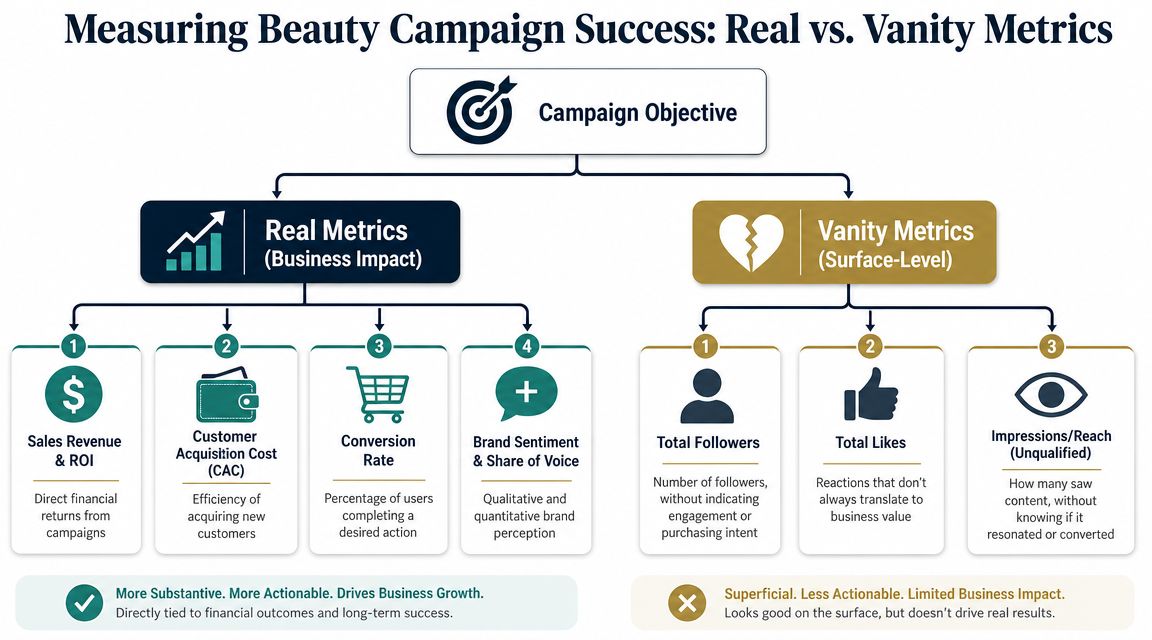
Beauty teams often over-report and under-learn. They produce polished dashboards full of reach, likes, and impressions, but can't answer a simple question: which creator, message, product angle, or landing page path changed buying behavior?
That's where analytics stops being a reporting function and becomes operating infrastructure. Beauty brands use data and AI to understand preferences, personalize recommendations, predict trends, and react faster to shifts in conversation. AI-powered tools can also automatically tag mentions by category and channel, which makes monitoring more scalable than manual review (data analytics in the beauty industry).
Set metrics by campaign purpose
The KPI should follow the campaign job. A launch campaign and a retargeting campaign shouldn't be judged the same way.
Use this simple alignment:
- Awareness campaigns: qualified reach, content saves, creator comment quality, branded search lift
- Education campaigns: watch-through, product page visits, add-to-cart progression, FAQ reduction
- Conversion campaigns: revenue, return on spend, new customer quality, checkout completion
- Retention campaigns: repeat purchase behavior, bundle take rate, replenishment timing
Build a feedback loop, not a postmortem
Most campaign reporting happens too late. By the time the team reviews the deck, the creators are paid, the assets are archived, and the learnings are already stale.
A better process looks like this:
- Before launch: define message hypotheses and tracking structure
- During campaign: review creator-by-creator performance and comment signals
- After first wave: shift budget, adjust briefs, swap hooks, refine landing pages
- After close: log reusable learnings by segment, format, and product type
Strong beauty marketing teams don't just measure results. They capture reusable pattern recognition.
The distinction matters. If one creator drives strong engagement but weak conversions, that may still be useful for top-of-funnel awareness. If another creator produces modest reach but strong product page movement, that creator may deserve more budget in direct response campaigns. Without a clean feedback system, both get misread.
Avoiding Common Pitfalls and Compliance Headaches
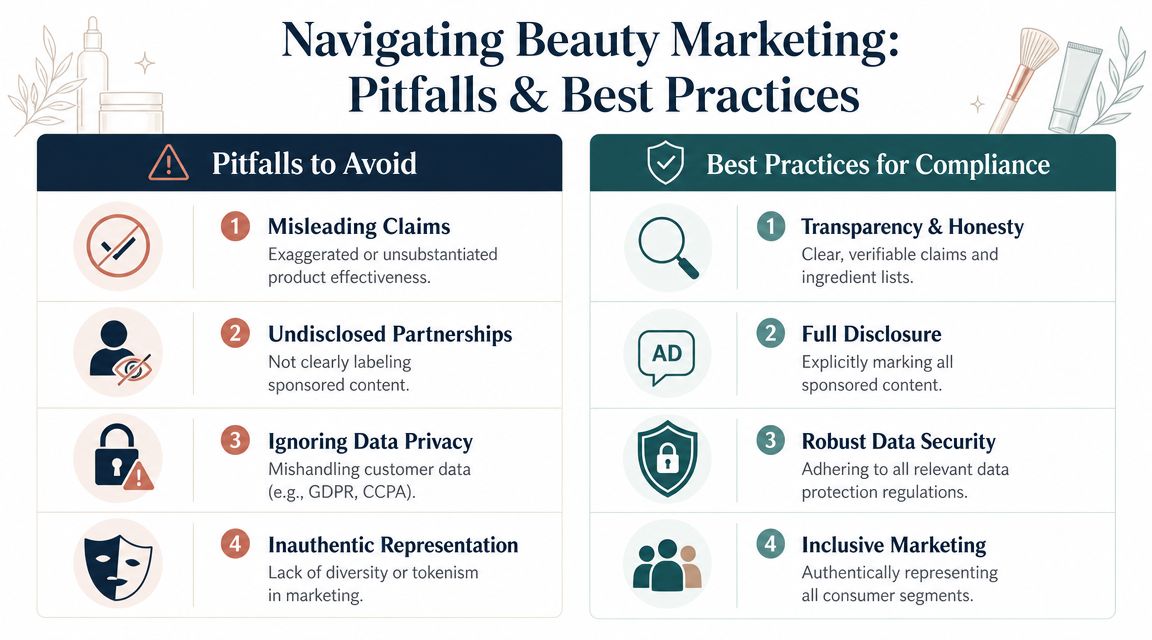
The glamorous side of beauty marketing gets the attention. The expensive mistakes usually happen in the unglamorous layer underneath. Claims, contracts, creator disclosures, data handling, and approval discipline don't feel exciting, but they protect margin and reputation.
The first trap is overclaiming. Beauty brands often drift into language that sounds persuasive but creates risk. If your team can't substantiate a performance claim, don't let it pass through product pages, ads, or creator briefs. The second trap is loose disclosure. Sponsored content needs clear labeling, and that expectation should be built into contracts and briefing documents, not handled informally after the fact.
The operational mistakes that hurt most
These issues show up constantly:
- Wrong creator fit: The creator has reach, but their audience doesn't trust beauty recommendations or doesn't match the product.
- Weak briefing: The team sends product notes, not a real brief. The result is off-message content and preventable revisions.
- No approvals structure: Assets arrive late, nobody owns review, and posting dates slip.
- Messy payment process: Slow payment damages creator relationships and makes future collaboration harder.
What disciplined teams do instead
The brands that avoid recurring problems usually standardize a few habits:
- Use claims guardrails: Approved language, restricted language, and escalation rules should be documented.
- Write usable briefs: Include audience, key pain point, proof points, visual direction, and mandatory disclosures.
- Track deliverables centrally: One source of truth prevents missed posts and approval confusion.
- Treat community feedback as signal: Comments often reveal message gaps, confusion, and objections before formal reporting does.
Compliance isn't a legal box to check at the end. It's part of campaign quality from the first brief onward.
In marketing beauty industry products, trust compounds slowly and breaks quickly. A misleading claim, inaccessible campaign, or sloppy partnership disclosure can undo months of good work. The operational discipline may feel tedious, but it's what allows creative campaigns to scale safely.
If your beauty team is spending too much time juggling creator DMs, spreadsheets, approvals, and payment follow-up, REACH can simplify the campaign workflow. It's built for what happens after creator discovery, so you can manage briefs, track content, organize deliverables, and handle payments in one place without adding more operational chaos.