 Skip to content

Think of social marketing goals as the destination you plug into your GPS before a road trip. It's the difference between a purposeful journey and just burning gas. Instead of vague ideas like "get more followers," you're setting specific, measurable targets for your social media that connect directly to your bigger business objectives, like driving sales or growing brand recognition. To hit those targets, you need a clear strategy and the right tools. Platforms like REACH Influencers give you the dashboard and analytics to turn ambitious goals into measurable ROI.
Table of Contents
- What Are Social Marketing Goals and Why Do They Matter?
- The Most Common Types of Social Marketing Goals
- How to Set SMART Social Marketing Goals
- How to Track and Measure Your Social Marketing Goals
- Common Questions About Social Marketing Goals
What Are Social Marketing Goals and Why Do They Matter?
Posting on social media without clear goals is like that road trip with no map. Sure, you're active—posting, sharing, and commenting—but you have no idea if you're actually getting anywhere. Your efforts feel random, and it's impossible to tell what's working or prove that your time and money are well spent.
This is where real social marketing goals come in. They give you direction. They’re the "why" behind every single post, campaign, or Instagram Story you create. This shifts your focus from chasing vanity metrics (like follower counts that don't pay the bills) to achieving real, tangible business results. It’s what separates the brands that truly win on social media from those just adding to the noise.
The Shift from Activity to Impact
Years ago, you could get by with just being active on social media. Success was measured by how many times you posted or how many followers you racked up. Not anymore. Today, it’s all about impact.
Every business is under pressure to show a clear return on investment (ROI), and social media is no exception. A goal like "get more likes" just doesn't cut it because it means nothing for the bottom line.
A goal like, "Increase website traffic from Instagram by 20% in Q3," is a completely different ballgame. It's specific, you can measure it, and it directly supports a core business objective like generating leads. It gives your team a clear finish line to run toward.
Aligning Goals with Business Priorities
Your social media goals should never exist in a vacuum. The best ones are tied directly to your company's overarching priorities. While building brand awareness is a common starting point, driving sales is often the ultimate objective.
In fact, new data shows that 29% of marketers now list revenue growth as their number one goal. With the average ROI from social media sitting at an impressive $5.20 for every $1 spent, it’s easy to see why. If you want to dive deeper, you can check out the full marketing statistics research from HubSpot.
For brands and agencies, this means tracking ROI is non-negotiable. This is where a dedicated platform becomes your best friend. For example, an influencer marketing platform like REACH acts as the GPS for your social strategy. It gives you the tools to set ambitious goals and track them with precision, helping you prove the value of your campaigns to stakeholders and make every dollar count.
Now that we understand what social marketing goals are and why they're so important, let's look at the most common types of goals you can set.
Key Social Marketing Goal Categories and Core Metrics
When you're ready to move past vague ambitions, it helps to think in terms of specific categories. Each category has a clear business objective and comes with its own set of metrics, or Key Performance Indicators (KPIs), that let you know if you're on the right track.
Here's a quick breakdown of the main goal categories and the KPIs you'll use to measure them.
| Goal Category | Primary Objective | Example Key Performance Indicator (KPI) |
|---|---|---|
| Brand Awareness | Increase visibility and recognition of your brand. | Reach, Impressions, Share of Voice |
| Audience Growth | Expand your community of followers and subscribers. | Follower Count Growth Rate, Audience Demographics |
| Engagement | Foster interaction and build a relationship with your audience. | Engagement Rate (likes, comments, shares), Mentions |
| Website Traffic | Drive users from social media to your website. | Click-Through Rate (CTR), Website Clicks, Bounce Rate |
| Lead Generation | Capture contact information from potential customers. | Leads Acquired, Cost Per Lead (CPL), Conversion Rate |
| Sales & Revenue | Generate direct sales from social media activities. | Revenue from Social, Return on Ad Spend (ROAS) |
| Customer Loyalty | Retain existing customers and build brand advocates. | Customer Lifetime Value (CLV), User-Generated Content |
This table gives you a solid starting point. Think of these as the primary "destinations" you can choose for your social media journey. The next step is to get specific about how you'll get there.
The Most Common Types of Social Marketing Goals
Before you can set powerful social marketing goals, you need to know what you're aiming for. Think of it like a menu of destinations for your social media strategy. While every brand's journey is different, most successful goals fall into just a few key categories. You can zero in on one at a time or mix and match them to support your bigger business plan.
This flowchart shows how fuzzy ideas can transform into strategic goals that actually drive business results.
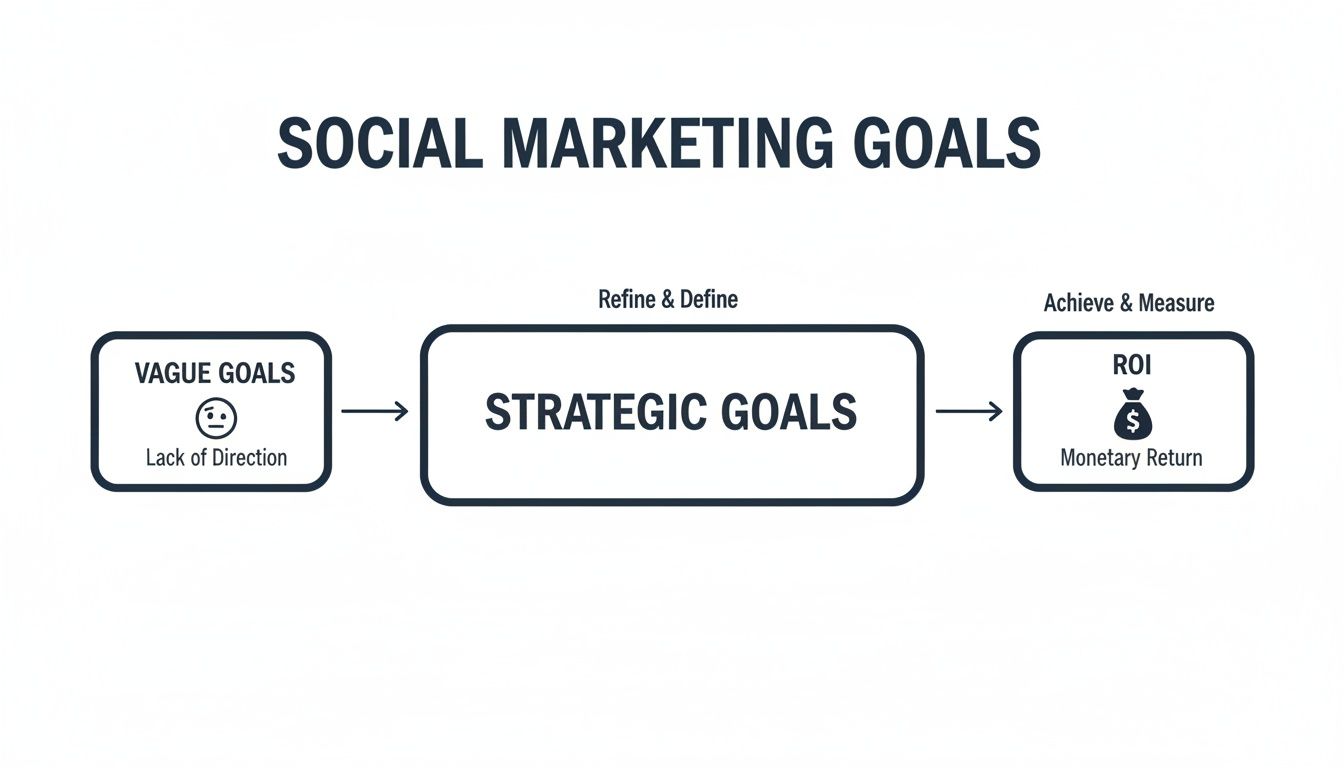
As you can see, there’s a clear path from "I wish we had more followers" to a real return on your investment. It all starts with getting specific.
Let's walk through the five most common types of social marketing goals every brand, creator, and agency should have on their radar.
1. Boost Brand Awareness
This is the most fundamental goal of all: simply getting your name out there. Brand awareness is all about making sure your target audience even knows you exist. It’s the very top of the funnel, where you’re making your first impression on people who could one day become customers.
- What it's really about: Creating content that's so good people can't help but share it, reaching a wide—but still relevant—audience.
- Why it matters: You can't sell to people who've never heard of you. Awareness lays the groundwork for every other marketing effort you'll make.
- What to track: Your Reach (the number of unique people who see your content) and Impressions (the total number of times your content is shown).
2. Generate Leads and Sales
This is where your social media efforts start to make a direct impact on the bottom line. The goal here is to turn your audience into actual customers by guiding them from a post to a purchase. This is where influencer marketing, in particular, has become a powerhouse.
The industry is seeing a huge shift. By 2026, influencer marketing is expected to overtake traditional paid ads as the top investment for brands. Why? Brands are reporting a 41% stronger ROI from their influencer partnerships compared to paid ads alone. You can dig into more of the 2026 marketing trends to see just how big this change is.
Platforms like REACH simplify this process completely. They let brands generate unique tracking links and discount codes for every influencer, so you can see exactly who is driving sales and what's working.
- What it's really about: Crafting compelling calls-to-action (CTAs), running promotions, and using features like shoppable posts to make buying easy.
- Why it matters: This goal provides hard proof of your social media's financial value, which is exactly what stakeholders love to see.
- What to track: Your Conversion Rate, Click-Through Rate (CTR), and Revenue per Campaign.
3. Build an Engaged Community
An engaged community is so much more than a follower count. It’s a tribe of loyal fans who actively talk to you and to each other. This goal is all about building real relationships instead of just broadcasting your message. It's how you turn casual followers into passionate brand advocates.
An engaged community is your brand's biggest asset. They provide priceless feedback, create user-generated content for you, and spread your message more authentically than any ad ever could.
- What it's really about: Hosting live Q&As, actually responding to comments, and encouraging your followers to share their own content featuring your brand (UGC).
- Why it matters: A strong community builds loyalty and trust, which leads to customers who stick around longer and do your marketing for you through word-of-mouth.
- What to track: Your Engagement Rate (the total likes, comments, and shares on a post) and Audience Growth Rate.
4. Drive Website Traffic
Sometimes, your main objective is just to get people off the social app and onto your own turf—your website or blog. This is a crucial goal for brands with a lot of content, B2B companies, or anyone who needs to guide users through a more complex customer journey.
- What it's really about: Sharing links to your blog posts, landing pages, and products with captions that make people want to click.
- Why it matters: Your website is a space you control. There, you can capture leads, share detailed information, and guide the entire customer experience without the distractions of a social feed.
- What to track: Website Clicks, Click-Through Rate (CTR), and the Bounce Rate from your social media referrals.
5. Enhance Customer Service
For many people, social media is the new 1-800 number. It's often the first place they go with a question or a complaint. Using your social channels as a customer support hub can completely change how the public sees your brand and keep your customers happy.
- What it's really about: Keeping an eye on your brand mentions, responding to questions quickly, and having a plan to handle issues either publicly or in a private message.
- Why it matters: Great social customer service proves you’re listening and you care. It builds trust and can even turn a customer's bad experience into a positive one.
- What to track: Your average Response Time and your Customer Satisfaction Score (CSAT).
How to Set SMART Social Marketing Goals
So, you've figured out the general direction you want to go. That's a great start, but a vague ambition like "get more engagement" is like wanting to drive "north" without a map. You'll never know if you've actually arrived.
To turn those broad goals into a real, actionable plan, you need a framework. The one that’s stood the test of time for a reason is SMART. It’s a simple acronym that forces you to get serious about what you want to achieve, turning fuzzy wishes into concrete targets. In fact, research shows that setting goals this way makes you 377% more likely to report a successful campaign.
Let's break down what it actually means in practice.
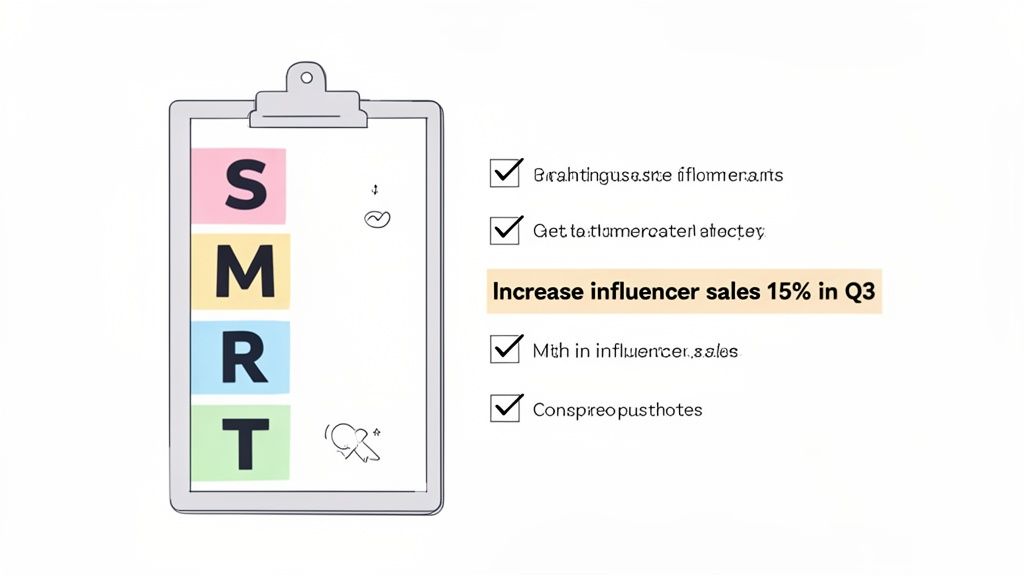
Specific
First things first, your goal has to be crystal clear. "Increase sales" is a wish, not a goal. A specific goal answers the basic questions: who, what, where, and why?
- Vague: We want more sales from social media.
- Specific: We want to increase sales of our new sneaker line from our Instagram influencer program.
See the difference? Now everyone knows exactly what the mission is.
Measurable
If you can't measure it, you can't manage it—it's that simple. A measurable goal has a number or a percentage attached to it. It’s the finish line that tells you whether you've won the race.
This is where a tool like REACH becomes your best friend. Instead of flying blind, you can use its analytics dashboard to track the exact metrics that matter—conversion rates, clicks per influencer, or total revenue. This makes your goal truly measurable from day one. If you're not sure what to track, start by exploring the top social media engagement metrics to get a handle on what's important.
- Vague: We want to increase sales a lot.
- Measurable: We want to increase sales by 15%.
Achievable
You want to stretch your team, not break them. A good goal should feel ambitious but not impossible. The key is to look at your past performance and industry benchmarks to find that sweet spot.
For example, aiming for a 15% sales bump is a solid goal if your past campaigns pulled in a 5-10% increase. This is another spot where a platform can help ground your ambitions in reality. By using the REACH influencer discovery tool, you can find partners whose past results suggest your target is realistic. It stops you from partnering with creators whose audience just isn't a good fit, which would make any sales goal a long shot.
Key Insight: An achievable goal is grounded in data, not just optimism. It considers your team's resources, your budget, and historical performance to find the sweet spot between ambition and reality.
Relevant
This one seems obvious, but it's where a lot of strategies fall apart. Your social media goal must support your company's bigger picture. If the main business objective is driving revenue, a social goal focused purely on growing followers might be a distraction.
Your goal has to answer the question: "So what?" To set truly relevant goals, it helps to understand what tactics actually move the needle in your industry, like the actionable clothing brand marketing strategies used by successful brands.
- Irrelevant: Increase our TikTok follower count by 30% (when the company’s real goal is to boost e-commerce revenue).
- Relevant: Increase online sales from our influencer program by 15% (which directly supports the company's revenue goal).
Time-Bound
A goal without a deadline is just a dream. Setting a timeframe creates urgency and gives everyone a clear schedule. Without a deadline, it's too easy for important objectives to get pushed to the back burner and drag on forever.
- Vague: We will increase sales by 15% sometime this year.
- Time-bound: We will increase sales by 15% in Q3 of this year.
When you put it all together, you get something powerful.
- Before SMART: "Let's sell more products with influencers."
- After SMART: "We will increase online sales from our influencer program by 15% in Q3 2026 to drive revenue for our new sneaker line."
That level of clarity is a game-changer. It gives your team a target, a way to measure progress, and a deadline. This isn't just busywork; it's the foundation of every great social media strategy.
From Goal Setting to Campaign Execution with REACH
Alright, you’ve put in the work and hammered out a solid, SMART goal. So… what now? This is where the rubber meets the road—turning that well-crafted objective into an actual influencer marketing campaign that gets results.
A great strategy is one thing, but execution is everything. This is where a dedicated platform becomes your best friend, acting as the bridge between your big-picture goals and the day-to-day actions needed to hit them.
Whether you're aiming to get your brand name on everyone's lips or drive a surge in sales, the right tools help you connect that goal to concrete steps. It’s all about finding the perfect creators, setting up the campaign for success, and keeping a close eye on your KPIs.
From Awareness Goals to Real-World Reach
Let’s imagine your goal is pure brand awareness. Maybe your specific target is: "Increase brand reach by 30% among women aged 25-40 in the fitness space by the end of Q4." That's a great goal. But how do you actually make it happen?
Instead of taking a shot in the dark, you can use a discovery platform like REACH to pinpoint creators who are a perfect fit. And it’s not just about finding people with a huge follower count; it’s about finding a genuine connection with the right audience.
Here’s how you’d tackle it:
- Find Your Niche Experts: Jump into the discovery engine and filter for creators who live and breathe fitness and have a strong following of women in that 25-40 age bracket.
- Look for Real Engagement: Pay close attention to creators with high engagement rates. A smaller, passionate community is often way more valuable for true reach than a massive, silent one.
- Track Reach and Impressions: Once your campaign kicks off, you’ll be watching reach and impressions like a hawk. A platform like REACH pulls all this data together, showing you exactly which partners are killing it at getting your brand in front of fresh eyes.
From Sales Goals to a Healthy Bottom Line
But what if your goal is less about eyeballs and more about ringing the cash register? Let's say you're aiming to "Increase online sales from our influencer program by 15% in Q3." This calls for a totally different playbook focused on one critical thing: attribution. You need to know, without a doubt, which influencer drove which sale.
This is more important than ever. Social commerce is booming, with global sales projected to top $1.3 trillion by 2026. And get this—shoppable content converts 1.7 times better than standard brand posts.
To get a piece of that action, you have to equip your influencers with the tools they need to turn their followers into your customers.
A sales-focused campaign lives and dies by its tracking. Without unique links and codes, you're just hoping for the best. With them, you have concrete data that proves your ROI.
This is where a platform's built-in commerce tools are a game-changer. For example, REACH makes tracking incredibly straightforward:
- Generate Unique Tracking Links: For every single influencer, create a distinct URL. This is your secret weapon for seeing exactly how many clicks and sales each person is generating.
- Assign Custom Promo Codes: Give each creator a unique discount code to share (like "SARA15"). It’s a great incentive for their audience and another crystal-clear way to track who's driving sales.
- Watch the Sales Roll In (in Real-Time): The best platforms give you a live dashboard. You can instantly see which creator’s content is resonating and which discount codes are flying off the virtual shelves.
This screenshot from the REACH platform gives you a perfect example of what that looks like—all your key metrics in one clean view.
From here, you can spot your top-performing influencers, keep an eye on your budget, and track crucial metrics like clicks and conversions. It’s all about having the data you need to make smart decisions on the fly. If you want to see how this could look for your business, you can explore how to find the right influencers for brands on our platform.
By connecting your high-level social marketing goals directly to these specific, platform-driven actions, you’re creating a straight line between strategy and real business impact. That's the key to running campaigns that don’t just create a little buzz—they build your bottom line.
How to Track and Measure Your Social Marketing Goals
So, you’ve set your social marketing goals. That's a huge first step, but let's be honest—that's where the real work begins. Once your campaign is live, you're officially in the driver's seat, and the data streaming in is your dashboard. Without a plan for checking that dashboard, you're just driving blind and hoping you end up somewhere good.
This is where you shift from just launching campaigns to actively steering them. It’s all about creating a feedback loop: measure your performance, understand what the numbers are telling you, and use those insights to make smart adjustments.
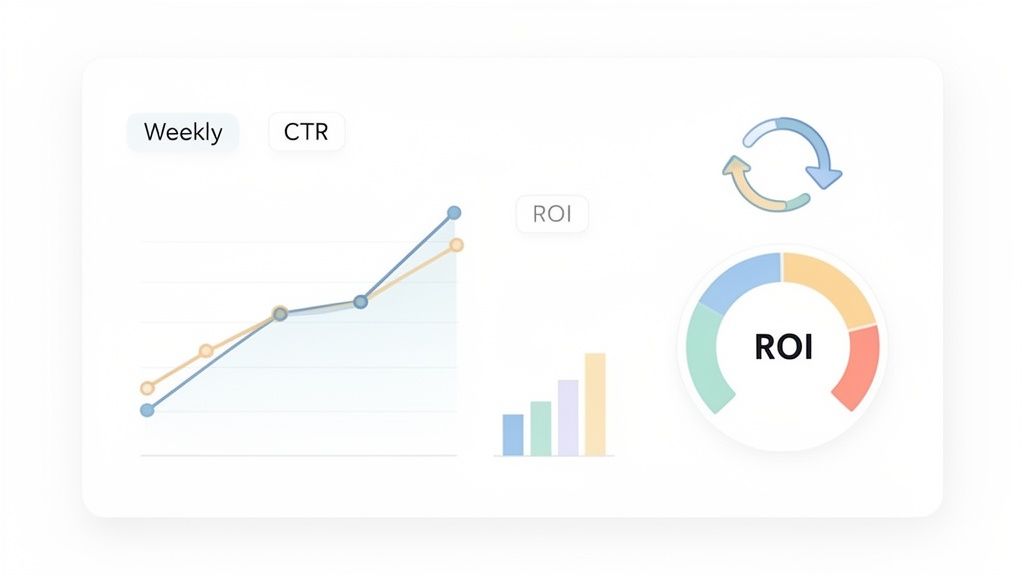
The key is to move past simply collecting data and start analyzing it. This is what separates campaigns that fizzle out from those that build serious momentum.
Setting a Rhythm for Your Reporting
To keep your strategy from going off the rails, you need a consistent reporting rhythm. This keeps everyone on your team on the same page and shows stakeholders that you're on track. But you don't need to look at every single metric every single day. The trick is looking at the right data at the right time.
- Weekly Check-ins: Think of these as your quick pulse checks. You're looking at tactical, short-term metrics like engagement rates, follower growth, and click-through rates (CTR). It’s your chance to spot what’s working right now and make small tweaks, like boosting a popular post or adjusting your publishing times.
- Monthly Reviews: Now you can zoom out a bit. This is where you measure progress against your monthly targets. Did video content outperform images? Which influencers drove the most traffic? Answering these questions helps you plan the next month's content with much more confidence.
- Quarterly Business Reviews (QBRs): This is the big-picture view. Here, you tie all your social media activity back to core business objectives. You’ll present your return on investment (ROI), cost per acquisition (CPA), and overall progress toward your main social marketing goals. This is the meeting where you prove the value of your work to leadership.
For agencies juggling multiple clients, this whole process can be a massive time sink. This is exactly where a platform like REACH becomes a game-changer. It automates all that tedious data gathering and creates clean, live reports you can share directly with clients. You get to spend your time analyzing results, not stuck in a spreadsheet nightmare. Having a solid grasp of social media measurement is the foundation for all of this.
To help structure this, here’s a simple framework you can adapt for your own reporting.
Goal Tracking and Reporting Cadence
| Metric Category | Tracking Frequency | Key Metrics to Report | Reporting Tool/Platform |
|---|---|---|---|
| Engagement & Community | Daily / Weekly | Comments, Shares, Likes, DMs, Follower Growth | Native Social Platforms, REACH |
| Traffic & Clicks | Weekly | Click-Through Rate (CTR), Landing Page Views, Cost Per Click (CPC) | Google Analytics, Bitly, REACH |
| Conversions & Leads | Monthly | Sign-ups, Downloads, Form Fills, Cost Per Lead (CPL) | CRM (e.g., HubSpot), Google Analytics |
| Revenue & ROI | Monthly / Quarterly | Sales Attributed to Social, Cost Per Acquisition (CPA), Return on Ad Spend (ROAS) | E-commerce Platform (e.g., Shopify), REACH |
This table is just a starting point. The key is to create a schedule that gives you the insights you need, right when you need them, without getting overwhelmed by the noise.
Turning Data Into Action
Collecting data is easy. The hard part is figuring out what it all means and what to do about it. The goal is to find the story behind the numbers.
Key Takeaway: Data is just noise until you give it meaning. Your job isn't to report every metric—it's to find the insight that tells you what to do next.
As you look over your campaign results, ask yourself a few simple but powerful questions:
- Who or what drove the most conversions? Pinpoint the exact influencers or content pieces. Was there something special about their message or call-to-action?
- What format got the most love? Was it video? Carousels? A really compelling photo? Double down on what your audience is responding to.
- Where did people lose interest? If they clicked the link but didn't buy, the problem might not be your social post—it could be a clunky landing page.
When you start answering these questions, you create a powerful feedback loop. You might discover that a handful of micro-influencers deliver a far better ROI than one celebrity, or that short, snappy videos with a clear CTA are your golden ticket.
These are the insights that let you stop guessing and start making strategic, data-backed decisions. This is how you consistently hit and then blow past your social marketing goals. For more expert takes on turning analytics into strategy, checking out resources from places like the Content Marketing Institute is always a smart move.
Common Questions About Social Marketing Goals
As you start putting your strategy together, a lot of questions come up. It's totally normal. Setting good social marketing goals isn't just about chasing a metric—it's about making sure your day-to-day actions actually connect back to your bigger business objectives.
Let's walk through some of the most common questions we hear from brands, agencies, and creators.
How Many Social Marketing Goals Should I Set at Once?
It’s so tempting to try and do it all. Brand awareness! Engagement! Sales! But that’s a surefire way to spread your team too thin and end up with muddled results.
The best move is to zero in on 2-3 primary goals per quarter. This gives your team the focus it needs to dedicate real resources and make a measurable impact.
Start by figuring out the single most important thing your business needs to achieve in the next 90 days. From there, pick one main social media goal that directly pushes that objective forward, then add one or two secondary goals to support it. This gives you a clear pecking order for all your efforts.
- For example: A direct-to-consumer brand’s top priority is to drive more revenue in Q3.
- Primary Goal: Increase sales from social media by 10%.
- Secondary Goal: Grow our engaged community by 5% to build a base for future sales.
This focused approach makes it crystal clear what's working and what isn't. When you use a platform like REACH, you can run separate campaigns for each goal with their own unique tracking. This lets you measure progress toward your sales and community goals at the same time, without getting the wires crossed.
What Is the Difference Between a Goal, a Strategy, and a Tactic?
It’s really easy to mix these three up, but getting them straight is the key to clear, actionable planning.
Think of it like planning a road trip. The goal is your final destination, the strategy is your chosen route on the map, and the tactics are the individual turn-by-turn directions.
Let's break it down with a social media example:
- Goal (The "What"): This is your destination—the specific, measurable result you're aiming for. For instance, "Increase website traffic from Instagram by 20% in Q4."
- Strategy (The "How"): This is your high-level plan for getting there. For example, "We'll partner with 10 lifestyle influencers to promote our new blog content and drive clicks."
- Tactic (The "Action Steps"): These are the concrete, specific tasks you'll execute. This includes things like, "Use REACH to find influencers whose followers are mainly 25-34 year olds," "Create unique tracking links for each influencer," and "Set up a campaign requiring 2 Instagram Stories and 1 in-feed post from each creator."
The goal is your ultimate destination. The strategy is your roadmap to get there. The tactics are the daily actions that move you forward.
How Often Should I Adjust My Social Marketing Goals?
You should be reviewing your big-picture goals quarterly. This timing lines up perfectly with most business planning cycles and gives your strategies enough breathing room to actually show results. If you're constantly changing your main objective, your team will always be playing catch-up, and no single strategy will ever get the chance to gain traction.
But that doesn't mean you set them and forget them for three months. You absolutely need to be checking in on your key performance indicators (KPIs) weekly or bi-weekly. This constant monitoring is what allows you to make smart tactical pivots without throwing your entire strategy out the window.
For instance, if you notice one influencer's content is driving a way higher click-through rate, you might decide to shift more of your budget toward similar creators mid-quarter. The live dashboards in platforms like REACH are built for this kind of real-time analysis, helping you optimize campaigns as they happen.
My Follower Count Is Growing but My Sales Are Not. What Is Wrong?
Ah, the classic problem. If we had a dollar for every time we heard this one! It’s a dead giveaway that you're chasing a vanity metric (follower count) instead of a metric that actually impacts your bottom line (sales).
A huge following looks great on paper, but it doesn't pay the bills. If your follower count is climbing but sales are flat, it almost always comes down to one of these three things:
- You're Attracting the Wrong Audience: You might be gathering fans, not customers. These are people who enjoy your content and think your posts are cool, but they either don't need or have no intention of buying what you sell.
- Your Content Isn't Built to Convert: Your posts might be racking up likes and comments, but they're missing a clear call-to-action (CTA) or a compelling reason for someone to stop scrolling and actually buy something. Entertainment doesn't automatically lead to a transaction.
- There's a Hang-Up in the Buying Process: Sometimes the problem isn't your social media at all. A follower might click your link ready to buy, but a slow-loading website, a confusing checkout, or a broken link can stop the sale cold.
To fix this, your primary goal needs to shift from "follower growth" to something like "conversion rate from social." Use a tool like the REACH discovery engine to find influencers whose audiences are a perfect match for your ideal customer. Then, use trackable links and promo codes to see who is really driving revenue.
Setting effective social marketing goals is the first step toward building a strategy that delivers real business impact. By focusing on measurable, relevant objectives and using a powerful platform to track your progress, you can move beyond vanity metrics and prove the true ROI of your social media efforts.
Ready to turn your ambitious social marketing goals into measurable results? With REACH, you can find the perfect influencers, track every click and conversion in real-time, and prove your ROI with automated reports. Stop guessing and start growing. Discover how REACH can power your next campaign.