 Skip to content

A social media dashboard is your unified command center for marketing. In an age of scattered data and endless browser tabs, it pulls all your performance metrics from every social platform into a single, easy-to-understand view. It’s the essential tool that separates organized, data-driven strategy from marketing chaos, allowing you to track what works, prove your value, and make intelligent decisions without guesswork.
For brands and agencies, especially those leveraging influencer marketing, a robust social media dashboard is non-negotiable. Platforms like REACH Influencers have integrated these dashboards into their core, providing an end-to-end solution that goes beyond simple metrics. This guide will walk you through exactly what a social media dashboard is, what to look for, which metrics matter, and how to use one to drive real growth.
Table of Contents
- What Is a Social Media Dashboard?
- What to Look For in a Great Social Media Dashboard
- The Key Metrics for Your Social Media Dashboard
- How Professionals Use a Social Media Dashboard
- How to Set Up Your Social Media Dashboard
- Frequently Asked Questions (FAQ)
What Is a Social Media Dashboard?
Trying to manage your social channels without a social media dashboard is like trying to fly a 747 by looking at dozens of disconnected gauges scattered around the cockpit. You’d spend all your time scrambling to gather information, never actually steering the plane effectively. It’s inefficient and incredibly chaotic.
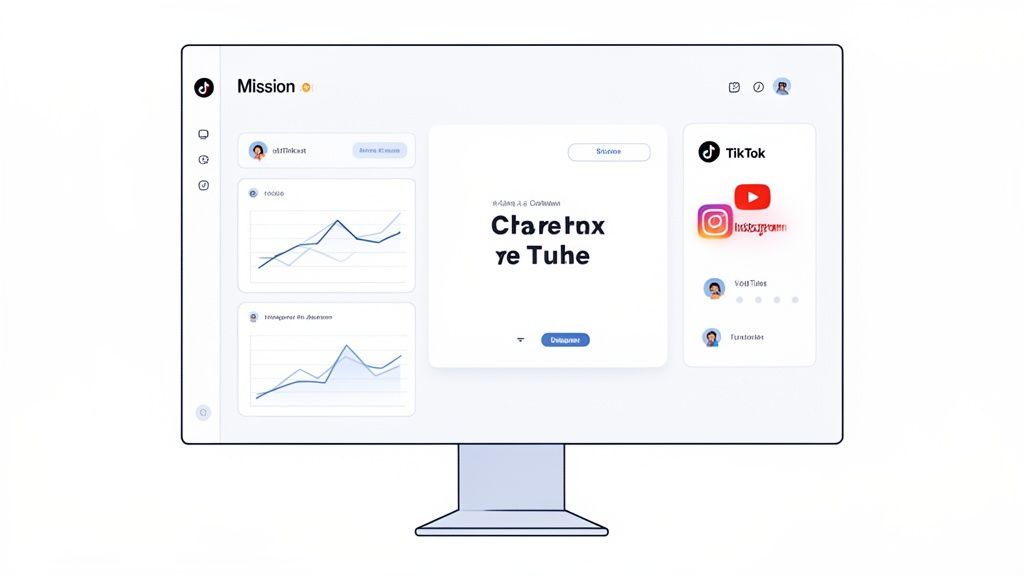
A social media dashboard is your integrated flight deck. It connects directly to your accounts on TikTok, Instagram, Facebook, YouTube, and other platforms, pulling all critical metrics into one visual, cohesive interface. Instead of manually logging into each app to check follower growth, engagement rates, or ad spend, you see it all in a single, unified view. This doesn't just save time—it provides total clarity.
With a social media dashboard, you establish a single source of truth. Suddenly, your entire team—from the social media manager to the CMO—is looking at the same data. This alignment eliminates confusion and empowers everyone to make faster, more strategic decisions based on a complete and accurate picture.
From Simple Tracking to Strategic Command
A truly powerful social media dashboard does more than just display numbers; it helps you understand the story behind the data. This is particularly crucial in influencer marketing, where a campaign's success hinges on a multitude of moving parts. A specialized dashboard is essential for demonstrating Experience, Expertise, Authoritativeness, and Trustworthiness (E-E-A-T).
For example, the centralized campaign dashboard built into the REACH Influencers platform gives you an end-to-end view of your entire influencer operation. It allows you to move beyond vanity metrics to see the complete campaign lifecycle unfold:
- Influencer Performance: Instantly identify which creators are driving the most clicks, conversions, and engagement.
- Campaign ROI: Directly connect social media activity to business goals like revenue and sign-ups to prove what’s working.
- Content Approvals: Manage the entire creative workflow from first draft to final post, all in one streamlined place.
- Payment & Contracts: Automate influencer payments and track agreements without ever leaving the dashboard.
This integrated approach is the new industry standard. According to Data Insights Market, the market for Social Media Analytics Tools is projected to skyrocket to $16.53 billion by 2025, growing at an incredible rate of 24.9% annually. With the number of daily social media users expected to hit 5.2 billion in 2026, the need to effectively manage multiple social media accounts is more critical than ever. Manually tracking performance in spreadsheets is no longer a viable option. A powerful social media dashboard is your key to working smarter and turning complex data into a competitive advantage.
What to Look For in a Great Social Media Dashboard
Not all social media dashboards are created equal. A basic tool might show you a few metrics, but a truly great one becomes the command center for your entire marketing operation. It empowers you to not just view data, but to understand, improve, and grow your strategy effectively.
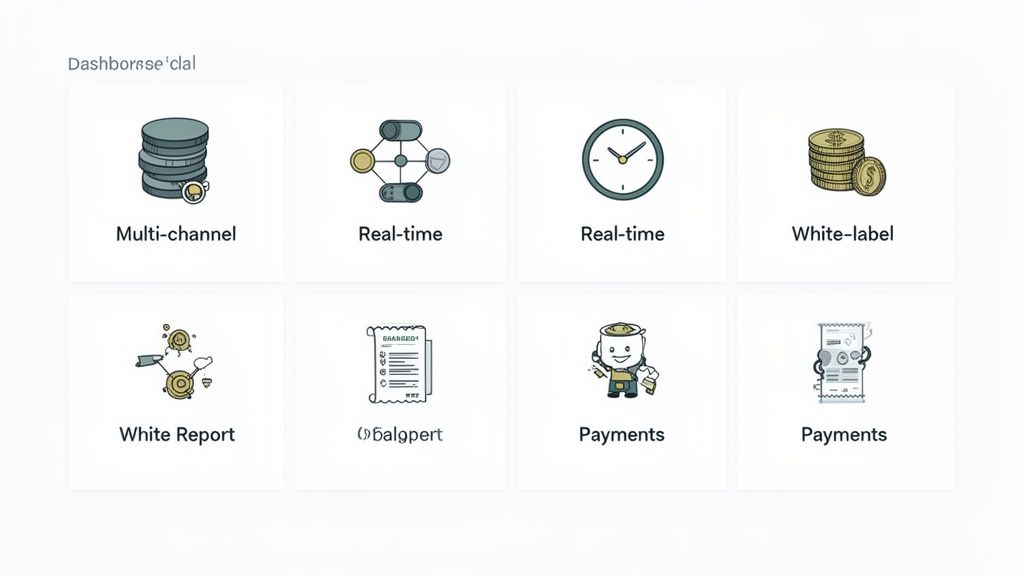
The first non-negotiable feature is multi-channel aggregation. Think of it as a universal remote for all your social accounts. Instead of logging into TikTok, then Instagram, then YouTube, it pulls all that data into one clean, unified view. This prevents you from drowning in a sea of open tabs and ensures your reports are consistent and error-free. You can finally compare apples to apples and see what’s truly resonating on each platform.
See What’s Happening, as It’s Happening
Social media moves at lightning speed. A post can go viral (or flop) in hours. If you’re waiting on weekly or even daily reports, you’re always playing catch-up. That's why real-time performance tracking is essential.
With a live feed of your campaign data, you can:
- Spot a viral hit instantly: See a post taking off? You can immediately put more budget behind it to amplify its reach.
- Kill bad ads before they drain your budget: If an ad has a terrible click-through rate, you can pause it immediately instead of discovering the waste a week later.
- Join conversations in the moment: Capitalize on trending topics as they happen, making your brand a relevant part of the cultural conversation.
This is the difference between reacting to old news and making proactive decisions that directly impact your campaign’s success.
Features That Solve Real Business Problems
The best dashboards go beyond tracking metrics; they solve the real-world problems that slow down agencies and marketing teams. A perfect example is white-label reporting. This feature allows an agency to add its own logo to a client report, turning a software-generated document into a professional, branded deliverable that builds immense client trust.
For teams running influencer marketing, integrated tools are a game-changer. Seeing an influencer’s engagement rate is one thing, but managing the entire relationship in the same place is another.
When your operational tools are built directly into your analytics dashboard, you eliminate friction. You stop just watching performance and start actively managing the entire process from a single screen.
For instance, a top-tier influencer marketing platform like REACH Influencers doesn't just show you how an influencer’s content performed. It also handles the complex logistics behind the scenes.
- Integrated Payment Processing: Automate and track payments to creators directly from the dashboard, eliminating the need for manual bank transfers and invoice chasing.
- Built-in Contract Management: Send, sign, and store influencer agreements right where you track their results, tying legal documentation directly to performance data.
This deep integration separates a simple tool from a professional platform. The social media dashboard becomes the single source of truth for everything related to your campaign, creating a seamless workflow where you can find a creator, sign a contract, monitor their content in real-time, and process payment—all without leaving the platform. To see how these reports fit into a broader strategy, check out our guide on digital marketing reporting tools. This all-in-one capability empowers teams to scale their work and prove their value from start to finish.
The Key Metrics for Your Social Media Dashboard
A social media dashboard can present a firehose of data. Likes, shares, follower counts—it's easy to get lost in vanity metrics that feel good but don't signal real business impact. To prove the value of your efforts, you must focus on Key Performance Indicators (KPIs) that show tangible results.
According to leading industry analysis, the most important key social media analytics metrics for 2025 fall into two categories: core business metrics and specialized influencer marketing metrics. A great social media dashboard separates the signal from the noise and presents both clearly.
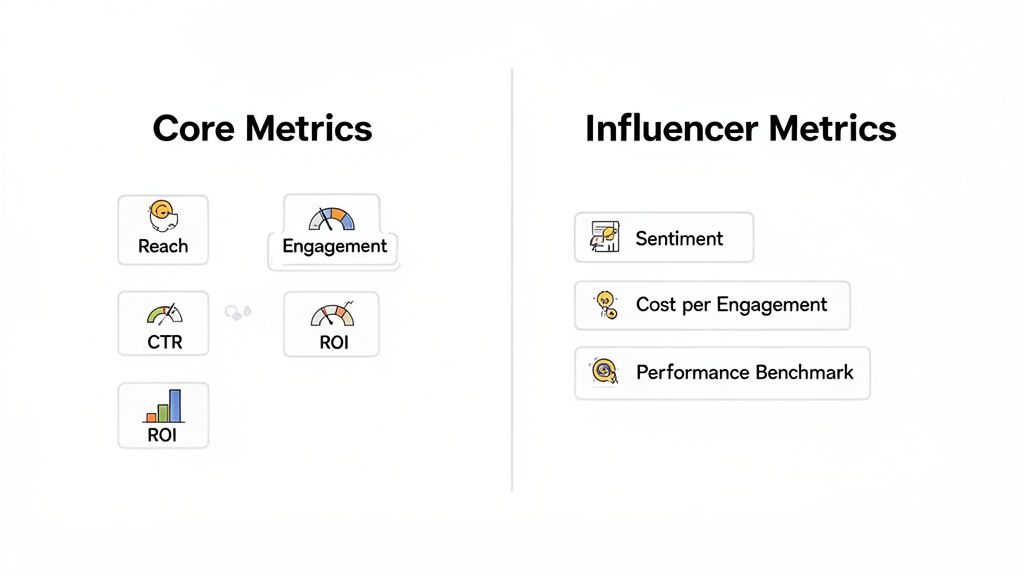
How do you distinguish between the numbers that matter for your overall brand health versus those that pinpoint the success of a specific creator collaboration? This table breaks it down.
Core Business KPIs vs. Influencer-Specific Metrics
| Metric Category | Key Performance Indicator (KPI) | What It Measures |
|---|---|---|
| Core Business | Reach | The total number of unique people who saw your content. |
| Core Business | Engagement Rate | The percentage of your audience that actively interacted with a post. |
| Core Business | Click-Through Rate (CTR) | How many people saw your content and clicked the link inside it. |
| Core Business | Return on Investment (ROI) | The direct revenue generated from your social media spending. |
| Influencer-Specific | Audience Sentiment | The feeling behind the comments—positive, negative, or neutral. |
| Influencer-Specific | Cost Per Engagement (CPE) | How much each interaction (like, comment, share) costs you. |
| Influencer-Specific | Influencer Benchmarks | How one creator's performance compares to others or the campaign average. |
By tracking both sets of KPIs, you get a complete picture—not just of your social media presence, but of how your partnerships contribute to the bottom line.
Core Business Metrics for Every Campaign
These are the foundational numbers for your entire social media operation. They tell you if people are seeing your content and, more importantly, if they care.
- Reach: Simply put, this is your audience potential. Great content is useless if no one sees it. This is step one.
- Engagement Rate: This reveals if your content connected with people. A high engagement rate means your posts are sparking conversations and building a community.
- Click-Through Rate (CTR): This shows how effective your content is at driving action, like visiting your website or product page.
- Return on Investment (ROI): This is the ultimate proof of success. ROI connects all your social media costs directly to the revenue it generates. A positive ROI is the clearest sign your strategy is working.
Tracking these numbers helps you shift the conversation from "How many likes did we get?" to "How much business did that campaign drive?"
Influencer-Specific Metrics You Can't Ignore
Working with influencers adds another layer of data. You’re measuring the effectiveness of a partnership, so your social media dashboard needs to go deeper. The centralized campaign dashboard in REACH Influencers, for example, is built to surface these specific insights, showing you exactly what’s working.
An influencer partnership isn't just a one-off post. You're investing in a relationship, and the right metrics tell you if that relationship is authentic, valuable, and worth continuing.
Key metrics to watch:
- Audience Sentiment: What are people actually saying? Sentiment analysis tells you if the conversation around your brand is positive, negative, or neutral.
- Cost Per Engagement (CPE): This is all about efficiency. CPE breaks down how much you paid for every interaction, helping you compare the value you get from different influencers.
- Influencer Performance Benchmarks: A good dashboard lets you stack influencers up against each other and your campaign average, quickly revealing top performers.
These metrics are critical for optimizing your influencer budget. To learn more about this process, explore our complete guide on what is social media measurement.
How Professionals Use a Social Media Dashboard
A social media dashboard isn't a one-size-fits-all gadget. Its true power is revealed when you see how it solves the unique, day-to-day challenges of different professionals. For a sprawling agency, a focused brand, or a solo creator, the right dashboard becomes an indispensable tool for mastering their work.
For the Fast-Paced Marketing Agency
Imagine running an agency with ten clients, each with a presence on Instagram and TikTok. Without a social media dashboard, your week is a nightmare of manual data entry and last-minute reporting. With one, you log in once and get a bird's-eye view of all ten clients, checking stats in real-time.
Here’s how a dashboard helps agencies:
- Scaling Operations: Easily manage 20 or 30 clients as smoothly as ten.
- Impressing Stakeholders: Generate professional, white-label reports in minutes.
- Boosting Client Results: Spot patterns across accounts and apply winning strategies to lift everyone's results.
A social media dashboard transforms an agency from a group of frantic account managers into a streamlined, data-driven machine. It automates grunt work, freeing your team to focus on the brilliant strategy clients pay for.
For the In-House Brand Team
As a brand manager at a DTC startup, your world revolves around driving sales and proving ROI. A basic analytics tool won't cut it. You need an integrated social media dashboard that speaks the language of business.
With a platform like REACH Influencers, your dashboard becomes the command center for the entire campaign lifecycle. When you launch a new product with micro-influencers, you can track everything from a single screen.
- Real-Time ROI Tracking: See which influencer's discount code drives the most sales, drawing a straight line from their content to your revenue.
- Streamlined Influencer Management: Find influencers, manage contracts, approve content, and handle payments—all in one place.
- Confident Decision-Making: When the CFO asks if the influencer program is working, you have a data-backed answer with precise CPA and ROAS.
This changes the narrative, positioning the marketing team as a powerful revenue driver.
For the Ambitious Creator
As a full-time content creator, you're a one-person business. A social media dashboard built for creators, like the one inside the REACH platform, gives you the data and structure to operate like a pro.
- Transparent Performance Data: Easily see your engagement rates and audience demographics to price your work fairly.
- Professional Contract Management: Handle contracts digitally within the platform, eliminating misunderstandings.
- Guaranteed Timely Payments: Integrated payments ensure you get paid automatically, letting you focus on creating great content.
For creators, a dashboard is an empowerment tool, providing the data to prove their value and run their personal brand like a scalable business.
How to Set Up Your Social Media Dashboard
You're sold on the idea of a social media dashboard. Now, how do you pick the right one and get it running without a headache? The process is straightforward with a bit of planning. Think of it like test-driving a car—it needs to be the right fit for your team, clients, and goals.
Social Media Dashboard Evaluation Checklist
Use this checklist to cut through marketing fluff and focus on what counts when choosing a social media dashboard.
| Evaluation Criteria | What to Look For | Why It Matters |
|---|---|---|
| Scalability | Does the platform grow with you? Check if you can easily add more social accounts, users, and client projects without steep price increases. | Your tools shouldn't hold your business back. You need a solution that can handle your success. |
| Integration Capabilities | Does it connect to all your social platforms, plus other tools like your CRM or Google Analytics? | A dashboard should be a central hub, not another data silo. Seamless integrations save time and provide a complete marketing picture. |
| User Experience (UI) | Is it genuinely easy to use? Look for a clean, intuitive interface. A confusing UI will lead to low team adoption. | If a tool is difficult to navigate, your team won't use it. A great UI means less training and more doing. |
| Reporting & Customization | Can you build the reports stakeholders want? Look for flexible report builders, custom views, and white-label options. | Generic reports don't tell the whole story. You need to focus on the KPIs that matter and present them professionally. |
The right platform simplifies your work, it doesn't create more of it.
Your Step-by-Step Implementation Roadmap
A planned rollout makes all the difference. This simple game plan ensures a smooth launch:
- Connect Your Accounts: Link all your social media profiles. A good platform will walk you through this authorization process.
- Set Up Your Tracking: Configure your main view to highlight core KPIs like engagement rate, conversion value, and ROI.
- Customize Views and Reports: Create custom views for different stakeholders and set up automated reports.
- Onboard the Team: Walk everyone through the features that will make their jobs easier.
A great social media dashboard shouldn't require weeks of setup. For a look at a tool designed for a fast start, see how our marketing dashboard software works.
Frequently Asked Questions (FAQ)
Even after seeing what a social media dashboard can do, a few questions often come up. Let's clarify the most common ones.
Can a Social Media Dashboard Track Competitors?
Yes, and it’s a powerful feature. Most dashboards let you monitor competitors’ public activity, such as follower growth, engagement rates, and top-performing posts. This provides valuable insights to help you spot trends and refine your own strategy, giving you a competitive edge.
Is It Just a Fancy Scheduling Tool?
No. A scheduling tool's job ends when a post goes live. A real social media dashboard, like the one in REACH Influencers, starts where a scheduler stops. It's an end-to-end campaign management platform that includes:
- Real-time analytics to measure post-publication performance.
- Influencer discovery tools to find creators.
- Contract and payment features for administration.
- Content approval workflows for team collaboration.
A scheduler just delivers the mail; a dashboard is the entire operations center.
Is a Dashboard Really Useful for a Small Business?
Absolutely. A social media dashboard allows a small team—or even one person—to operate with the efficiency of a much larger department. It automates manual data collection, freeing you up to focus on strategy. This levels the playing field, allowing you to compete with bigger players without needing a big budget.
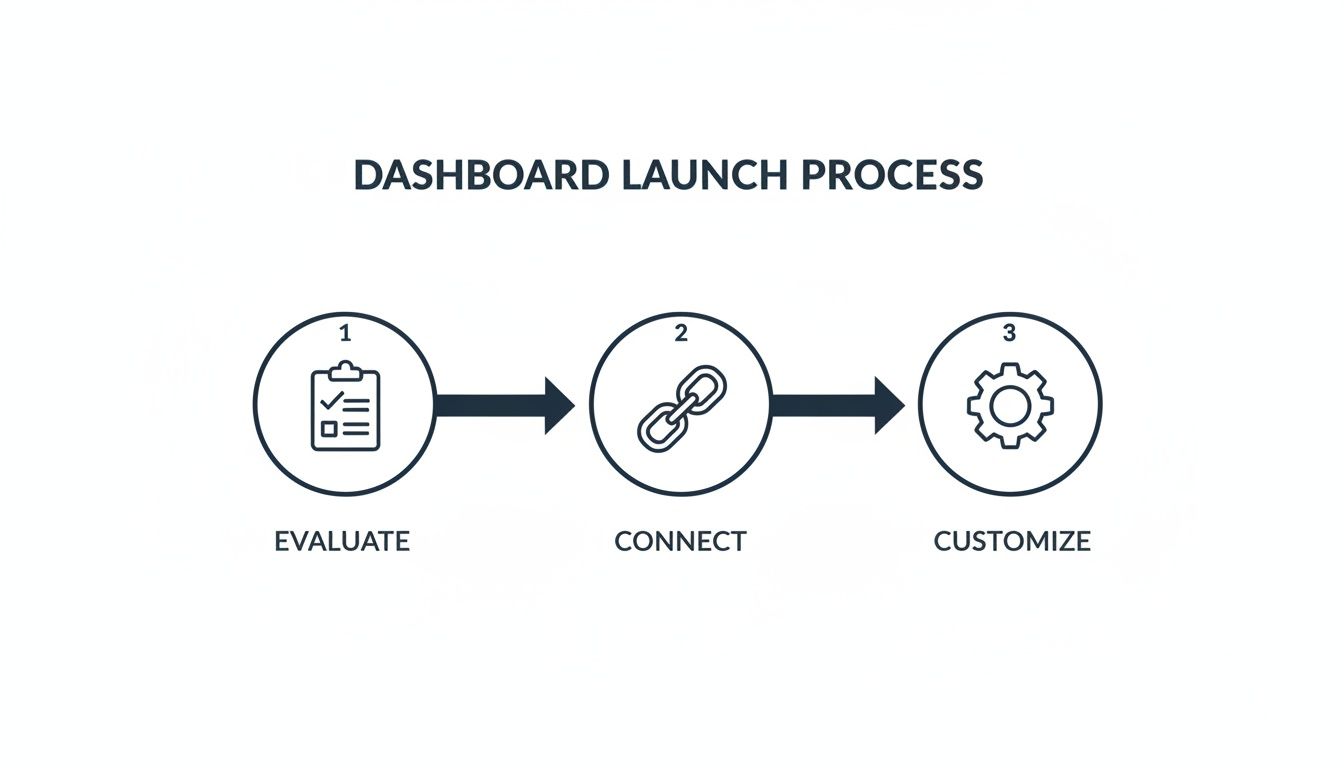
As the diagram shows, you simply evaluate your needs, connect your accounts, and customize your view. Powerful, data-driven insights are within reach for any business size.
Ready to stop juggling tabs and start making data-driven decisions with a powerful social media dashboard? The centralized campaign dashboard from REACH Influencers brings all your influencer marketing analytics, payments, and contracts into one unified view. Discover how REACH can transform your workflow today.