 Skip to content


Content repurposing is the strategic process of adapting a single piece of high-value content into multiple formats for distribution across different channels, and one guide reports that a systematic approach can boost reach by 300%. In practice, strong teams usually plan 5 to 7 repurposed pieces from one long-form asset and publish those derivatives 2 to 4 weeks after the original.
If you're publishing solid content and still feeling pressure to create more, you're not dealing with an idea problem. You're dealing with a distribution problem. Most marketing teams don't need to double output from scratch. They need to extract more value from what they've already made.
That matters even more in influencer marketing. A creator brief, a product demo, a testimonial clip, or a campaign recap shouldn't live for one post and disappear. The smart move is to turn each strong asset into a small content system that feeds email, paid social, organic social, blog content, sales enablement, and creator follow-up.
A lot of teams ask what is content repurposing because they think it means reposting an old post with a new caption. That's the low-value version. The useful version is operational. You start with one strong anchor asset, break it into reusable parts, then adapt those parts to the places your audience pays attention.
What Content Repurposing Is and Is Not
Content repurposing isn't content recycling with better branding. It's a strategic system for getting more output, more relevance, and more lifespan from work you've already funded, written, recorded, edited, and approved.

The difference between repurposing and recycling
Think of a strong article, webinar, or creator video as a content power plant. One source produces multiple kinds of usable energy. The same underlying idea can become a LinkedIn post, a short video, an email section, a quote graphic, a sales one-pager, or talking points for a creator partner.
Recycling is much weaker. That's when a team reposts an old asset with little or no adaptation. Sometimes that works for reminders or resurfacing a timely post, but it usually doesn't create new value.
A useful rule is simple:
| Approach | What happens | Result |
|---|---|---|
| Recycling | The same asset gets reposted | Limited relevance outside the original context |
| Repurposing | The core idea gets adapted to a new format and channel | Better fit, more shelf life, broader distribution |
According to Ross Simmonds' explanation of strategic repurposing, effective repurposing starts with an audit of high-performing, evergreen assets, then atomizes them into reusable ideas and adapts them natively for each channel. That's the part generic definitions usually miss.
Practical rule: If the audience on the new channel gets no added value, you didn't repurpose the content. You just moved it.
Anchor content and derivative assets
The cleanest way to run this is to separate anchor content from derivative assets.
Anchor content is the large, high-value source. That could be:
- A blog post with original thinking or a strong how-to framework
- A webinar recording with useful teaching moments
- A creator video from an influencer campaign
- A customer interview with quotable proof points
- A research-backed guide your team wants to keep distributing
Derivative assets are the outputs built from that source:
- Short clips for TikTok, Reels, or Shorts
- Carousel posts with distilled takeaways
- Quote cards pulled from interviews or creator soundbites
- Email modules for newsletters or nurture flows
- Sales snippets for decks, landing pages, or one-pagers
This distinction changes how teams work. Instead of asking, "What should we post today?" they ask, "What assets can we produce from the best thing we already have?"
Why Content Repurposing Is a Superpower for Brands
Repurposing works because it improves the return on effort already spent. The expensive part of content is often the thinking, planning, briefing, approvals, production, and stakeholder alignment. Once you've done that well, it makes little sense to stop at one format.
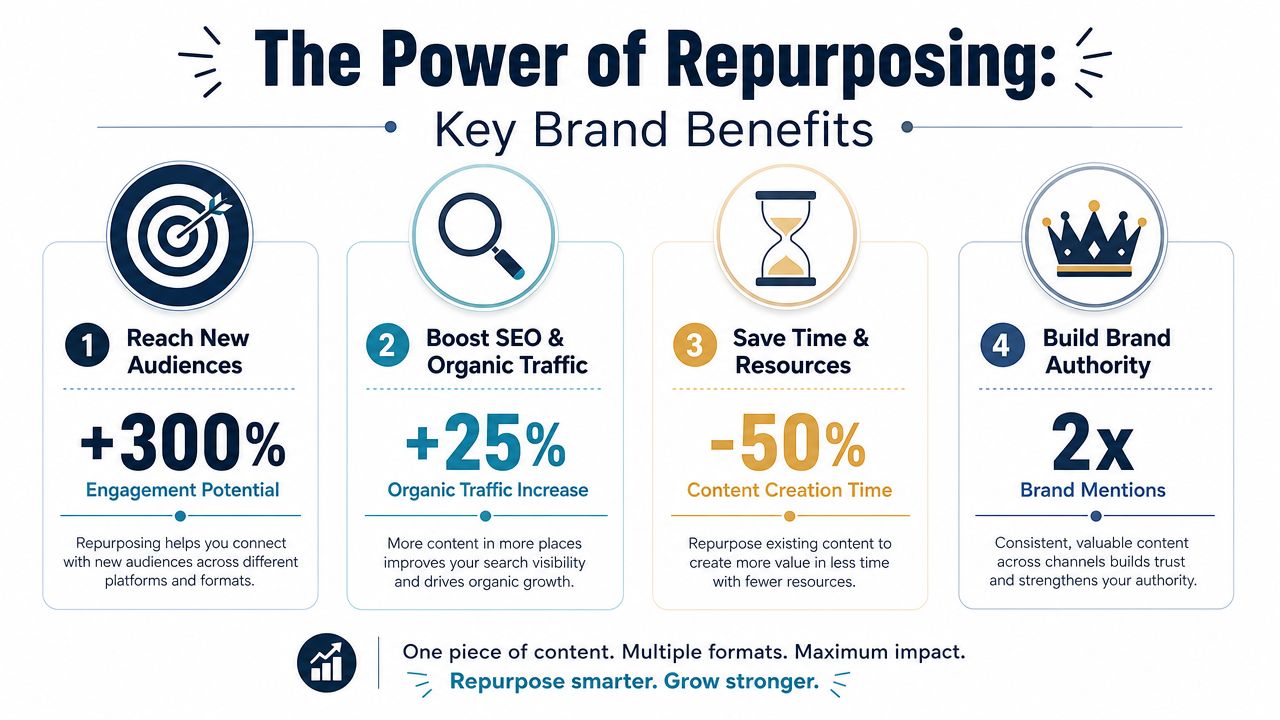
One practical guide from Cloud Present says systematic content repurposing can boost reach by 300%. That same guidance recommends building 5 to 7 repurposed pieces from each long-form asset and releasing them 2 to 4 weeks after the original. That's a distribution strategy, not a last-minute salvage job.
It makes your content budget work harder
The strongest argument for repurposing isn't "save time." It's "stop wasting paid-for insight."
A good webinar often contains a dozen social posts, several short clips, an email angle, customer education material, and useful sales support. A strong influencer campaign usually contains more than the hero post. It also contains product reactions, hooks, visuals, voice-of-customer language, and platform-native proof your brand can keep using if rights and workflow are handled properly.
That reuse is one reason repurposing has become mainstream. ClearVoice cites a 2025 survey where 46% of marketers said repurposing is more effective than creating new content from scratch, and 65% said they already use repurposing as part of their approach in its guide to repurposing content for SEO.
Teams don't usually run out of content ideas first. They run out of production capacity and distribution discipline.
It reaches different audiences in different formats
The same buyer won't always read a blog post, watch a full video, and open a newsletter. Some people want the full argument. Others want the takeaway in under a minute.
Repurposing lets you meet those preferences without inventing a new topic every time. One core message can appear as:
- A detailed article for search and consideration
- A short-form clip for discovery
- A creator testimonial for trust
- A carousel for quick education
- An email summary for retention and repeat traffic
That matters for brand consistency. Repetition helps when the message stays coherent but the format changes.
Later in the content lifecycle, video can help extend the idea further:
It multiplies influencer campaign value
Many brands often leave value on the table. They pay for creator content, use the live post, then move on.
A better approach treats creator output as source material. A single campaign can generate social proof for the brand site, ad creative inputs, email snippets, organic repost concepts, product page reinforcement, and campaign recap content for future partner recruitment. That's especially useful when your team is trying to produce more without burning out the people managing briefs, edits, and approvals.
Smart Content Repurposing Strategies for Maximum Impact
The best repurposing strategy starts before design or editing. It starts with choosing the right source asset. Not every piece deserves a second life.
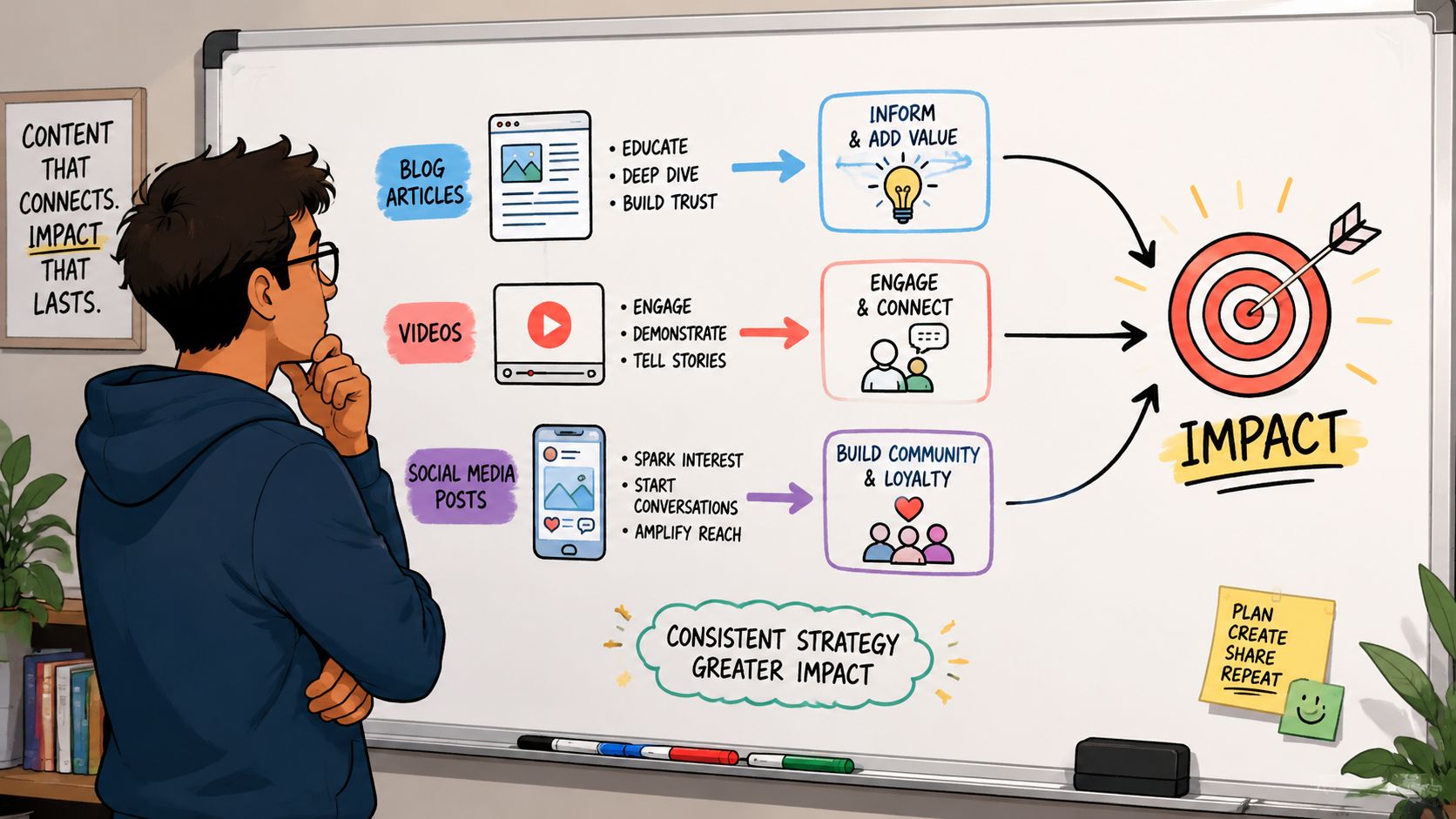
Pick anchor assets with replay value
Strong anchors usually have three traits. They performed well, they stay relevant, and they contain more than one usable idea.
Look for content with:
- Clear demand through traffic, engagement, or repeated internal use
- Evergreen usefulness that won't feel stale next week
- Dense structure such as steps, frameworks, examples, FAQs, or memorable quotes
- Cross-channel potential that can work in text, video, visual, or email form
Teams get more efficient. Instead of repurposing everything, they repurpose the pieces that already proved they deserve more distribution.
Use a hub and spoke model
A simple operating model is hub and spoke. The hub is the anchor asset. The spokes are all the smaller pieces adapted from it.
Here is what that can look like:
| Hub asset | Possible spokes |
|---|---|
| Long-form blog post | LinkedIn post, carousel, email intro, short video, quote graphic |
| Webinar or podcast | Clips, article summary, newsletter section, pull quotes, sales snippets |
| Influencer campaign recap | Testimonial graphics, product page quotes, ad variations, creator highlight reel |
Jasper's benchmark is useful here. Its repurposing guide recommends planning 5 to 7 derivative pieces from each long-form anchor asset. For higher-volume operations, it notes teams can produce 20 to 30 derivative pieces per month from 3 to 5 anchor assets.
That isn't a command to flood every channel. It's a reminder that one good source should yield more than one post.
Working standard: If a long-form asset can't generate several strong derivatives, the source probably wasn't strong enough or specific enough.
Match the format to the platform
At this stage, strategy separates from copy-paste distribution. A creator interview might become:
- A punchy Reel built around the strongest hook.
- A LinkedIn post focused on the lesson.
- An email that frames the lesson as a practical takeaway.
- A quote card for brand credibility.
- A short blog expansion that answers the obvious follow-up question.
If your team works with video or podcast material, this guide for video podcast content transformation is a useful example of how to think through format shifts without losing the core message.
For brands combining creator assets with owned content, this piece on using UGC and influencer content together is also a practical reminder that repurposing works best when social proof, brand messaging, and channel goals are planned together.
A Practical Workflow for Repurposing Content at Scale
Most repurposing problems aren't creative problems. They're workflow problems. Assets live in too many folders, nobody knows what rights exist, clips don't get requested on time, and published derivatives aren't tracked clearly.

A reliable process fixes that. One practical framework comes from Digital Applied's audit, atomize, and reformat workflow. It recommends three stages: audit high-value assets, atomize the source into reusable units like stats and quotes, then reformat those units into platform-native deliverables.
Audit what deserves more distribution
Start with a short list, not your entire archive.
Review assets that already show signs of value:
- Traffic or engagement winners that people already respond to
- Conversion-support content that helps signups, demos, or purchase decisions
- Evergreen assets that still answer stable questions
- Influencer deliverables with reusable product proof or strong audience response
During the audit, answer four operational questions:
- Is the asset still accurate?
- Does the message still fit the brand?
- Do we have the files and usage rights we need?
- Which channels could use this idea in a better format?
Without that checkpoint, teams end up repurposing outdated material or content they can't confidently reuse.
Atomize before you design
Atomizing means breaking one asset into small reusable components. Through this method, efficiency becomes evident.
From one source, pull:
- Hooks for social captions and subject lines
- Quotes from founders, customers, or creators
- Steps for carousel slides or threads
- Visual moments that can become clips or stills
- Objections and answers for FAQ content
- Proof points that support product or campaign messaging
This step is often skipped. Teams go straight from full asset to final derivative and make every new piece from scratch. That defeats the point.
A shared tracker helps. If your team doesn't already have one, this article on how to create a content calendar is a good companion because scheduling and repurposing work better when the derivative plan is visible next to the original asset.
A repurposing system gets faster when the team stores pieces, not just finished posts.
Reformat for native use
Reformatting is where judgment matters. The same idea may need a different opening line, tighter pacing, new visuals, or a stronger call to action depending on the channel.
A practical checklist:
- For short video trim to one idea, one hook, one takeaway.
- For LinkedIn lead with the lesson, not the headline from the original blog.
- For email connect the takeaway to a specific reader problem.
- For creator content preserve the voice and context that made it persuasive in the first place.
Teams that handle influencer marketing feel this acutely. One creator video may support organic social, whitelisting, paid testing, product pages, and campaign reports. If those outputs aren't mapped and tracked centrally, the work splinters fast.
Common Content Repurposing Pitfalls to Avoid
Repurposing can increase output. It can also create more mediocre content faster. That's the trade-off teams need to respect.
The common failures
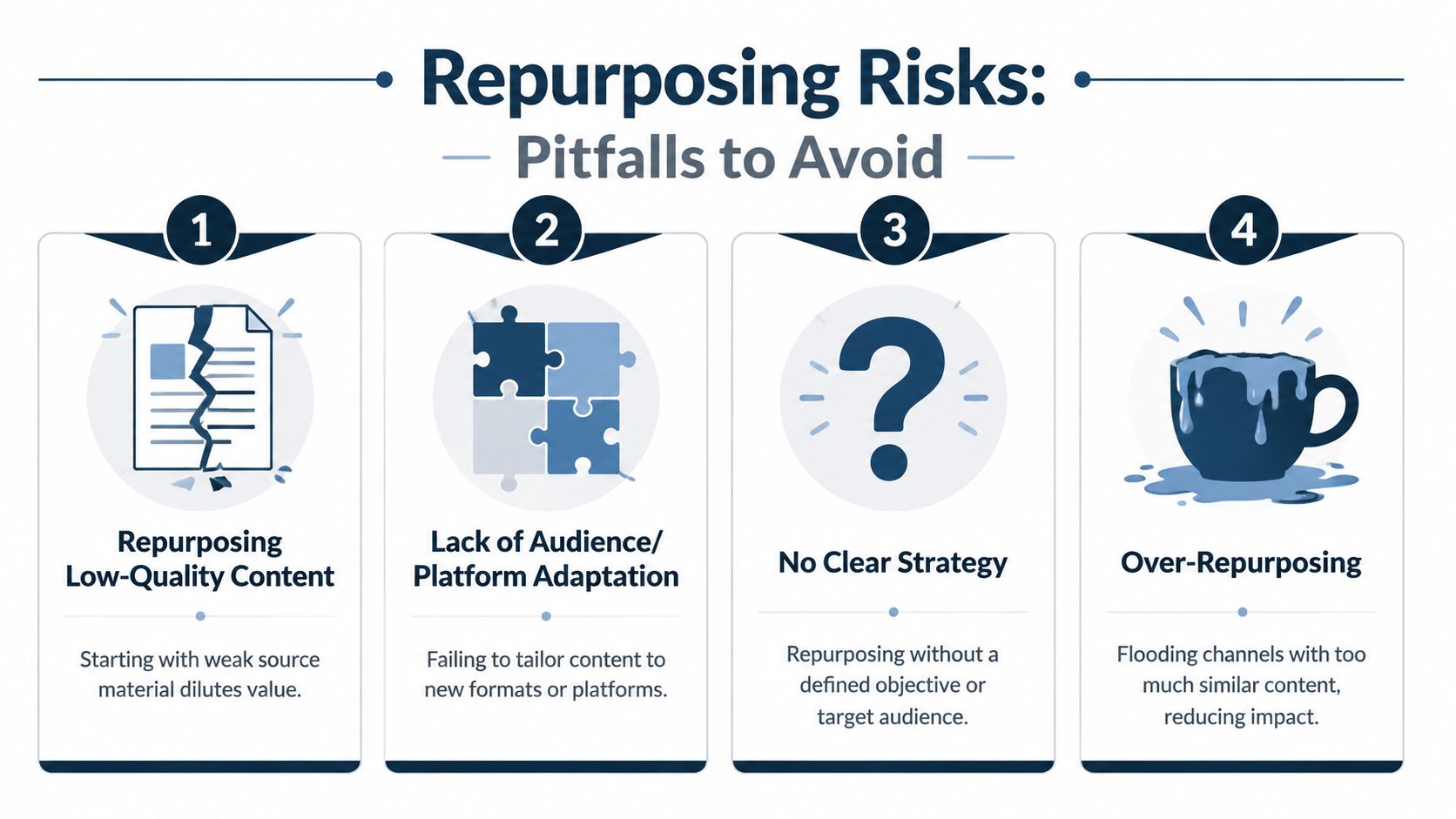
Most bad repurposing falls into one of these buckets:
- Weak source material. If the original blog, webinar, or creator post wasn't useful, making more versions won't fix it.
- No platform adaptation. A LinkedIn post pasted into Instagram captions or a horizontal video dumped into vertical channels usually feels lazy.
- Volume without purpose. More assets don't automatically mean better performance.
- AI without review. Fast conversion isn't the same as good publishing.
Optimizely's content repurposing glossary makes this point clearly. AI can help automate transcription, summaries, and format conversion, but human review is still critical for accuracy and for matching tone, length, aspect ratio, and platform conventions.
What good teams do differently
They don't ask, "How many derivatives can we squeeze out of this?"
They ask:
- Does this version add value for this audience?
- Does it feel native to the platform?
- Does it protect the original meaning?
- Is this helping the campaign goal, or just filling the calendar?
That last question matters most. A busy calendar can hide poor judgment. If every derivative says the same thing in nearly the same way, the audience feels repetition without relevance.
Build a smaller system first. Keep quality high. Add volume only when your team can maintain standards.
Start Repurposing Your Content Like a Pro Today
If you've been asking what is content repurposing, the useful answer is this. It's not reposting. It's not recycling weak material. It's a structured way to turn one good asset into several channel-ready assets without forcing your team to reinvent the wheel every day.
The strongest programs share a few habits. They choose better anchor content, break it into reusable parts, adapt each output to the platform, and track the results by format. That process works especially well for brands running influencer campaigns, because creator content usually contains far more usable value than the initial post alone.
If you want a practical place to start, pick one high-performing asset from the last quarter. Build a short derivative list. Keep the formats varied. Publish with intention instead of speed. Then review which versions helped traffic, engagement, signups, or campaign support.
For teams that also support creators, agencies, or social-first brand programs, the surrounding tool stack matters. This roundup of best tools for content creators is a useful place to think about how content production, scheduling, collaboration, and asset reuse fit together.
Consistency is the primary win. Once repurposing becomes part of planning instead of an afterthought, content production gets lighter, campaigns get longer legs, and your best work stops disappearing after a single publish date.
REACH helps brands and agencies turn messy influencer workflows into a repeatable system. If you want a cleaner way to organize creator deliverables, track campaign assets, manage communication, and keep content moving after the initial post goes live, explore REACH.