 Skip to content


{
“@context”: “https://schema.org”,
“@type”: “BlogPosting”,
“mainEntityOfPage”: {
“@type”: “WebPage”,
“@id”: “https://reach-influencers.com/white-label-influencer-software-for-agencies/”
},
“headline”: “The Ultimate Guide to White‑Label Influencer Software for Agencies”,
“description”: “Discover how white-label influencer software for agencies can help you strengthen your brand, unlock new revenue streams, and improve client retention. Learn the must-have features and how to choose the right partner.”,
“image”: “https://cdn.outrank.so/64cdc0e0-2a54-4cd9-a45d-c4196c5e1d4e/99e09fa6-5b9c-4a56-bbb0-9d236dd927ff/white-label-influencer-software-for-agencies-virtual-chef.jpg”,
“author”: {
“@type”: “Organization”,
“name”: “REACH Influencers”
},
“publisher”: {
“@type”: “Organization”,
“name”: “REACH Influencers”,
“logo”: {
“@type”: “ImageObject”,
“url”: “https://reach-influencers.com/wp-content/uploads/2023/07/REACH-logo-black.svg”
}
},
“datePublished”: “2023-11-15”
}
Ever wonder how some agencies seem to have their own sophisticated, custom-built influencer marketing platform? The secret isn't a massive in-house development team—it's often white-label influencer software for agencies.
Think of it as a ready-made platform that your agency can put its own branding on and offer to clients as your own proprietary tool. With a solution like REACH Influencers, you get to skip the years of development time and massive costs of building software from scratch. It’s an instant, powerful upgrade to your agency’s capabilities and the value you bring to your clients.
Table of Contents
- What Is White-Label Influencer Software
- Why Your Agency Needs a White-Label Platform
- Must-Have Features in Your Influencer Software
- How to Successfully Launch Your New Platform
- Understanding Pricing and Calculating Your ROI
- Choosing the Right Partner: How to Sidestep Common Blunders
- Common Questions We Hear from Agencies
What Is White-Label Influencer Software
Let’s use an analogy. Imagine you're a talented chef famous for your amazing food. You want to open a new restaurant, but building a professional kitchen from the ground up would cost a fortune and take ages. Instead, you find a fully equipped, state-of-the-art kitchen, put your restaurant's name over the door, and start cooking.
You get to focus entirely on what you're best at—crafting incredible dishes and creating a great dining experience—while using a top-tier facility built by experts.
That’s precisely how white-label influencer software for agencies works. A company like REACH Influencers builds and maintains a robust influencer marketing platform packed with all the features you need: creator discovery, campaign management, reporting, and payments. Your agency licenses that software, slaps your logo and brand colors on it, and presents it to clients as your own.

The Core Concept Explained
At its core, white-labeling is a strategic partnership. The software company becomes your silent tech partner, handling all the behind-the-scenes work—development, bug fixes, and updates. Your agency gets to be the star, owning the client relationship and the entire brand experience. If you want to dive deeper into the basics, you can explore what is white-labeling in more detail.
This model lets your agency go from being just another service provider to a tech-forward partner almost overnight. You can give clients their own branded portal to track campaign progress, approve content, and see results in real time. It immediately elevates your agency’s credibility and makes your services much harder for clients to leave.
Key Takeaway: The white-label provider builds the engine, and your agency provides the brand, the strategy, and the expert guidance. It’s the fastest route to adding a scalable, high-value tech solution to your offerings.
Ultimately, this solves a huge challenge for agencies: how to deliver advanced tech without the headache of becoming a software company. You get to market quicker, boost your profit margins, and wow clients with a platform that looks and feels like it was made just for them.
Why Your Agency Needs White-Label Influencer Software
So, you get what white-label software is. But knowing why it can completely change the game for your agency is where the real value lies. This isn't just about adding another tool to your tech stack; it’s about making a fundamental shift in how you operate, scale, and deliver incredible results for your clients.
The benefits go way beyond simple convenience—they hit your bottom line and set you up for long-term growth.
The whole strategy really boils down to four key wins. You elevate your brand by putting your name on the platform. You open up new, high-margin ways to make money. You make your agency so essential to a client's workflow that they can't imagine leaving. And finally, with a platform like REACH Influencers, you get the operational horsepower to handle more clients without burning out your team.
Strengthen Your Brand and Build Trust
Think about it: when you show a client a generic, third-party platform, you're basically giving free advertising to another company. A white-label influencer software for agencies flips that script entirely.
By customizing the platform with your logo, your colors, and your domain, every single client interaction reinforces your brand. It's a subtle but powerful move that recasts your agency from just another service provider to a true, tech-powered partner.
Clients log into a sleek, professional portal that looks and feels like you built it just for them. This creates a perception of immense value and expertise, building a kind of trust that simply running campaigns can't buy. It tells them you’ve invested in the absolute best tools to make them successful.
A branded platform instantly sets your agency apart in a crowded market. It’s no longer just about the campaigns you run; it’s about the unique, integrated experience you provide.
This approach cuts out all brand confusion and cements your authority. Instead of having to explain which third-party tools you’re cobbling together, you can just show off your platform's capabilities. This seamless experience makes your agency look more established and resourceful, which helps you land bigger contracts and command higher prices.
Unlock New Revenue and Higher Margins
One of the best and most immediate perks of a white-label platform is the power to create brand-new, profitable revenue streams. You're no longer just selling your team's time or management services; you're selling access to a valuable piece of technology.
This opens the door to a few smart pricing strategies:
- Software as a Service (SaaS) Fee: Charge clients a monthly or annual subscription for access to your branded platform. This creates a steady, recurring revenue stream that's separate from your campaign work.
- Premium Tiers: Bundle platform access into your top-tier service packages. The added value of real-time reporting and collaboration tools easily justifies a significant price bump.
- Value-Added Reselling: You pay a wholesale price for the white-label software and then sell it to your clients at a markup. It's an instant boost to your profit margins on every single account.
This model can completely change your agency's financial footing. Agencies that use white-label services often see a major revenue jump without a big increase in overhead. While the services might differ, the principle is the same. To get a broader view, check out the top benefits of hiring a white-label service and see how this works across the industry. By productizing your services around a software platform, you start breaking free from the "time for money" trap and move toward a much more scalable business.
Improve Client Retention and Stickiness
Losing clients is one of the toughest challenges any agency faces. A white-label influencer software is your secret weapon for retention, weaving your agency directly into your clients' day-to-day operations.
When clients are logging into your platform to approve influencers, review content, and check campaign ROI, your agency becomes indispensable. This "stickiness" makes it incredibly difficult for them to even think about switching to a competitor.
Leaving your agency would mean losing access to the platform, all their historical data, and the easy, streamlined process they’ve gotten used to. It creates a massive barrier to exit that you just don't get with a traditional service relationship.
For instance, a platform like REACH Influencers lets you give each client their own secure login. They can pop in anytime to see live campaign dashboards and chat with your team right inside the system. This transparency and simplicity become part of their routine, turning your agency from a replaceable vendor into an essential partner for the long haul.
Must-Have Features in Your White-Label Influencer Software
Picking the right white-label influencer software is a huge decision. It's not just about getting a new tool; it's about building the engine that will run a core part of your agency. Get it right, and you'll see a massive boost in efficiency, scalability, and client happiness. Get it wrong, and you're in for a world of logistical headaches.
Think of a great platform as the central nervous system for your influencer marketing services. It handles the tedious, repetitive tasks in the background so your team can stay focused on what really matters: strategy, creativity, and growing client relationships.
This diagram shows how a white-label solution really pays off by building trust, growing revenue, and keeping clients around for the long haul.
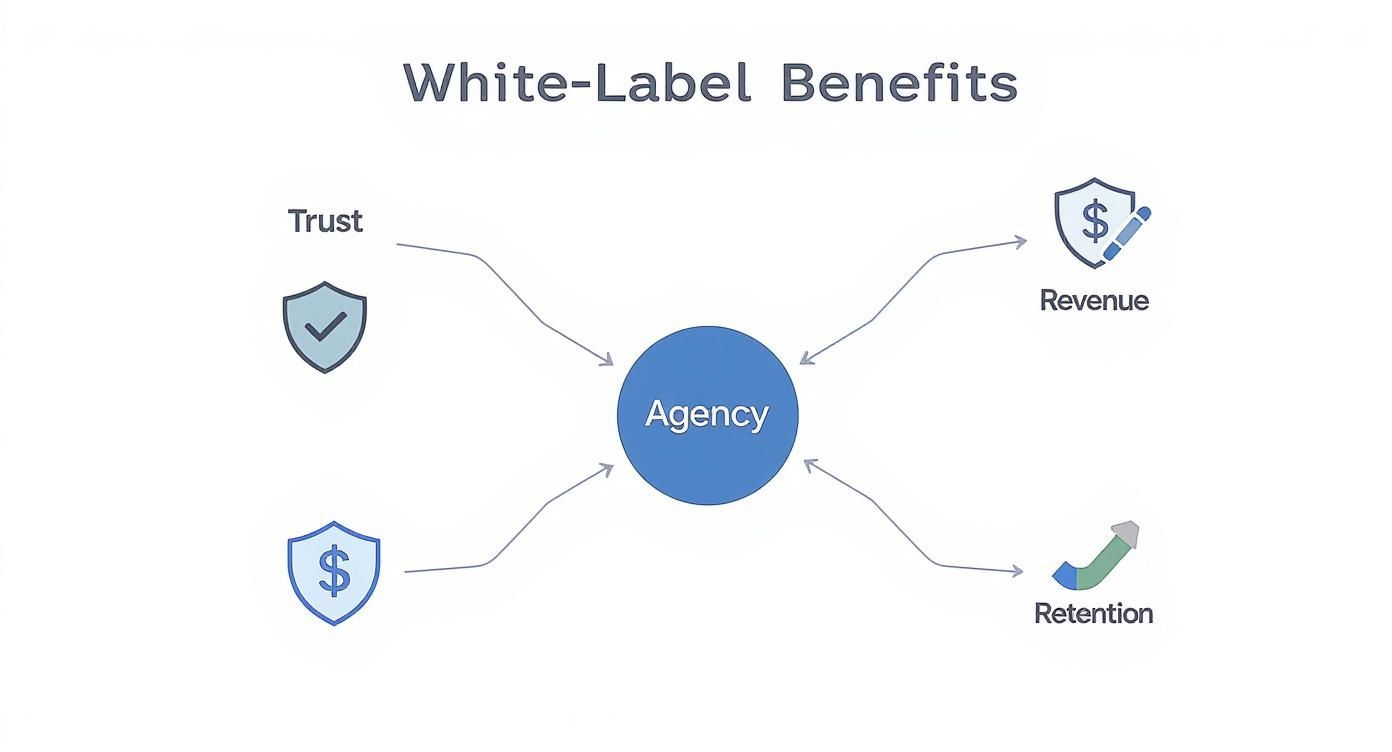
As you can see, it's a cycle. A branded platform makes your agency look more professional, which builds trust. That trust leads directly to more revenue and happier clients who stick with you.
A Powerful Influencer Discovery Engine
Let’s be honest: your ability to find the perfect influencers for a campaign is a huge part of your value. A basic search bar just isn't going to cut it. You need a discovery engine that lets you get laser-focused with your criteria. It's the difference between using a pair of cheap binoculars and a high-powered telescope—one gives you a fuzzy, general picture, while the other lets you zero in on exactly what you’re looking for.
A solid discovery tool has to let you filter by the nitty-gritty details, like:
- Audience Demographics: Dig into a creator’s audience by their age, gender, location, and even their interests.
- Performance Metrics: Search for influencers based on real numbers, like engagement rates, follower counts, and average video views.
- Content Niche: Quickly find creators in hyper-specific verticals, whether it’s vegan cooking or sustainable fashion.
For example, a platform like REACH Influencers lets you dive deep into these metrics. This means every partnership you propose is backed by data and perfectly aligned with what your client wants to achieve. No more guesswork or wasted hours manually vetting creators.
Streamlined Campaign Management
So, you've found your influencers. Now the real fun begins. Juggling dozens of creators across several campaigns can turn into pure chaos without a central place to manage it all. The best white-label influencer software for agencies pulls every single step of the campaign into one clean, organized dashboard.
This means everything from the first outreach email and contract negotiation to content briefs and posting schedules lives in one spot. Forget about messy spreadsheets, endless email chains, and trying to remember what you said in a DM. Your team can handle all communications and track every milestone right inside the platform. It’s not just about being more efficient; it’s about creating a single source of truth for every campaign.
A centralized campaign dashboard is non-negotiable. It turns messy, manual workflows into a scalable, repeatable process that allows your agency to handle more clients with the same team.
Automated Content Approval Workflows
The content approval process is often where campaigns grind to a halt. The endless back-and-forth—waiting for feedback, chasing down clients, and trying to track edits sent in five different emails—is a massive time-sink and a recipe for mistakes. This is where automated approval workflows completely change the game.
With a modern platform, you can set up a simple, step-by-step approval chain. Influencers upload their content directly to the portal. Your team gets a notification, leaves feedback, and requests any edits right there. Then, with a click, you can loop your client in for the final sign-off, all within your agency’s branded environment. It’s a clean system that leaves a clear audit trail.
Client-Ready Reporting and Analytics
At the end of the day, proving ROI is everything. Your software has to do more than just track numbers; it needs to present them in a way that’s impressive and easy for clients to understand. Look for a platform with powerful analytics that automatically pulls key performance indicators (KPIs) into clean, visual dashboards.
Make sure your reporting tools include:
- Real-Time Tracking: Keep an eye on clicks, conversions, engagement, and reach as the campaign unfolds.
- Customizable Dashboards: Build reports that focus on the specific metrics each client cares about most.
- White-Labeled Exports: Generate professional-looking PDF reports or share live dashboards that feature your agency’s logo and branding.
This turns reporting from a chore into an opportunity. You get to show off your agency's results and reinforce the value you bring. And as you're thinking about features, it's worth checking out a comprehensive list of AI content creation tools, since many of these capabilities are now being built directly into top-tier influencer platforms.
Feature Checklist for White-Label Influencer Software
Choosing a platform means sorting through a lot of features. Some are absolutely essential for running an efficient agency, while others are just nice extras. This table breaks down what you truly need to look for.
| Feature | Core Functionality | Why It's Essential for Agencies |
|---|---|---|
| Influencer Discovery | Advanced search with demographic, performance, and niche filters. | Lets you find the perfect, data-vetted influencers for any client campaign, saving dozens of hours of manual research. |
| Campaign Management | Centralized hub for briefs, contracts, communication, and scheduling. | Creates a single source of truth for every campaign, eliminating confusion and making it possible to manage more clients at once. |
| Content Approval Workflow | Automated, multi-step system for internal and client feedback on creator content. | Drastically speeds up the approval process, reduces bottlenecks, and keeps projects on schedule. |
| Reporting & Analytics | Real-time, customizable dashboards and white-labeled PDF/live reports. | Makes it easy to prove ROI to clients, showcase your value, and make data-driven decisions for future campaigns. |
| Integrated Payments | Automated system for paying creators globally and handling tax compliance (e.g., 1099s). | Solves a huge logistical headache, ensures creators are paid on time, and keeps your agency compliant. |
| Multi-Client Management | A single login to manage all client accounts, campaigns, and data separately. | Non-negotiable for agencies. It keeps client data secure and organized, allowing your team to work efficiently across accounts. |
While features like CRM integrations or advanced AI forecasting are great, the items in this checklist are the bedrock of a successful white-label platform for any serious agency.
Integrated Influencer Payments and Compliance
Let's talk about one of the biggest operational pains: paying influencers. When you're working with dozens or even hundreds of creators, payments become a logistical nightmare. A top-tier platform has to include an integrated payment system that automates everything from sending money in different currencies to generating the right tax forms, like 1099s. This feature alone can save your finance team countless hours and ensures your creators are paid on time, which is key to building strong, lasting relationships.
White-label platforms are no longer a "nice-to-have"—they're essential for agencies serious about scaling. The market is exploding for a reason. By 2025, there are expected to be over 6,900 influencer marketing service providers, a staggering jump from just over 1,100 in 2019. This growth shows just how much agencies are relying on these tools to manage bigger campaigns while keeping their own brand front and center. If you want a more general overview, feel free to check out our complete guide on influencer marketing platforms.
How to Successfully Launch Your New White-Label Platform
Rolling out new software can feel like a massive project, but a smart, phased launch is what separates a frustrating experience from a game-changing one. Launching your white‑label influencer software for agencies is more than just flipping a switch—it’s about bringing your team and your clients along for the ride. Get it right, and you'll see faster adoption, instant efficiency boosts, and a killer first impression.
The whole process really boils down to three key phases. First, you'll make the platform look and feel like it's yours. Then, you'll turn your internal team into expert users. Finally, you’ll roll it out to clients, positioning it as a powerful, proprietary tool that gives them an edge.

Step 1: Customize Your Platform Branding
This is the fun part—making the software truly yours. This is where you transform a generic tool into an impressive extension of your agency’s brand. The end goal is a completely seamless experience where clients feel like they’re using a platform custom-built just for them, by you.
Start with the essentials:
- Upload Your Logo: Swap out the default logo for your own. It should appear everywhere—dashboards, reports, and login pages.
- Set Your Brand Colors: Tweak the color scheme to match your brand guidelines. Consistency is key to making it look professional.
- Establish a Custom Domain: This is a non-negotiable step. Set up the platform to run on a subdomain like
clients.youragency.com. It immediately reinforces your ownership and builds a ton of trust.
A good partner like REACH Influencers makes this super easy. Their team will usually walk you through these settings to get your branded portal looking sharp and ready to go in no time.
Step 2: Train Your Internal Team
Before you even think about showing this to a client, your own team needs to know it inside and out. A confident team is your front line for getting clients on board, answering questions, and showing off all the cool new features. Think of this as an ongoing process, not a one-and-done meeting.
Your training checklist should include:
- Core Functionality: Make sure everyone is comfortable with the day-to-day stuff, from finding influencers and setting up campaigns to handling content approvals and pulling reports.
- New Workflow Integration: Map out exactly how this platform changes your current processes. For instance, are you moving all client feedback from messy email threads into the platform’s approval system? Document it.
- Client-Facing Demos: Have your account managers practice walking clients through the portal. They need to be able to sell the benefits that matter most to each specific client, like real-time campaign tracking or a simpler way to review content.
Expert Tip: Appoint an internal "platform champion." This person will be the go-to expert for everyone else, helping solve little issues and sharing clever tricks as the team gets more familiar with the software.
Step 3: Introduce the Platform to Clients
How you roll this out to clients will completely shape their perception of it. Don't just call it "a new tool." Position it as a major upgrade to your service—a direct investment in their success. Frame it as your agency's proprietary technology, designed to give them better results and more transparency.
Here’s a tried-and-true game plan for the client launch:
- Announce the Upgrade: Kick things off with a personalized email announcing the launch of your "new" platform. Focus on what’s in it for them, like 24/7 access to campaign data or one-click content approvals.
- Schedule Onboarding Sessions: Don’t just send a login and hope for the best. Set up quick, one-on-one video calls to personally walk each client through their new portal. That personal touch makes all the difference.
- Provide Simple Resources: Create a simple one-page guide or a quick Loom video that covers the basics. Show them how to log in, find their dashboard, and approve content. The easier you make it, the faster they'll adopt it.
By following these steps, your agency can launch its white-label platform without a hitch. This investment won’t just make your team more efficient—it will deepen client relationships and cement your reputation as a forward-thinking leader in the influencer space.
Understanding Pricing and Calculating Your ROI for White-Label Software
Let's talk about the money. Deciding to invest in white-label influencer software is a big step for any agency, and you need to know exactly how the numbers will play out. It's not just another line item on your expense sheet—it's a move designed to make your agency more profitable, scalable, and indispensable to your clients.
The market itself tells the story. The influencer marketing software space was valued at $3.16 billion in 2021 and is on track to hit $5.06 billion by 2025. This explosion, tracked by Cognitive Market Research, shows just how many agencies are realizing they need powerful tools to stay competitive and efficient.
Common Pricing Models Explained
As you shop around, you'll run into a few standard ways these platforms are priced. Each one is built for different agency needs, so knowing the lingo will help you find the perfect fit.
-
Per-Seat Licensing: Simple and direct. You pay for each team member who needs to log in. This is a great starting point for smaller teams where only a few people are running the show.
-
Tiered Plans (Client/Campaign Volume): This is the most common model you'll see for agencies. Your price is tied to a specific tier that sets a limit on how many active clients or campaigns you can handle at once. As your agency lands more business, you just bump up to the next level.
-
Usage-Based Pricing: Some providers charge based on your activity—things like the number of influencers you reach out to or the volume of content you manage. This can be a smart option if your campaign flow has peaks and valleys.
Platforms like REACH Influencers typically offer flexible options that grow with you. This way, you’re not overpaying when you start out but have a clear path to scale as your client roster expands.
Calculating Your True Return on Investment
Figuring out the ROI of a white-label platform is about so much more than just reselling software. The real win comes from the massive operational efficiencies, the ability to take on more work without burning out your team, and the stronger relationships you build with clients.
Key Insight: The real ROI isn’t in the software markup. It’s in the billable hours you get back from automation, the extra clients you can manage without new hires, and the revenue you save by keeping clients happy and loyal.
To see the complete financial picture, you have to look beyond the obvious. Of course, you can mark up the software cost to generate direct revenue. But what about the less tangible—but incredibly valuable—gains? Think about the hours your team will save every single week by automating mind-numbing tasks like chasing down content approvals or manually building reports. Those hours are pure profit, freeing up your team for high-value strategic work. For a more detailed breakdown, take a look at our guide on how to measure influencer marketing ROI.
Here’s a quick way to map out how the investment pays for itself and starts generating a profit:
- Direct Revenue: Start with the easy part. Calculate how much you’ll mark up the software license for each client you bring onto the platform.
- Time Saved: Estimate how many hours an account manager saves per week on manual work. Multiply that by their billable rate. It adds up fast.
- Increased Capacity: How many more clients can each person on your team realistically manage now? That number represents brand new revenue potential.
- Client Retention: What’s the value of keeping just one extra client this year? Your branded platform makes your agency "stickier," reducing churn and protecting that recurring revenue.
When you put all those pieces together, you'll quickly see that the upfront cost of the software is often eclipsed by the financial upside you gain in just a matter of months.
Choosing the Right White-Label Partner: How to Sidestep Common Blunders
Let's be honest: the right technology partner is just as critical as the software itself. I’ve seen agencies get stuck with a fantastic platform backed by nonexistent support, and it quickly becomes a source of daily frustration. Getting this choice right from the start is crucial, but many agencies stumble right out of the gate.
A few common pitfalls can lead to stalled growth and unhappy clients. By knowing what to look for, you can pick a partner who’s genuinely in your corner, not just another vendor cashing a check.
The biggest mistake? Chasing the lowest price tag instead of the best long-term value. Budget is always a reality, but the "cheapest" option is often loaded with hidden costs. Think of the hours your team will waste on clunky workflows, the manual workarounds you’ll need for missing features, and the sheer agony of waiting for support when you’re on a tight deadline.
Ignoring Your Future Self
Another classic oversight is picking a platform for the agency you are today, not the one you want to become. That software might work just fine when you have five clients, but what happens when you’re trying to manage twenty? A limited white-label influencer software for agencies will absolutely become a bottleneck, forcing you to turn down new business or hire more people just to keep up.
When you're in a demo, you need to pressure-test the platform. Get specific and ask the tough questions:
- How does the system perform when we launch a dozen campaigns at once?
- What does it cost and how long does it take to add new clients or team members?
- Will the reporting dashboard grind to a halt when we try to pull data on a massive, year-long campaign?
You need a solution that grows with you, not one that forces you to pump the brakes right when you're gaining momentum.
Underestimating the Power of Great Support
Picture this: it's launch day for a huge client campaign, and a technical glitch pops up. This is the moment when the quality of your provider's support team really matters. It's easy to get wowed by flashy features during a sales pitch, but so many agencies forget to dig into what happens after they sign on the dotted line.
A partner’s true colors show in how they respond when you need help. Their commitment isn’t in the sales deck; it’s in their willingness to help you succeed long after the deal is closed.
Before you commit, ask about their standard response times. Look for providers that offer dedicated account managers and clear service-level agreements (SLAs). Check G2 or Capterra for real-world reviews about their support quality. A platform like REACH Influencers gets it—your success is their success, and that means providing the hands-on guidance you need to make the platform work for your agency and your clients.
Common Questions We Hear from Agencies
Jumping into a white-label platform is a big move, and it’s smart to ask a lot of questions. Here are some of the most common ones we get from agency owners just like you, with straight-up answers to help you get clear on what to expect.
How Tech-Savvy Does My Team Really Need to Be?
This is probably the number one question we're asked, and the answer is always a relief: not very. A great platform like REACH Influencers is designed to feel simple, even though the technology behind it is powerful. The whole point is to make your life easier, not more complicated.
If your team can use Instagram and handle basic project management tools, they have all the skills they need. They won’t be messing with code or server settings. Everything from finding influencers to running campaigns and pulling reports is designed to be intuitive, so your team—and your clients—can get up and running fast.
Can We Bring Our Current Influencer List with Us?
Of course. You've worked hard to build your network of creators, and that’s a huge asset. Any worthwhile white-label partner will make it easy to bring that database right into your new platform.
The process is pretty straightforward and usually looks something like this:
- You’ll pull your existing data into a simple file, like a CSV.
- Their team will help you map your old columns to the new system (for example, making sure your "IG Handle" field lines up correctly).
- They’ll handle the import, making sure every relationship and piece of data you’ve collected is moved over cleanly.
This way, you start on day one with all your trusted influencers right there inside your agency’s shiny new branded portal.
How Do You Keep My Clients' Data Separate and Secure?
This is non-negotiable. Top-tier platforms use what’s called a multi-tenant architecture. The best analogy is a secure apartment building: every client gets their own private, locked apartment where their data, campaigns, and reports are stored. They all share the same secure building, but nobody can peek into their neighbor's unit.
This structure makes it impossible for data to bleed between client accounts. Client A will never see Client B’s influencer list or campaign results. Period. Always make sure any platform you consider is also compliant with privacy regulations like GDPR—it’s a critical layer of protection for you and your clients.
Ready to see how a branded platform can boost your agency's profits, streamline your work, and make clients stick around for the long haul? See how REACH delivers the powerful and secure white-label influencer software for agencies you need to grow.