 Skip to content

Ever heard of white labeling? It's a surprisingly common and clever business model.
Imagine a local coffee shop famous for its amazing cheesecake. What if I told you they don't actually bake it? Instead, they buy it from a fantastic local bakery, pop their own logo on the box, and sell it as their own. That's white labeling in a nutshell. It lets you offer a proven product or service without having to build it from the ground up.
Understanding the Core Concept of White Labeling
At its heart, white labeling is a simple, strategic partnership. You have the manufacturer, the company that actually creates the product, and the reseller, the business that puts its own brand on it and sells it to customers.
The beauty of this arrangement is that it's completely invisible to the final customer. They just see the reseller’s brand and assume they made it. It’s a behind-the-scenes collaboration where everyone plays to their strengths. The manufacturer focuses on making a top-notch product, while the reseller handles what they do best: marketing, sales, and building that all-important customer relationship.
The Key Players and Their Roles
To really get it, let's break down who does what:
- The Manufacturer (Provider): This is the company that does the heavy lifting. They handle all the research, development, and production to create a solid, generic product that multiple businesses can rebrand and sell.
- The Reseller (Your Business): This is you. You take that ready-made product, give it a makeover with your own branding—your logo, colors, and name—and introduce it to your audience as your own.
This model is a fantastic shortcut to expanding your offerings. For instance, a digital marketing agency can start providing a sophisticated social media management tool almost overnight. They don't need to hire developers or write a single line of code; they just partner with a white-label software company. The agency manages the client, and the provider's tech works silently in the background.
A white label product is a ready-to-use solution that is sold to multiple resellers. In contrast, private labeling typically involves creating a unique product exclusively for one reseller. To get a clear understanding of the fundamental concept, you can explore the definition of private labeling.
How White Labeling Differs from Other Models
It's easy to get white labeling mixed up with other business models like private labeling or reselling. While they sound similar, the differences are crucial when deciding which path is right for your business.
Let’s break down the key distinctions.
Comparing White Label, Private Label, and Reselling
This table clearly outlines how these three popular business models stack up against each other, helping you see where white labeling fits in.
| Attribute | White Labeling | Private Labeling | Reselling |
|---|---|---|---|
| Exclusivity | Non-exclusive; sold to many resellers | Exclusive; created for a single reseller | Non-exclusive; sold by many retailers |
| Customization | Limited to branding (logo, colors) | High level of product customization | No customization; sold as-is |
| Product Control | Manufacturer controls the product specs | Reseller has significant input on specs | Manufacturer controls the product specs |
| Ideal For | Quickly adding proven services/products | Creating a unique, exclusive brand | Selling established, well-known brands |
As you can see, white labeling is the perfect solution for businesses looking to quickly expand their services with a proven, ready-to-go product. It's all about speed to market and leveraging someone else's expertise under your own trusted brand name.
How the White Labeling Process Works Step by Step
So, how does white labeling actually work in the real world? The best way to understand it is to walk through a quick example.
Let's imagine a small but sharp digital marketing agency we'll call "Growth Spark." They're absolute wizards at content marketing, but they keep getting asked for professional SEO services—something they don't have the team for.
Instead of turning clients away or trying to build an entire SEO department from the ground up (which is expensive and time-consuming), Growth Spark decides to give white labeling a shot. Here’s what their journey looks like.
Step 1: Spotting the Gap and Finding a Partner
First things first, Growth Spark admits they have a service gap. Saying "no" to clients who need SEO is costing them money and stunting their growth. They need a way to offer top-tier SEO services under their own name, and they need it now.
So, the hunt begins. They start researching white label SEO providers, looking for a true partner, not just a vendor. Their checklist includes:
- A Proven Track Record: They need to see real case studies and testimonials from happy clients. No fluff, just results.
- Service Quality: They dig into the provider's actual process. How do they handle keyword research? What’s their approach to link-building?
- Communication and Support: How does the provider report on progress? Are they responsive? A silent partner is a useless partner.
After doing their homework, they pick a provider that ticks all the boxes and feels like the right fit.
Step 2: Setting Up the Partnership and Getting Integrated
Next, it's time to make it official. Growth Spark and their new SEO partner draw up an agreement. This isn't just a formality; it's a critical document that lays out pricing, service level agreements (SLAs), how they'll communicate, and who owns the branding. It gets everyone on the same page from day one.
With the contract signed, the integration starts. The SEO provider gives Growth Spark access to a project dashboard that’s completely rebranded with Growth Spark's logo and brand colors. This is where they'll manage client campaigns, check on progress, and download performance reports. For the client, it looks and feels 100% like a Growth Spark system.
This infographic breaks down the basic flow, showing how a product or service gets from the creator to the end customer through a reseller.
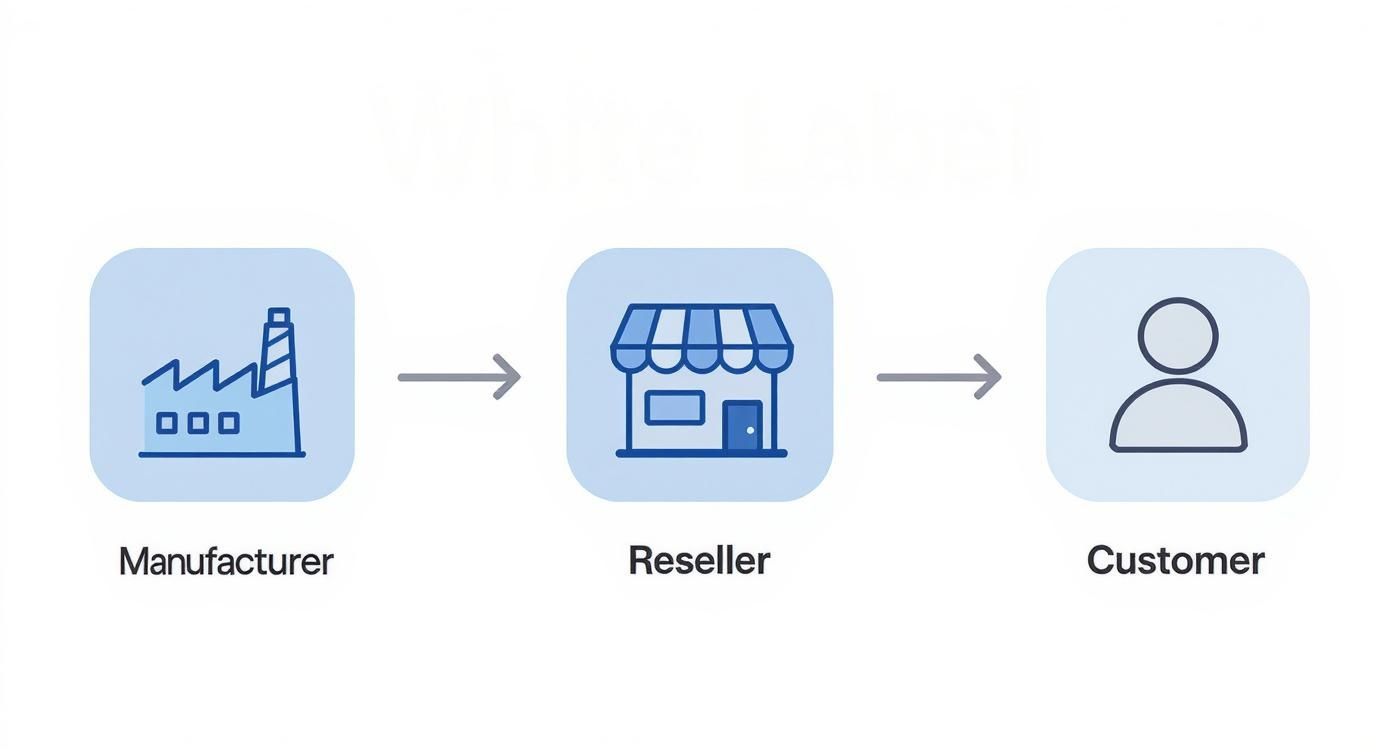
As you can see, the reseller (in this case, Growth Spark) is the one who packages and presents the final service.
Step 3: Selling and Delivering the Service
Now for the fun part. With all the technical stuff handled, Growth Spark proudly adds SEO to its website and marketing materials. They decide on their own pricing, often bundling SEO with their core content services to create high-value packages and boost their profit margins.
When a new client signs up for an SEO package, Growth Spark is the only company they ever talk to. They handle the kickoff call and the entire onboarding process—a smooth start is crucial, which is why following client onboarding best practices is so important.
Once they have the client’s goals and info, they simply pass the project details over to their white label partner.
The partner does all the heavy lifting—the keyword research, the technical audits, the outreach—completely behind the scenes. Meanwhile, Growth Spark manages the client relationship, presents the branded reports, and gets all the credit for the fantastic results. The client is happy, and they have no idea a third party was ever involved.
Unlock Growth with White Label Products and Services
Think of white labeling as a strategic shortcut to growing your business, fast. It’s not just about slapping your logo on a new product; it’s about instantly adding services that would otherwise take years and a small fortune to build yourself. This is how you expand your capabilities and give customers what they want, right now.
Let's say you run a great web design agency, but clients keep asking if you handle social media. You could say "no" and watch that money walk out the door, or you could go on a hiring and training marathon. Or, you could partner with a white label provider. Just like that, you’re offering a full suite of social media services under your own brand, making you the full-service solution your clients were looking for.
This isn't just a clever idea—it's a proven growth engine. For any business trying to broaden its horizons, understanding the best SEO tools for agencies is a perfect example of how white-label solutions can open up new revenue streams.
Drastically Accelerate Your Time to Market
The biggest win with white labeling? Speed. Building a new service from the ground up is a marathon of research, development, testing, and countless setbacks. We're talking months, if not years, before you have something ready for the market.
White label solutions let you skip that entire painful process. The product is already built, debugged, and market-tested. You can go from idea to launch in a few weeks, not a few years. This lets you jump on new trends and get a serious head start on the competition.
With a ready-made solution, you get to focus on what you're actually good at: marketing and selling. You’re not stuck managing developers; you're out there winning new business.
Expand Your Offerings and Enhance Brand Authority
Adding new services is crucial for growth, but it's also risky. White labeling lets you offer in-demand services without the massive upfront investment. You can easily become the one-stop shop your clients need, which builds incredible loyalty and increases their lifetime value.
When you offer a wider range of quality services, you’re no longer just a specialist. Your brand becomes the go-to expert, the comprehensive provider clients trust with all their needs. This kind of smart expansion is often powered by specialized white label marketing software that takes care of all the heavy lifting behind the scenes.
The market statistics speak for themselves. The white label SaaS market is on a rocket ship, projected to hit a staggering USD 908.21 billion by 2030. That's fueled by a compound annual growth rate of 18.7%. This trend isn't just a number—it’s a clear signal of the massive opportunity waiting for businesses smart enough to adopt these solutions to scale their operations.
See White Labeling in Action Across Different Industries
White labeling is way more versatile than most people think. It’s not just for software or marketing agencies—the same ideas of speed, efficiency, and brand building work just as well for physical products. Once you see it in different industries, you really get a sense of its power.
Let's look at the beauty industry. Say an entrepreneur has a great idea for a new skincare line. They don't have to go out and build a factory from scratch. Instead, they can find a white label cosmetics manufacturer that already produces top-notch, unbranded serums, moisturizers, and cleansers.
The entrepreneur simply chooses the formulas that fit their brand, designs their own packaging and labels, and voilà—they have a product ready for market. This lets small, indie brands get trendy products out the door fast and compete with the big guys, all without the massive upfront cost of R&D and manufacturing.

Launching Consumer Brands at Speed
The cosmetics world is a perfect example of this model working beautifully. The demand for niche, independent beauty brands has created a huge opportunity. The global white label cosmetics market was valued at around USD 1.01 billion and is expected to hit USD 1.57 billion by 2030. That steady growth shows just how much brands are relying on this strategy to keep up with what customers want. You can find more details in this white label cosmetics market report.
The same logic works for food and drinks. Picture a local gourmet shop that wants to sell its own line of artisanal olive oil or organic coffee.
- Sourcing the Product: The store owner connects with a reputable producer who supplies high-quality, unbranded olive oil or coffee beans.
- Branding and Packaging: They come up with a brand name, design a cool label, and bottle or bag the product to match their store's vibe.
- Selling to Customers: The final product goes on their shelves as an exclusive "store brand," which opens up a new revenue stream and builds customer loyalty.
To the customer, it’s a premium product they can only get at their favorite local spot. Behind the curtain, it’s just a smart white labeling partnership.
Common Threads Across Industries
Whether we're talking about a digital service or a physical good, the core benefits of white labeling are always the same.
The biggest advantage is that it dramatically lowers the barrier to entry. White labeling lets businesses add new offerings, jump into new markets, and build their brand without getting stuck in the weeds of production costs and complexity.
This frees up entrepreneurs and businesses to put their energy where it really counts: building a strong brand, marketing their products, and giving customers a fantastic experience. From a software dashboard to a bottle of olive oil, the principle is identical—sell a great product under your own trusted name. That's what makes white labeling such a powerful and flexible strategy for any business.
How to Choose the Right White Label Partner

Your success with white labeling comes down to one thing: picking the right partner. Think of it like a business marriage. The right partner will help you soar, but the wrong one can seriously damage the reputation you've worked so hard to build. It’s about way more than just the price tag; you need a provider whose quality and goals actually line up with yours.
Don't rush this decision. Taking the time to properly vet your options will save you a world of headaches later on. You're handing over a piece of your brand to another company, so getting this right from the very beginning is absolutely essential.
Evaluate Product Quality and Reliability
First things first: get your hands on the product or service. If you're looking at software, insist on a demo and put it through its paces. If it's a physical product, get samples. You have to be ruthless here.
Remember, your customers will see this as your product. It has to be good enough for your name to be on it. Look for a partner with a solid track record and happy customers. A cheap product that constantly breaks isn't a bargain; it's a liability.
After you've checked out the product, turn your attention to their support system.
- Responsiveness: When things go wrong, how fast do they jump in to help? Slow support will leave your customers hanging, and they'll blame you.
- Expertise: Can their team actually solve problems, or are they just reading from a script?
- Availability: Do their support hours match up with when you and your customers actually need them?
A great white label partner is more than a vendor; they're an extension of your own team. Their reliability becomes your reliability. Their support becomes your support. This is non-negotiable.
Assess Scalability and Partnership Terms
You’re planning to grow, right? Your white label partner needs to be able to keep up. Ask them directly how they handle a sudden increase in demand. Can their system manage 10x your current workload without slowing down or breaking? A partner that can't scale with you will eventually hold you back.
Finally, it’s time to read the fine print. The partnership agreement is the rulebook for your entire relationship, so go through it with a fine-tooth comb. Pay special attention to these areas:
- Branding Flexibility: How much can you customize the product to make it look and feel like yours? You need to be sure it can seamlessly fit into your brand.
- Pricing Structure: Get a crystal-clear understanding of all the costs. Are there hidden setup fees or different pricing tiers that will kick in as you expand?
- Exclusivity Clauses: Does the agreement lock you in or prevent you from working with anyone else?
Nailing this decision is a crucial first step, especially if you're just learning how to start a social media marketing agency and need dependable services from the get-go. The secret to a profitable white label strategy is finding a partner who not only shares your vision but has the capacity to grow right alongside you.
Common White Labeling Mistakes and How to Avoid Them
Jumping into white labeling can be a game-changer for your business, but a few common missteps can easily trip you up and hurt your reputation. Knowing what to watch out for is the key to building a strategy that actually works.
One of the biggest traps is picking a partner just because they’re the cheapest. Of course, budget matters, but a low-cost provider with a shoddy product will end up costing you far more in lost clients and credibility. It's your name on the box, so the quality has to be something you're proud of.
Another major mistake? Not setting up clear, open lines of communication with your provider from day one.
Overlooking Brand and Quality Alignment
A great partnership is about more than just a good product—it's about a deep alignment on values and quality. If your provider’s work culture is a mess or their standards don't match yours, that disconnect will eventually bleed into what your customers receive.
Before you sign anything, do your homework. Dig into their internal processes, ask tough questions about their quality control, and get a feel for their company culture. This is how you ensure the service you're selling genuinely feels like it came from you. A mismatch here creates a jarring customer experience that chips away at trust.
Failing to Establish Quality Control
Even when you're working with a partner you trust, you can't just set it and forget it. Assuming every deliverable will be perfect without checking is a recipe for disaster. You absolutely need your own system to review everything before it gets to your client.
Set up a simple, non-negotiable review process:
- For Services: Use a checklist to go over every report or campaign result before it's sent to the client.
- For Products: Make a habit of testing samples from new batches to make sure they're consistently up to snuff.
Think of this as your safety net. It protects your brand and, more importantly, your client relationships. The global retail market offers a great example here. Private label sales recently hit a massive $271 billion, growing at 3.9%—blowing past the growth of national brands. That success is built on a foundation of strict quality control. You can learn more about these private label market trends and insights at Market.us.
Remember, your customer’s contract is with you. When something goes wrong with a white-labeled service, they won't know or care about your provider—they will only hold your business accountable. Taking ownership of quality is non-negotiable.
Got Questions About White Labeling? We've Got Answers.
Here are a few common questions we hear from agencies and brands thinking about getting started.
Is White Labeling a Legal Business Practice?
You bet it is. White labeling is a completely legal and widely accepted business practice. It all boils down to a contractual agreement where a company that makes a product or service gives another company permission to sell it under its own brand. As long as everyone signs on the dotted line and agrees to the terms, it’s a perfectly legitimate way to grow your business.
What’s the Main Difference Between White Label and Private Label?
This is a great question, and the answer comes down to one word: exclusivity.
Think of a white label product as something a manufacturer creates and sells to many different resellers. Anyone can buy it, slap their logo on it, and sell it.
A private label product, on the other hand, is made exclusively for one single reseller. That reseller often works with the manufacturer to create unique features or a custom formula just for them.
Can Small Businesses Really Benefit from White Labeling?
Absolutely. In fact, white labeling can be a game-changer for small businesses. It lets you offer top-tier products or services without having to spend a fortune on research, development, and manufacturing from scratch. It’s a powerful way to level the playing field and expand your offerings almost overnight, letting you compete with much larger companies.
Accelerate your agency's growth with REACH, the all-in-one influencer marketing platform you can completely white label for your clients. Book your personalized demo today!