 Skip to content

When we talk about YouTube influencer marketing, we’re talking about something far more powerful than traditional ads. It's about partnering with creators who have built genuine trust with their audience, letting you tap into that connection to promote your brand, product, or service. An effective YouTube influencer marketing strategy can unlock unparalleled audience engagement and drive significant business growth, but it requires a strategic approach, not guesswork.
This comprehensive guide will walk you through every step of building, launching, and measuring a successful YouTube influencer marketing campaign. We'll cover everything from goal setting and creator discovery to contract negotiation and ROI analysis, providing actionable frameworks and expert insights along the way.
Table of Contents
- Building Your YouTube Influencer Marketing Foundation
- How to Find and Vet Creators for Your YouTube Influencer Marketing
- Crafting Outreach That Gets a Reply
- Managing Your YouTube Campaign from Start to Finish
- How to Measure Your YouTube Influencer Marketing ROI
- Frequently Asked Questions About YouTube Influencer Marketing
Building Your YouTube Influencer Marketing Foundation
Before you even dream of finding the perfect creator, you need to lay the groundwork. A winning YouTube influencer marketing strategy doesn't start by endlessly scrolling through creator channels. It begins with a solid, documented plan. Honestly, skipping this step is the fastest way to waste your budget on partnerships that don't move the needle for your business.
This initial phase is about setting clear, measurable goals. And we don't mean vanity metrics like views and likes. Are you trying to drive direct sales? Boost brand awareness in a new market? Or generate qualified leads for your sales team? Your answer will shape every decision you make from this point forward.

Define Your Campaign Goals and KPIs
Your goals are your north star. They dictate which metrics you'll obsess over and which you can safely ignore. Nailing this down from the start makes it much easier to prove your campaign’s return on investment (ROI) later on.
To help, here's a quick table showing how different goals connect to specific KPIs.
Matching Campaign Goals to YouTube KPIs
| Campaign Goal | Primary KPI | Secondary KPI |
|---|---|---|
| Brand Awareness | Video Views, Impressions | Unique Viewers, Mentions, Subscriber Growth |
| Lead Generation | Link Clicks, Form Submissions | Cost Per Lead (CPL), Email Sign-ups |
| Direct Sales | Conversions, Revenue | Affiliate Clicks, Discount Code Usage |
Think of this table as a starting point. Your primary KPI is the one number you'd take to your boss to prove success, while secondary KPIs add important context.
Using a platform like REACH is essential here, as it lets you track these different goals from one central dashboard. For example, a skincare brand using REACH was able to track a 30% increase in qualified leads from a single micro-influencer partnership by monitoring link clicks and form submissions in real-time. This ability to connect creator activity directly to business outcomes separates a good campaign from a great one.
Pinpoint Your Target Audience
Okay, you’ve got your goals. Now, who are you actually trying to talk to?
You need a detailed picture of your ideal customer that goes beyond basic demographics. Think about their interests, the problems they're trying to solve, and where they hang out online. What makes them tick?
This is where having the right tools makes all the difference. Instead of guessing, you can use the audience analytics in a platform like REACH to find creators whose subscribers perfectly match your ideal customer profile. You can filter by location, age, gender, and even specific interests, ensuring your message lands with people who will actually care.
E-E-A-T In Action: A brand gets starstruck by a creator's huge subscriber count and throws money at them. Real success comes from audience alignment. You need to partner with creators whose followers are genuinely your potential customers. A creator with 50,000 highly-aligned followers is far more valuable than one with 500,000 un-engaged ones.
The magic of YouTube is its deep engagement. We're seeing YouTubers hit an average engagement rate of 73%—a number that highlights just how strong those creator-audience bonds are. With 50.2% of US marketers expected to work with YouTube creators in 2026, finding that perfect audience match is your key advantage. You can dig into more of these influencer marketing trends to see how the platforms stack up.
Set a Realistic Budget
Last but not least: your budget. A proper YouTube influencer marketing budget is more than just the creator's fee. It’s a common rookie error to forget the other costs involved.
Your budget needs to account for everything:
- Creator Fees: The main cost, obviously.
- Product Costs: The value of any products you're sending to the creator.
- Platform Fees: If you're using a management tool like REACH to streamline operations.
- Contingency: I always recommend setting aside an extra 10-15% for unexpected opportunities or hiccups.
When you start with a solid foundation—clear goals, a well-defined audience, and a comprehensive budget—you’re setting your campaign up for success. This strategic thinking turns influencer marketing from a gamble into a predictable channel for growth.
How to Find and Vet Creators for Your YouTube Influencer Marketing
The success of your entire campaign hinges on partnering with the right creators. This isn't a numbers game about chasing the biggest subscriber counts. It’s about finding a genuine connection—a creator whose voice and audience align perfectly with your brand. Smart YouTube influencer marketing always starts with thoughtful discovery and vetting.
Let's get one thing straight: the old idea that more subscribers equals better results is dead. The creator world has exploded with diversity. Different types of influencers achieve different goals, and knowing who to partner with is the key to spending your budget wisely.
Differentiate Between Creator Tiers
Not all influencers are created equal. Each tier brings something different to the table, and the "best" choice is the one that matches your specific campaign objectives.
Nano-Influencers (1K-10K Subscribers): These creators run small but incredibly tight-knit communities. Their engagement rates are often through the roof because they have a real, personal connection with their followers. They are an amazing choice for niche products or for brands looking to build authentic, grassroots credibility without a massive budget.
Micro-Influencers (10K-100K Subscribers): For many brands, this is the sweet spot. Micro-influencers have established themselves as experts in their niche. Their audience is dedicated and truly trusts their recommendations, yet they’re still accessible and more affordable than the YouTube celebrities.
Macro-Influencers & Beyond (100K+ Subscribers): Think of these as the A-listers of YouTube. A partnership here is fantastic for huge brand awareness campaigns where your main goal is simply to get in front of as many eyes as possible. It comes with a premium price tag, but the reach can be massive.
The creator economy is surprisingly democratic. A whopping 69.4% of YouTube creators fall into the nano-influencer category. For a discovery platform like REACH, this highlights how crucial it is to have advanced filters that can sift through the noise and find those high-performing gems in any niche.
Use a Platform for Efficient Discovery
Let’s be honest, manually scrolling through YouTube hoping to stumble upon the perfect creator is a recipe for frustration. It’s slow, inefficient, and you’re basically just guessing. This is exactly where an influencer marketing platform like REACH becomes a game-changer.
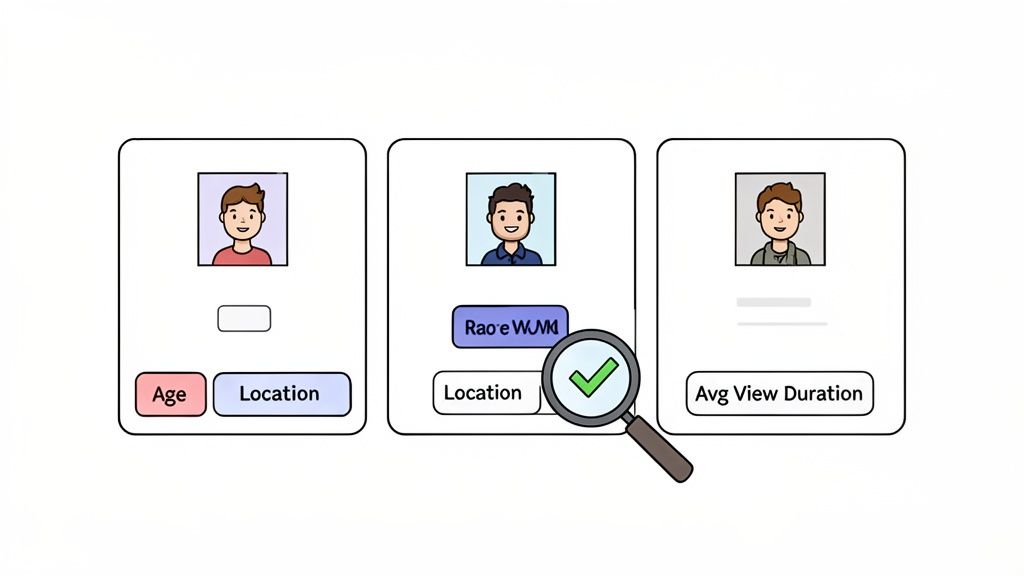
With a dedicated tool, you can search a huge database of creators using the metrics that actually drive results. Instead of getting distracted by subscriber counts, you can zero in on partners by looking at:
- Average View Duration: A golden metric that tells you if people are genuinely captivated by their content.
- Audience Demographics: Filter by age, gender, location, and even interests to make sure you’re reaching your ideal customer.
- Past Brand Collaborations: See who they've worked with before. It’s a great way to gauge their professionalism and see if they're a good fit for your brand's vibe.
Our platform helps you find the perfect YouTube influencer without all the guesswork, saving you countless hours and ensuring your shortlist is packed with high-potential partners.
The Ultimate Creator Vetting Checklist
Okay, you've got a list of promising creators. Now it's time to roll up your sleeves and do some real digging. A solid vetting process is what protects your brand and makes sure your investment pays off. You have to go beyond the numbers on their profile.
Key Takeaway: A creator's authenticity is their most valuable asset. Look for genuine passion and a consistent content style. If their sponsored videos feel forced or dramatically different from their usual content, it's a major red flag that their audience will spot immediately.
Here’s a quick checklist I use to vet every potential partner:
- Analyze Content Quality and Consistency: Is their video and audio quality up to par? Do they post on a reliable schedule? A channel that looks and feels professional shows they take their work seriously.
- Scrutinize Engagement Authenticity: Don't just look at the number of comments—read them. Are people having real conversations, or is it just a wall of "Nice video!" from bots? You want to see genuine interaction between the creator and their community.
- Check for Brand Alignment and Values: Watch their older videos, especially the non-sponsored ones. Do their personality, tone, and values feel like a natural fit for your brand? A history of controversial takes or bizarre brand deals is a clear warning sign.
It also helps to see things from their perspective. Understanding the work that goes into how to become an influencer and build a personal brand gives you valuable insight into their mindset. This empathy leads to much stronger and more collaborative partnerships in the long run.
Crafting Outreach That Gets a Reply
You've spent hours, maybe even days, finding the perfect creators. Their audience is your audience. Their vibe is your vibe. Now for the make-or-break moment: the first email.
Let's be real—top creators have inboxes that are a war zone. They're flooded with dozens of partnership requests every single day. If your message looks like you just copied and pasted it with a different name, it's getting deleted before they even finish the first sentence.
The trick is to prove you're not just another brand blasting out emails. You need to show you're a genuine fan who has a real idea for a partnership. This first touchpoint isn't about closing a deal; it's about starting a conversation.
Make Your First Message Un-Ignorable
Think about it from their side. A creator has built their channel on trust. Their audience relies on their authentic recommendations. A generic pitch that could have been sent to anyone feels disrespectful to the work they've put in.
Your outreach needs to cut through that noise. It has to feel less like a cold pitch and more like a compliment from someone who actually gets it.
A creator's inbox is their first line of defense against bad partnerships. Your outreach needs to prove you're one of the good ones. Reference a specific video, mention a joke they made, or comment on a recent project—anything that shows you're a fan first and a marketer second.
So, how do you write an email that gets a reply?
- Nail the Subject Line: Keep it short and personal. Something like "Love your recent video & a quick idea" works way better than "Marketing Opportunity."
- Show You've Done the Work: Open with a specific, genuine compliment. "Your recent review of the XYZ camera was fantastic—I immediately tried out your lighting tip!" shows you’re paying attention.
- Connect the Dots for Them: Briefly explain why you think their channel is a perfect match. Is it their comedic timing? Their in-depth technical breakdowns? Tie it directly to your brand.
- State the Obvious: What's in It for Them? Be upfront about the opportunity. Is it a paid project? Are you sending a product you know they’ll geek out over? Don't be vague.
- Keep the Ask Simple: Don’t send a novel. End with a simple, low-pressure question. "If you're interested, I'd love to share a few more details" is all you need.
Getting the tone right can be tricky. We've compiled some great influencer outreach email templates that walk this tightrope between professional and personal.
The Creative Brief: Your Blueprint for Collaboration
Once a creator says, "I'm interested," it's time to map out the project with a creative brief. This is where a lot of brands stumble. They send over a document that reads like a list of demands, sucking all the creative energy out of the room.
A great brief isn't a rulebook; it's a shared game plan. It’s the tool you use to align your marketing goals with their creative genius. Your job is to provide the destination, and their job is to creatively pilot the ship.
The best briefs give creators clear guardrails but also the freedom to be themselves. After all, you’re hiring them for their unique voice and connection with their audience.
Here’s what every solid brief should include:
- The Goal: Start with the "why." Are we trying to drive sales (using a unique discount code) or boost brand awareness (measuring views and shares)?
- Key Messages: What are the 2-3 things you absolutely need the audience to know about your product? Keep it concise.
- The Must-Haves: This is the spot for non-negotiables. Think specific calls-to-action, a link for the description box, or required disclosures like
#ad. - The "Do's and Don'ts": Provide helpful direction, not rigid rules. For instance, "Do show the product in a real-life setting," or "Please don't show our old packaging."
- Deliverables & Deadlines: Be crystal clear. What is the format (e.g., 60-second integrated mention, 10-minute dedicated review)? When is the draft due for review, and what’s the final go-live date?
When you give a creator this level of clarity from the start, you’re setting them up for success. It shows you respect their craft and transforms the relationship from a one-off transaction into a true partnership.
Managing Your YouTube Campaign from Start to Finish
Once you've secured your creator partnerships, the real work begins. This is where you shift from planning to execution, turning those great ideas into a campaign that actually delivers. Managing this process well is what separates a chaotic, forgettable campaign from a truly effective YouTube influencer marketing effort.
Juggling contracts, content feedback, payments, and legal compliance across multiple creators can get messy fast. If you're still stuck in a maze of spreadsheets and email threads, it's time for an upgrade. A dedicated influencer marketing platform like REACH can act as your central command center, bringing much-needed order to the creative and logistical chaos.
Finalize Contracts and Set Clear Expectations
Let's get one thing straight: a handshake deal won't cut it. A formal, signed contract is absolutely non-negotiable. It’s your single best tool for protecting your brand and the creator, ensuring everyone is on the same page from day one. Ambiguity is the enemy here; a vague agreement is just asking for trouble later.
While you should always have a legal expert look over your contracts, any solid agreement should clearly spell out these key points:
- Content Usage Rights: Define exactly how you can use the creator's content. Can you feature it on your website? Run it as a paid ad? Be specific about where, how, and for how long (e.g., one year for paid social ads).
- Exclusivity Clause: Can the creator work with your competitors? If not, name them. Define the exclusivity window clearly so there’s no confusion.
- Payment Schedule: Don't leave payments to chance. Detail the total compensation, how it will be paid, and when. A 50% upfront and 50% on completion structure is pretty standard and fair to both sides.
- Deliverables and Deadlines: Reiterate what you expect. Is it one 10-minute dedicated video and two YouTube Shorts? Lock in the dates for drafts, revisions, and the final go-live day.
Platforms like REACH make this part a lot easier by providing vetted contract templates you can tweak, send, and have digitally signed right inside the dashboard. It’s a simple way to make sure every partnership starts on a firm legal footing.
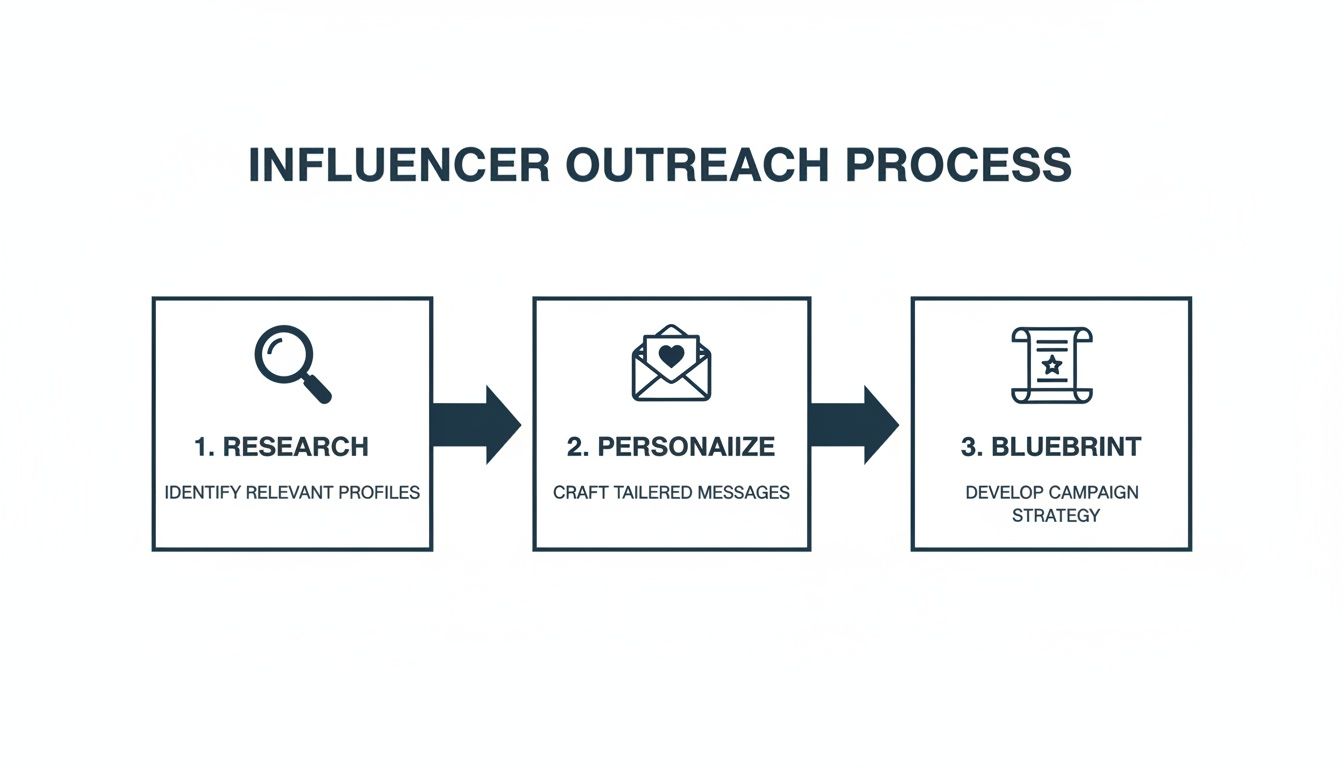
As the process flow shows, building a great partnership starts long before the camera rolls—it’s founded on solid prep and clear, mutual understanding.
Implement a Streamlined Content Review and Compliance Process
The content review stage is a delicate dance. You need to protect your brand message and stay on the right side of the law, but you hired the creator for their voice and authenticity—stifling that defeats the whole purpose.
Key Insight: I always recommend building a two-round revision limit directly into the contract. It encourages creators to get it right the first time and forces your team to provide clear, consolidated feedback. No more endless email chains with conflicting notes.
A huge part of this review process is ensuring compliance with FTC guidelines for sponsored content. Disclosures aren't optional, and they have to be obvious. For YouTube, that means you need all three:
- A verbal disclosure early in the video itself. Something as simple as, "A big thank you to [Your Brand] for sponsoring this video."
- YouTube’s own “Includes paid promotion” feature must be enabled. This adds a clear, standardized label to the video.
- A written disclosure (like #ad or #sponsored) placed at the very beginning of the video's description box.
Getting this wrong can lead to serious penalties for both you and the creator, so it’s not something to take lightly.
Having a dashboard where you can review video drafts and check off these compliance requirements before hitting "approve" is a lifesaver. It lets you catch any issues before the content is live, protecting your brand and keeping your YouTube influencer marketing campaigns running smoothly.
How to Measure Your YouTube Influencer Marketing ROI
So, the influencer’s video is live. The views are climbing, comments are rolling in… but your job is far from over. In fact, this is where the real work begins. It’s time to translate all that buzz into cold, hard data that shows whether your investment paid off.
Measuring success in YouTube influencer marketing isn't about chasing vanity metrics anymore. It’s about connecting the content people are watching directly to your business goals.
Frankly, reporting on views and subscriber bumps is a relic of the past. While those numbers are nice, they don’t pay the bills. They won't tell you if a campaign actually drove a single sale or captured a valuable lead. True measurement is all about the metrics that hit your bottom line.
Go Beyond Vanity Metrics
To get a real feel for performance, you have to track actions, not just eyeballs. This means you need to bake measurement into your campaign right from the start. Forget sending creators a generic link to your homepage. You need tools that can pinpoint exactly which creator drove which action.
I always tell my clients to focus on these key metrics:
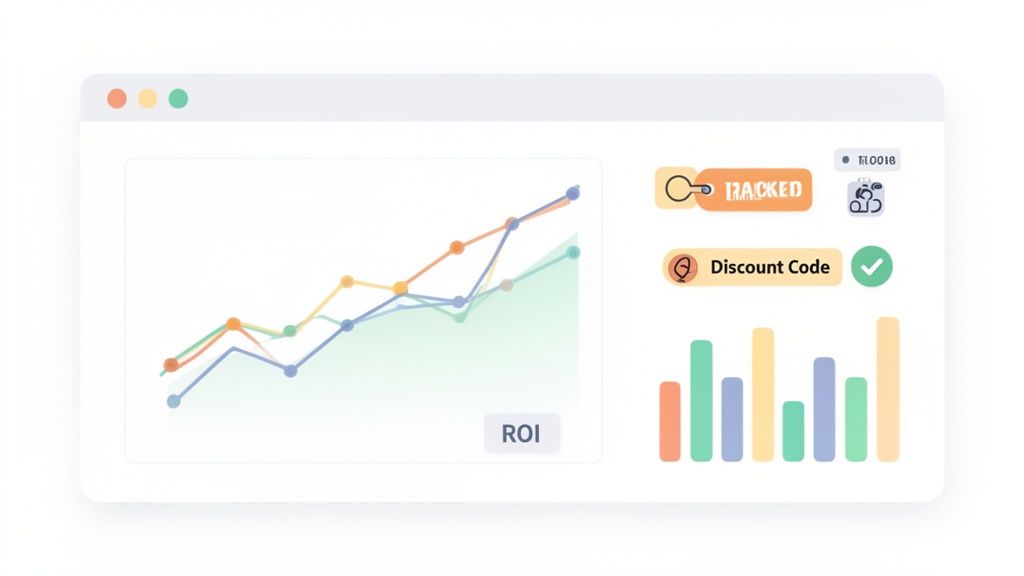
- Tracked Link Clicks: This is non-negotiable. Using unique UTM parameters for every single creator is the only way to see exactly how much traffic a specific video is sending your way.
- Unique Discount Codes: This is one of the cleanest ways to track sales. Give each influencer a unique code (like "SARAH15" or "TECHGUY10"), and you can tie revenue directly back to their content. Simple and effective.
- Affiliate Link Performance: If direct sales are your main goal, an affiliate model is a great option. It tracks conversions automatically and turns the partnership into a true performance-based relationship.
- Conversion Rate: Okay, so they clicked. But did they buy? This metric shows you the quality of the audience a creator is bringing. A high click-through rate with a low conversion rate might signal a mismatch between their audience and your product.
An influencer platform like REACH really simplifies this. Its dashboard pulls all this data together in real-time, showing you who’s driving clicks and sales without you having to mess with a dozen spreadsheets. For instance, one of our clients, a D2C coffee brand, saw that one influencer's discount code generated over $15,000 in sales in the first month alone—data they used to immediately double down on that partnership.
Analyze Qualitative and Quantitative Data
While the numbers tell you what happened, they rarely tell you why. The full story of a YouTube influencer marketing campaign comes from blending that hard data with the human feedback you get from the community.
E-E-A-T In Action: The comment section on a sponsored video is a goldmine of consumer insights. Are people asking about the price? Tagging friends saying "we need this"? This is raw, unfiltered consumer research you can use to sharpen your messaging for the next campaign.
To get the complete picture, you need to wear two hats: the data analyst and the community listener.
Quantitative Analysis (The Numbers)
- Which creator's video drove the most affiliate sales?
- What was the average click-through rate (CTR) across the campaign?
- Did the dedicated review videos outperform the quick 60-second integrations?
Qualitative Analysis (The Feedback)
- Read the comments. Was the sentiment positive and excited, or skeptical?
- Did the audience bring up product uses or features you hadn't even thought of?
- How did the creator talk about the product? What parts of their story made the integration feel authentic and not just like an ad?
The best marketers I know don't just glance at a dashboard. They watch the videos. They read the comments. They understand the context behind the numbers. If you're finding it tricky to tie your efforts to revenue, we go into much more detail in our guide on how to measure influencer marketing ROI.
By looking at both the data and the audience chatter, you can spot your top performers and most effective content styles. This creates a powerful feedback loop, giving you a clear, data-backed plan to optimize your next campaign.
Frequently Asked Questions About YouTube Influencer Marketing
If you're new to YouTube influencer marketing, you probably have a lot of questions. I get it. Brands and agencies I work with usually want to know about the same things: costs, rules, what a "good" campaign looks like, and how long it all takes.
Let's cut through the noise. Here are the straightforward answers to the most common questions I get, based on years of running these campaigns.
How Much Does YouTube Influencer Marketing Cost?
This is always the first question, and the real answer is: it depends. The price tag for a YouTube influencer marketing campaign can swing wildly based on the creator's audience size, their specific niche, how complex the video is, and what you’re asking them to do.
But you need a starting point, so here’s a rough guide to get you oriented:
- Nano-Influencers (1k-10k subscribers): Don't sleep on these creators. They often have incredibly high engagement. A dedicated video might cost you between $100 and $500.
- Micro-Influencers (10k-100k subscribers): This is the sweet spot for a lot of brands. You're looking at a range of $500 to $5,000 for a single video, with the final price depending on their performance history and topic.
- Mid-Tier & Macro-Influencers (100k-1M+ subscribers): When you need serious reach, you come here. A dedicated video can easily run from $5,000 to $25,000, and the biggest names on the platform will command much more.
Keep in mind, other details like the video's length, production value, and whether you're asking for exclusivity will push the price up. This is where a tool like REACH becomes a lifesaver, as you can filter creators by their rates right from the get-go and keep your budget in check.
How Do I Make Sure Influencers Follow FTC Rules?
Making sure your sponsored content follows Federal Trade Commission (FTC) guidelines isn't optional—it's the law. And the responsibility lands on both you and the creator. Get this wrong, and you're both on the hook for some hefty fines.
The bottom line: The FTC demands that a sponsorship disclosure must be "hard to miss." Tucking
#adat the bottom of a huge description box or flashing it on screen for a second doesn't count. An average viewer has to be able to see it and understand it immediately.
For a YouTube video to be fully compliant, you need these three things. No exceptions.
- A Verbal Callout: The creator has to actually say they're being sponsored. Something as simple as, "A big thank you to [Your Brand] for sponsoring this video" works perfectly.
- YouTube's "Paid Promotion" Label: When uploading, creators must check the box that adds YouTube's own "Includes paid promotion" graphic to the video. It’s a built-in feature.
- A Written Disclosure (Up Top): You need a clear tag like #ad, #sponsored, or #brandpartner at the very beginning of the video description. Not buried at the end.
Make these three items a non-negotiable part of your influencer contract. If you use a platform like REACH, their contracts are already legally vetted and include these clauses, which saves a lot of headaches and protects your brand.
What Is a Good Engagement Rate for a YouTube Influencer?
There's no single magic number for a "good" engagement rate on YouTube. It really depends on the creator's niche and how many subscribers they have. A general rule of thumb is that as an audience gets bigger, the overall engagement rate dips a bit.
- Micro-influencers often have tight-knit communities, so their engagement rates can be fantastic, usually between 3% and 6% of views.
- Macro-influencers deliver huge reach, so their rates might hover between 1% and 3%.
But don't get obsessed with the percentage. The quality of the engagement is what truly matters. When you're checking out a potential partner, actually read the comments. Are people asking smart questions about the product? Are they excited? Tagging friends? That kind of qualitative feedback is a much better sign of a healthy, engaged community than a simple number.
How Long Until I See Results from a YouTube Campaign?
How quickly you see results is tied directly to what you're trying to achieve. Some benefits show up right away, while others are a slow burn.
If your goal is brand awareness, you'll see a spike almost instantly. Views, impressions, and mentions will light up your dashboards the moment a video goes live.
But if you're focused on conversions—like sales or sign-ups—you need to play the long game. A YouTube video isn't a fleeting social post; it has an incredibly long shelf life and can drive traffic and sales for months, sometimes even years. Give yourself 2-4 weeks to look at the initial numbers, but keep tracking performance for at least 90 days. That's when you'll start to see the true, long-term value of your investment.
Ready to stop guessing and build data-driven YouTube influencer marketing campaigns that actually work? The REACH Influencers platform provides the discovery, management, and measurement tools you need to find the right creators, streamline your workflow, and prove your ROI. Stop wasting time in spreadsheets and start driving real business results. Book a demo today and see how much simpler your influencer marketing can be.