 Skip to content


Nano-influencers often beat bigger creators where it counts most. On Instagram, nano-influencers average 2.74% engagement, and on TikTok they reach 10.3%, while macro-influencers typically average 1.3% engagement according to Amra & Elma’s nano-influencer statistics roundup. That flips the usual assumption that a larger audience automatically means stronger performance.
That is why more marketing teams are asking a sharper question than “How many followers do they have?” They want to know what is a nano influencer, why this creator tier works so well, and how to run campaigns without getting buried in spreadsheets, DMs, and vague reporting.
The answer is simple on the surface and more strategic underneath. A nano influencer is not just a smaller creator. They are often a niche voice with audience trust that behaves more like word-of-mouth than advertising. For brands, that can create a powerful mix of relevance, lower spend, and stronger conversion intent. The catch is operational. Small creators can be hard to find, vet, organize, brief, and measure at scale.
The Hidden Power of Small Audiences
Many marketing initiatives begin by chasing visibility. That instinct makes sense. Bigger creators seem safer because their numbers are easy to see.
But influence does not work like a billboard. It works more like a recommendation in a group chat. When someone you trust says, “I bought this and liked it,” you treat that message differently than a polished celebrity ad.
That is where nano creators stand out. They usually speak to smaller communities that know their habits, preferences, and style. Their audience is not just watching. They are responding, asking questions, and often buying based on a level of familiarity that larger accounts struggle to maintain.
Why smaller can outperform larger
Follower count measures reach. It does not measure closeness.
A creator with a compact audience can answer comments, remember recurring followers, and stay tightly focused on one niche. That changes how recommendations land. A skincare tip from a creator known for honest routines feels different from a broad endorsement delivered to a massive, mixed audience.
A small audience with strong trust can produce better business outcomes than a large audience with weak attention.
This matters even more now because marketing teams are under pressure to prove return, not just impressions. Nano influencer campaigns can look modest from the outside, yet drive stronger action because the audience relationship is more personal.
Why this tactic gets misunderstood
Many brands still treat nano influencers like a “starter tier.” That misses the point.
Their primary value isn't just their size. Their significant strength lies in being closer to their audience. If your goal is community response, product feedback, local relevance, or conversions from a niche segment, a nano campaign can be the more strategic choice.
The challenge is execution. Running one partnership is easy. Running many at once requires a system for discovery, outreach, approvals, tracking, and payment. Without that structure, brands often give up too early and assume the channel is messy rather than mismanaged.
What Is a Nano Influencer in 2026
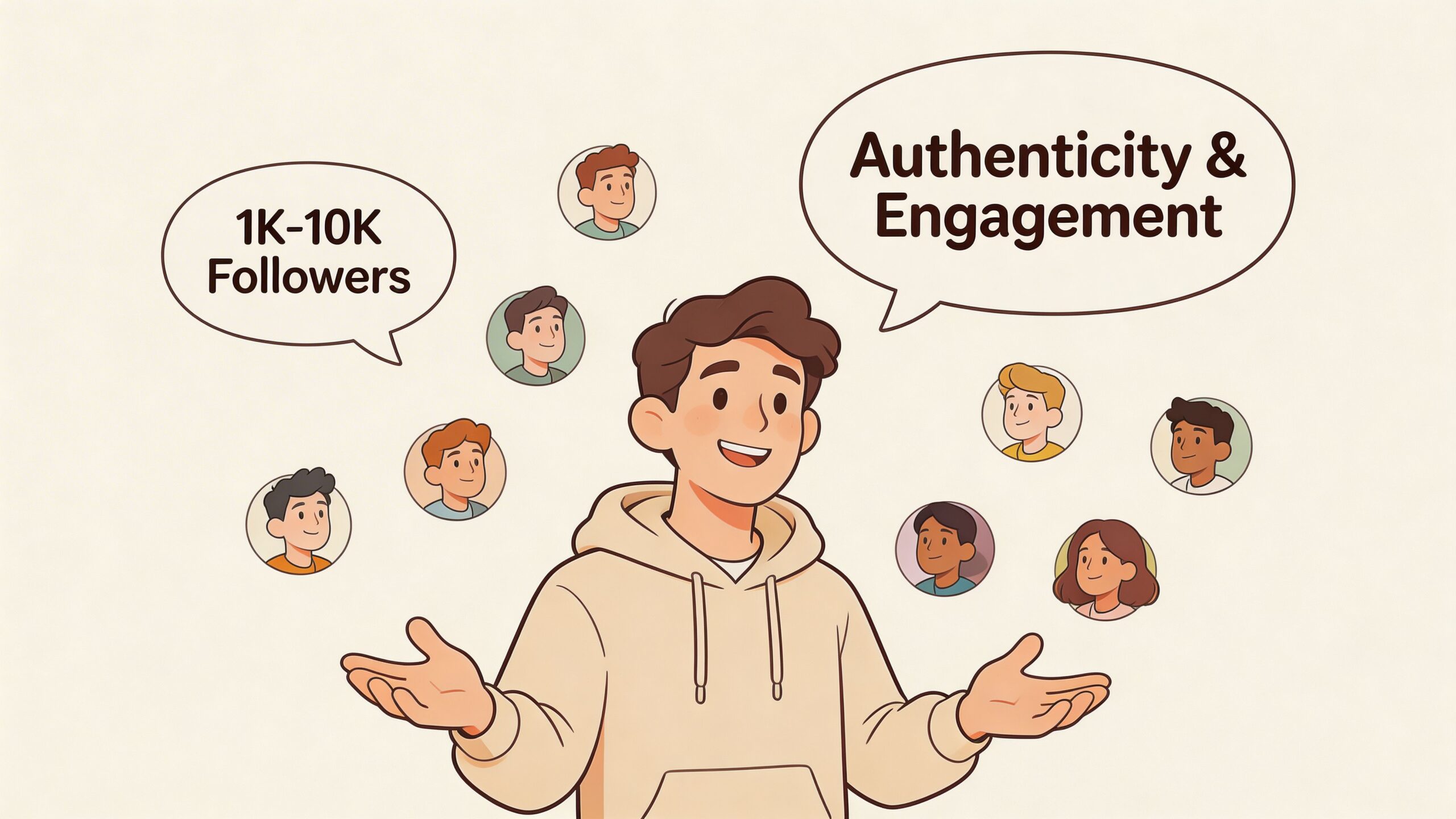
Analysts at Sprinklr define nano influencers as creators with 1,000 to 10,000 followers on platforms such as Instagram. That number gives you the boundary. It does not explain the business value.
A nano influencer is a small creator with a recognizable niche, an active two-way relationship with followers, and enough consistency that recommendations feel personal rather than generic. In practice, they operate less like rented media and more like a trusted specialist inside a specific community.
The simplest way to understand it
Consider the difference between two recommendations.
One comes from a famous face speaking to millions. The other comes from a creator whose posts you have followed for months because they always review budget skincare, trail-running gear, meal prep, or local restaurants with the same clear point of view. The second recommendation usually carries more weight because it arrives inside an existing relationship.
That is the definition in action.
What separates a nano influencer from a regular user
Follower count alone is too blunt an instrument. A regular user may have 3,000 followers and no real influence. A nano creator usually shows three signals that matter to marketers:
- Consistent content: They post often enough that followers recognize their style, standards, and opinions.
- Clear niche: People follow for a specific reason, such as modest fashion, home gym routines, regional food spots, or beginner tech advice.
- Active conversation: They respond to comments, answer questions, and create the sense that followers are part of an ongoing exchange.
This difference in interaction explains why nanos often outperform larger creators on engagement. Sprinklr notes that nano accounts often see engagement rates of 3.5% to 8%+, while macro influencers are typically under 2% on that benchmark page.
Why this matters more in 2026
In 2026, the category matters for a second reason. Brands are no longer asking only, "Can this creator get attention?" They are asking, "Can this creator drive measurable action, and can we run this at scale without turning the campaign into a spreadsheet mess?"
That is where nano influencer marketing gets misunderstood. The audience relationship is the advantage. The operations are the challenge.
One nano partnership can feel simple. Twenty or fifty partnerships create real workload across sourcing, vetting, briefs, approvals, links, usage rights, payouts, and performance tracking. Professional teams need a repeatable system to handle that volume and measure which creators produce revenue, leads, content assets, or customer insight. Platforms built for creator management, such as REACH, help turn a promising tactic into a channel you can run with discipline.
If you are also comparing nano creators with the next tier up, this guide to the micro influencer definition and follower range helps clarify where each model fits.
A useful way to remember it is simple. The follower range tells you who qualifies. The relationship quality, and your ability to manage many of those relationships well, determines whether the strategy pays off.
Nano Influencers Compared to Other Creator Tiers
A creator tier chart is useful for one reason. It helps you match the job to the right messenger.
Many teams start with audience size because follower counts are easy to report upward. Internal reporting pressures can lead teams to overvalue visible scale, even when the campaign goal is not mass exposure. That is how brands end up hiring a billboard when they really needed a trusted store clerk.
Influencer Tier Comparison 2026
| Tier | Follower Range | Avg. Engagement Rate (IG) | Est. Cost Per Post | Best For |
|---|---|---|---|---|
| Nano | 1,000 to 10,000 | Higher than larger tiers on Instagram benchmarks cited earlier | $25 to $175 | Niche trust, community response, conversion-focused campaigns |
| Micro | 10,000 to 100,000 | Varies by niche | Not specified here | Balancing reach and relevance |
| Macro | 100,000 to 1M | Lower than nano tiers on the benchmark cited earlier | Not specified here | Broad awareness |
| Mega | 1M+ | Not specified here | Not specified here | Mass visibility and brand recognition |
The point of this comparison is not to crown one tier as the winner. It is to clarify the tradeoff.
Larger creators function like broadcast media. They are useful when the priority is reach, repeated exposure, and brand recall. Smaller creators function more like distributed word of mouth. They are useful when the priority is relevance, replies, saves, clicks, product questions, and purchase intent from a specific group.
That distinction is critical because awareness and persuasion are different jobs. A macro creator can put your brand in front of more people quickly. A nano creator can make the recommendation feel close enough to act on.
A simple way to choose:
- Use larger tiers for launches, broad awareness, and top-of-funnel visibility.
- Use nano creators for niche offers, local campaigns, product testing, and conversion-focused outreach.
- Use a tier mix when you need scale at the top and trusted validation lower in the funnel.
If you want a clearer breakdown of where nano ends and micro begins, this guide to the micro influencer definition and follower range helps set the boundary.
Why the wrong tier often gets chosen
The wrong choice usually comes from measurement, not strategy.
A large account looks stronger in a slide deck because the reach number is obvious. The harder question is whether that reach matched the buyer, produced usable content, or created trackable action. With nano creators, the audience is smaller, but the signal is often cleaner. You can see who asked questions, clicked the link, redeemed the code, or generated content your brand can reuse.
That is also where operations start to matter. One macro partnership may be simple to manage. Twenty nano partnerships can produce better market coverage, but they also create more coordination work. The key comparison is not only reach versus engagement. It is reach versus relevance, and simplicity versus scalable execution.
For a professional team, that changes the buying decision. You are not just choosing a creator tier. You are choosing a campaign model your team can run, measure, and improve.
The Strategic Advantages of Nano Influencer Campaigns
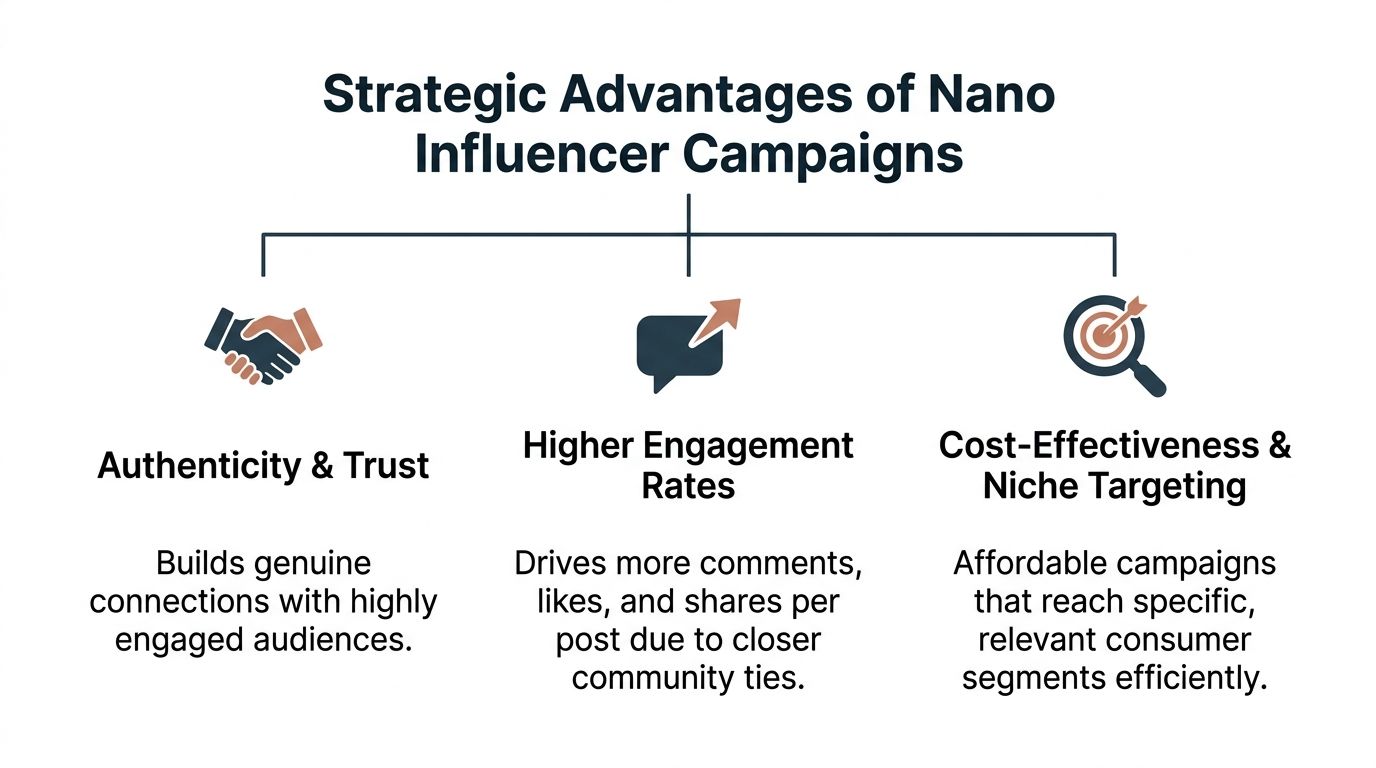
Nano influencer campaigns earn attention because they solve three business problems at once. They can lower costs, improve audience trust, and help brands reach niches that broad campaigns often miss.
Better economics for tighter budgets
Nano partnerships are still relatively affordable compared with larger creator tiers. Pricing has risen to $25 to $175 per post in 2026, and brands increasingly prioritize nano and micro creators, with 61% of brands making those partnerships their primary strategy according to Awisee’s influencer marketing statistics.
That same source reports that nano-influencers generate 20x return on investment, and brands receive an average of $4.12 for every $1 spent on influencer campaigns.
Those numbers matter because they change how a team can plan. Instead of committing budget to one high-profile creator, a brand can test several niche voices, compare performance, and learn faster.
Trust that reduces hesitation
Trust is not a soft metric. It affects whether someone scrolls past or stops.
When a nano creator recommends a product, the audience often treats it more like advice than an ad. That lowers friction. People ask practical questions. They look for proof in the comments. They respond to demonstrations that feel native to the creator’s usual style.
This is one reason nano campaigns are often useful for products that need explanation, social proof, or routine-based adoption.
Nano influencers are not just less expensive creators. They are often more persuasive because the recommendation feels socially closer.
Strong niche targeting
Broad campaigns reach many people, but many of those people are only loosely relevant.
Nano influencers help brands match the message to the exact audience. A local runner, a home coffee creator, a budget décor account, or a minimalist skincare reviewer each attracts a very different buyer mindset. That makes nano campaigns useful for:
- Product testing: Smaller communities often leave specific feedback.
- Localized launches: A creator with concentrated local credibility can outperform broad regional messaging.
- UGC collection: Nano partnerships can produce content that feels more native and reusable across owned channels.
- Niche education: If a product needs context, a creator embedded in that niche can explain it clearly.
Why this strategy keeps growing
As algorithms reward content people interact with, brands gain more from creators who prompt comments, saves, replies, and shares. Nano creators often fit that pattern because the audience relationship is built around participation, not just passive viewing.
That makes them especially valuable for teams that care about measurable action, not just audience size.
Common Challenges and How to Solve Them
Nano influencers are powerful, but they are not effortless. The biggest mistake in this category is pretending that authenticity solves every operational problem.
It does not.
A campaign can fail even with strong creators if the workflow is weak, vetting is shallow, or reporting is unclear.
Challenge one: fake engagement and weak vetting
A common assumption is that small creators are authentic by default. That is not always true. A HypeAuditor 2025 audit cited by Indeed’s nano influencer overview found that 28% of nanos have 15-20% fake engagement from bought followers.
That means brands cannot rely on follower count and visible likes alone.
A better screening process includes:
- Comment quality: Look for real discussion, not repetitive one-word replies.
- Audience fit: Review whether the content and community match your buyer.
- Posting behavior: Check consistency and whether sponsored content disrupts the account’s usual style.
- Account hygiene: Review suspicious spikes, mismatched engagement, or off-brand audiences.
If you need a practical starting point, this breakdown of fake subscriber count helps explain the warning signs.
Challenge two: managing many small partnerships
One macro creator is simple to brief. Twenty nano creators are not.
The complexity shows up fast. Outreach sits in email, approvals live in messages, content links disappear, payment details get messy, and performance reporting turns into a patchwork. This is why many teams underinvest in process.
A cleaner approach is to standardize:
- A single brief format
- Clear disclosure guidance
- Approval rules
- One payment workflow
- Shared tracking links or codes
For brands that need a centralized system, REACH provides influencer discovery filters, campaign dashboards, content approvals, click tracking, payment handling, and reporting in one workflow. That kind of structure helps when the goal is to scale nano campaigns without losing control.
Challenge three: sponsorship can change audience response
Some nanos lose credibility when a paid post feels abrupt or unnatural. Followers notice when a creator shifts from normal content into stiff brand language.
The fix is not avoiding sponsorships. The fix is selecting creators who can integrate a product naturally and briefing them with guardrails instead of scripts.
The strongest nano campaigns protect the creator’s voice. The brand gives direction, but the creator keeps the delivery believable.
How to Find and Partner with Nano Influencers
Finding nano influencers manually is possible. You can search hashtags, review tagged posts, watch competitor mentions, and scan comment sections. That works for early research.
It breaks down when you need consistency.

A manual search usually creates three problems. It takes too long, it surfaces inconsistent profiles, and it gives you weak reporting later because you did not build a tracking structure from the start.
Start with filters, not follower envy
A better discovery method begins with campaign criteria.
Reports summarized by Meltwater’s nano-influencer article note that nano-influencers deliver 22% higher ROI on average for campaigns under $10K, and that AI-driven discovery tools that prioritize engagement-over-reach filters can yield 2.7x better stakeholder reports.
That points to a practical lesson. Do not start by asking who has the biggest audience. Start by asking who best matches the campaign.
Useful filters include:
- Follower range: Keep the shortlist in the nano band.
- Engagement quality: Look beyond totals and inspect conversation depth.
- Niche keywords: Terms like vegan skincare, home workouts, local cafés, or family travel.
- Audience geography: Important for retail, events, and regional launches.
- Content format: Reels, short-form video, product tutorials, or story-first creators.
A practical partner selection process
Once you have a shortlist, move through selection in this order:
Relevance first
The creator should already talk about the category, routine, or audience mindset your product fits.Credibility second
Review how they disclose partnerships, answer questions, and handle recommendations.Creative fit third
Their content style should support the type of message you need, whether that is education, demo, testimonial, or lifestyle integration.Operational fit last
Make sure they can meet deadlines, deliver assets, and follow basic process.
This short video gives a useful overview of how nano and small-scale influencer campaigns work in practice.
How to structure the first outreach
Your first message should be brief and specific. Avoid mass-template language.
A good outreach note usually includes:
- Why you chose them: Mention a real content theme or post type.
- Why the fit makes sense: Connect their niche to the product clearly.
- What the partnership includes: Product, payment, deliverables, timeline.
- What flexibility they have: Let them know you want the content in their voice.
That last point matters. Nano creators perform best when the content still sounds like them.
Build the workflow before launch
Many brands think about tracking after content goes live. That is too late.
Before the first post, decide how you will attribute value. Set up links, codes, approval steps, usage rights, and payment terms in advance. That turns influencer activity into a repeatable channel rather than a one-off experiment.
Measuring Success with Nano Influencer KPIs
A nano campaign should not be judged by likes alone. Likes can signal attention, but they do not prove business impact.
The more useful approach is to track a few KPIs that connect creator activity to actual outcomes.
The KPIs that matter most
Use a simple scorecard:
- Conversion rate: Track purchases tied to a creator’s code or link.
- Click-through rate: Measure how many people move from content to landing page.
- Cost per acquisition: Compare spend against the customers generated.
- Content quality: Review whether the creator produced reusable, persuasive UGC.
- Audience response: Comments can reveal objections, use cases, and buying intent.
For creators who rely on profile traffic rather than direct in-app linking, a guide to best link in bio tools can help you set up cleaner attribution paths.
How to make reporting usable
Do not wait until the campaign ends to gather evidence.
Create one live dashboard or reporting sheet where every creator has:
- tracking link
- discount code
- content status
- post URL
- spend
- clicks
- conversions
- notes on comment quality
That gives you a clearer picture of what happened and why. It also makes internal reporting easier when stakeholders want proof that smaller creators are producing more than “awareness.”
If you want a framework for structuring those metrics, this resource on influencer marketing KPIs is a useful reference.
A strong nano campaign report explains both performance and pattern. It shows which creators drove action, which messages resonated, and what to repeat next time.
Conclusion Your Next Step in Influencer Marketing
If you have been asking what is a nano influencer, the short answer is this. It is a small creator with a trust advantage. The long answer is more important. Nano influencers can become a reliable growth channel when brands pair that trust with clear vetting, tight workflow, and practical measurement.
They are not a shortcut. They are a disciplined strategy.
If you want a broader framework for connecting campaign activity to business results, this guide to ROI on social media adds helpful context beyond influencer work alone.
If you are ready to test a structured nano-influencer program, explore REACH to discover creators, organize outreach, manage approvals, track clicks, and measure campaign results in one place.