
You've probably heard someone say, “Just send them a DM,” or “Slide into their DMs,” and nodded along while only half sure what they meant. That's common, especially if you're new to social media marketing and most of your work has lived in email, spreadsheets, and meetings.
In practice, DMs sit in a strange middle ground. They feel casual, but they often become the first point of contact for creator outreach, customer questions, and partnership conversations. That's why understanding what a DM is matters. It's a basic social media skill, but it also affects how professionally your brand communicates online.
What's a DM and Why Does It Matter
A DM is a Direct Message, which means a private message exchanged between users on social platforms rather than in a public feed. The term became standard after Twitter introduced direct messaging shortly after its 2006 launch, and it later spread across major platforms including Instagram, Facebook, LinkedIn, and TikTok, as explained in RecurPost's DM glossary.
That history matters because it explains why people use “DM” as a universal shorthand. They don't usually mean one platform's exact feature. They mean, “Send me a private message on social.”
What people usually mean by DM
If someone comments, “DM me for details,” they're asking to move the conversation out of the public thread and into a private space. That private space could be Instagram, LinkedIn, X, TikTok, Facebook, or another social app.
For a personal user, that might mean chatting with a friend.
For a marketer, it can mean:
- Starting creator outreach
- Answering a product question
- Handling a partnership inquiry
- Moving a lead toward a call or email thread
Practical rule: A DM is often the fastest way to start a conversation, but it's rarely the best place to manage a complicated one.
That's where people get confused. They think a DM is just a casual chat tool. It is, but it's also a business channel now. Brands use DMs to reach creators. Influencers use them to ask about campaign terms. Customers use them when they don't want to post a complaint in public.
If you're building social systems, it also helps to understand what happens after that first private message. For example, if your team gets lots of Instagram inquiries, it's worth learning how messaging automation works. This guide on how to transform your business with an Instagram bot gives a useful overview of how brands handle repetitive conversations without losing responsiveness.
How Direct Messages Work Across Platforms
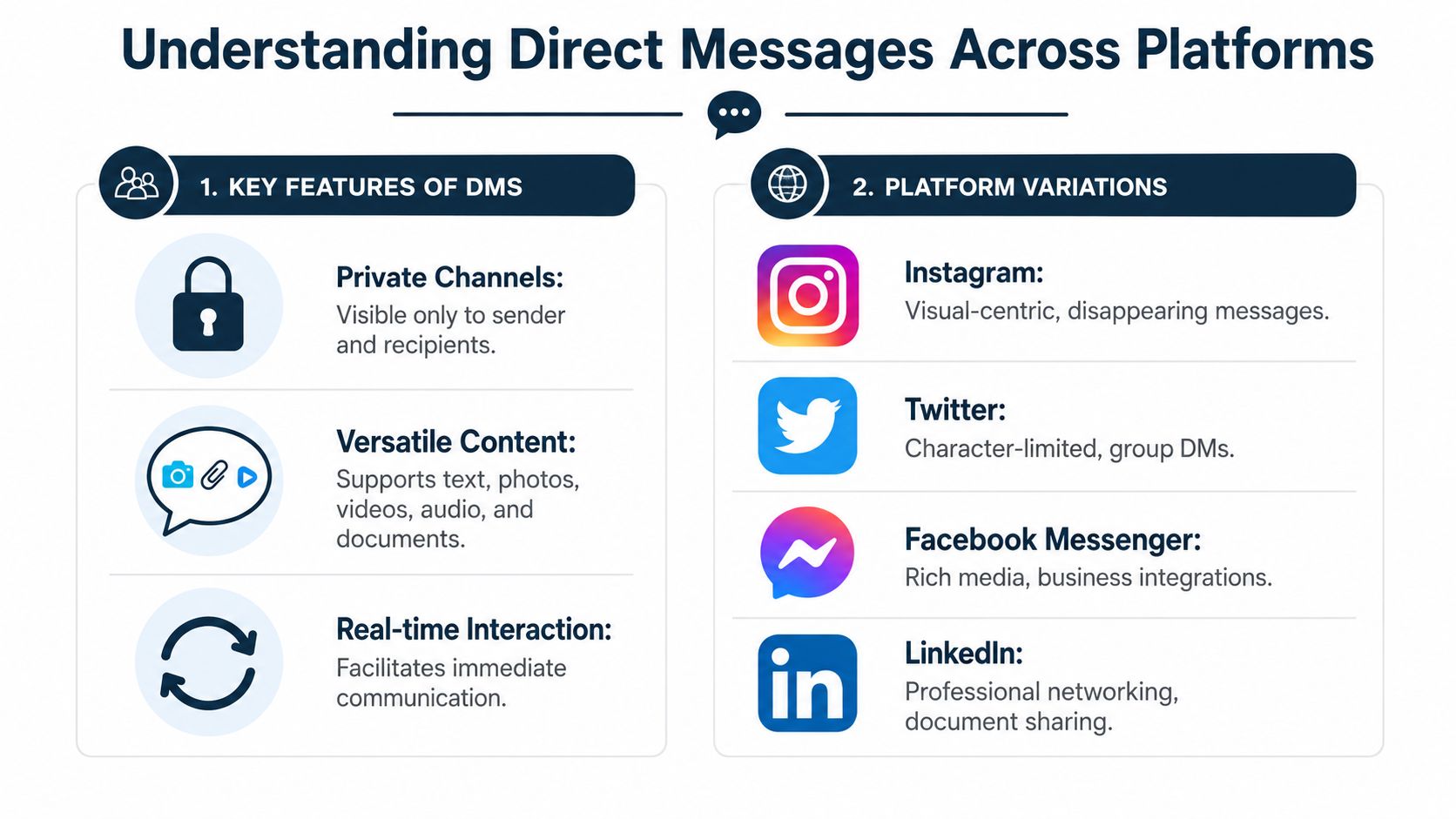
A DM is a private, platform-native messaging channel. Its content is visible only to the sender and recipient, or to a defined small group on platforms that support group chats. It's used for one-to-one or small-group communication and can carry more than plain text, including images, videos, documents, and links, as outlined in Sprinklr's DM glossary.
The core features stay the same
Across most social apps, DMs do a few basic jobs well:
- Private communication so you can move away from public comments
- Media sharing for screenshots, product images, short videos, or links
- Quick replies when email feels too slow or too formal
- Small-group coordination for lightweight planning
That makes DMs useful. It also makes them deceptively easy to overuse.
The platforms feel different in practice
Even though the term is universal, the experience changes depending on the platform. Here's a simple comparison.
| Platform | Best used for | What stands out |
|---|---|---|
| Creator outreach, visual brand conversations | Strong for image and short-form content sharing | |
| X | Fast back-and-forth text conversations | Feels quick and informal |
| Professional introductions and partnership discussions | Better fit for business tone | |
| Facebook Messenger | Community support and broader consumer messaging | Familiar for many general audiences |
| TikTok | Creator communication tied to short-form content | Useful when your campaign starts on TikTok |
A beauty brand, for example, might discover creators on Instagram, start outreach there, then later move the serious details elsewhere. A B2B software company might skip Instagram entirely and begin with LinkedIn messages because the audience expects a more professional tone.
Platform choice changes the tone before you write a single word.
That's why workflow matters. If your team is handling messages across several platforms at once, the true challenge isn't writing one DM. It's keeping track of all of them. If you're dealing with that problem already, this breakdown of SleekPost's social media workflow is a helpful read on organizing activity across accounts.
For marketers working with creators, audience fit matters just as much as platform fit. If you want a practical example of how influencer categories map to real outreach work, REACH's list of Instagram influencers in India shows the kind of segmentation teams often need before they ever send a first message.
What confuses beginners most
New social media managers often assume all DMs work exactly like email inboxes. They don't.
A few common misunderstandings:
- DMs aren't always structured well. Threads can get messy fast.
- Not every platform handles attachments the same way.
- Message requests can hide unread outreach.
- Conversation history may be hard to search later.
That's fine for a simple exchange like, “Can you send your rate card?” It becomes a problem when the thread starts holding approval notes, deadlines, usage rights, shipping details, and payment questions.
The Good and The Bad DM Etiquette and Security
DMs feel informal, which is exactly why people misuse them. A private message can open a great business relationship, but it can also come off as spammy, careless, or unsafe if you handle it poorly.
What good DM etiquette looks like
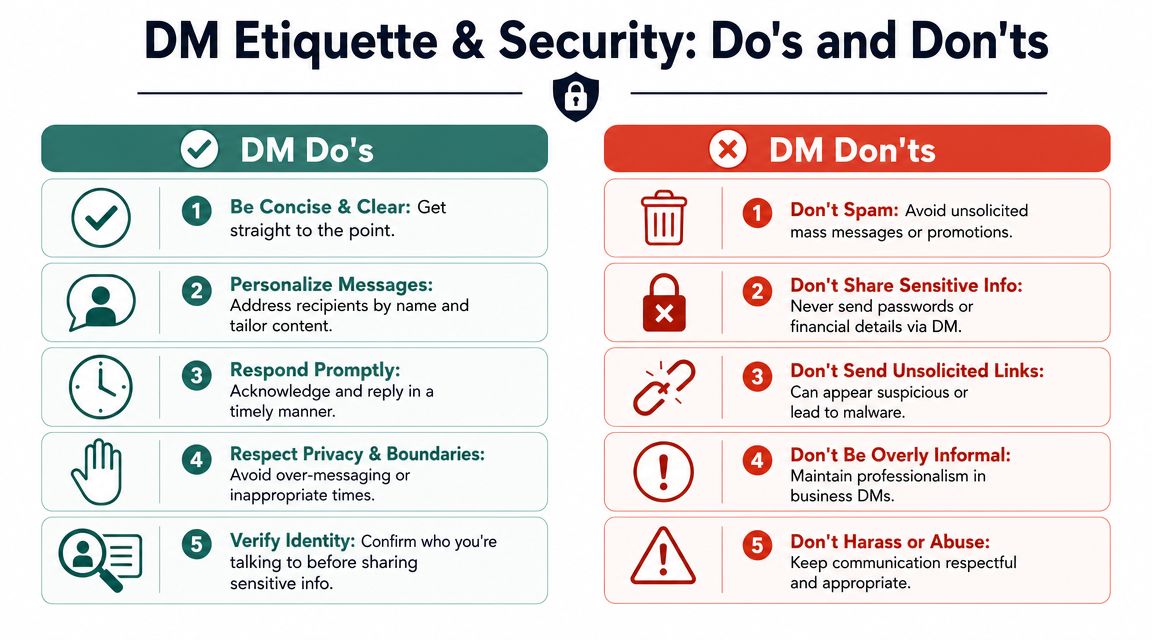
Here are habits worth keeping:
- Keep it short. A first message should be easy to read on a phone screen.
- Make it personal. Use the person's name and mention something specific about their content or question.
- State your reason early. Don't make people guess why you contacted them.
- Move complex topics out when needed. If legal details, contracts, or deliverables come up, shift to email or a structured tool.
- Reply like a professional. You don't need to sound stiff, but you do need to sound clear.
A simple outreach note often works better than a long pitch. “Hi Maya, I manage partnerships for a skincare brand and loved your recent routine video. Would you be open to hearing about a paid collaboration?” is stronger than a huge message full of brand history.
What to avoid
Some mistakes turn people off immediately:
- Mass-copy outreach
- Pushy follow-ups
- Unsolicited attachments
- Sending sensitive information in chat
- Overly casual language in a business context
A DM should feel human, not copied from a blast list.
Security matters too. Because DMs feel quick and personal, people sometimes lower their guard. That's when scams and impersonation attempts get through.
Basic DM safety for marketers and creators
Use a few simple checks before you trust a message:
- Check the account identity. Look at profile details, recent posts, and whether the message matches the sender's public presence.
- Be careful with links. If a link seems odd or unexpected, don't click it right away.
- Don't share payment or password details in DMs.
- Use block and report tools when needed.
- Trust context. If the tone is off, the urgency is weird, or the request feels rushed, pause.
If you manage social accounts for a company, your team should also have clear rules. A written policy helps people know what belongs in a DM, when to escalate, and how to handle suspicious outreach. REACH's guide to corporate social media policies is a practical starting point for setting those boundaries.
How Brands and Influencers Use DMs for Business
Brands use DMs because they're immediate. Influencers use them because that's where opportunities often show up first. If you work in marketing, you'll see DMs show up in several parts of the job, even if they aren't where the whole job should live.

Common business uses for DMs
A few examples come up all the time:
- Customer support: answering order questions, shipping issues, or product concerns
- Lead handling: moving a curious follower into a sales conversation
- Community building: responding to loyal fans, ambassadors, or members
- Partnership outreach: contacting creators, affiliates, or collaborators
For influencer marketing, DMs are often the opening move. A brand spots a creator, likes the fit, and sends a short private note to ask if they're open to working together.
That part makes sense. It's fast, low-friction, and familiar.
Where the process starts to break
Now take a realistic campaign scenario. A small brand wants to work with a group of creators for a seasonal launch. The social media manager starts outreach on Instagram and TikTok because that's where the creators are most active.
At first, everything feels manageable.
A few creators reply right away. Some ask for the brief. Others want product details. One wants to know posting dates. Another asks about usage rights. A few don't respond until days later, buried in message requests.
Then the side systems appear:
- a spreadsheet for who replied
- an email draft for contracts
- a notes doc for content ideas
- a calendar for posting windows
- a finance reminder for payments
None of that lives neatly in the DM thread.
DMs are great for opening a door. They're weak at running the whole house.
That's why agencies often mix channels. They might start in Instagram DMs, confirm interest, then move to email, a project tool, or a dedicated campaign system. Some teams also use messaging apps outside social for client communication. If your work includes more service-based or agency-style outreach, this guide to WhatsApp Business for agencies is useful for understanding where another messaging channel can fit.
The core limitation is simple. DMs are built for conversation, not for campaign operations. Once approvals, deadlines, assets, usage permissions, and payments enter the picture, the thread stops being enough.
When DMs Aren't Enough Managing Campaigns at Scale
You can run a lightweight collaboration in DMs. You can even run a few at once if you're organized and the campaign is simple. The trouble starts when the work expands and the message thread becomes your unofficial command center.
That setup creates friction in ways that don't look dramatic at first.

What breaks first
Teams often run into the same issues:
| Problem | What it looks like in daily work |
|---|---|
| Lost context | Key details are buried deep in old threads |
| Fragmented tracking | Status lives partly in DMs, partly in spreadsheets |
| Approval confusion | Creators send drafts in one place, edits happen in another |
| Payment friction | Finance details are disconnected from campaign history |
| Team visibility gaps | One manager knows the thread, nobody else does |
That's not a messaging problem alone. It's an operations problem.
A brand manager may know that a creator agreed to a revision in Instagram DMs, but the account lead may only see the spreadsheet. Finance may know payment is pending, but not whether the content was approved. The campaign doesn't fail because anyone is careless. It gets messy because the system is scattered.
What a better workflow looks like
A scalable workflow separates conversation from execution.
DMs still have a role. They help with discovery, first contact, and quick relationship-building. But after that, serious campaign work needs structure:
- A shared dashboard so the whole team can see status
- Clear deliverable tracking so no post gets missed
- Organized approvals so feedback doesn't live in random threads
- Payment coordination tied to the actual campaign record
- Cross-platform visibility when campaigns span TikTok, Instagram, YouTube, and more
That's the kind of workflow teams usually start looking for after they've outgrown inbox juggling. If you want to compare the broader category, REACH's overview of social media campaign management tools is a useful reference point for what structured campaign operations should include.
Why this matters for professional teams
A lot of social media advice treats DMs like the end goal. In real marketing operations, they're usually the beginning.
The better question isn't only “What's a DM?” It's “What should happen after the DM?” If your answer is “we copy details into three other tools and hope nothing gets missed,” the workflow needs work.
The strongest teams don't stop using DMs. They stop relying on DMs for everything.
That shift matters most in influencer marketing because creator relationships move fast, but campaigns still require coordination. If you want consistent execution, the handoff from casual chat to structured workflow has to be intentional.
Your Next Step in Mastering Digital Communication
A DM is a private social media message. It's one of the simplest tools in digital communication, and it matters because so many business conversations now start there.
For marketers, that's the key takeaway. DMs are excellent for first contact, quick replies, and relationship-building. They're much less effective when you need a reliable system for approvals, deliverables, timelines, and payments.
If you're new to social media marketing, learn to use DMs well. Write clearly. Respect boundaries. Stay organized. Then build a workflow that doesn't depend on a scrolling message thread to keep your campaigns on track.
If you're ready to move beyond scattered inboxes and run influencer campaigns with more structure, explore REACH. It's built for brands and agencies that need a cleaner way to manage creator communication, track deliverables, and keep campaigns organized from outreach to payment.