 Skip to content

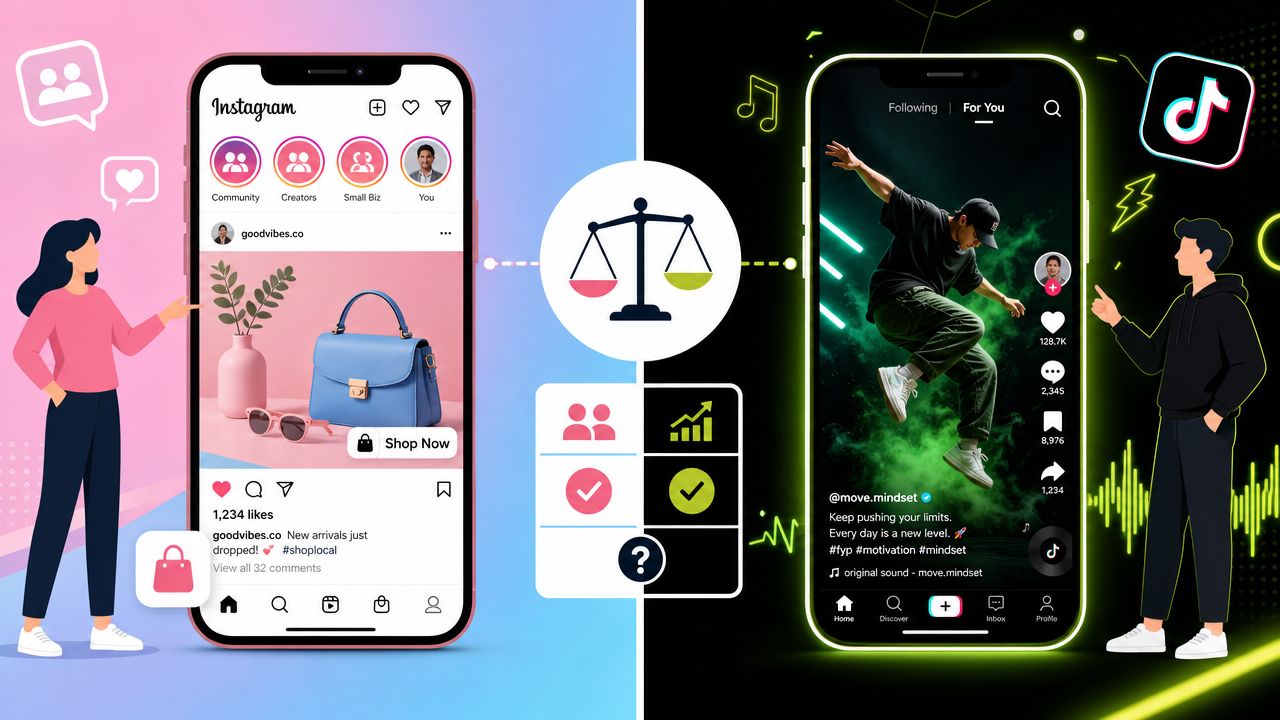
Meta description: Instagram v TikTok for marketers in 2026. Compare reach, engagement, conversion, audience fit, and the hidden campaign execution gap that affects influencer ROI.
Most advice on Instagram v TikTok asks the wrong question.
Marketers keep debating which platform is better, then act surprised when the campaign still becomes messy. Platform choice matters, but it's rarely the point of failure. Key problems show up after creator selection, when your team has to brief talent, chase draft approvals, track live posts, reconcile payments, and explain performance to finance.
That's why the cleanest way to think about Instagram v TikTok isn't “Which app wins?” It's “Which app fits the objective, and can our team execute the program without drowning in admin?”
A lot of brand teams can get to a reasonable platform decision on their own. Fewer can run a cross-platform creator program smoothly at scale. That post-discovery gap is where campaigns slow down, creators get frustrated, and reporting turns into spreadsheet archaeology.
For a marketing director, that changes the brief. You're not just picking a channel. You're choosing a content environment, a discovery model, a conversion path, and an operating burden.
Instagram vs TikTok The Wrong Question for Marketers
The usual debate frames Instagram and TikTok as substitutes. In practice, they behave more like different parts of a marketing system.
TikTok is where content can break out fast, especially when the creative is native, quick, and trend-aware. Instagram is where brands often build steadier relationships, shape narrative, and move users closer to purchase. If you reduce the decision to vanity metrics, you'll miss the business model behind each platform.
Why the old comparison falls short
A marketing team can choose the right platform and still lose time, margin, and internal trust if execution is weak. Discovery is visible. Operations are not. Nobody posts screenshots of delayed payments, missing creator contracts, or unapproved captions. But those are the things that make an influencer program hard to scale.
Practical rule: Don't judge a platform only by how easy it is to find creators. Judge it by how hard it is to run the campaign after the shortlist is approved.
That's the gap most surface-level comparisons skip. They talk about aesthetics, trends, and demographics. They don't talk enough about ownership. Who tracks deliverables? Who confirms usage rights? Who makes sure finance has what it needs? Who catches the creator who posted, but forgot the required disclosure?
What a marketing director actually needs to decide
A useful Instagram v TikTok decision usually comes down to four questions:
- What is the campaign goal: Broad awareness, stronger consideration, direct response, or community building.
- What kind of creative will win: Polished brand storytelling, raw social proof, tutorial content, or trend participation.
- Where does your audience spend attention: Not just by age, but by behavior and content expectations.
- How much operational complexity can your team absorb: A lean team should be honest about this early.
If you answer those four questions first, the platform choice gets clearer. If you skip them, you'll probably end up with a campaign that looks active from the outside and feels chaotic inside.
The Core DNA Instagrams Social Graph vs TikToks Content Graph
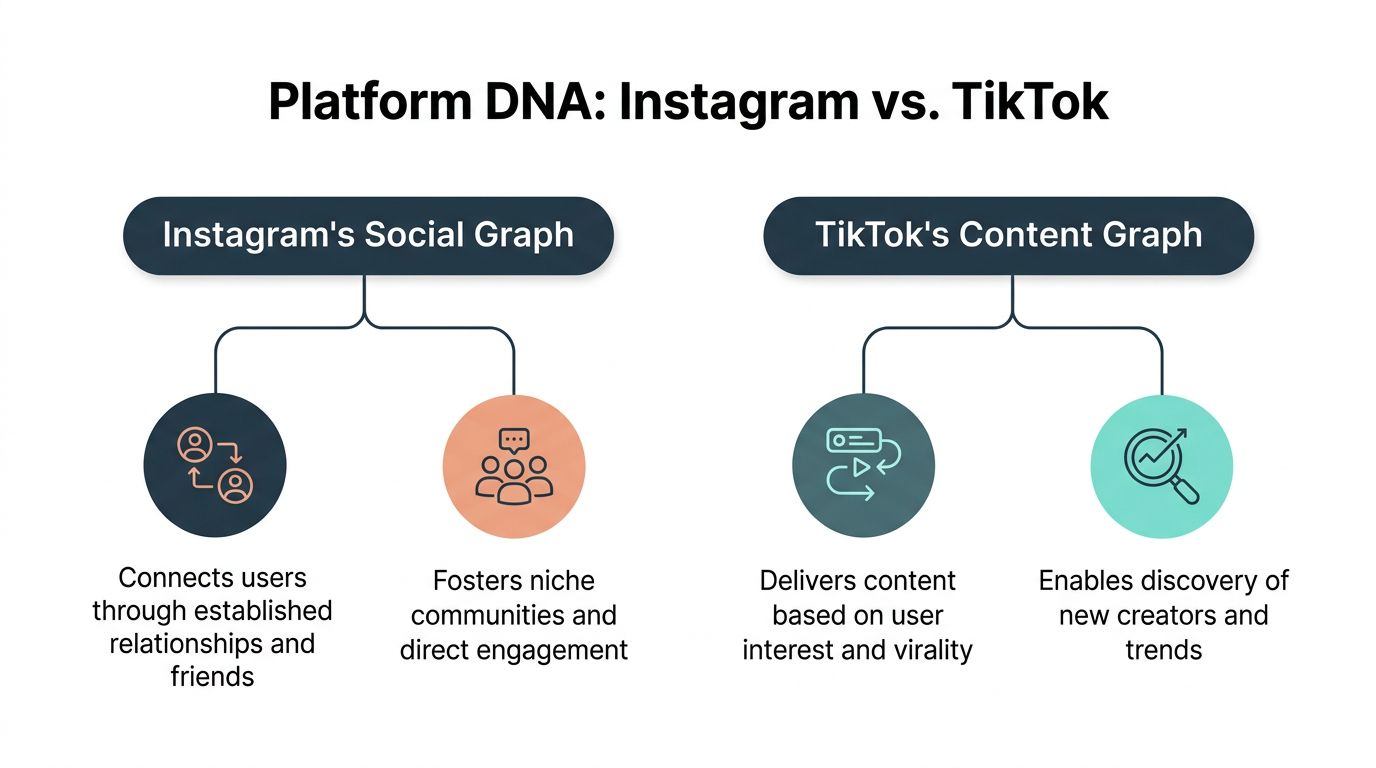
Instagram and TikTok feel different because they are built on different distribution logic.
Instagram is rooted in a social graph. It tends to reward existing relationships, follower familiarity, and repeated interaction. TikTok runs on a content graph. It pushes content based on user interest, watch behavior, and the likelihood that a video will hold attention, whether or not the viewer knows the creator.
What this means in campaign planning
On Instagram, the brand often benefits from context. A creator's audience already knows how that person speaks, recommends products, and frames stories. That makes Instagram useful when trust and continuity matter.
On TikTok, the video itself carries more of the burden. The creative has to earn attention immediately. If it does, the platform can introduce the content to a much broader pool of non-followers. That's why TikTok is so strong when the brief is discovery, momentum, or cultural relevance.
This difference also affects briefing. Instagram content often performs best when the creator can integrate the product into an existing narrative or community habit. TikTok content often performs best when the hook, pacing, and opening seconds are built for interruption and retention.
The audience overlap is real, but the age profile still matters
The audience split isn't night and day, but it isn't identical either. Billo's Instagram vs TikTok comparison notes that 31% of Instagram's audience is aged 25 to 34, compared with 32.5% on TikTok. Billo also reports that TikTok has more users in the 18 to 24 and 25 to 34 ranges, while Instagram has relatively more older users.
That doesn't mean younger brands should automatically choose TikTok or that Instagram is only for older audiences. It means the content expectations differ. Younger audiences on TikTok often tolerate more experimentation, faster trend cycles, and less polish. Instagram usually asks for a cleaner bridge between creator identity and brand presentation.
The biggest mistake is treating the same creator brief as portable across both platforms. It rarely is.
A simple working model
Use this mental shortcut when planning:
| Platform logic | Best used for | What usually fails |
|---|---|---|
| Instagram social graph | Community depth, recurring brand presence, considered storytelling | Forcing trend-first creative that doesn't fit the creator's normal voice |
| TikTok content graph | Fast discovery, broad exposure, trend adaptation, awareness | Overproduced ads that ignore pacing, hooks, and platform behavior |
That distinction drives almost every practical decision that follows.
Instagram vs TikTok A Marketers Side by Side Analysis
Feature comparisons miss the budget question. A marketing director is not choosing between two apps. They are choosing where creative time, creator fees, paid support, approvals, and reporting effort will produce the best commercial return.
The side by side view below is the one that matters in practice.
| Decision area | TikTok | |
|---|---|---|
| Primary strength | Fast organic discovery beyond current followers | Higher purchase intent and stronger brand continuity |
| Creative style that performs | Native, trend-aware, low-friction video | Polished but still creator-led short-form and Stories |
| Best fit in funnel | Awareness, new audience entry, product curiosity | Consideration, trust-building, conversion support |
| Typical brand mistake | Over-approving until the content stops feeling native | Reposting TikTok-style creative without adapting it to Instagram behavior |
| Operational pressure | High volume testing, fast turnarounds, frequent revisions | More asset variations across Reels, Stories, feed, and paid reuse |
Performance means different things on each platform
TikTok usually wins on raw discovery. More non-followers see the content, and strong creator posts can travel quickly without an established audience base. That makes TikTok useful when a brand needs reach fast, wants to test multiple hooks, or is entering a category where it has little existing attention.
Instagram usually wins on quality of downstream action. The user journey is more familiar for profile visits, saves, DMs, link taps, retargeting, and paid amplification. Teams running product drops, creator whitelisting, or conversion-focused campaigns often find Instagram easier to connect to revenue reporting.
That is why reach alone is a weak decision rule.
Creative trade-offs are operational trade-offs
TikTok rewards speed. Instagram rewards consistency.
On TikTok, the highest-performing creator content often looks close to what the creator would post without a brand involved. Fast hooks, comment-style framing, looser edits, and trend participation can outperform polished assets. The problem for brand teams is internal. Legal, brand, and paid media stakeholders often try to clean up the very elements that make the content work.
Instagram creates a different workload. A single creator partnership may need a Reel, Story frames, usage rights for paid social, and visuals that still fit the brand's broader presence. If the team wants to improve social media reach with Reels, production quality and platform fit both matter, but the execution burden also rises.
The practical split for marketers
Use TikTok first when the goal is to generate new attention, pressure-test messaging, or get more creative volume from creators who are strong on camera and comfortable reacting quickly.
Use Instagram first when the campaign needs stronger purchase intent signals, easier handoff into retargeting, or content that can support both organic publishing and paid media.
Use both only if the team can manage the extra coordination. Cross-platform campaigns sound efficient. In execution, they often mean separate briefs, separate edit notes, separate approval logic, and separate reporting. Brands that want that coverage usually need a real TikTok campaign management workflow instead of scattered spreadsheets and DMs.
What a side by side analysis should actually answer
The useful question is not which platform has better features. It is which platform can support the outcome your team is accountable for this quarter, with the staff, process, and approval speed you have.
That is the gap a lot of comparison posts skip. Discovery happens on Instagram and TikTok. Campaign management does not.
Beyond Discovery The Campaign Execution Gap You Cant Ignore
Most comparison articles stop once they've named the better platform for reach or conversion. That's where the easy part ends.
The hidden workload starts after contracts are discussed and creators are selected. Someone has to keep outreach organized, turn a brief into approved content, track posting dates, confirm live links, manage revisions, log usage rights, process payments, and make sure compliance isn't an afterthought.
The administrative burden is real
The operational drag isn't a niche problem. Shift's analysis of TikTok vs Instagram cites data showing that 78% of marketing teams name manual workflow and disconnected tools as their primary barrier to scaling influencer programs. The same source says a 2025 BrightHub report found that agencies managing 10+ campaigns spend 35% of their time on administrative work such as spreadsheets and DMs rather than strategy.
That tracks with what brand teams run into every day. Instagram and TikTok are good at distribution and discovery. They are not campaign operating systems.
What platforms don't solve
The gaps usually appear in the same places:
- Deliverable tracking: Creators post late, post incorrectly, or post without the latest approved messaging.
- Communication sprawl: Key decisions end up spread across email, DMs, Slack, and comments in shared docs.
- Compliance risk: Disclosure rules, payment records, and rights approvals get handled manually.
- Reporting friction: Performance data lives in too many places to turn into clean weekly reporting.
A team can survive this with a handful of creators. It gets painful once campaigns overlap.
For teams running multi-platform creator work, dedicated TikTok campaign management software is often the difference between a scalable process and a constant cleanup cycle.
Why this matters in the Instagram v TikTok decision
Operational cost changes the platform choice more than is often acknowledged. TikTok may be the better discovery engine, but if your team can't process the creative volume, posting cadence, approvals, and payment workflow that come with it, the “winning” platform becomes expensive in practice.
Instagram can look slower on raw exposure and still produce a better internal outcome if your team can manage it cleanly and turn creator content into sales support, retargeting assets, and repeatable reporting.
A campaign doesn't scale because the algorithm is good. It scales because the workflow holds up under pressure.
Decision Framework When to Prioritize Each Platform
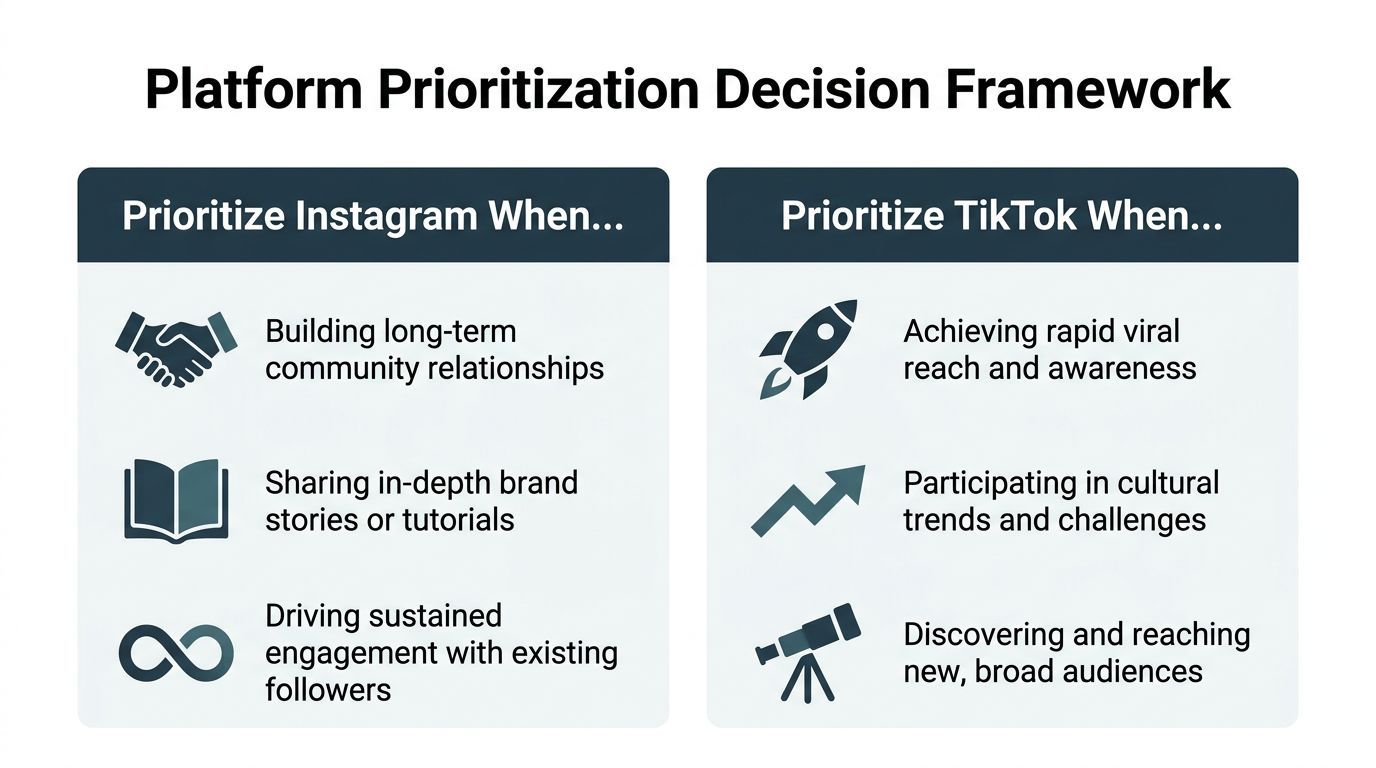
Choosing between Instagram and TikTok gets easier when you force the decision through campaign goals instead of platform loyalty.
For maximum awareness and new audience reach
If your main goal is broad visibility, choose TikTok first.
Verified benchmark data shows TikTok drives 3.4% average engagement by video views, while Instagram Reels is the stronger conversion environment. That makes TikTok the more natural fit when the brief is discovery, cultural momentum, or testing multiple creator angles at the top of the funnel.
This is especially useful when you want content to travel beyond the creator's existing followers.
For higher-intent purchase behavior
If your goal is to move users closer to transaction, prioritize Instagram.
The same benchmark guidance shows Instagram Reels delivers 1.3x higher e-commerce conversion rates from ad campaigns. That doesn't mean every Instagram campaign will outperform TikTok in sales. It means Instagram has a stronger pattern when the objective is converting demand, not just generating it.
Use Instagram when the product needs more explanation, stronger trust signals, or cleaner movement into DMs, product pages, and shopping flows.
For community and relationship depth
Choose Instagram when you want creator content to reinforce a longer brand relationship.
Instagram's social-graph behavior supports repeat exposure and audience familiarity. It's often the better place to build a program around recurring ambassadors, educational content, before-and-after storytelling, or product drops that benefit from sustained attention.
For planning audience alignment before launch, this breakdown of social media demographics by platform helps teams pressure-test fit by channel.
For trend participation and UGC velocity
Choose TikTok when speed matters more than finish.
TikTok works well when the campaign relies on multiple creator variations, fast reactions, remix culture, or user-generated momentum. It's the platform to prioritize when your category benefits from social proof that feels immediate instead of composed.
A quick summary helps:
- Pick TikTok for awareness, trend-led content, and broad non-follower discovery.
- Pick Instagram for stronger conversion behavior, repeat audience contact, and deeper brand storytelling.
- Pick both when your funnel needs discovery and trust-building in sequence.
The Hybrid Approach Using Instagram and TikTok Together
The most effective answer to Instagram v TikTok is often not “either.” It's “sequence them properly.”

A hybrid model works best when each platform does the job it's naturally built for. TikTok opens the funnel through discovery. Instagram deepens interest through repeated touchpoints, better creator continuity, and stronger conversion support. The paid and organic pieces don't have to be identical, but they should be coordinated.
A workable funnel model
Use TikTok at the top of the funnel for creator-led hooks, problem framing, product introduction, and trend-native storytelling. Then move the strongest messages into Instagram, where creators can support consideration with more context, product routine content, Stories, and direct audience interaction.
That workflow is easier to understand in action:
The operational risk in hybrid campaigns
The strategic logic is straightforward. The operations are not.
Convince & Convert's comparison of TikTok vs Instagram highlights a key issue from the verified dataset: a 2024 McKinsey study found that 45% of DTC brands face payment fragmentation when scaling across platforms. That's the hidden tax on hybrid strategy. More creators, more platforms, more approvals, more finance handoffs.
If you want the upside of both channels, you need a workflow that keeps creator communication, deliverables, payments, and status visibility in one place. Otherwise the hybrid plan turns into duplicate admin.
For teams building repeatable cross-platform programs, dedicated Instagram influencer marketing tools help reduce the handoff problems that usually slow campaigns down.
What good hybrid execution looks like
A strong cross-platform campaign usually has these traits:
- One strategic message, multiple native executions: Don't repost the same asset everywhere.
- Separate success criteria by platform: Judge TikTok by discovery behavior and Instagram by downstream intent.
- Centralized approvals and payment tracking: these activities frequently cause time loss for many.
- Reusable creator learnings: The first wave should improve the second, not just generate a report.
Hybrid works. But only if the team respects that discovery and execution are two different disciplines.
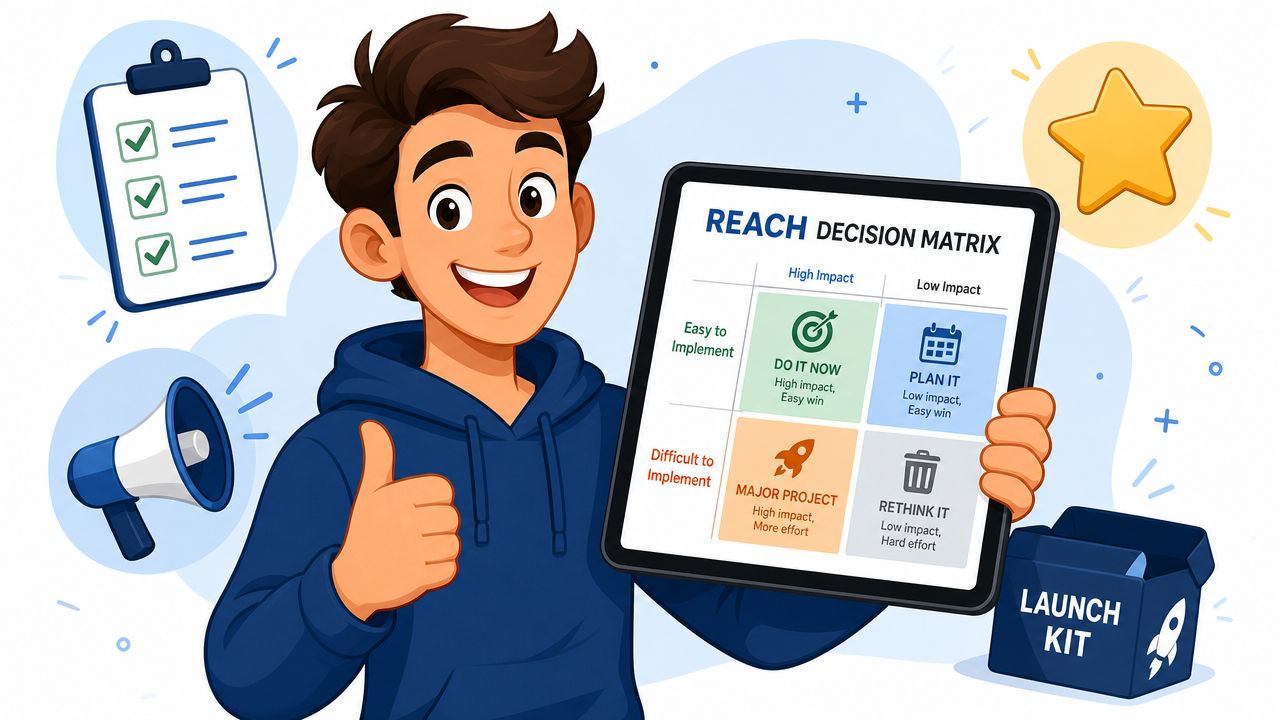
Your Influencer Campaign Launch Kit Powered by REACH
Platform choice gets too much attention. Launch discipline decides whether the campaign ships on time, stays compliant, and produces usable reporting.
A good launch kit keeps the team aligned after discovery, when operational work starts.
The decision matrix
Use a one-page matrix before outreach starts. It should force decisions on objective, audience fit, creative format, conversion path, approval owner, and expected internal effort. If those inputs are vague, creator selection gets messy fast, and the campaign slips before the first post is live.
The universal creator brief
Build one master brief, then adapt only the platform-specific instructions. Keep the core constant: offer, audience, message, required deliverables, usage rights, disclosure rules, timeline, revision limits, and approval process.
That approach cuts rework. It also makes performance easier to compare across Instagram and TikTok because the strategic input stays consistent even when the execution changes.
For teams refining the creative side of short-form, this guide to creating engaging short videos is a useful reference for both creator briefs and internal production.
The launch checklist
Before anything goes live, confirm these items:
- Creator readiness: Contracts, posting dates, deliverables, and file handoff expectations are confirmed.
- Content controls: Required claims, disclosures, prohibited language, and brand safety notes are documented.
- Measurement plan: The team has clear success criteria by platform, plus owners for tracking and reporting.
- Payment process: Finance has the information it needs for payouts, tax records, and reconciliation.
The point of the launch kit is simple. Remove ambiguity before it turns into missed deadlines, approval bottlenecks, or payment issues.
REACH helps close that post-discovery gap. Instead of managing creators through spreadsheets, inbox threads, and scattered status updates, teams can run campaign communication, deliverables, approvals, payments, and 1099 workflows in one system. If your Instagram and TikTok strategy looks solid on paper but execution keeps slowing it down, REACH is the practical fix.