 Skip to content

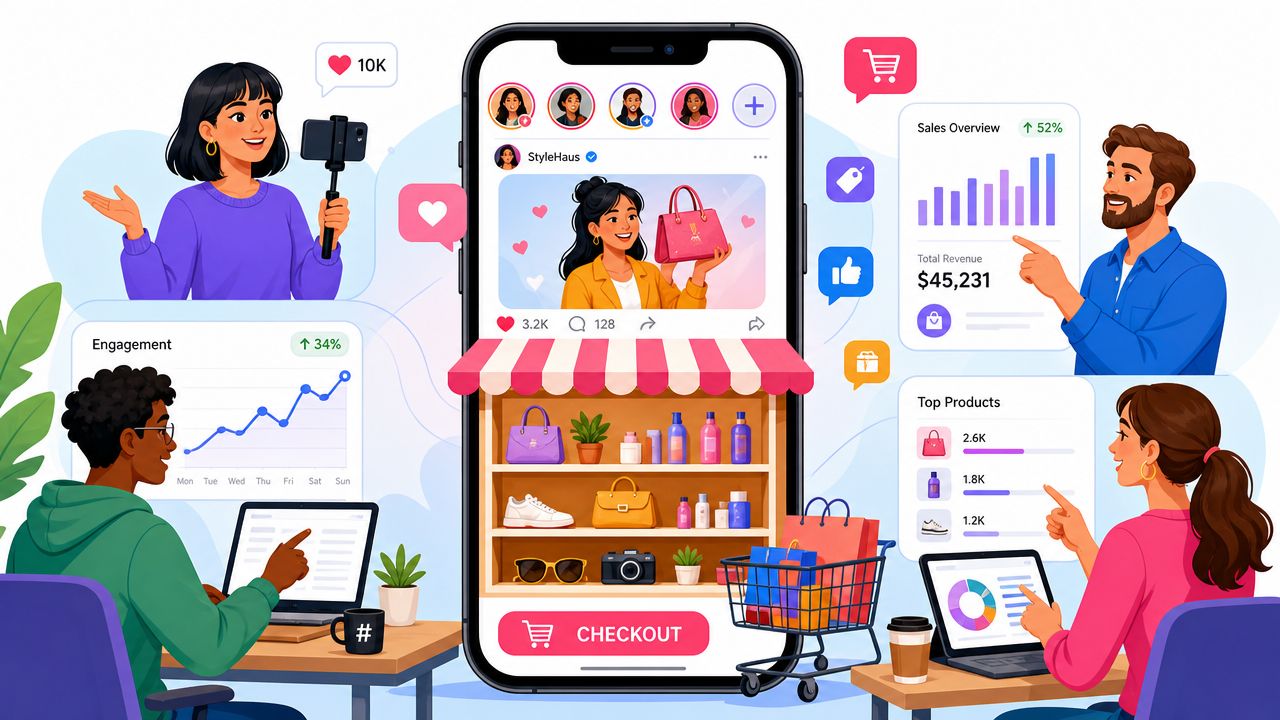
Social commerce has already moved beyond pilot status for consumer brands. Analysts project rapid category growth over the next few years, but the bigger point for a marketing manager is simpler. Purchase intent now forms inside feeds, creator content, comments, DMs, and live shopping moments, not just on your ecommerce site.
That shift changes the job. Social commerce is not only a merchandising play. It is an operating model that connects content, creators, product data, approvals, support, and fulfillment closely enough that a customer can buy at the exact moment interest spikes.
A lot of articles stop at the customer view. A shopper taps a tag, sees social proof, and checks out inside the app. What gets less attention is the work required to make that experience hold together under real campaign volume. A creator posts a product that is nearly out of stock. Pricing changes after content is approved. Comments fill with product questions your team does not answer for six hours. Those are the points where revenue leaks.
That is why social commerce tends to break behind the scenes before it fails in public. Brands need a clear system for creator briefs, asset review, product availability, offer updates, and handoff between marketing, ecommerce, and customer support. Without that, every campaign creates more coordination debt.
If you're building around TikTok, Million Dollar Sellers' TikTok guide is a useful companion resource because it shows how sellers operate on the platform.
What Is Social Commerce and Why It Matters Now
What is social commerce? It's the sale of products directly inside social platforms, where discovery, consideration, and purchase happen without sending the shopper out to a separate ecommerce site.
That sounds like a subtle shift, but it changes the economics of attention. Traditional social media marketing usually asks users to click away from the feed, wait for a website to load, and complete checkout in a different environment. Social commerce compresses that process into one native experience.
What changed
Social apps used to be traffic sources. Now they function as transaction environments.
That matters because buyer intent is often fragile. Someone sees a product in a Reel, TikTok, Story, or tagged image and wants to act immediately. Every redirect creates another chance to lose them. Social commerce keeps the momentum alive at the exact point where interest peaks.
Practical rule: If your strategy still treats social as awareness only, you're likely breaking the buying journey at the moment customers are most ready to purchase.
Why brands care now
The customer-facing story is convenience. The operational story is harder.
To run social commerce well, brands need product feeds that stay accurate, creators who understand the offer, approval systems that don't delay publishing, and teams that can answer questions in comments and DMs before purchase intent fades. This is why social commerce often looks easy from the outside and feels messy inside the business.
That gap is where many programs underperform. The problem usually isn't demand. It's coordination.
How Social Commerce Turns Feeds Into Storefronts
The simplest way to understand social commerce is this. It turns a feed from a digital magazine into a shoppable catalog.
TechTarget describes social commerce as an in-app transaction architecture, meaning product discovery, reviews, recommendations, and checkout all happen inside the platform rather than sending users elsewhere, as explained in TechTarget's definition of social commerce.
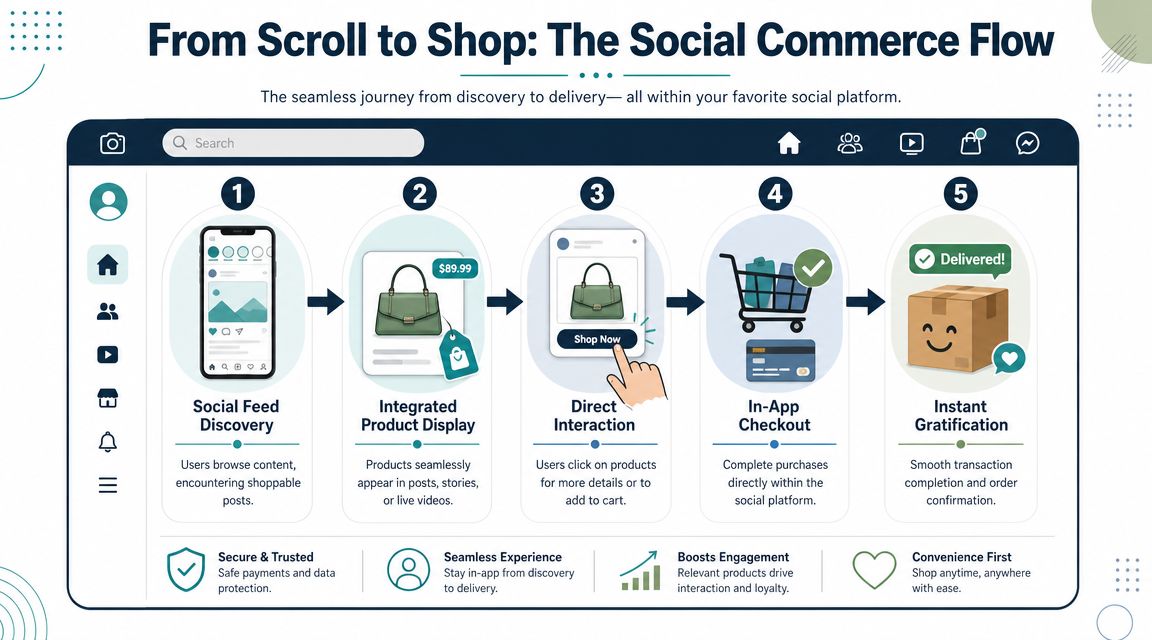
The in-app journey
A typical social commerce flow looks like this:
Discovery in the feed
A shopper sees a creator video, tagged post, Story, live stream, or product pin while scrolling.Product detail without leaving the app
They tap the item and get price, images, product variants, or a lightweight product page.Validation through social proof
Comments, reactions, creator demonstrations, and platform-native feedback help them evaluate the product.Native checkout
Payment happens inside the app or within the platform's embedded commerce experience.Post-purchase follow-up
Confirmation, support questions, and often repeat engagement continue in the same social environment.
Why this model converts attention better
The big advantage is reduced friction. Fewer handoffs mean fewer chances for a buyer to change their mind, get distracted, or abandon the purchase.
That's also why the content itself matters more than many teams expect. On a standard ecommerce site, strong navigation and product pages can rescue weak acquisition. In social commerce, creative does more of the selling because the feed is the storefront.
For brands selling through Instagram, affiliate-led content is often part of that storefront. Teams that want to connect creator partnerships with actual transactions should study how Instagram affiliate marketing programs work in practice.
The feed isn't just media inventory anymore. It's product merchandising, social proof, and point of sale in one surface.
The Social Commerce Ecosystem on TikTok Instagram and Beyond
Social commerce does not run as one channel with a few feature variations. Each platform has its own buying behavior, content norms, fulfillment rules, and creator workflows. That matters because the customer experience may look simple in-feed, but the operating model behind it is not.
Teams usually feel this fast. A product that sells through a creator-led TikTok video may stall on Instagram if the content looks too reactive for the brand. A polished Instagram asset may underperform on TikTok because it reads like an ad before it earns attention. The platform choice affects creative briefs, approval cycles, creator selection, moderation, inventory planning, and customer support.
Platform differences that matter
| Platform | Key Commerce Features | Best For |
|---|---|---|
| TikTok | TikTok Shop, shoppable videos, creator-led selling, live shopping | Fast product discovery, creator-led conversion, trend-driven offers |
| Product tags, Reels, Stories, shop surfaces, creator affiliate workflows | Visual brands, polished product storytelling, recurring creator campaigns | |
| Facebook Shops, broad audience reach, community groups, marketplace-style behavior | Established brands, broad demographic reach, catalog-based selling | |
| Product-focused discovery, planning behavior, visual search intent | Home, beauty, fashion, gifting, considered discovery | |
| Messaging-led channels | DMs, chat-based selling, direct customer questions | High-touch sales, customer support, custom recommendations |
The practical mistake is treating these platforms as distribution outlets for the same campaign. They are closer to separate retail environments that share a content layer.
TikTok and Instagram require different operating models
TikTok rewards volume, speed, and creator credibility. Products often sell because someone demonstrates them in a way that feels native to the feed. That creates pressure on teams to source creators quickly, review more variations, approve claims carefully, and keep stock aligned with content spikes. For brands planning to sell there, understanding TikTok Shop policies for brands and creators helps prevent basic execution problems before they turn into listing issues, rejected content, or fulfillment headaches.
Instagram is usually more controlled. Brand presentation, visual consistency, and merchandising discipline matter more. The content mix also tends to be broader. Reels may drive discovery, Stories may handle reminders or limited-time offers, and tagged posts may support repeat exposure before purchase. That means campaign management gets heavier, not lighter. Teams have to coordinate creators, usage rights, product tagging, posting cadence, and performance reporting across multiple placements that all influence the same sale.
This is the part many social commerce guides skip. The buyer sees one tap. The brand team manages creators, approvals, inventory, comments, support, and attribution across several tools and stakeholders.
Facebook and Pinterest still play specific roles
Facebook still works for brands with broad catalogs, older customer segments, or community-led demand. It is less about novelty and more about reach, retargeting, and familiar storefront behavior.
Pinterest serves a different job. People use it while planning purchases, saving ideas, and comparing options. That makes it useful for categories where intent builds over time, such as home, beauty, fashion, and gifting. The content may convert more slowly, but the traffic often arrives with clearer purchase context.
A strong social commerce strategy matches platform mechanics to buying behavior, then builds the workflow to support that choice. The content gets the click. The operating system behind the campaign determines whether social commerce scales or becomes expensive chaos.
Weighing the Benefits and Risks of Social Commerce
The upside is clear. Social commerce shortens the distance between interest and checkout.
SellersCommerce notes that when product tagging, shoppable content, and embedded payment options combine with real-time engagement and social proof, shoppers can move from intent to purchase within the same session, which improves impulse-buy capture, as described in SellersCommerce's social commerce overview.
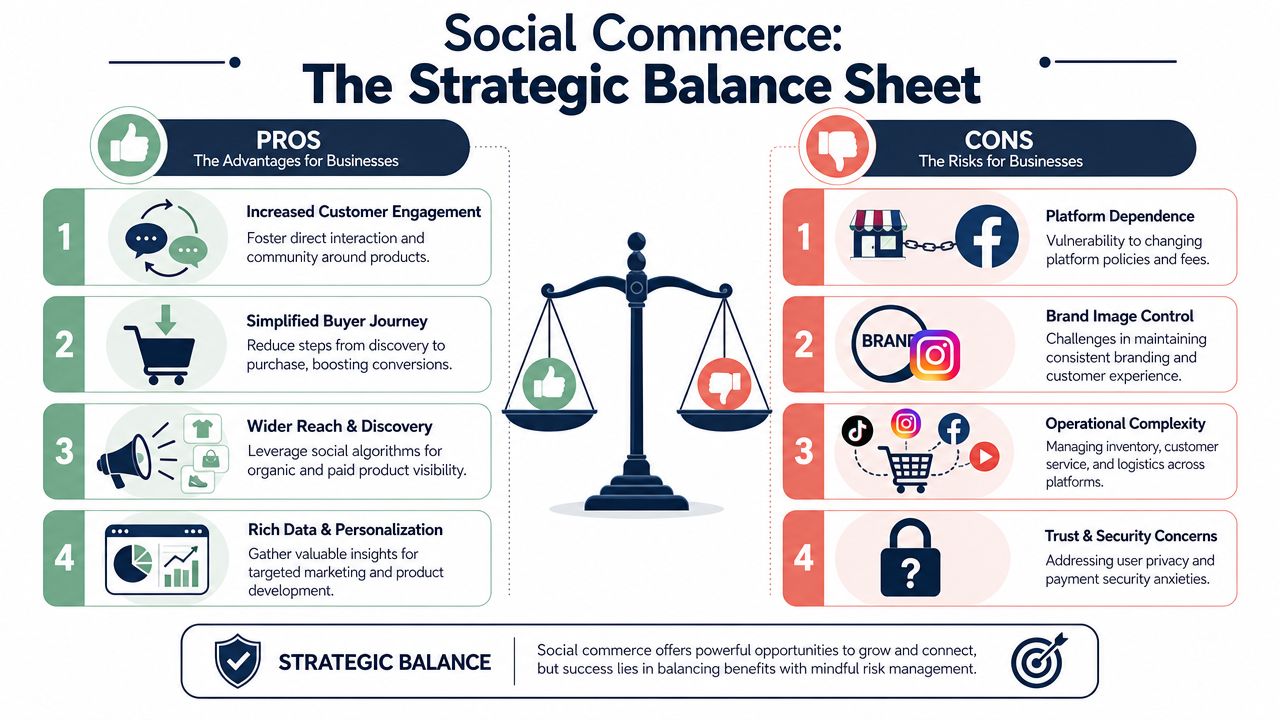
Where the benefits show up
Social commerce works best when a product benefits from demonstration, recommendation, or immediate action.
Shorter path to purchase
Buyers don't have to jump from app to browser to site to cart. That usually makes the buying decision easier to complete in the moment.Stronger social proof
Reviews, comments, and creator content appear close to the product itself. That makes reassurance part of the shopping experience, not a separate research step.Better alignment with mobile behavior
People already scroll, save, share, and message inside these apps. Social commerce builds around that behavior instead of asking shoppers to switch context.Faster creative feedback loops
Teams can see which hooks, formats, and creators trigger buying behavior, then adapt content quickly.
Where teams get into trouble
The risks are less visible, but they're real.
A brand can become too dependent on a platform's rules, ranking systems, and checkout environment. If the platform changes product eligibility, fees, visibility, or moderation standards, revenue can move with it.
Operations also get complicated fast. Inventory has to match what creators are promoting. Customer support has to happen where the purchase happened. Finance has to track payouts, creator fees, and attributed sales. Legal has to keep disclosures clean. If those systems don't connect, social commerce creates internal drag.
Social commerce reduces friction for the customer by increasing coordination requirements for the brand.
The compliance layer matters
A lot of social commerce depends on creator content, and that introduces disclosure risk. If the brief is loose and approvals are rushed, brands can end up with content that sells well but creates compliance problems later.
Teams running creator-led commerce should build disclosure review into the workflow, not treat it as a final check. A practical starting point is understanding FTC compliance in influencer marketing.
Building Your First Social Commerce Campaign
A first campaign shouldn't start with “let's turn everything on.” It should start with one product line, one platform, one content model, and one owner for execution.
Adjust makes an important distinction here. Social commerce is not the same as influencer marketing, even though the two often work together. The buying journey may happen in-app, but real execution still depends on coordinating content, messaging, and fulfillment across teams and platforms, as noted in Adjust's social commerce glossary.

Start with the offer, not the platform
Choose a product that has a clear hook. It should be easy to demonstrate, easy to explain quickly, and easy to buy without a long education cycle. Social commerce usually struggles when the offer needs too much setup before the customer understands why it matters.
A practical first pass looks like this:
Pick a hero product
Start with the item most likely to benefit from visual proof, creator endorsement, or impulse demand.Match it to one channel
If the product needs fast demos and creator energy, TikTok may fit. If it needs aesthetic storytelling and a tighter brand frame, Instagram may be the better starting point.Define one conversion path
Don't mix too many actions. Choose one. Shop now, join live shopping, use a creator code, or click a tagged product.
Build the campaign around creators and operations
Teams often underestimate the management layer. Finding creators is only the beginning. The essential work involves briefing them, approving content, tracking deliverables, checking disclosures, linking products correctly, and making sure no one promotes an item that's low on stock.
That's why spreadsheets and scattered DMs fail once volume picks up.
A campaign management platform can centralize those moving parts. For example, REACH is built for the operational side after creator discovery. It gives brands and agencies one place to build campaigns, organize communication, track deliverables across platforms, and handle payments and compliance tasks that often get split across email, documents, and manual trackers.
Keep the test small enough to learn
You don't need a huge launch to validate the model. You need a clean test.
Use a small creator group, one product angle, and a short reporting window. Review what content drove purchase behavior, which questions came up repeatedly in comments or DMs, and where the team got stuck internally. Those friction points usually tell you more than top-line engagement.
A useful walkthrough of the workflow side is below.
What usually works and what usually doesn't
What tends to work:
- Creator-native scripting that leaves room for personal delivery
- Fast approval cycles so content stays timely
- Clear product availability before posts go live
- Comment and DM coverage during the campaign window
What usually breaks:
- Overproduced content that feels like an ad instead of a recommendation
- Too many stakeholders in approvals
- Weak fulfillment coordination after the first spike in orders
- No tracking discipline around links, codes, or assigned deliverables
Keep the first campaign boring on the inside so it feels seamless on the outside.
The Future of Retail Is Social and Actionable
Social commerce is shifting retail because discovery and purchase now happen in the same moment. A customer sees a creator use a product, taps once, and buys before intent cools off. For brands, that short path to purchase is the upside. The harder part is building the operation that supports it.
The next phase is less about adding another checkout option and more about deciding which social buying behaviors fit your category, audience, and team capacity. Scayle's social commerce glossary outlines the common models, from live shopping to creator-led shoppable content. The trade-off is practical. More formats can create more buying opportunities, but they also add approval work, inventory risk, customer support load, and reporting complexity.
That is why strong execution separates brands that test social commerce from brands that turn it into a repeatable revenue channel.
Tagged products and creator posts are the visible layer. Underneath, someone has to assign briefs, approve content quickly, confirm stock, track links and codes, answer pre-purchase questions, reconcile deliverables, and review performance by platform and creator. If that work sits across inboxes, spreadsheets, and DMs, the customer experience may look smooth while the internal process breaks under volume.
Teams that treat social commerce as an operating model usually make better decisions, faster. They know which creators drive sales instead of just engagement. They spot fulfillment issues before a campaign scales. They can run more campaigns without adding chaos.
If your team is building that layer, REACH offers a practical system for handling the workflow behind creator-led commerce. Its How It Works overview, pricing, and blog show how brands can organize creator collaboration, approvals, and campaign tracking in one place.
Social commerce will keep growing as platforms reduce friction for shoppers. The brands that benefit most will be the ones that also reduce friction behind the scenes.
If your team is trying to turn creator content into a real sales channel without running the whole operation through spreadsheets, DMs, and manual follow-up, REACH is a practical place to start. It helps brands organize the workflow behind social commerce so campaigns move faster, approvals stay visible, and execution doesn't fall apart as volume grows.